BooksFebruary 2026In Conversation
GEORGE SAUNDERS with Mandana Chaffa
Word count: 2695
Paragraphs: 29
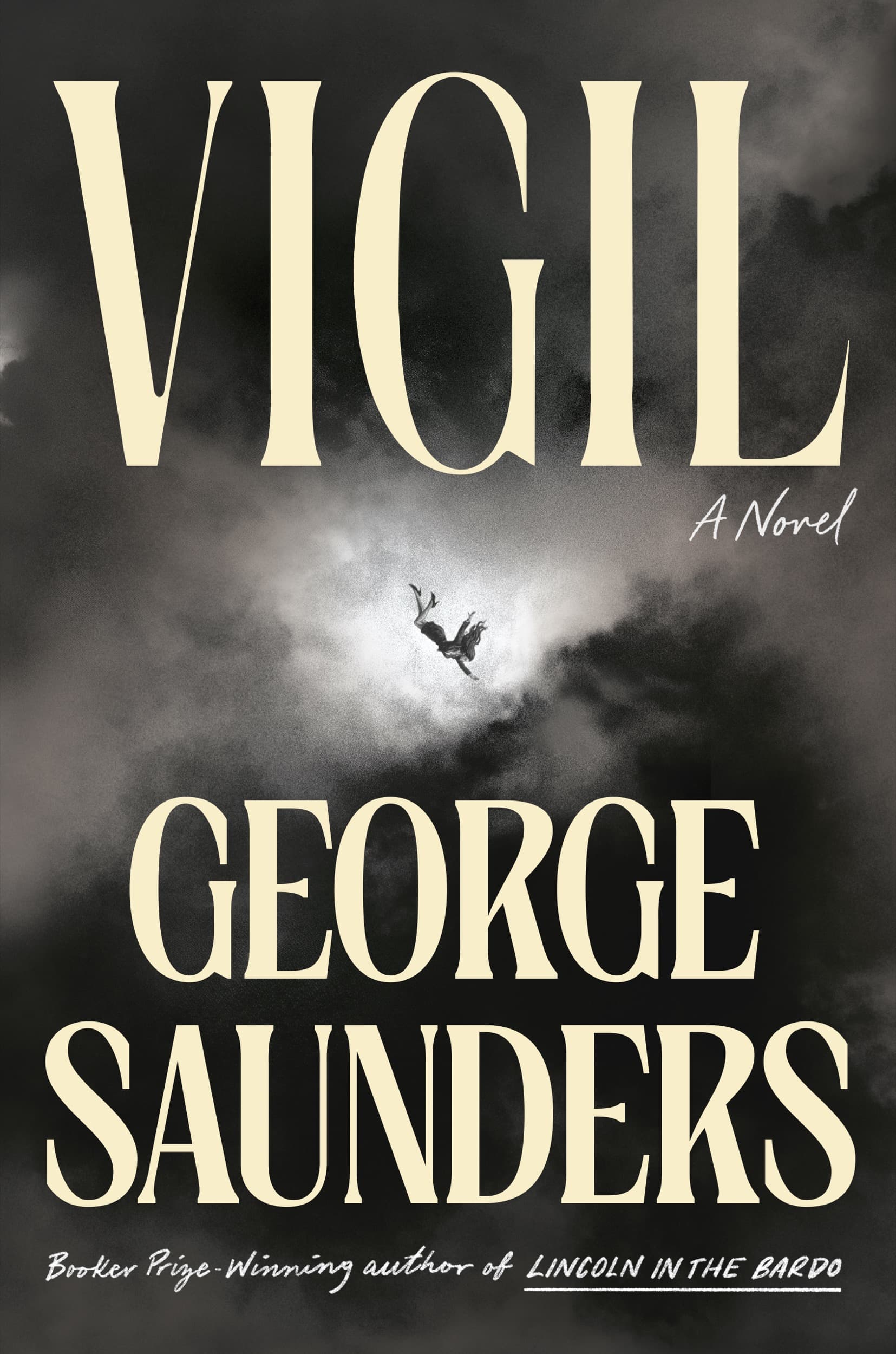
Vigil
Random House, 2026
I could describe George Saunders’s Vigil literally as the final night of K. J. Boone’s life. Boone, a reprehensible oil tycoon—is there any other kind?—source of significant harms to people and the environment, is guided on this journey into the mostly unknown by Jill “Doll” Blaine who is there to provide “comfort, for all else is futility” while other assorted afterlife entities remain prepared to drag unrepentant Boone to the punishment he so richly deserves. Yet that only scratches the surface of this imaginative and open novel that showcases Saunders’s singular ability to craft a supremely human tale that accrues more meaning—and delight—with each chapter.
I was born in a culture that has a deep sense of fate, of what is written on our heads at birth, and have spent most of my life in pull-yourself-up-by-your-bootstraps self-determinism, so I was especially taken by Saunders’s nuanced dance between such seemingly conflicting concepts. It’s also a vibrant contemplation about the value of being a “good” or “bad” person, and whether salvation is possible for the latter, or is a reward for the former. Or whether that even matters at the end, as Jill says early in the novel, “Who else could you have been but exactly who you are?”
We’re all bound by our narratives—those we create for ourselves, and those that others impose upon us—and somewhere within those lines are our lives and legacy. George Saunders’s Vigil is a kind of ars narrationis—the art of narration, if I may be bold enough to create this phrase—consummately plaiting often faulty human perceptions into a novel that examines the subject of storytelling itself, this deeply necessary, essentially human, pursuit.
Mandana Chaffa (Rail): I read that François Rabelais’s last words were “Je m’en vais chercher un grand peut-être; tirez le rideau, la farce est jouée”—or in Peter Anthony Motteux’s translation: “I am going to seek a grand perhaps; draw the curtain, the farce is played”—which feels in kinship with the themes and queries of Vigil. I’m especially taken with that seeking, which can be said about every primary character, dead, alive, or somewhere in the middle. A broad question to start off our conversation, but what were you seeking with this novel? What sparked your imagination?
George Saunders: I’m always seeking the same thing, I think, which is to find a field in which to play—with language, with structure, with humor. I also hope to push out my own boundaries in some way, by trying something that might feel a bit impossible. Once I get working, I love the feeling of seeing something complex coming out of stone. Suddenly, what was just typing is starting to cohere and even somewhat reference things I know from the real world—patterns and tropes and human tendencies start appearing.
Here, the starting point was a kind of thought-experiment: What would the world look like to a person who, in the prime of his life, had been actively complicit in some great act of wrongdoing? And, especially, what would it look like at the end of that person’s life? Any regrets? Might he repent? If so, why hasn’t he done so already? What are the ways in which we (not just he, but we) tend to live in denial? (Why is it that, in life, we take such pains to avoid that “grand perhaps?”)
Although, to be honest, I wasn’t thinking of that at the beginning. That’s what the book decided it wanted to be about. I just started with the thought-experiment. And then it sort of grew organically out from there.
Rail: There’s a subtle and fluid temporality throughout Vigil: even eternity has express and local trains, it seems, country roads and autobahns. It all happens in one (human) night, but within that evening, the temporality shifts both in direction and momentum. Might we talk about how you crafted such intricate elements so that these entities meet, perhaps imperfectly, in these multidimensional moments in time?
Saunders: Well, thank you for all of that. For me, the answer is always: a line at a time. I see a work of fiction as an elaborate call-and-response organism, done over many iterations. So at one point in its text, the book produces a need, and, in re-reading, I notice that and spontaneously address it (or try to), and then, in the next read, it’s an incrementally different book, and I notice a need… and so on. It’s amazing the kinds of unintended-but-then-embraced effects this kind of writing can produce—the book is always teaching you about itself (if you can manage to listen to it). There’s a lot of trust involved, too—just blundering along, making these small choices, in the faith that the book knows what it’s doing. You take your hands off the wheel and the car drives itself, even though it sometimes drives itself into, and then out of, a ditch.
Rail: There’s so much playfulness in this book, George, beyond the weighty concepts of elevation and descension. I was tickled by how Jill joins the narrative in the first pages, inelegantly headfirst into the earth, echoing the Wicked Witch in Oz, though in far more sensible shoes. Or the diversity of ways the Frenchman dramatically appears, disintegrates and re-appears, increasingly frantic and determined. Or the Tweedledee-and-dumness of the Mels. Vigil shares DNA with a long line of epics that use humor to explore existential issues. What were you engaging with artistically while developing this novel?
Saunders: Well, I read Don Quixote during the pandemic and that stuck with me—the way that prose can be playful and perverse to purpose—as a way of bringing in or combining the high and the low. I love that feeling, because it is so lifelike. Fools can be wise and wise people can behave foolishly; teachings can come from strange places; what we believed in passionately can be overturned; we can try to do right and fuck things up even more; and so on.
I think we also respond to our own earlier work, and there were a few moments (or flavors, maybe, is a better way to put it) from Lincoln in the Bardo that were alive in me while I was writing Vigil—I think of them as moments of dissonance, or juxtaposition (the ghost of the beloved Willie Lincoln in a crypt and out front of the crypt are the Barons, perverse orgiasts, making their case—that feeling of wildness and dark comedy).
I also had Nikolai Gogol on the brain—the sense you get in his work of people thinking they are behaving sensibly while, from the outside, they look insane.
Rail: Though I’ve mentioned it elsewhere, I’d love to touch on the variety of cultural touchstones you employ, and I couldn’t help but also think of Vigil as Virgil, that eternal writer who guided us into the afterlife, as you do with this narrative. These repetitions of familiar set pieces have a cumulative effect on how the reader experiences the novel, grounding them in a sense, while the narrative itself flies.
Saunders: In this sort of book—what we might call supernatural or speculative—the grounding is so important. I think of it as the foundation on which the crazy dances can take place. Or some really solid, traditional fabric, on which there’s some wild-ass embroidery. I think the trick is to try to be aware of where a reader might be at any point in the book—is she still believing in the fictive reality, or starting to drift, or ready for a surprise?
Rail: Reading Vigil as one enters the fallowness of winter equinox, as shadows lengthen and then light slowly regains strength, felt particularly organic to these considerations of endings and beginnings. So too the cinematic seasonal bombardment of Scrooge, George Bailey, or even Citizen Kane, all of which contemplate the meaning of life, of a life well-lived; or a selfish life that can be rewired, diverted. The book explores a range of judgment and deliverance—loosely represented by the Frenchman and Jill—with a few unexpected twists and turns near the conclusion. A salient question for our times: can there be salvation for the seemingly unredeemable?
Saunders: I think so, if we define “salvation” as coming out of the state of denial. I mean, clearly, not everyone can do it. But it can be done. Even if only briefly—that’s a form of salvation.
The thing about these redemption narratives (and I’d add Leo Tolstoy’s “Master and Man” and “The Death of Ivan Ilyich,” Katherine Anne Porter’s “The Jilting of Granny Wetherall,” and maybe even Flannery O’Connor’s “A Good Man is Hard to Find”) is that, in addition to whether redemption is possible, they also take up the question of how such a thing might be accomplished—what kicks in, or doesn’t, as life comes to a close, that might drive a person toward the truth, and, importantly, what are the forces that would keep him in denial? As I was working through this book, it occurred to me that the great pro-denial force is habit—a person has been telling himself or herself a set of comforting stories all their life, and it’s so hard to step outside that story. I think the book also takes up the subject of how someone on the outside might urge someone to step out of denial—what works, what doesn’t? One of the great stories on this idea is Robert Stone’s “Helping.”
Rail: I worked on Wall Street for a long while, so Boone felt less like a caricature or a television villain than an amalgam of the types—and egos—one comes across in those skyscraper-ed environs. I felt that you had a certain affection for Boone, if I may use that word, as wretched as he is. I know that you were a geophysical engineer, knowledge that is put to great use in the climate change narrative, but can we talk about the source of your knowledge of the internal workings of tyrannical business minds?
Saunders: Well, honestly, part of what I did was remember my own mind, back when I worked in the oil business—that tribal sense of pride (especially in the face of critique from people outside the field). And I knew a few oil people, one exec in particular. I was channeling a few different frequencies—that guy, me, a few other people… but ultimately, a fictional character comes from the writer sort of playing dress-up—letting this hidden part of his personality step up to the microphone without the usual virtuous filters in place.
But the fun of it, for me, was just trying to track denial in general—like, what are the stages a person goes through as he gradually gets moved toward the truth? That’s where a lot of the revision work was centered—trying to get that psychological progression right.
Rail: For all that Boone has done despicable things, I appreciated that he isn’t the only one with an unsubsumable ego and determination in this novel, and how you play against conventional expectations of afterlife consorts and traditional binaries of halos or hellfire. For all her gentility, Jill—“Doll”—also has a sense of pride about her role as a death doula, and both she and the Frenchman are opinionated, and stubborn, and have a surprising amount of ego.
Saunders: Yes, that’s a great observation, and as I got near the end of the book it became clear to me that she is also not all that great at comforting, for all her intensity, and, as you suggest, takes a lot (maybe too much) pride in her abilities—and so she’s sort of stuck, too, in her vision of her own goodness. But then again, I also admired her and felt very fond of her, for her good intentions.
This was something I really loved about writing this book: my view of the characters and their roles kept being changed by edits the book seemed to be insisting I make. Even now, I have very changeable opinions about the things the characters did and the positions they occupy. But this—this book-driven ambiguity—was the fun and was the revelation of the book—it came to seem like an example of what Anton Chekhov meant when he said that “art doesn’t have to solve problems, it just has to formulate them correctly.” I wanted to make the book give off the maximum number of sparks, by adjusting and adjusting its parts—and then the meaning of the book was one: just whatever comes off of that arrangement; and two: not even fully known by me, when I finished (and not even now). But I am pretty darn sure all is as it should be and it’s as good as it could possibly have been.
Strange, this “art thing.”
Rail: I want to also touch on some of the sidebars that enhance the centerpiece of the novel—Boone’s passage to the next level of existence—so well. I especially appreciated the wedding happening next door, oblivious to all that is going across the planes of existence and non-existence is life: scent, touch, connection, hope, the future. And then the contrast, in almost agonizing fashion, with Jill’s unfortunate decision to find out what transpired with her husband after her passing, reverberations of Our Town, perhaps? She died, and they moved on. This was such a stabbing and sweet reminder of the stakes of what it is to be alive; the ephemerality of it all, the miracle of each moment, and the aching inability to ever return.
Saunders: Thank you—yes, that wedding showed up early, somehow related to a tour I took a few years ago of this place in Italy—a kind of pleasure palace for a prince that he built so he could pursue an affair. Somehow that idea—of a place built for the senses—transmogrified into that wedding which then, as if on its own, started drawing Jill over there. And that, in turn, helped me learn about how she was wired, and what battle she was in.
It’s so weird, really, how fiction works—almost as if the book existed in my mind and then I had to clear things away until I found it, sitting there waiting for me.
Rail: Congratulations on winning the 2025 National Book Award for Distinguished Contribution to American Letters, though it feels premature to consider a “lifetime” of literary achievements at this juncture! I was so touched by your remarks, especially how in early years, when you weren’t yet a full-time writer, you would write short vignettes as you commuted. There’s a kind of sacred aspect of that kind of craft, writing without consideration of what the end result might be, that I’d like to take with me into my own new year. Would you talk about your current writing practice?
Saunders: Thank you. That was a really fun night—both of our daughters were able to be there, and Esther Newberg, my agent and my editor at The New Yorker, Deborah Treisman, and my Random House editor, Andy Ward—it was a great party and I’ll never forget it.
As for my process… it’s been mostly the same all these years: write pretty freely, for fun, and then go through the piece day after day, revising whatever I have into what I think of as “undeniability.” All of those small tweaks start to add up and solidify, and then some number of pages are behind me, more or less locked into place—although never entirely locked. There’s also a lot of moving around of bits and sections, trying to get them to give off the most possible light, by finding the right place for them. I’ve likened it to taking an apartment and replacing one or two items a day with things of equal value—this idea that, after two or three years of doing that, the place would feel more like “you” than you ever could have imagined at the start.
And the underlying gift is the certainty that this—the everyday mind—is only part of what we have to offer the world—this sense that we have untapped abilities that we can get at through artistic practice and that leave behind a result (the book) that is markedly more aware (alive, alert) than its writer.
Mandana Chaffa is a writer, editor and critic whose work has appeared in a variety of publications and venues. She is founder and editor of Nowruz Journal and an editor-at-large at Chicago Review of Books. She serves on the boards of Brooklyn Poets, and the National Book Critics Circle where she is vice president of the Barrios Book in Translation Prize; and is also the president of the board of the Flow Chart Foundation. Born in Tehran, Iran, she lives in New York.