BooksFebruary 2026In Conversation
LANA LIN with Porochista Khakpour
Word count: 3302
Paragraphs: 35
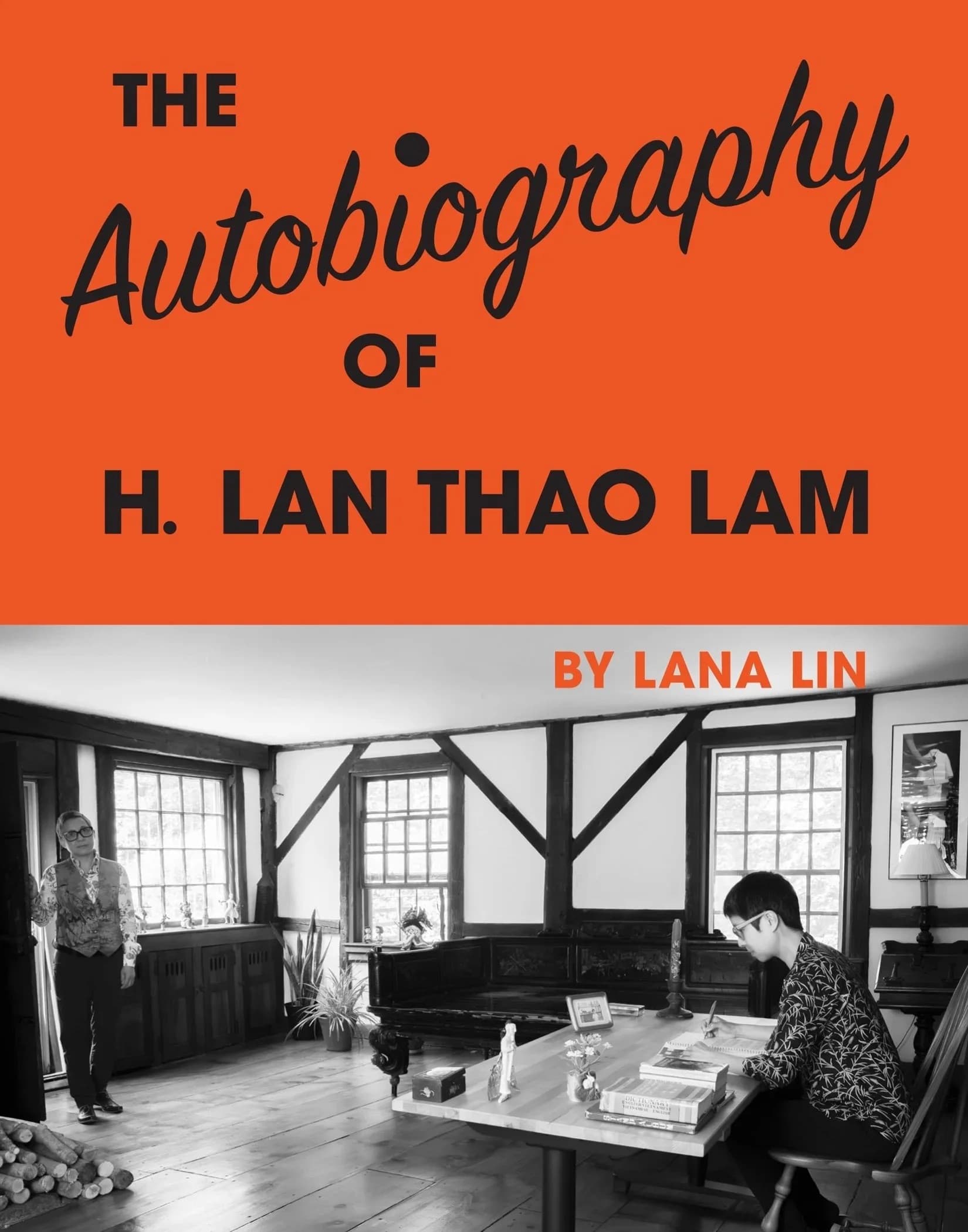
The Autobiography of H. Lan Thao Lam
Dorothy, a publishing project, 2025
Lana Lin and I have known each other since 2017 when I worked with her on a film project inspired by Audre Lorde’s The Cancer Journals. Then almost exactly four years ago, Lana sent me an email seeking mentorship for an unrelated project: “I am working on an experimental double memoir modeled on Gertrude Stein’s Autobiography of Alice B. Toklas. Mentorship would entail reading one hundred pages or so of my manuscript in the next month and giving me critical feedback.” I was so honored. I was a big Stein and Toklas fan—as well as a Lana Lin fan by then—and so I was quite excited to dive in.
The following is an exchange about art, Asian Americans, and The Autobiography of H. Lan Thao Lam that took place over email in the last days of 2025.
Porochista Khakpour (Rail): Could you perhaps take us beyond this point, where the project first came into being, when the early drafts began happening, when inspiration first struck, or even when you first encountered Stein? How did this project come about?
Lana Lin: In the book I mention that the idea for the book came to me not long after meeting Lan Thao twenty-five years ago, because H. Lan Thao Lam obliquely rhymes with Alice B. Toklas, and it struck me that their lives as lesbians ensconced in the arts also obliquely rhymed with ours as queers. I sat on the idea for about two decades, and then during my sabbatical from full-time teaching, which coincided with the initial surge of the COVID pandemic in 2020, I started on it in earnest. This was not long after Cathy Park Hong’s Minor Feelings: An Asian American Reckoning came out amid Black Lives Matter protests and the rise of anti-Asian hate, which spurred me to claim space for an Asian queer perspective that was practically non-existent in Stein’s (and Toklas’s) texts. I was inspired, and still am, by Stein’s device of speaking through the voice of her lifetime partner, but I also knew from the outset that my project would be both an homage and an intervention.
Rail: Can you talk about those two decades where you sat on the idea? Did you visit it at all? Were you thinking of it? Why was it necessary? Is this part of your process?
Lin: In some ways it was necessary because Lan Thao and I had to live our lives. I wasn’t thinking about it actively and didn’t revisit it except in jest from time to time. Lan Thao would also casually remark that a particular incident might be used in “their” autobiography. When I took it up after twenty years of our lives together, I discovered that Stein wrote her autobiography after twenty-five years with Alice B. Toklas. Uncannily, “my” autobiography was published after twenty-five years with Lan Thao. I don’t typically need two decades to marinate a project, but I do tend to work relatively slowly. I can also work quickly on deadline, particularly for smaller projects. It’s really dependent on the project, and I’m adept at scaling a project according to time and other, for instance, financial, constraints.
Rail: I left you at that mentorship juncture, but I remember feeling so confident about the book finding a publisher, even though it was an experimental project of course. I didn’t hear much more until it actually came out. Dorothy seems like the perfect home, but was the journey a tough one? What was the process of finding a home for it like?
Lin: It was arduous! I do not have a literary agent, so there was about a year-long process of querying agents and publishers who would accept un-agented manuscripts, of which there are very few. I had written an entire draft and was despairing that it would ever secure publication. Jackie Wang brought Dorothy to my attention, and the publishing project, as they call it, had an open call. I almost didn’t submit my manuscript to them because they explicitly stated that they don’t accept memoirs. I had gotten habituated to labeling my project a memoir for the purpose of filling in query forms or conforming to recommended email subject headings. When I initiated the project, I wasn’t thinking in those terms. If anything, I thought I was writing a faux or mock autobiography. When I expressed hesitation about submitting to Dorothy, my writing group laughingly advised me just not to call my book a memoir. And I was dumbfounded at how easy a fix that was. I mentioned this to Dorothy editor Danielle Dutton, and she replied without missing a beat that they publish “near fiction.” I love this term, which I confirmed on the Dorothy website. I’ve also gravitated toward calling my book an “autobiomythography,” after Audre Lorde’s Zami: A New Spelling of My Name, tagging “auto” onto Lorde’s biomythography to draw the self into the relations of life, myth, and writing. I couldn’t be happier with Dorothy, which is indeed the perfect home for this project.
Rail: I would love to know more about your concept of “autobiomythography.” As well as “near fiction,” which is not totally clear to me. And why do you think we are experiencing such reluctance toward memoir when it was the most popular genre not long ago?
Lin: Maxine Hong Kingston is credited with inventing a new form in The Woman Warrior: Memoirs of a Girlhood Among Ghosts. The reissued 1989 book description reads: “An exhilarating blend of autobiography and mythology, of world and self, of hot rage and cool analysis.” Although I wouldn’t pit rage and analysis against each other in that manner, this is a pretty good definition of “autobiomythography” to me. In The Autobiography of H. Lan Thao Lam, the narrator refers to Kingston when making a case for including the inconsequential details of daily life for people that are not heroes or celebrities or victims or otherwise notable:
What of the seemingly insignificant, unverifiable, imaginative minutia that composes the non-heroic vernacular of people of color? This gossamer substance that interweaves our lives fuels dream work, mythmaking, and fantasies and, as Kingston notes of women of color, keeps us alive.
Autobiomythography, as biomythography was to Lorde, is a survival strategy.
“Near fiction,” is not my phrase, but as I understand it, it is something that comes close to fiction. And definitely I feel like my book brushes up against fiction. I think memoir has the capacity to reveal the porous border between fiction and nonfiction. My autobiomythography questions the mythology of the autonomous, bounded self: How can we really know who we are when we are constantly in flux? How do we know where we end and another begins when we are permeable beings that absorb our loved and hated objects?
If “near fiction” is a genre of Dorothy books, I would say it applies to Nathalie Léger’s Suite for Barbara Loden, which combines literary criticism, biography, memoir, and autofiction into a hybrid text that is officially categorized as fiction. We could really get into the weeds with the distinctions between autofiction, autotheory, autobiographical novel, autobiographical essay, narrative nonfiction…
But hasn’t memoir always been a somewhat denigrated genre, even when it has enjoyed popularity? There’s a popular conception of memoir as self-indulgent and lacking in literary substance. But I think some people whose literary tastes lean toward seemingly more substantive nonfiction don’t recognize books that they do embrace as memoir—for instance, Omar El Akkad’s One Day, Everyone Will Have Always Been Against This and Saidiya Hartman’s Lose Your Mother are deeply researched, critical works of nonfiction that could also be categorized as memoir. I was also reluctant to call my work memoir without qualifying it as “experimental” or inventing a new category of “autobiomythography.”
Rail: How has your partner dealt with this being out in the world? You two are collaborative artists of course, but has this managed to be on that same level of collaboration? How did you two manage this book’s creation and then its delivery into the world?
Lin: After the book launch, Lan Thao related an anecdote about how two of their students came up to them, excited about Lan Thao’s book. Lan Thao corrected them, as they have had to do on numerous occasions, saying that their partner Lana wrote the book. The students were in awe of what I think seemed to them like a radical act of trust, generosity, and care. They put it something like this: my friend here just bought me a matcha tea that I didn’t even ask for, but that is “next level love.” This is a brilliant encapsulation of the heart of the book: next level love. Lan Thao underscores that we collaborate in life and in art, but not on this book. Lan Thao’s participation in the book was deeply collaborative in the sense that they gave me blanket permission to write it as I pleased and spent many hours talking with me formally and informally about memories, facts, and feelings pertaining to their life and their family’s lives. But the book is not a collaboration. I alone must take responsibility for it. The effect it’s had on our lives was that for much of the fall we hardly saw one another because I have been touring with the book; it hasn’t otherwise changed our relationship. Writing the book confirmed my/our next level love—I suppose we have gained this wonderful phrase to describe it because the book is out in the world.
Rail: Can you speak to your work in all these different mediums? Being a filmmaker and video artist and now an author? What does it even mean to be a multidisciplinary artist in this world today?
Lin: I feel like most artists today are to some degree multidisciplinary and becoming increasingly so, which I fully embrace as someone who likes to work from idea to medium, and between idea and medium. Collaborating with Lan Thao, who was trained as a multidisciplinary artist to seek the medium that is most appropriate to the idea, I have become much more attuned to medium as a choice that emerges out of a project’s needs. The Autobiography of H. Lan Thao Lam is a book because it is modeled on a book. The device of writing through the voice of another is distinctly literary. I gesture toward that in my book when I say that I fear that I am writing myself out of existence, but then I wonder if I have written myself into existence. For me, the book could only exist as a book and not a film, although I tried once prior to writing it to propose it as a film, but the proposal really didn’t make sense to me, which was probably evident to the funders because I didn’t get the fellowship. I have made films that similarly had to be films because their source material was film, and they were about the materiality of analogue film and its analogous relationship to mortality.
Common to my practice is my interest in producing some kind of experience over time, the movement of thoughts, feelings, and affects, usually through the language of words, images, and sounds. Although I am more of a novice in literary writing, most if not all of my creative projects have started with writing. My thinking begins with writing and I think through writing. I sometimes joke that I am a non-visual visual artist.
Rail: Can you tell me more about the film idea and why you think it would not work? Could it be a film now that the book is done?
Lin: I don’t remember the film proposal well. It definitely wasn’t fleshed out. I do think that the book could be adapted into a film, but it would be quite a different kind of work than the book. I imagine that the interiority of the narration and the uncertainty as to who is speaking would be challenging, though not impossible, to translate to the film form. I would be interested in an adaptation that had a relation to the original in the sense that Walter Benjamin writes about—a translation that has a kinship with the original as its supplement, even echo, while acknowledging a foreign element of untranslatability at its core. RaMell Ross’s adaptation of Colson Whitehead’s The Nickel Boys is an example of a cinematic translation that formally departs from its source, yet retains the heart of the original, at least according to my reading. If someone could envision a translation of my book as daring as that, it would be exciting.
Rail: I have already heard talk of this book as a masterpiece of Asian American art. I agree of course, but I also wonder how you feel about that kind of categorization, especially with a book that resists fitting into any convenient category.
Lin: This is a very complex question and my feelings are equally complex. As an Asian American Gen X-er, I have felt the need to make work that addresses what I have experienced as the invisibility of Asian Americans as represented by Asian Americans in North American art and culture. I say this in this cumbersome way because I am aware of what might be characterized as almost an abundance of “Asian American art” these days, maybe in the past few years. I was recently in conversation with Summer Kim Lee about her book, Spoiled: Asian American Hostility and the Damage of Repair, which examines Asian American, mostly Millennial, artists. There is a generational difference, I think, in how one experiences the category of “Asian American,” and how that is realized in art, and in turn how that art is received. Lee points to Patty Chang, a Gen-X artist, who noted that when she first started performing in the 1990s, no one called her work Asian American. This is probably true of my early films of the 1990s, which were made in the context of an experimental film community that from my perspective seemed almost entirely white. There were pros and cons to this—mostly cons. The “pro” was that perhaps my work was not pigeonholed as being only “Asian American.” The “cons” were that there weren’t many opportunities for my work as a queer Asian American artist researching critical theory, history, psychoanalysis, and feminism to be shown.
I want my work to be recognized as Asian American while not being ghettoized as such. I want my work to be included where it is relevant, in conversations that include but go beyond Asian American issues and expression. I want an intersectional reception that honors the intersectional content of the book. I want our categories to be intersectional, while acknowledging that intersectionality challenges categorization at all. But I also acknowledge that it is probably impossible to do away with categorization, if only as an organizational tool, and that all organizational tools, like archives, have a politics.
The categories of art, literature, poetry, and film come with benefits and harms. While I found no comradeship with Asian Americans making experimental film, I did find that with experimental writing, like Theresa Hak Kyung Cha’s, for example. I’m gratified that you see my book as resisting convenient categories even as I invest in the category of Asian American.
Rail: I would love to hear more about your thoughts on generations. I make a lot of generational observations myself and sometimes it irks young people. I am Gen X like you, and I feel an attachment to our generation.
Lin: We are all conditioned by the time period in which we live, but the experience of being Asian American feels notably different in the present tense than it did certainly when I was a kid, even when I was in my thirties or forties, maybe even since COVID. Another way to put this is that the recognition of the status of Asian Americans has felt slower to rise to the level of broader public awareness than other identitarian claims, such as sex or gender.
In an unpublished piece for Syndicate, I followed W.E.B. Dubois’s well-known question regarding Black folks, “How does it feel to be a problem?” with the Asian rejoinder, “How does it feel not to be a problem?” I grew up and spent much of my adult life trying not to be a problem. Younger Asian Americans that I’ve had access to recognize themselves as Asian Americans and are willing to make themselves a problem. They have models, though still not a lot, in film, TV, popular culture, and they have words like “minor feelings” and “microaggressions” and even “feeling Asian American” that name their experiences. Hence, they can make demands that I had never been able to articulate. I see this in my students and it extends beyond Asian Americans. Younger people today are called on to demand justice at a faster pace and greater scale because their own and the earth’s existence literally depends on it. And I think they are rising to the occasion.
Rail: And finally, what keeps you hopeful these days? I think it’s a question one has to ask of all artists who continue to create.
Lin: It sounds hokey, but despite the many frustrations of teaching as a professional occupation these days, my students are indeed a source of inspiration. Younger people, for all that they have endured in terms of chronic crises on the global, national, and often also local stage, are still not quite as jaded, exhausted, and cynical as I am or as like-minded loved ones and acquaintances of my age. They take to the streets to protest genocide in Gaza, unfair labor practices, and most recently in my sliver of world, the extreme austerity measures at the New School which have entailed the closure of humanities and social science degrees and programs, another iteration of the threat to liberal arts education across the country. Out of necessity, they believe in possibilities for the future. Witnessing them showing up compels me to show up for them, which is, after all, how I commit to the future.
Lan Thao and I have been working on a project called How to Live with Solastalgia that takes its title from Australian philosopher Glenn Albrecht’s concept of “solastalgia” or the existential distress induced by environmental change when the solace one expects to derive from “home” is absent even when one remains at home. Solastalgia identifies the grief that accompanies climate catastrophe, but it isn’t an entirely hopeless sensation, at least not in our conception. The project is very much in progress, but we’ve had the title for a while and it sits in the present tense, asking and also proposing a way of living on with the burdens of ongoing loss. This might mean taking fleeting moments of pleasure in a heron’s spindly legs skating awkwardly across an iced over pond. Wildlife is astoundingly adaptive and persistent. Since I have spent all but the last few years of my life where nature is extremely curtailed, I am only coming to perceive this now.
I spent a good part of the fall traveling with my book through dreadful immigration raids, the protracted withholding of the Epstein files, relentless horrors against the Palestinian people, and so on. I marveled at the humans who showed up to brick-and-mortar bookstores—not just for me, actually hardly for me because I am hardly well known, though I certainly appreciated those who were there for me, but for themselves and each other. First Light Books in Austin was hopping with people chatting, working on computers, and reading physical books. It gives me hope that there are still readers for whom bookstores are meaningful spaces and books are indispensable sustenance.
Porochista Khakpour is the award-winning Iranian-American author of the novels Sons and Other Flammable Objects, The Last Illusion, and Tehrangeles, as well as the memoir Sick and essay collection Brown Album. Her writing has appeared in the New York Times, the Los Angeles Times, the Washington Post, Bookforum, Elle, Slate, and many others. Among her many fellowships is a National Endowment for the Arts award. She has taught at Columbia, Johns Hopkins, Bard, Wesleyan, Fordham, and more for the past twenty years. Her most recent book Tehrangeles (Pantheon, 2024) was an Indie Next Pick, an NPR Book of the Day, one of TIME’s 25 Most Anticipated Books of 2024, as well as one of the “Best Books of 2024” by Vogue, Harper’s Bazaar, and W; it has also been longlisted for the 2025 Joyce Carol Oates Prize and the 2025 Mark Twain American Voice in Literature Award. She was born in Tehran, raised in LA’s San Gabriel Valley, and currently lives in NYC’s Harlem. For more info see porochistakhakpour.com.