BooksFebruary 2026In Conversation
DAVID GUTERSON with Jonathan Daniel Gardner
Word count: 2621
Paragraphs: 46
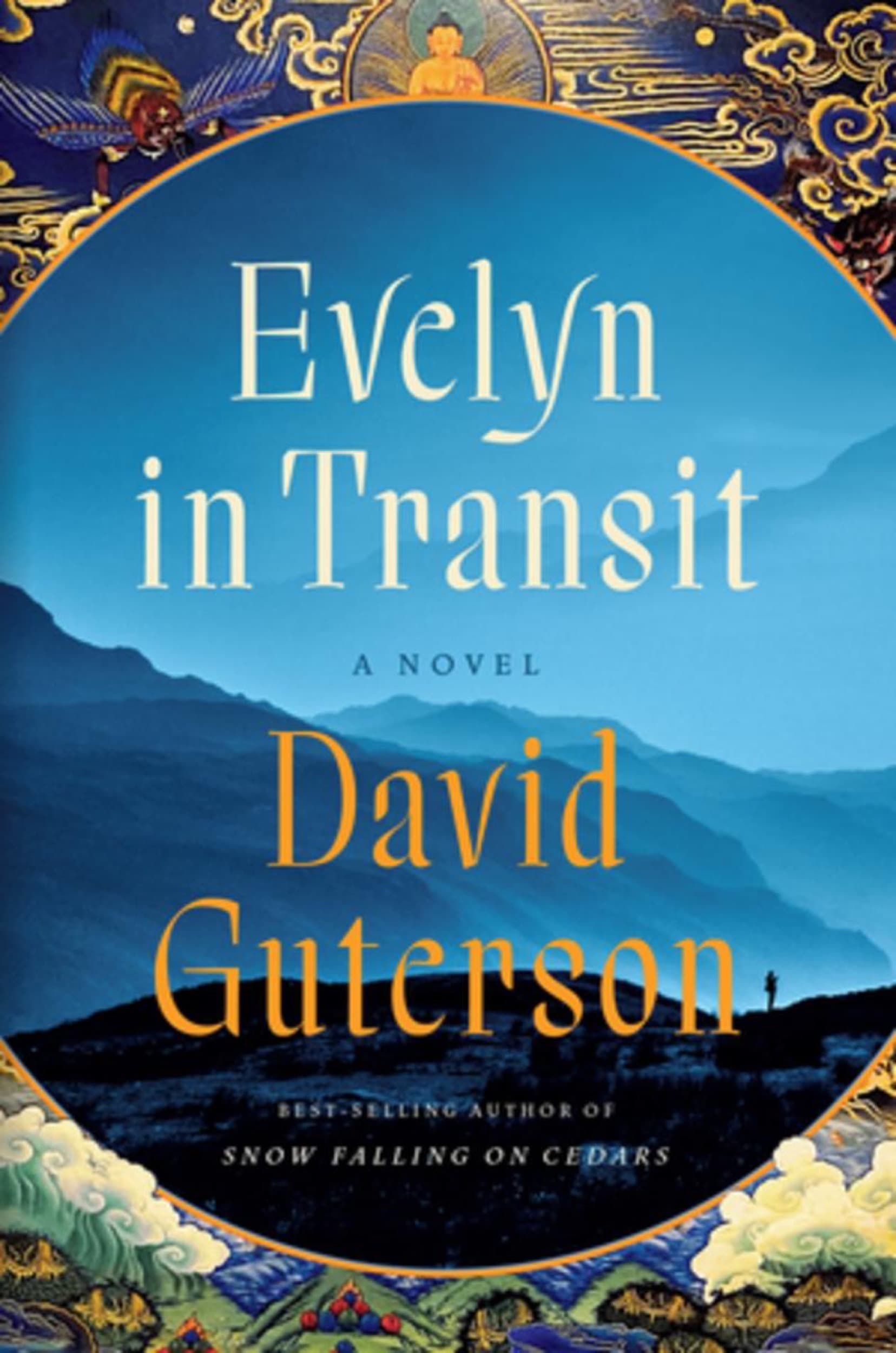
Evelyn in Transit
W. W. Norton, 2026
When I began reading Evelyn in Transit, the new novel by David Guterson, my experience of its author was of a quiet, kindly presence at a crowded luncheon table nestled within the Flatiron District. He introduced himself plainly to some members of the literary community, then spoke briefly and modestly about his work. That sense of understatement and humility carries through the novel itself. It’s a book shaped by attention rather than assertion, one that moves patiently between childhood and adulthood, allowing meaning to arrive through quiet accumulation.
During my conversation with David, we explored his commitment to restraint, his trust in the reader’s intelligence, and his belief that what remains unseen—or out of reach—can be as truthful as what is named. His approach, like the novel itself, is patient and generous, attentive to the way significance emerges when it is not compelled.
David Guterson is the author of thirteen books, including the PEN/Faulkner Award winner Snow Falling on Cedars. This interview was conducted over email.
Jonathan Gardner (Rail): Early in the novel, Evelyn, after giving herself a haircut, scrutinizes her appearance in the mirror and realizes, almost with a kind of stunned clarity, that the trouble is not her hair; it’s all of her. This is a small scene, but it carries this force of collapse. I’m interested in how these small moments you create in the book open onto something much larger about self-perception and the narratives we build around the body. When you were writing that passage, how were you thinking of it? And more broadly, how do these quiet recognitions shape the arc of Evelyn’s search for meaning?
David Guterson: Evelyn is five years old when this happens.
That morning she’d cut her bangs with desk scissors. They’d come out ragged, and in trying to fix them she’d made them worse. All day she’d felt ashamed of her bangs. Now they troubled her so much that she went into the bathroom to check on them in the mirror. Did they still look terrible? She stared at herself and then she knew: it didn’t matter. Cutting her bangs right wouldn’t have made any difference. She just didn’t look good. Until now she hadn’t understood that.
Much later, as an adult, Evelyn is in a backstage green room prior to a television appearance. A makeup artist has primped and painted her for it.
There was a mirror in the green room bathroom like the ones in movies where they show actors in dressing rooms—up one side, over the top, and down the other, lights. “Worse with make up,” thought Evelyn. “All it does is cover up the moles.” She had a joke in her head, something she thought she’d say to a hairdresser if she ever decided to go to a hairdresser. The hairdresser would rotate Evelyn’s chair toward a mirror, put her hands on Evelyn’s head, plump her bad hair and say, “What did you have in mind?” Evelyn would answer, “What I want you to do is make me look different from how I really look. Keep cutting until I have a different face.”
We’re judged. To the torment in it we add self-torment. You can carry that around with you until you die—tormented by your desire to look different from how you look—or you can seek liberation from it. The revulsion Evelyn encounters is in some ways fortunate because, as awful as it is, it propels her toward transcendence. In her case—given her indomitable nature—the deeper the pain, the greater the drive.
Rail: You’ve spoken about identifying with the push-pull between detachment and deep care, a tension Evelyn phrases as wanting “to live the right way.” In shaping her choices, how did you imagine the “right” action for a person who feels estranged in such a profound way?
Guterson: I said this about it: I’m probably like a lot of fiction writers—on the one hand, a detached observer, on the other, driven by pathos. Evelyn in Transit is about this kind of person—estranged and alienated, driven existentially, and wanting, as Evelyn puts it, “to live the right way.”
But alienated from what exactly? In the case of contemporary life in America, alienated from its primary assertions about happiness. In the case of life in general, alienated from inescapable features of it—illness, suffering, death, the violence of nature, the madness of human beings. Evelyn is pierced from childhood by an acute feeling that something’s wrong with existence. She feels it in the way children feel truths in their bodies. Why is life like this? Can these things be transcended? If so, how might they be?
The close, perpetual examination of our culture as a means toward addressing such questions leads nowhere. A child who feels as Evelyn does rejects the answers on offer here. They think, “I’m not going to arrive at happiness via the acquisition of things and experiences. It isn’t going to help me to buy something, or to do something advertised as pleasurable. The answer must be elsewhere.” And so a search unfolds—a search to live the right way, which would be a way that directly addresses the fundamental truths of human existence. In this sense, alienation and estrangement are necessary spurs.
The story of Siddhartha Gautama is precisely this story. No matter how full of pleasurable experiences and material well-being life might be, it falls short by definition. That story is in fact told broadly among human beings. Something’s wrong. We’ve been kicked out of the garden. We’ve been cursed by God to toil and die. We’re fallen. Paradise comes later. We’re dissatisfied with life at every turn. No matter how good things are, underneath we’re anxious in particular about mortality. Someone like Evelyn is incapable of distracting herself from all of this or of deceiving herself about it. She’s put together such that it remains central to how she lives.
I sometimes hear people respond to this sort of thing with “Ugh, sounds like such a bummer.” They view Buddhism that way—one big bummer—when in point of fact it’s the opposite.
Rail: At one point the novel invokes the idea that “what is seen is transitory, but what is unseen is eternal,” which feels like a current running beneath the book. I’m curious how you think about that distinction in your work: the seen versus the unseen, the measurable versus the felt. In the book, does the unseen function as something spiritual or something more psychological? And how do you navigate writing toward the invisible without tipping into abstraction?
Guterson: As a girl, Evelyn goes to bury her dog Toby on a windy day:
When the wind got strange, she knew it meant something. Just like the twister in The Wizard of Oz meant a door to another world.
First the leaves on the ground started rattling, then the trees stirred and the corn tassels flailed. It all stopped. Then it all started again. This time, the dry leaves rose clacking against each other and funneled skyward. Sunlight hit the leaves while they fluttered and twisted. Some exploded—leaves so brittle they couldn’t hold together for the ride up. The priest had said, more than once, “What is seen is transitory, but what is unseen is eternal.” And that you were not supposed to mourn without hope.
Toby was wrapped in his blanket. With a stick she’d carved clean sides to make a vault, so everything was set now. She put Toby in, and when she did, the wind came up so that leaves went in with him.
Dusk was in the corn when she started home. She felt bad in a way that usually only happened when she knew no one liked her. Toby had been the greatest dog of all time. He’d slept with her and licked her face at night. He could stand on his hind legs and walk across the yard to the fence. All she had to do was put one shoe on and Toby would know she was fixing to leave, which he didn’t like. It wasn’t that way with people. People never talked about anything that mattered. The priest came to class to give a moral teaching, and she raised her hand and said she didn’t understand the Mass and could he explain it, and instead of explaining it he’d said, “I am not discussing the Mass now, young lady, I am talking about the cultivation of virtue and you are changing the subject and not listening.” When the fact was, she listened better than anybody. She listened how an owl listens—like the owl on Wild Kingdom who could hear a mouse under snow.
I like understatement—as a writer, a reader, and a human being. There’s graciousness and consideration in it. Which is not to say that a narrative voice should be reticent. Only that, by holding much in reserve—by leaving it between the lines—you have a lot to gain.
The gain you get is at least two-fold. First, you stave off the reaction readers have to a voice that underestimates and condescends. Second, you free them to speculate and infer, to wonder and guess, to sort out for themselves—to sound out depths (if there are any) with their own tools. These are flip sides of the same thing: understatement. They’re ways of showing readers respect.
Readers don’t want to be spoon fed. They might even get angry with you about it. If a writer thinks I need to be spoon fed, I not only feel that writer’s lack of trust and respect, I also feel diminished trust in, and respect for, that writer. I begin to suspect small powers of observation. The failure to take me seriously as a thinking, feeling human being capable of making inferences rears up as a limitation. The dearth of trust seems unsuited to the writing of worthwhile fiction. If you, as a writer, can’t see me as someone capable of reading between the lines, what does that tell me about how you see your characters? Do you condescend to your characters as you do to me? Do you see them in their depth and complexity?
Rail: Evelyn moves through the world without a home, while Tsering comes from a tradition where your place is chosen for you. It feels like the novel is using their paths to think about the forms belonging can take—geographic, spiritual, even accidental. Was it a certain aspect of belonging that you were exploring with that dichotomy?
Guterson: Evelyn was born in Evansville, Indiana and grew up in a neighborhood called Arcadian Acres. Nearby is the remnant path of the old Evansville and Eastern Electric Railway, and beyond that is farmland, and beyond the farmland are the Angel Mounds—built centuries before by Indigenous people—and beyond the Angel Mounds is a bend in the Ohio River.
Tsering grows up at the edge of a village in eastern Tibet. His family summers in tents pitched in the high country. At a young age he goes to live with his Uncle Samten in a retreat setting, and from there moves on to monastic life.
Both Evelyn and Tsering find reason to strike out into the world as transients. They leave the known world behind and open themselves to whatever the road brings. Evelyn wanders in the American West. She visits a Hutterite community, lives with fruit pickers, pitches a tent in an Alaskan campground, and trades work for room and board at a meditation center in New Mexico. Tsering, wearing robes, travels broadly in Tibet.
In both cases, there’s only one kind of belonging that eventually makes sense, and that’s spiritual belonging. Once Evelyn and Tsering come to grips with that, it no longer matters to either where they are in the world. Tsering ends up living in an apartment in Seattle, where he learns how to use a rice steamer, an electric fryer, a toaster, a washing machine, a dryer, and a vacuum cleaner. Evelyn, after much transience, returns to Arcadian Acres, settles down with her mother and her young son, Cliff, and cleans houses for a living.
Belonging becomes for each an inner state—a way of being in the world no matter where they are.
Rail: So much of Evelyn in Transit is about people trying to find meaning out of uncertainty. The characters don’t get tidy epiphanies; they get moments that complicate things. When you’re writing toward that kind of ambiguity, how do you know when it’s enough? What tells you you’ve reached the truth of the moment, even if the moment doesn’t necessarily resolve anything?
Guterson: I will appeal again to the beauty of understatement here, with this inflection: that truth is in the thing itself, which is the principle behind Imagist poetry and haiku. Writing fiction in this mode is about paying attention to what’s essential in what’s present, and as that is honored—often a matter of paring away excess—meaning emerges.
As in William Carlos Williams’s red wheelbarrow—so much depends upon a red wheelbarrow glazed with rain water beside white chickens.
It’s paradoxical that abstract symbols point beyond themselves beautifully when they express the world in spare, concrete terms, as in this haiku written by Takarai Kikaku:
Above the boat,
bellies
of wild geese.
Those few, spare symbols point toward raw existence. They do this not by holding a perfect mirror up to nature, but by holding up the only mirror words can hold—a flawed one. If we pay attention, we will know that we aren’t satisfied on hearing this haiku. We’ll feel the presence of beauty and truth, but something will be missing, something will remain beyond, out of reach. As it should be. As is real and true.
Rail: I’m interested in how a writer can trust a scene enough to stay out of its way. It seems like a delicate balance, shaping the moral tension without over-defining it. Have you developed any methods for letting ethics emerge through action instead of assertion?
Guterson: I love this question for the same reason I love the five that precede it—they’re all real questions that writers ask each other, things the asker wants to think about on behalf of personal creative pursuits (or anyway they seem to me to be those kinds of questions, i.e., the kinds of questions I ask, too).
Here the inquiry is specific to morality and ethics. How might ethics emerge through action instead of assertion? I think that’s loosely the same question asked immediately above, which I answered by contemplating poets whose art lies in letting the world speak both for and beyond itself. The difference is that here, we’re definitively in an abstract realm—that of morality and ethics—which deeply complicates the creative challenge.
I’m at a bit of a loss to answer here and will have to fall back on something that is true generally for me when it comes to writing fiction—that really there are no guiding principles.
I don’t have a theory or a method. Each of my works of fiction came into the world differently. Each moment of each presented me with its singular dynamic. There was nothing to anchor to. There were no principles to apply. There was always only here and now.
A good metaphor for fiction writing is Indra’s net. This image first appeared in Vedic scriptures—specifically in the Atharvaveda, sometimes called the “Veda of magical formulas.” Indra’s net is an infinite web of multi-faceted jewels, each of which reflects the others. It’s a hall of mirrors—an endless shimmer. When something happens at a single point there, it happens everywhere. Which means that, as a fiction writer, you have no choice but to take everything into account before you touch the next word.
Jonathan Daniel Gardner, originally from the American South, lives in Brooklyn, New York. His work has appeared in Change Seven Magazine, Maudlin House, and Avalon Literature & Arts Magazine, with pieces forthcoming in Blood+Honey and The Disappointed Housewife. He is currently completing his first novel, In Moon I Keep You.