Anika Jade Levy’s Flat Earth
Word count: 1066
Paragraphs: 10
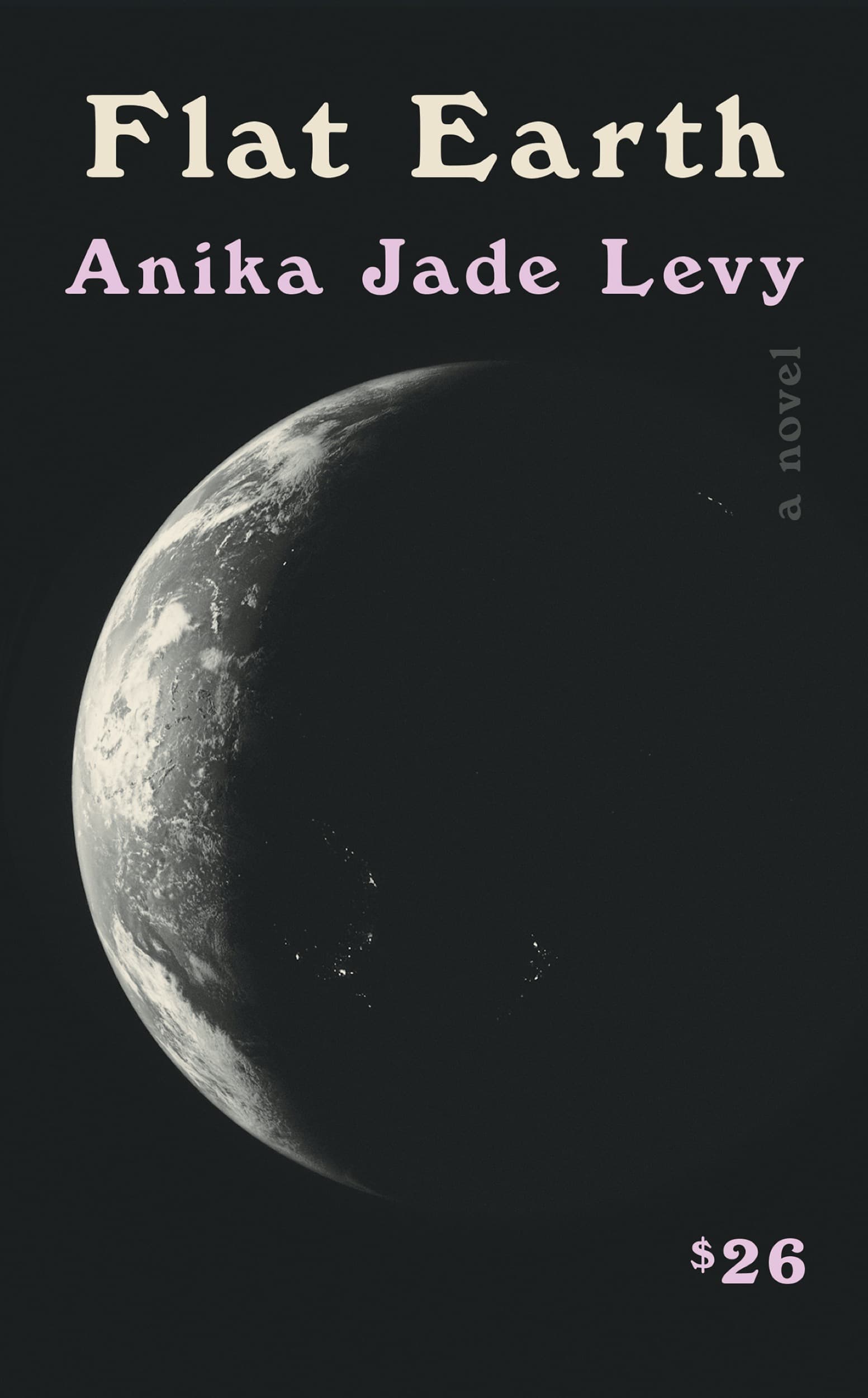
Flat Earth
Catapult, 2025
If the constant barrage of headlines hadn’t desensitized us to the signs that the world might be ending, and if we took a moment to actually sit with the carnage before us, we might have the same response to our current sociopolitical state as Flat Earth’s Avery: becoming unbearably shallow and jaded and caring for no one but ourselves—while caring for ourselves very little.
Living in New York as a graduate student and aspiring writer (term used loosely), Avery roams the outskirts of the city’s upper-crust societies—academia, the art scene, the general downtown assortment of lost young adults who still haven’t forgiven their parents for giving them a trust fund—with a profound, if mostly subconscious, desire to fit in. She’s middle class and unmotivated, not even deeply traumatized or mentally ill, so she hates herself. Not necessarily for being a waste of space (she has a “perfect body”) but for being uninteresting. We gather as much from her desperate attempts to acquire the cachet that might make her legible, if not appealing, to the culturally elite.
Avery lurks around gallery openings, engaging a sad, embarrassing faith that perhaps proximity to the art world may give her what she desires. That having sex with a bad sculptor or rubbing shoulders with who she hopes might be a Saudi prince (maybe I’m not going out enough, but when was the last time you saw a Saudi prince at a gallery opening?), will hand her esteem. It might even make her look like her peers, who all seem to have what she doesn’t: a lineage of privilege to lean on.
Her only friend, Frances, has family money, and Avery intrinsically understands how boring and average this makes her look in comparison (because people who come from wealth are inherently important and beguiling, obviously). For some of the novel, Avery follows Frances around rural America as she shoots a documentary on how easy it can become to believe in conspiracy when you feel like you’ve been generationally disregarded, i.e., when you live in a fly-over state. The film is equal parts opportunistic as it is straight mockery. It goes on to be lauded by the coastal establishment who love laughing at how stupid everyone else is. Avery tries, mediocrely, to attach herself to Frances’s charisma and drive, but the veil is thin: she accomplishes nothing on her own. Her biggest creative achievement is a measly series of half-formed cultural reports on the state of the world. They are all extremely negative and true: There is no hope. Civilization is about to crack open and consume itself. We are all fucked. Frances, Avery knows, is also much prettier than she is.
In her most of-the-moment act, Avery takes a job at a conservative dating app, getting paid to go on dates with Republican men who hate women. These men are narcissistic and brutish, unaware of the limits of their own charm and bodily allure. They are kind of like her. But she gets fired because, you guessed it, she doesn’t come from a “good enough family.” Avery was raised by a single mother, which may signal to these men that she is of a breed too independent and untamable. Even her whiteness can’t save her from this new-age eugenics. I imagine she is disappointed when let go, not because of the loss of money, but because she can no longer fashion herself as someone whose occupation is adjacent to sex work.
What stayed with me most from my time in Levy’s Flat Earth world were the vile thoughts expressed with zero guilt. Like when Avery goes to Chinatown and scoffs at the dirtiness of the street, which she describes as smelling like “hot blood.” (She had only come to the neighborhood to stop by the new high-end hotel—ostensibly Nine Orchard—which she imagines must pump in its own oxygen to keep it clean.) Or how it’s noted that everything looks better on young girls because their bodies are like clothes hangers, hollow vessels designed for observation and consumption.
Or, my favorite, how jealous Avery becomes by the city’s high school freshmen and their bald presentations of wealth, denoting how she, on the other hand, “had the decency to at least show an interest in poverty at their age.” When she says it, I want to roll my eyes, but I can’t. Her point is true. It was in vogue at my elite private university to compare whose thrifted outfit cost the least—the more holes and stains from the burden of activities we would probably never know (i.e. manual labor) the better. I remember a classmate whose reputation on Twitter was being the “girl on loans,” stating that you could tell how rich someone was by how many photos of garbage there were on their Instagram. My friend who had gone to Trinity for high school and ripped the Canada Goose logo off of his jacket had three. The fact that the freshmen in Flat Earth no longer virtue signal struggle only proves how far society has come in pretending to be anything other than what it is: a class system. This fuels Avery as much as it shames her. She yearns to be accepted by a class she just wasn’t born into.
What drives Flat Earth is a version of personal enlightenment available only to a very specific kind of woman: white, educated, cis, skinny, secular (or safely Christian), conventionally attractive, and insulated enough to experience money as abstraction rather than threat. I can’t lie, the inclination while reading to inhabit such a mindset—the willful inability to consider anyone other than myself, to be honest about my darkest desires for privilege and clout—is intriguing. I imagine how freeing, in its own dystopian way, it might be to think like Avery. To give up on care, to refuse earnestness. But then I think about those in the real world who occupy such a position—for example, the women who host Red Scare and those who listen to it—and I am reminded of my earlier claim: joining the club of the sexy alt cynic has most of the same barriers to entry that ground what a Nazi might look for in a wife. And I remember that that isn’t a club I want to be a part of, even if we’re all about to die.
Elle Gordon is a writer based in New York. Her reviews and essays have appeared in The Sun Magazine, The Cut, and elsewhere. She is a Production Assistant at the Brooklyn Rail.