Sebastian Castillo’s 49 Venezuelan Novels
Word count: 981
Paragraphs: 7
49 Venezuelan Novels
Translated from the English by Elisa Díaz Castelo
La Barba Metafísica, 2025
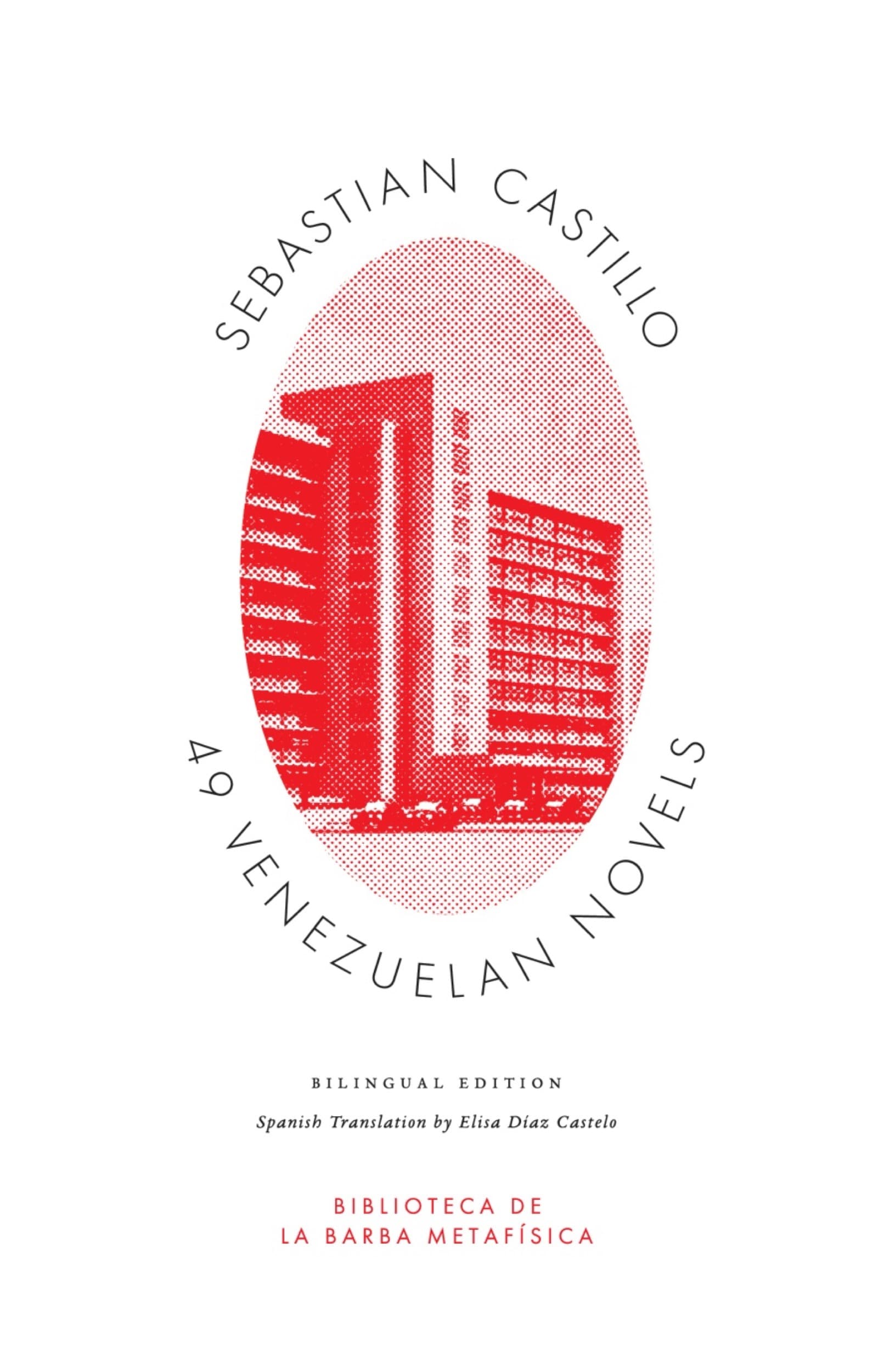
49 Venezuelan Novels—Sebastian Castillo’s first book, now translated into Spanish by Elisa Díaz Castelo—delivers on its title. These are indeed forty-nine novels, if you can think about novels in an expansive (and thus tiny) way. The work’s epigraph is Jorge Luis Borges: “Writing long books is a laborious and impoverishing act of foolishness: expanding in five hundred pages an idea that could be perfectly explained in a few minutes.” The writer Noy Holland said essentially the same thing: that novels have gotten too fat with bloat. These are hot takes, undoubtedly, but if you read 49 Venezuelan Novels—something you can do in just one sitting at a café, with two cortados—you might be able to see clearly the small shape of the idea and that it does, in fact, have some strange legs.
Castillo’s Venezuelan novels range in length from a few words to a chunky paragraph. Despite their brevity, each delivers in the movement or arc you might expect from a longer work. The shorter novels are often comprised of a single, discursive sentence that covers the ground of a whole life or centuries of lives. “Evol” is as follows: “I wish to make you sick, though not because my story is sickening (it is), but because the pages are doused in poison.” (“Evol”: “Quiero enfermarte, pero no porque mi historia sea nauseabunda [y lo es], sino porque las páginas están rociadas con veneno.”) Here, the horror/murder twist presented in a most direct way: I’m sick so I’ve sickened you. In “Lifespan”: “Life on Mars in the 31st century is unbelievably sad, even sadder than life on Mars in the 24th century.” (“Esperanza de Vida”: “La vida en Marte durante el siglo 31 es increíblemente triste, incluso más triste que la vida en Marte durante el siglo 24.”) These strange nuggets of story evolve into something much larger because of both their brevity and the abundance of white space in the English version. As readers, we’re invited to imagine the evolving sadness of life on Mars (surely soon to come) or consider the strategic opacity of a person moved to sicken. What ensues is almost colossal in scope or at least better than an over-explanation that takes from a story its possibility. And that’s perhaps what is most luxurious about the novel as described by Borges or Holland or enacted by Castillo: brevity as possibility.
Many of the longer novels in 49 Venezuelan Novels twist into sad absurdity. In “Mr. Ice Cream” (“Sr. Helado”), a man recounts traveling from Caracas to Mérida, where he witnessed another man pulling a family from a burning car. Attempting to match the man’s heroism, the narrator buys “ice cream for the members of the charred, half-dead family” (“helado para los miembros de la familia carbonizada y medio muerta”) and then, later in life, accidentally enters the ice cream business, whereby he gets the nickname Guillermo Helado. People think the nickname is for the man’s profession, but actually it’s for his “shame” and “memory, which becomes less precise by the day” (“vergüenza” y “memoria, que se vuelve menos precisa día a día”). The clumsy yet well-intentioned protagonist of “Sr. Helado” isn’t unlike J.B. Mooney, played by Josh O'Connor, in Kelly Reichardt’s recent film The Mastermind. They are just two men, toiling about in crummy circumstances of their own making, shame abound. It’s a trope, but one that when detailed in just a single paragraph permits the reader expansive thoughts about Guillermo Helado’s disposition towards heroism, towards sweet gaucherie.
Many of 49 Venezuelan Novels’ best moments are those that engage directly with the subversion of the novel’s form. In “Art Story” (“Cuento de Arte”), a painter’s concerns about whether his paintings (at a first solo exhibit!) will sell are disrupted by a bomb dropping on his city because “the other country had nasty ideas. And they could make money from killing!” (“el otro país tenía ideas perversas. ¡Y podían ganar dinero por matar!”) This novel concludes with a satirical “that’s the twist” (“ésa es la vuelta de tuerca”), placing the artist, and therefore his concerns, within a larger geo-political scope (one that, despite Castillo writing this about a decade ago, still feels deeply relevant). There is something discreetly sad about one’s artistic concerns being rendered irrelevant because of larger circumstances, but not as sad as a bombing. That’s the twist. In “Driver” (“Conductor”), an unnamed narrator observes that he’s been driven around the same forest by a “benevolent limousine driver” (“benevolente conductor de limusina”) for what must have been “at least the first forty pages of [the driver’s] novel” (“las primeras cuarenta páginas de la novela [del conductor]”). The narrator notes that they “pray not to the writer, but to his deficiencies” (“le rezamos no al autor, sino a sus deficiencias”). This is a nod to the idea of the forty-nine novels themselves: brevity as not exactly salvific, but at least capable of saving us from forty pages of musty forest. The whole idea here (or joke) is that novels can be whittled down to some essential components, presented to the reader in fluff-less form, and yet still effectuate joy, or tenderness, or absurdity; if it is indeed a joke, it’s a pretty good one.
Elisa Díaz Castelo’s translation of 49 Venezuelan Novels into Spanish offers us another reading, one just as fun and strange as the original in English. Without the white space, the translated novels feel more linked, almost as if they cascade into one another. The narrators feel more connected, the titles more strung together. “La Vaca Payaso Bully” or “La Cabeza Esteta Deprimido.” The result is something pleasingly fluid and distinct from the original in form. Meaning, these are ninety-eight Venezuelan novels if you’ve got the right reading (or get the joke).
Danielle Bradley is the winner of the 2025 Elizabeth Alexander Creative Writing Award and a 2025/2026 Tin House Reading Fellow. Her work appears or is forthcoming in Salt Hill Journal, Indiana Review, Colorado Review, and Meridians: feminism, race, transnationalism, among others. She is the second daughter of a Puerto Rican landscaper and a domestic worker and received her J.D. from the University of Pennsylvania Carey Law School and MFA from the MFA for Poets and Writers at the University of Massachusetts Amherst. Her first novel is currently a semi-finalist in Simon & Schuster (Avid Reader Press) BOOKS LIKE US First Novel Contest.