ArtSeenDecember/January 2025–26
Voice of Space: UFOs and Paranormal Phenomena
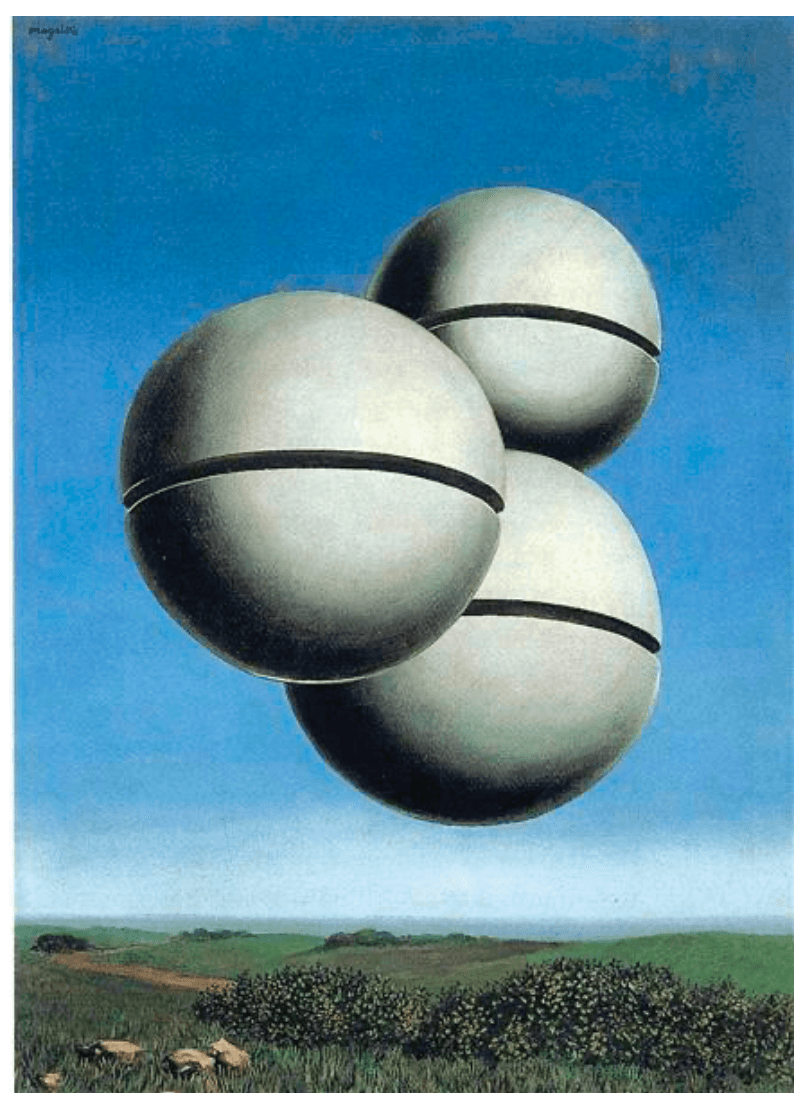
Rene Magritte, Voice of Space, 1931. Oil on canvas, 28 ⅝ × 21 ⅜ inches. Courtesy of the Peggy Guggenheim Collection, Venice (Solomon R. Guggenheim Foundation, New York).
Word count: 1233
Paragraphs: 8
The Drawing Center
October 17, 2025–February 1, 2026
New York
UFOs didn’t always look like this: they have their own art history. Though people have described unexplained heavenly phenomena for centuries, it was just in 1947 that the pilot Kenneth Arnold reported seeing lights in the sky that moved like saucers skipping across water; a journalist misunderstood his description and reported instead on “flying saucers.” Almost immediately, UFOs in other sightings took on a disc shape, in what was not only a notable example of the suggestibility of human perception and comprehension, but also an acknowledgment of the aptness of the flying saucer profile to what had been witnessed. Its tapering ends visually suggest speed, the presumption that it moves by spinning replicates the elliptical orbits of planetary bodies, and it looks like no flying machine on Earth.
There are remarkably few flying saucers in Voice of Space: UFOs and Paranormal Phenomena, a show at the Drawing Center curated by Olivia Shao, though they do make some appearances. A small blue card illustrating in storyboard format a UFO observation in the city of Kharkiv July 4, 1978, Observation time 21:05–22:10, attributed to A. Beletskiy, concludes with a reddish-brown capsule that coalesces from or bursts through a radiant portal—its flagellum suggests the Milky Way—in the night sky. David Weiss’s group of humorous ink-on-paper Wandlungen [Metamorphoses] (1975) hints at the pattern recognition that might occur when humans see such occurrences. In one drawing, a Saturn-like planet’s rings relate to the flattened fins surrounding a spaceship, and in another, a mountain’s lenticular clouds morph into flying saucer shapes. More austere are Isa Genzken’s untitled 1980 sketches in red and blue ink and pencil of one of her signature “Ellipsoids,” which she would later translate to three dimensions: elegantly balanced, lacquered wood blades the artist compares to weapons.

Installation View: Voice of Space: UFOs and Paranormal Phenomena, the Drawing Center, New York, 2025–26. Courtesy the Drawing Center. Photo: Daniel Terna.
Far more common here are circles and spheres. In René Magritte’s painting Voice of Space (1931), which lends the exhibition its title, three enormous orbs hang ponderously over an Alpine valley. We read them as UFOs until noticing their incised meridians: these are resounding cowbells. Shao notes in her catalogue essay that the observation of such floating circles is transcultural and -historical: “Mysterious fireballs, spheres, lights, flying wheels, and beings are interpreted through each civilization’s distinct culture and belief systems.” Accordingly, a Native American Visionary Drawing (1920), attributed to He Nupa Wanica (Joseph No Two Horns), depicts a blue human left hand filled with green crosses and solid black circles encircled by red outlines; maybe they are fireflies or twinkling stars. Above the pinkie finger are a four-pointed red star and a blue and red four-pointed star surrounded by a black circle. The latter is strikingly similar to compass-rose-like diagrams found in a Chumash Painted Cave in the mountains above Santa Barbara, California; scientific dating has placed some of the cave’s pigments to around 1677, the year of a solar eclipse. Elsewhere, we find an undated nineteenth-century Farsi Drawing that illustrates an Islamic ritual in which the participant sat in the center of a ring of twelve lit candles to attempt a “folding of the earth.” In Boundless (2024), a mixed-media collage, Char Jeré seems to be alluding to both of these histories while also developing what she calls “Afro-fractalism,” in which “the future [is] less of a destination and more of an ongoing rehearsal or ritual.” On the right-hand side of the paper support, Jeré has affixed a canceled library catalogue card for Meridel le Sueur’s study The Mound Builders (1974), which explores the North American indigenous cultures that built enormous astronomical observatories in the form of earth mounds; Ohio’s celebrated Serpent Mound (Adena peoples, ca. 300 BCE) and Illinois’s massive Cahokia complex (Mississippian culture, ca. 1050–1350 CE) are just two of such sites. On the left-hand side of Jeré’s collage is an unused yellow balloon with handwritten instructions for use, including “Blow 2x for a spaceship…/ 50x to see time collapse.”

Attributed to He Nupa Wanica (Joseph No Two Horns), Visionary Drawing, 1920. Watercolor, graphite, and color pencil on paper, 9 ¼ × 7 ½ inches. Courtesy of Donald Ellis Gallery and Galerie Gisela Capitain.
Jeré’s second collage, Go Bag (2024), continues the show’s spherical motifs in the forms of drawn satellite dishes, a cylindrical medicine bottle and its cap, and two turquoise pills in a blister pack, perhaps referencing the altered states sometimes necessary for communion with paranormal experiences. (Though I couldn’t help thinking, too, how inevitably useful painkillers and antihistamines will be on our descendants’ extraterrestrial travels: in space no one knows what you’re allergic to.) A double-ended, red hookup wire is looped back on itself so that its two ends nestle together, forming a closed loop, yes, but also suggesting a heart. This coiling and circulation are echoed in a small diagram drawn onto the paper ground, a loose spiral—illustrating the trajectory of a spent balloon?—connecting twelve numbered dots, with number one marked “Past” and twelve labeled “Present.”
That little figure connects Jeré’s work to others that use diagrammatic language and the visuality of advanced mathematics to suggest interplanetary travel and the engineering prowess needed to achieve it. I simply don’t have the adequate arithmetical know-how to fact-check on foot the equations in Melvin Way’s meticulously reckoned layers of marked Scotch tape (in an untitled work, ca. 2013) or the square roots calculated amidst the numbered dots and buoyant arrows of Howardena Pindell’s ecstatic Astronomy: Northern Hemisphere (August–September 1997) (2000–01), so I have to take comfort in Arthur C. Clarke’s axiom that, “any sufficiently advanced technology is indistinguishable from magic.”

Installation View: Voice of Space: UFOs and Paranormal Phenomena, the Drawing Center, New York, 2025–26. Courtesy the Drawing Center. Photo: Daniel Terna.
Trisha Donnelly’s disembodied sound piece Untitled (Bells) (2007) hauntingly links the two floors of Voice of Space, permitting both Magritte’s painting on the ground level and Isa Genzken’s concrete-and-antenna radio Weltempfänger Daniel (World Receiver) (1990) downstairs to throw their voices, as it were. Donnelly is also represented by an untitled drawing (2025), in which rivulets of blue ink and yellow colored pencil course down the page from and around several oval voids. It could represent water, hair, or falling drapery, but what it is is an encounter between up and down, the top of the page and the bottom. Donnelly is the subject of a solo exhibition currently installed in the Drawing Center’s front gallery, and several of the works there seem to be untethered found objects from Voice of Space reconnoitering a different show. The opening grayscale photographic print, Untitled (2024), features a sphere looming in indeterminate space, the ominousness of Magritte recast for our days, while the drawing hedm! (2005) glows from an unseen light source through cavities in its very fabric. Tucked into a narrow hallway, an untitled video (2010) projects a hovering circle agitating above what could be read as a landscape; Donnelly has described these videos as an effort to “bend motion into object,” a technological “folding of the earth.” On the floor of the main gallery lies an untitled 2019 sculpture: a smoothly chiseled beam of veined Verde Lipsia marble. This single stone is so allusive, calling to mind futuristic 2001: A Space Odyssey plinths and their Minimalist brethren while also, in its material, hearkening back to the ancient cipollino verde pilasters—wonderfully carved with birds, reptiles, and insects—from Hadrian’s villa now on display at the Metropolitan Museum. Donnelly’s slab has been subtly pockmarked here and there with hollow dimples that evoke honeycomb mesh or the prismatic constructions of bees, a sophisticated earthbound culture that continues to be largely alien to us.
Amanda Gluibizzi is an art editor at the Rail. An art historian, she is the Co-Director of the New Foundation for Art History and the author of Art and Design in 1960s New York (2021, paperback 2025).