ArtSeenDecember/January 2025–26
Julian Schnabel: Plate Paintings, 1978–2025
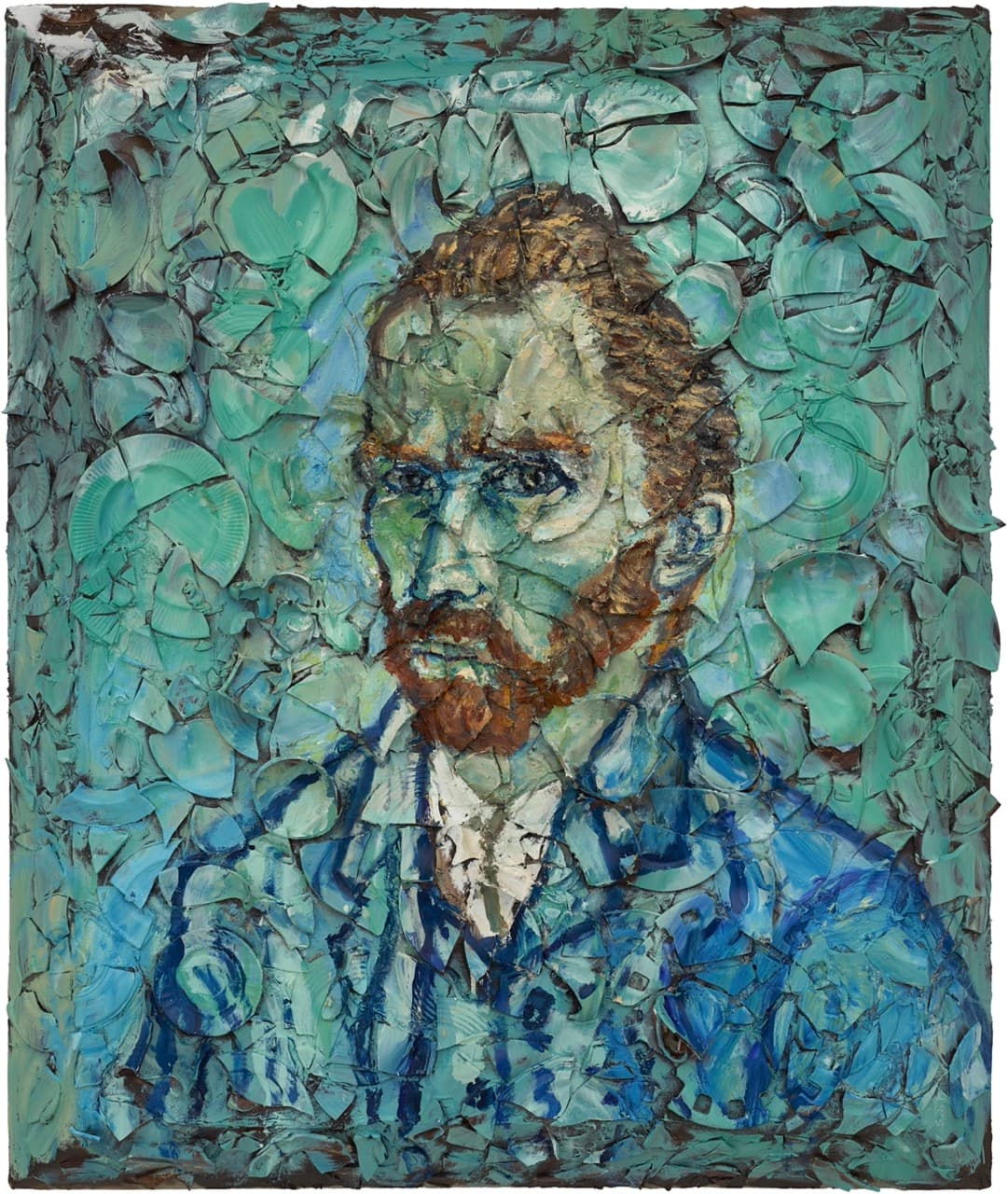
Julian Schnabel, Number 6 (Van Gogh Self-Portrait Musee d'Orsay, Vincent), 2020. Oil, plates, and bondo on wood, 72 × 60 × 10 inches. Courtesy Mnuchin Gallery. © Julian Schnabel Studio. Photo: Tom Powel Imaging.
Word count: 733
Paragraphs: 7
Mnuchin Gallery
November 6, 2025–January 31, 2026
New York
Julian Schnabel began making plate works, composed of broken dishware fragments, painted and affixed to wood panels, in 1978 and continues to make them in 2025, just a single facet of his production. He is wildly diverse, so he may paint a traditional landscape on a domestic scale or a huge, multi-part abstraction the size of a public mural, but he always remains constant in deploying certain tensions: abstraction versus figuration, narration versus stasis, passion versus control, autobiography versus anonymity. All these factors appear in the nineteen works on view at Mnuchin.
The plate paintings have never lacked for detractors. Back in 1988, the British art critic Brian Sewell viciously attacked both them and Schnabel himself, writing that Schnabel “sucked up other men’s ideas and regurgitated them in noisy and attention-seeking confusion.” He accused Schnabel of stealing from Antoni Gaudí, even though Schnabel made a point of saying Gaudí was an inspiration. Sewell called Schnabel an American Autolycus, referring to the Grecian demigod who was a master thief that could change the shape of stolen goods. Attacking the man who made the art rather than attacking the art alone is a specious ad hominem ploy. Calumny does not equate to art criticism, malgré Sewell.

Installation view: Julian Schnabel: Plate Paintings, 1978–2025, Mnuchin Gallery, New York, 2025–26. © 2025 Julian Schnabel Studio. Photo: Tom Powel Imaging.
What Sewell couldn’t see (or refused to see) was that Schnabel’s plate paintings were an innovation with roots in the past: they shift collage into sculpture while simultaneously referring to textured, impasto painting. We see a consequence of all this in his 2018 Van Gogh film biopic, At Eternity’s Gate, which engendered the plate portraits he showed at the Brant Foundation in 2021. Five of these portraits are included in this show and are meant to be seen from varying distances because the texture of the paint-encrusted plates changes as light and shadows create new effects. Number 6 (Van Gogh Self-Portrait Musee d’Orsay, Vincent) (2020) is a concrete result. Schnabel enlarges the original 26-by-21-inch painting, subduing the blue-green swirls around the head to give us a Van Gogh suffused with memory, no longer a self-portrait but a portrait of a self-portrait. He does the same thing in Self-Portrait with a Hat and Blue Glasses II (2025) by inserting himself, dressed in his usual overalls and straw hat, among a pantheon that includes Diego Velázquez and Rembrandt, an homage to his masters.
Fittingly, eight of the nineteen pieces here are from the 1980s, the decade when Schnabel made a name for himself. “I think a painting should be able to make you examine your preconceptions by creating a viewing time with its own information,” he wrote in Artforum in 1984, apropos of his first plate painting, The Patients and the Doctors (1978). “I try to cut out as much distraction as possible; jerk you outside of yourself and make you beside yourself.” Schnabel focuses on the affective aspects of his work, but anyone seeing The Patients and the Doctors in 1978 would be befuddled: is it a painting, a sculpture? This is a strange kind of triptych: the two side panels are separated by a third that projects forward. This middle panel is offset to the viewer’s left, so there is no center to our focus; Schnabel does create his own viewing time by slowing down our vision.

Julian Schnabel, The Sea, 1981. Oil, Mexican pots, plates, burnt wood, plaster, styrofoam, antlers, and bondo on wood, 108 × 156 × 41 inches. Courtesy the Brant Foundation, Greenwich, Connecticut. © Julian Schnabel Studio. Photo: Tom Powel Imaging.
But even if we had seen The Patients and the Doctors in 1978, we would still not be prepared for the outrageousness of The Sea (1981). The materials that constitute the work require a table of contents: oil, Mexican pots, plates, burnt wood, plaster, Styrofoam, antlers, and bondo on wood. Here, Schnabel does not “cut out as much distraction as possible.” The proliferative elements of the composition seem designed to distract. But as we stare, we realize this is a landscape or seascape, and instead of enthralling us with a vast, sublime horizon, Schnabel stacks up his elements vertically. Yes, there is some distance, but the sundry objects turn the scene into an archeological site. The burnt wood piece leaning against the canvas simultaneously enhances the sculptural nature of the work and makes it intrude into our reality. If the intention of much surrealist art is to disconcert viewers and put them in touch with their subconscious, then Schnabel is a surrealist of the latter day, as these perpetually astonishing constructions demonstrate.
Alfred Mac Adam is Professor of Latin American literature at Barnard College-Columbia University. He is a translator, most recently of Juan Villoro’s Horizontal Vertigo (2021), about Mexico City.