ArtSeenDecember/January 2025–26
Sean Scully
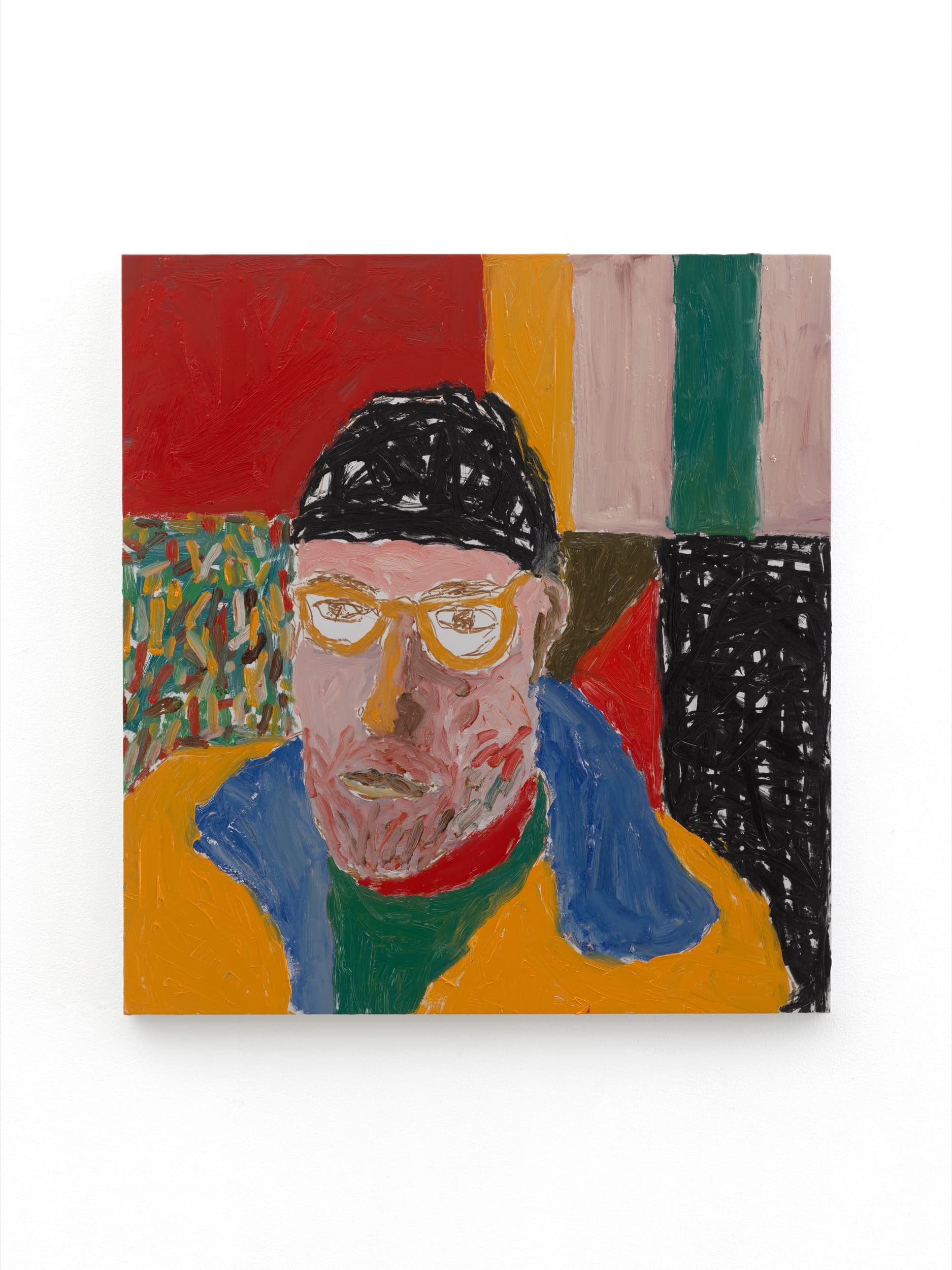
Sean Scully, The Artist, 2025. Oil and oil pastel on aluminium, 30 × 28 inches. © Sean Scully. Courtesy Thaddaeus Ropac gallery.
Word count: 1257
Paragraphs: 10
The Estorick Collection of Modern Italian Art
October 8, 2025–December 14, 2025
London
Lisson Gallery
November 6, 2025–January 24, 2026
New York
Sometimes it seems as if Sean Scully is showing almost everywhere. Well, he is! In mid-October I saw his exhibition placed against Giorgio Morandi in London. And then in early November, I looked at his show of new works in Manhattan. Set together, these two reviews of rather varied paintings and sculptures reveal the extraordinary range of his artistic interests.
Mirrors can be tricky. By replicating the visual world, mirror images are like figurative paintings. They ask us to consider: what is reality and what mere appearance? No wonder that philosophers from Plato to Arthur C. Danto have used them to explicate the nature of knowledge. Indeed, Danto refers to “mirrors as metaphors for art” in his treatise on aesthetics The Transfiguration of the Commonplace. Some of Sean Scully’s mirror paintings play with, and complicate, this familiar idea by juxtaposing two fields of differently colored stripes. Then one needs to ask which is the original and which the mirror image. In fact, there is no unproblematic way to answer that question. At the Estorick Collection in London, as his exhibition title Mirroring signifies, Scully takes our thinking about this visual process of mirroring a natural step further. Art historians tend to speak of a painter as being influenced by their predecessors. What exactly does that mean when the two painters are very different, such as Morandi and Scully? When comparing them, it may be better to indicate how they complement each other. Let’s do that and speak of mirroring. We want to acknowledge that if Morandi influences how we see Scully’s art, now Scully also affects our experience of Morandi.

Sean Scully, Untitled, 1967. Pencil on paper, 16 × 23 inches. © Sean Scully. Courtesy Thaddaeus Ropac gallery.
The Estorick Collection is a small museum in North London that is devoted to Italian art. On the second floor, in one medium-sized room, Mirroring is displayed. On one sidewall are twenty paintings and drawings by Scully from 1964 to the present, densely hung, without labels. There is a checklist identifying these works. At the right side is a recent painted self-portrait. It’s natural to see him as watching over you, looking to make sure that you grasp the point of his exhibition. And on the opposite wall are a dozen Morandi etchings and drawings from the Estorick Collection. Sitting on the comfortable sofa at the center of this gallery, one can see—literally see—the relationship between Morandi’s and Scully’s artworks.
Sean Scully likes to tell the story of how, as a young student working as a construction laborer, he became aware of the singular presence in the Tate of a Morandi painting. Most of the works in that museum were large and assertive, attempting to gain your attention. But the little Morandi was just “there.” Sometimes, Scully now recalls, it seemed as if that Morandi was just nothing. But then at other moments, it was obviously important. Morandi is greatly admired by contemporary artists. He is one of the few modernists who has a real mystique. But so far as I know, no one else has presented him with the subtlety of Mirroring. We view the affinities of Scully’s abstractions and figurative portraits—and the affinities of these works with Morandi’s. Here, Scully truly is a philosopher-painter.

Installation view: Sean Scully: Tower, Lisson Gallery, New York, 2025–26. © Sean Scully. Courtesy Lisson Gallery.
Although Morandi is a figurative painter, he has, as Scully observes, “learned the lessons of abstraction.” We enjoy his bottles, boxes, jars, and vessels, true containers of meaning, as if they were abstract paintings. As Scully says, “huddled together in familial dependencies. So that their edges touch.… They stand for themselves, but they don’t articulate exactly what that is.” I have rarely seen a more economical, supersubtle visual demonstration of a far-reaching thesis in aesthetic theory. Morandi’s figurative images don’t of course look like Scully’s abstractions or his figurative images. It’s the similar ways that the two artists present their subjects that justifies speaking of mirroring. In short, Scully draws and paints stripes in the way that Morandi depicts bottles. Art historians say in words how diverse artworks are related. And here Scully shows visually how he understands his relationship to Morandi. In a week of gallery-going in art-rich contemporary London, I did not see a more thought-provoking art exhibition.
Is there any abstract painter who has proven to be more consistently inventive than Sean Scully? Consider how many distinct media he has invented and developed. His early grids, I grant, are his personal adaptations of an inherited format. But then he invented the “Walls of Light,” paintings showing the appearance of light on walls in various diverse places. And he created what he calls “Landlines,” images showing the sky against the land’s horizon. And now he adds three more media. The “Tower” works, one group of new paintings in his Lisson exhibition, are assemblages of forms of his signature style stripes gathered from his earlier paintings. Like high-rise buildings, they are assemblages of heterogeneous elements. Because Scully has now had such a long, richly suggestive career, it’s possible for him to assemble elements in diverse styles from his back catalogue. Think, if you will, of the Tower of Babel, which contained people speaking many diverse, mutually incomprehensible languages. Made of wood, felt, and aluminum, the “Tower” works contain graffiti-style spray paint, competing grids and flashes of road signs, like urban high-rises. Consider for example Yellow Tower (2025) which has narrow and broad stripes, verticals and horizontals, some painted in the style of Scully’s 1980s paintings. And in addition, seven large “Tower” paintings are on view at Scully’s studio near the Lisson gallery, available by appointment. It is astonishing to see how these paintings hold together, gathering into one whole surprisingly heterogenous elements. Some of them, it seems, allude to cubist structures. Then eight new small paintings are oil on copper. Several are “Landlines”; Landline Grey Grey (2025) is a superb example. But others are walls. Wall Brown Violet (2025) is a great one. The copper support shines through as an underpainting. And, finally, there are three small sculptures, small cubes composed of handcrafted stone blocks. I look forward to seeing more of these massive structures, which are strikingly different from his other recent sculptures.

Sean Scully, Yellow Tower, 2025. Oil and spray paint on aluminum, wood, and canvas with felt, 110 × 86 × 3 inches. © Sean Scully. Courtesy Lisson Gallery.
One useful way to understand Scully’s media is to consider the obvious analogies with genres of figurative art. At the Metropolitan Museum of Art in gallery 623 is a small, early Nicolas Poussin, The Agony in the Garden (1626–27), a dark glowing work. It is the one picture in that room painted on copper, a support medium occasionally used by old master artists. In that context, this painting stands out. Like Poussin, Scully is interested in how works on copper glow. In gallery 627 is Giovanni Paolo Panini’s Modern Rome (1757), an imaginary art gallery showing the great modernist Italian paintings. Panini summarizes a rich tradition. Just as old master European art has a rich tradition because its subjects include not just history paintings, but also landscapes, portraits, and still lives; so, I would say, Scully’s new work is astonishing because it uses these various motifs, which reference his earlier art. The old-age style of some very great painters—Willem de Kooning is one—involved simplification. Scully rather complicates, referring back to his earlier work in a way that is almost unprecedented. Now, as often was the case earlier, he outdistances even the most energetic commentary. But, as he has said, eighty is the new thirty!
David Carrier is a philosopher and art critic who has published books on topics such as the methodologies of art history, Poussin’s paintings, Baudelaire’s art criticism, and the aesthetics of comics. He has held academic positions at Carnegie Mellon University, Case Western Reserve University, and the Cleveland Institute of Art. His recent works include Philosophical Skepticism as the Subject of Art: Maria Bussmann’s Drawings (Bloomsbury, 2024) and Bill Beckley and Narrative Art: The Word-Image Riddle and the Aesthetics of Beauty (Electa, 2023).