ArtDecember/January 2025–26In Conversation
JEFF KOONS with Joachim Pissarro
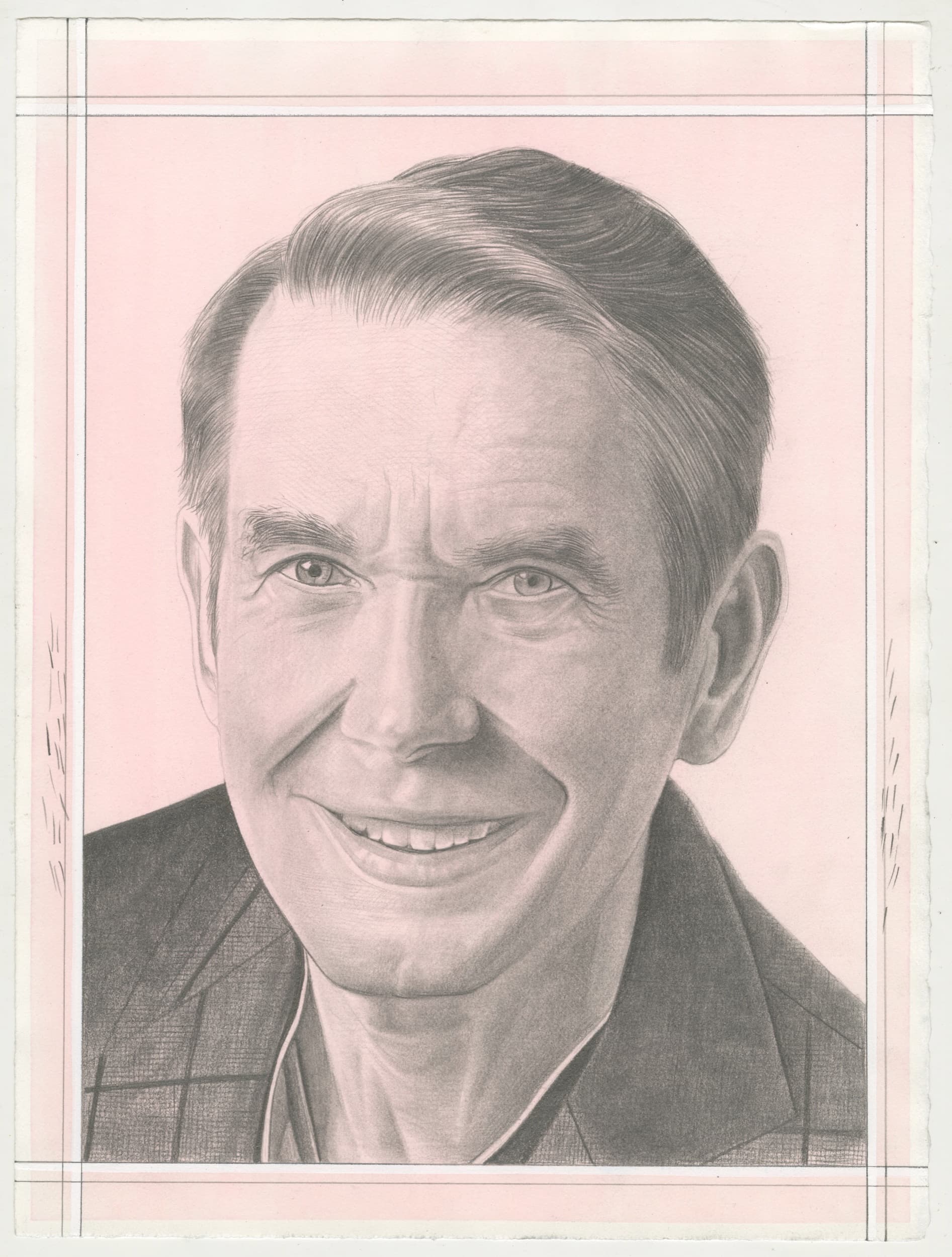
Portrait of Jeff Koons, pencil on paper by Phong H. Bui.
Word count: 4041
Paragraphs: 84
Gagosian
November 13, 2025–February 28, 2026
New York
The great classical archeologist Vinzenz Brinkmann once said to Jeff Koons that if the ancients had the technology that we do today, they’d be doing exactly what Koons is doing. Brinkmann would know; he’s one of the world’s experts on polychromy (sixth century BCE). This is particularly apt when one considers the paintings and sculptures Koons is showing in New York this season. On the occasion of his exhibition, Porcelain Series, Joachim Pissarro visited the Koons studio in the lead-up to the installation. Amidst many technicians applying finishing touches, Koons and Pissarro walked around discussing the visual power of art, how that power stimulates a viewer’s sensations and arouses emotion, as well as our noetic faculties.

Installation view: Jeff Koons: Porcelain Series, Gagosian, New York, 2025–26. © Jeff Koons. Courtesy Gagosian. Photo: Maris Hutchinson.
Joachim Pissarro (Rail): Jeff, thank you for having me in the studio on this momentous occasion. Every time I visit, I’m amazed by what I see. It’s obvious to me that your heart is motivated. Now you’re back with Gagosian?
Jeff Koons: I’m thrilled to be back. I’ve worked with Gagosian for at least three decades, but my last show in the New York gallery was back in 2018. We were able to arrange the exhibition with seven paintings and seven sculptures. I’ve been putting ceramics—not directly porcelain per se, but referencing porcelain with these ceramics—into my work since the mid-seventies.
Rail: Right, I think of Michael Jackson and Bubbles (1988), for instance.
Koons: Well, that’s porcelain, and it’s from the late eighties when I was working in my “Banality” series. I worked directly in porcelain.
Rail: I’d like to spin the thread of porcelain and ceramic as a material culture that runs throughout your works.
Koons: My grandparents had porcelain figurines. When I was a kid, I would play with them and I would be so excited. It was titillation, really. And the excitement that comes from this, that excitement is equal to any experience anybody else could have, even looking at a Michelangelo. You can’t really define how one is of more value, because as a young child you don’t know those hierarchies, but you do feel excitement, stimulation. I like that porcelain is a material that was democratized and became ceramic. So even my family could have porcelain when you know this came originally from the emperor’s kitchen. So the concept of porcelain—or ceramic—to me they are very close. I don’t make a distinction.
Rail: I did not realize that your interest in ceramic goes so far back. I mean, almost your starting point—almost. And so for me, there’s a difference between ceramic and porcelain, right? Ceramic is the more popular version of porcelain, which is more the kingly, imperial—
Koons: A more refined clay.
Rail: And rare, right? Porcelain is a rare, precious, fragile material. Is that something you were playing with already, or not really?
Koons: Well, I would say that was just what was accessible to me, but I would also say that the dialogue of the high and the low becomes more refined as my work goes on. I wanted to work directly in porcelain and to make them. Later, I began traveling to Europe and observing collections.
Rail: I’m sorry for being so nerdy, but at what point do the distinctions between ceramic and porcelain lose meaning to you?
Koons: You can see that, for me, there was almost no distinction. That’s why I brought up these pieces to show you, they’re models, and they’re models that have the color. [Moving to a different area in the studio.] This is a replica of the first rabbit that I worked with.
Rail: It doesn’t have a carrot yet.
Koons: This is the original one. When I made my mirrors, I remanufactured them. The Broad owns the one. And so I placed these inflatable rabbits on these mirror plates, 12-by-12 plates, kind of Robert Smithson style, and I’ve sat this one there, and I’ve sat an inflatable flower on that one, but that’s the first rabbit I worked with.
Same thing with my porcelain series. These are some of the models that I did—this stag and dog. If I have an interest, I will look all over, going to different antique shows where they’re selling porcelains. I would collect the images that I was interested in, and then I would work from there. And so there’s a certain freedom that I enjoy. I love to treat things as being perfect in their own being, but I’m an artist, so it’s all about freedom. So for example, this model: I may like the physical form, but I may prefer the color of another one. Or I like this one, but I still would like to adjust color, maybe make it a little richer. I’m free to do what I would like, but generally I try to use things as I find them, as much as possible.
This one will be in the exhibition, Kissing Lovers (2016–25). This cabinet has many of the figurines that I use for models or inspiration. For example, this is a Meissen.

Jeff Koons, Kissing Lovers, 2016–25. Mirror-polished stainless steel with transparent color coating, 88 x 77 x 55 inches. © Jeff Koons. Courtesy Gagosian. Photo: Maris Hutchinson.
Rail: This is a Meissen?
Koons: This is also a Meissen, yes. All of these. In my version, some of the colors are the same, but in other areas I added some different colors to emphasize different areas, so I just didn’t have the raw steel.
Rail: The object you’re holding in your hands is a Meissen?
Koons: It’s eighteenth century. This is also a Meissen. This is Meissen. All of these.
Whenever you get into these Three Graces, the original models have some angles to them. I preferred to straighten these out. I’m free to do all that, but yes, I’ve looked at so many models.
Rail: So the Three Graces (2016–22) that you showed in Granada, that’s the model?

Jeff Koons, Three Graces, 2016–22 (detail). Mirror-polished stainless steel with transparent color coating, 104 × 47 ½ × 31 ⅞ inches. © Jeff Koons. Courtesy Gagosian. Photo: Tom Powel Imaging.
Koons: Yes, and there are other things that are in here that I didn’t use for the models, the Venus for example, but I’m just trying to show that these are the original source materials, that they come from early in the early twentieth century, or even further back to the eighteenth century.
Rail: This is another Hercules?
Koons: That’s Hercules and the Nemean lion, but we’re still finishing that. It’s in metal. I did this doe being hunted by dogs, which is really a nice piece. But some of these were kissing lovers that I was looking at. I used this for my sculpture, Pluto and Proserpina (2010–13), in the “Antiquity” series. This model is kind of a Staffordshire type of design.
Rail: So as a collector, Jeff, you have these cabinets of incredible Staffordshire, Meissen, and other porcelain pieces. How would you differentiate them? Which do you prefer?
Koons: I don’t prefer. It depends what the narrative is.
Rail: This is Staffordshire as well?
Koons: These are just different pieces of different colors. Some of these are different Venuses I was looking at. Some of this was from the “Antiquity” series. These are different periods. I think I’ve always liked the material—
Rail: From childhood onwards, basically.
Koons: I’ve always liked the dialogue of internal being, and its exchange with the external world. And if we think about the skin as a kind of membrane, or interface—that’s something my balloon works emphasize, that interface between the interior and the exterior… But if we move from our inner being into our domestic environment, that’s the next membrane outward almost, a layer of some form—we’re engaged in the outside world. We’re interacting with it, but there’s still some protective environment that keeps it more internalized.
So I think that there is an openness there. There’s also a sense that even though these pieces become very large and heavy, these models that are being worked from, it’s almost like going back to Platonism and the idea of pure forms. It’s something that you can always kind of carry with you.
Rail: How does this new stainless-steel body of work relate to the earlier “Statuary” series?
Koons: When I first started making my stainless steel series, “Statuary,” they were works that if you had to get out of the house, it was something you could grab and take with you. But these are different. These works come together and create a conceptual show about being, about the arts, about philosophy. I always love Titian’s poesie paintings, and if I look at my source material for this exhibition, from 2009 onward, I was looking at Annibale Carracci’s work, and Bartholomaeus Spranger as I was starting to develop the concept of these paintings.
I mean, I have these paintings basically dated from 2018 onwards because the sort of montage that I created for these I defined at that time, but I was already working with those images, and these porcelain pieces I started collecting back in 2012–13. So it was information that I was carrying, and I started to make the commitment, isolating the pieces, and by 2018 I defined it as a series.
Rail: So I wish to stop you there, Jeff, because we’ve suddenly moved from those gorgeous stainless-steel sculptures to a completely new group of paintings.
Koons: Well, yes, but there is a connection with metal. Because what we’re doing here in the painting studio right now is we’re tweaking every little aspect, every detail of the aluminum delineations.
Rail: That’s interesting that you mentioned this, because if I’m correct, the aluminum represents the etching of the line underneath, right? And there’s a combination of etching plus painting in these works?
Koons: That’s right. So I start with a background which is a landscape-type background, whether it’s a breaking wave, a volcano, a forest, clouds. And then on top of that, I would paint a gesture. My own gestural marks. All those gestures—painterly marks are my gestures. Nobody has touched them. Purely my own. Nobody has made any gesture. Now, of course, all of the works are my works. I oversee everything and all the systems to create these works. But we make the backgrounds, we’ll create a stencil, and people will be putting in these backgrounds, painting them to images and the systems I’ve created and colors I approve, and all that, but the gestures, every aspect—that’s all my own.
Rail: Purely yourself.
Koons: Then on top of that, after that would dry, then we would lay the aluminum lines that you mentioned earlier. And we would lay an aluminum stencil of works that are basically, most of them, Counter-Reformation, some of them are Renaissance. Then I come in and make these physical gestures that are purely self, completely—it’s kind of for the naysayers.
Rail: Those great naysayers who claim you never added a brushstroke to your own work! [Laughs] This painting debauchery must have been huge fun as well?

Jeff Koons, Swiss Landscape, 2018–25. Oil on canvas with aluminum leaf, 90 x 104 ¼ inches. © Jeff Koons. Courtesy Gagosian. Photo: Maris Hutchinson.
Koons: Absolutely. It’s fun because of the risk taking. Sometimes a move doesn’t work out exactly the way you thought, so you go back into it again. I really like doing this kind of thing. Really, I was always a painter. I was kind of a figurative painter, but when they started to become too big, at the very end of my just making paintings myself, that’s when I started to be more involved in sculpture.
I’ve always made paintings, but usually they were machine-based paintings, or I set up systems, like my “Celebration” paintings, or my “Luxury and Degradation” paintings, or the “Made in Heaven” paintings. I created works that were role-based, but when I say “I created,” what I mean is I would frame a poster that was already created by Nike, for instance this, and I would put that within the context. I was always thinking of two dimensional and three dimensional together. I really find this the most powerful, and the “Gazing Ball” series tries to achieve a similar thing of the two dimensional and three dimensional being fused together. The “Porcelain” series too, plays on that ambiguity. These paintings are sculptures, I mean, they’re paintings—these sculptures are paintings, and the paintings are sculptural
Rail: Sorry Jeff, are you saying that these sculptures are painted? Or that your paintings are three dimensional?
Koons: Both! You can see that these paintings are very three dimensional, and the sculptures in that all their surfaces have been painted through a very complex technological process of applying paint on stainless steel.
Rail: So you start with a matrix underneath?
Koons: In case for Satyr Nymph (2018–25), it would have been that cloud. On top of that, I came and painted these gestures. And then this image, which is a Ludovico Carracci, it’s a satyr and a nymph and that’s laid down in the aluminum—so this should never tarnish. I mean, this silvery sheen should look like this two hundred years from now. Then when I’m done, I come back and I make gestures on top of this—
Rail: There’s a sense of to-ing and fro-ing, instead of rotation, because this element is on top, right?
Koons: That very little one, this one’s on top. I try to stay as true to the original etching as possible. So we’ll just come back and we’ll tweak those areas. This shows how we broke it down to be able to create the stencil to use lasers to cut this. But some of these look optic, like this is a completely finished painting, but it’s covered right now because we just laid some silver onto it and we haven’t pulled it right here. We went around the gesture that I laid on top.
Rail: So, Jeff, I’m curious. When do you come to the studio and make these purely personal pictorial gestures? Do you come in the studio by yourself? Do you insist on being by yourself, or—
Koons: Mostly weekends, sometimes during the week. There’s aluminum laid over this right now, but we’re going to be coming in and peeling this area.
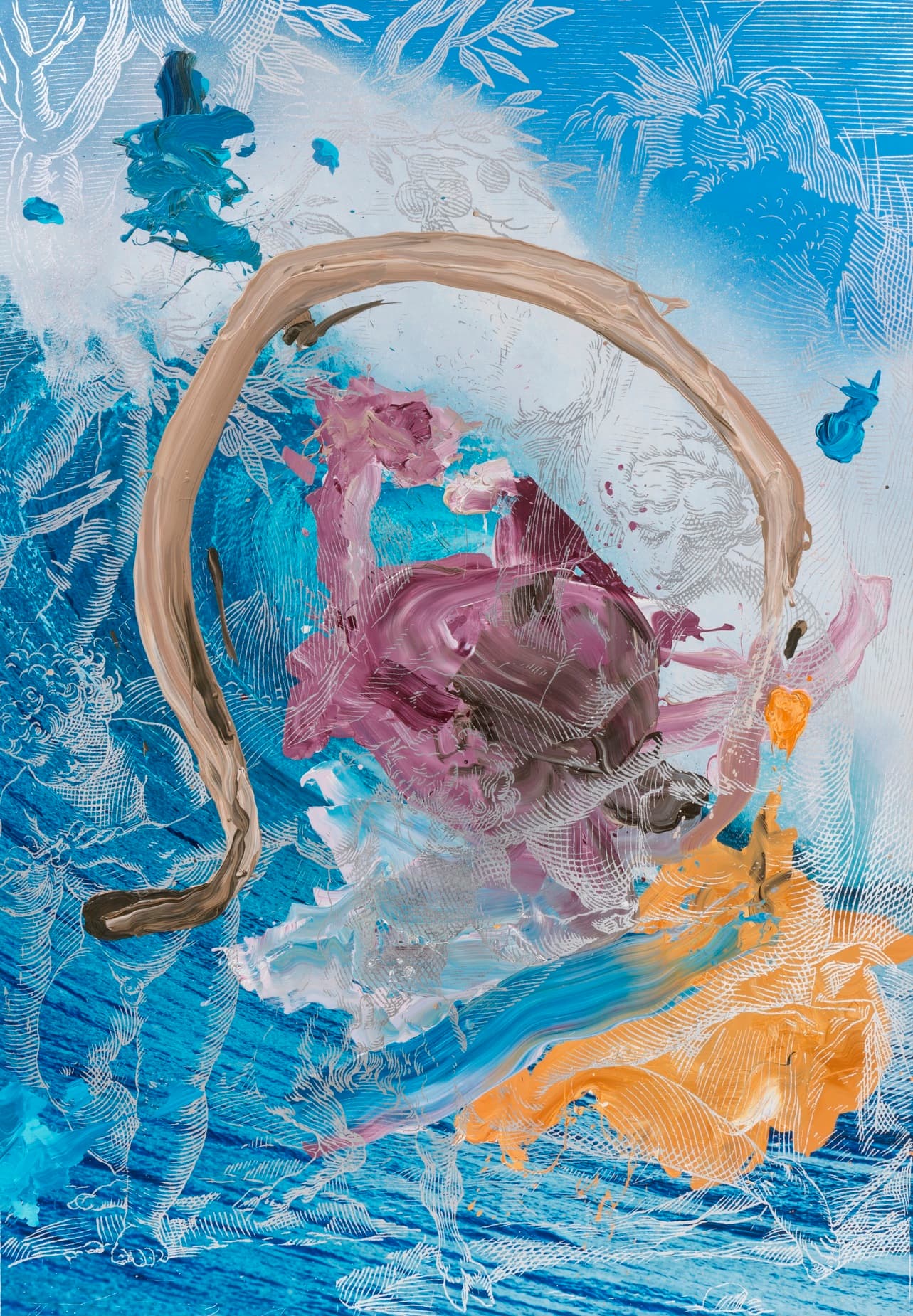
Jeff Koons, Nymph, Pluto, and Satyr, 2018–25. Oil on canvas with aluminum leaf, 102 x 71 1/16 inches. © Jeff Koons. Courtesy Gagosian. Photo: Maris Hutchinson
Rail: Just a quick technical question: when you say aluminum laid over, it looks like here your own gesture has spread over the aluminum lines, or am I misreading this?
Koons: Yes, so it’s just certain shapes that are going to be laying that are staying in there. This will get peeled. So this is just creating that finish.
Rail: What is the subject of this one?
Koons: This is Venus and Mercury (2018–25). The original source is Jan Muller’s Venus and Mercury (ca. 1600), after Bartholomeus Spranger. When it’s cleaned up, it’s going to look incredible. This is hard to see right now because we have it lying down. We’re going in here on the finest areas here, where we have to come back in and try to get a little more information. And over here is The Judgment of Paris, based on Marcantonio Raimondi’s famous engraving of The Judgment of Paris (1513–15), which itself was based on a drawing by Raphael. And you know, I love the sky—for me, it’s the epitome of a Mannerist vision. Then I made these gestures underneath and then came back on top, gestures. And now we just have to clean up just a little bit of the aluminum.
Rail: I have to ask a question, did you conceive that this, this would have this effect as you started working?
Koons: You know, Joachim, I’ve been doing this silver/aluminum material for a long time! I did it in my “Antiquity” series, my “Popeye” series. I’ve been doing it for a long time, but we really try to get the most active quality. I’m going to show this Carracci, this Spranger, this Carracci. This is a Carracci. A lot of these Carracci come from a series, it’s called “Lascivie.” It’s like a love poem. How would you say?
Rail: Is it Vesuvius? It’s a volcano.
Koons: When I was talking about Titian, I’d always love Nymph and Shepherd (1570–75) that’s in Kunsthistorisches, the fine arts museum in Vienna. I have a “Gazing Ball” painting that I made of that painting that I keep in my dining room kitchen. And I realize my interest in this painting is that this is real high level. This is the epitome of high-level pastoral poetry. I look at Titian, and I wonder, “Oh, why do I love this so much?” And I didn’t realize that the dialogue is really the highest point of value and sophistication of understanding dialogue and the essence of something, at the same time, it is completely accessible—just the feeling, sensation. Just the wonderment of light and reflection, the basic needs of humanism, but at the same time, involved in the mathematics of pastoral poetry and the connectivity.
People love narratives; I love narratives. I always try to be involved with narrative because they tell a story. And we as humans, we love stories because we love the sense of connection. How one thing can be connected to another thing, and that can be connected to something else. This information chain is what creates a story. So I love the idea of connectivity, and for me, a body of work like this celebrates connectivity. It celebrates the accessibility. I mean, I really have tried. It’s not playing down. It’s not making work that plays down to the contrary. It’s work that tries that on, whatever again, whatever place somebody is within their life, that they can find an entrance in, and that you just take it from there.

Installation view: Jeff Koons: Porcelain Series, Gagosian, New York, 2025–26. © Jeff Koons. Courtesy Gagosian. Photo: Maris Hutchinson.
Rail: I’m speechless, Jeff.
Koons: I don’t know if you can see this. Let me turn on the lights. This is Phyllis riding Aristotle—
Rail: So, this is wisdom fighting versus…?
Koons: Phyllis—that name is used a lot in pastoral poetry—incarnates pure sensual pleasure. In medieval European legend, Phyllis was considered to have been a mistress to Alexander the Great. Aristotle, the great philosopher, was Alexander’s tutor and had warned his student against the dangerous lascivious powers of Phyllis. She was extremely beautiful, though, and she swore that she would not only succeed in seducing Aristotle, but also reduce him to humiliation by riding him like a horse. So this is a story about beauty, desire triumphing over intellect.
Rail: My first degree was in philosophy. We would read Aristotle in Greek for our punishment. [Laughter.]
Koons: I love Led Zeppelin. And if you think of a song like, “Since I’ve Been Loving You,” it has all this wooing and all this love of feelings and sensations—you have all these extremes of pleasure. And it leads to the ultimate question: what’s most beneficial way for one to live one’s life? It’s great to have feelings and sensations. But you have a responsibility to yourself to understand those feelings and sensations—
Rail: The split of the personality according to Freud: the id, the ego, and the superego. Basically, the id is the pure, instinctual, pleasurable sexual joy, but it has to be reined in for us to function in society.
Koons: Within the whole “Porcelain” series, the different groups kind of change roles; I have mythic nudes, I have lovers, and I have animals, and they all change roles throughout the series. Different exchanges go back and forth between the groups: you could have deer kissing each other, just as the lovers do—I see them take on these interchangeable roles. I have kissing lovers, the figures, humans, but then I have the animals that are kissing lovers, too. You know, the stag is licking the top of the doe. And so there’s this role change that goes back in place with nature and the violence, the violence of the fox and bird. You also have, like the Carracci, there’s this role changing. We have mythology, Three Graces. And I have mythic nudes, I have my animals, and I have the lovers, and there’s this—
Rail: This is the first time, Jeff, I’m thinking so much about Freud while looking at your work. I’m thinking of the book that Freud published in 1920, Beyond the Pleasure Principle, right after World War I, a period of utter self-decimation for humanity. There he introduced the concept of the death drive (Thanatos) as inseparable from the sex drive or love drive (Eros). We see throughout this exhibition an extraordinary alliance of love and violence. This is a very large aspect, it seems, of the “Porcelain” series.
Koons: You know, Plato would say that the first thing that you have to deal with in art is size. It’s the first thing that I’ll deal with. So I did Diana in plaster and glass 2013 with a gazing ball, then came her stag and her dog. So, you have that moment when a nymph recognizes Actaeon; Diana’s looking the other way. But then when she finally looks right, and Actaeon gets turned into the stag, his dogs hunt him down. So this is there.
Rail: This is just incredible. There’s the relationship of the painting and the sculpture, I’m tempted to say that you’ve never sewn it so beautifully, and it’s talking about connectivity. They seem to be engaged in dialogues with one another in very profound ways. Technically speaking, do you consider the paintings as part of the “Porcelain” series?
Koons: Yes, these are the “Porcelain” series. I have been thinking for quite some time how to bring them together. It was very important to me that I could show all of it together. Everything is dependent on its environment. So, the sculptures will be reflecting these paintings. And when the viewer enters, they’re reflecting you
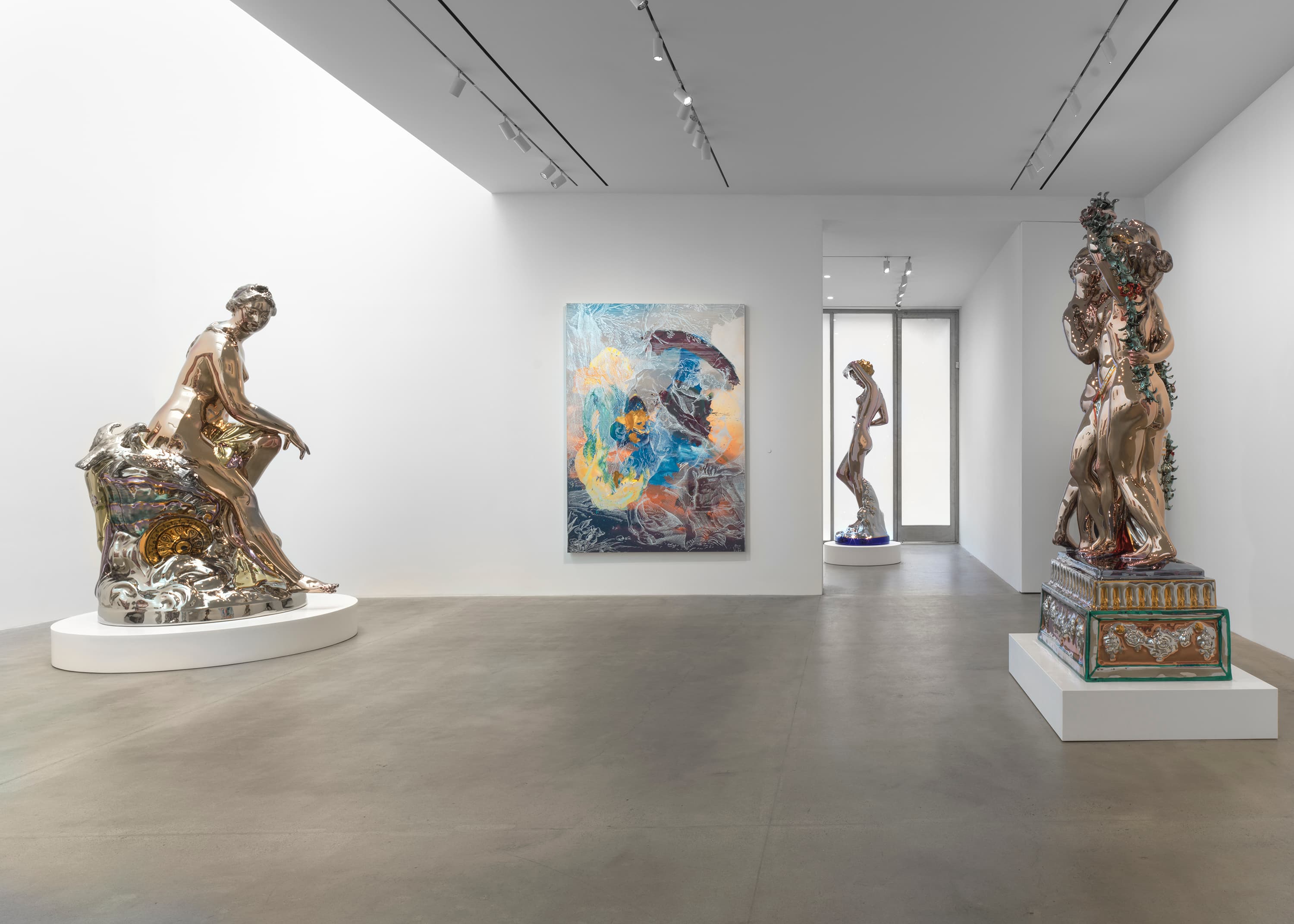
Installation view: Jeff Koons: Porcelain Series, Gagosian, New York, 2025–26. © Jeff Koons. Courtesy Gagosian. Photo: Maris Hutchinson.
Rail: It’s clear you spent a lot of time thinking about this show.
Koons: Absolutely. The reason I have the painting in this location, also behind the stag and dog, is the color in the room. Otherwise, it’s just reflecting the white walls. For me, this is all very much of the moment. The gestures can be read as a symbol; they connect to the type of energy that is happening now. For me, when I was talking about narrative and connectivity, that’s what I love.
I mean when I had my first art history lesson and went to art school, I had no idea what art was, but I took lessons from the time I was a kid, and I was always considered very good at it—that I could draw and create any illusion, I could paint portraits and still lives—I wasn’t really prepared for anything other than to go to art school. So when I had my first art history lesson, and the art history teacher brought up the Édouard Manet painting Olympia (1863), and what some of these images may have meant in nineteenth-century France: the black cat in the corner, the offering of the bouquet of flowers, the woman lying in the position referencing Francisco Goya’s work, and I tell you, I felt like the luckiest person in the world, because it became clear to me that art can empower. That art is something that can connect me to philosophy and theology and aesthetics, physics—all the human disciplines.
Rail: The fact that connectivity is simply inherent in art…
Koons: Like our synapses, the connections of information create the concepts for anything. But when you think about how some people talk about time, that there’s nothing other than now, but any type of connectivity is actually out of the moment, in some way—
Rail: It transcends the moment, perhaps?
Koons: Yes, because the connectivity is what really makes everything so rich, so joyous. It gives us so much opportunity to be able to appreciate and to want to become, to transcend, and to find more areas of interest. So for me, an exhibition like this opens doors. It opened doors for me. I hope that viewers feel that stimulation, that connective energy. It’s like tapping into the essence of their own potential, that feeling of—
Rail: It’s elating. The word “elating” comes from Latin. Elating is to elevate yourself above yourself. I think that’s what you’re doing, which is incredible. We have worked together on many shows, but I don’t think I’ve ever seen such a totally seamless harmony and dialogue between sculpture and painting.
Joachim Pissarro has been the Bershad Professor of Art History and Director of the Hunter College Galleries, Hunter College, New York, since 2007. He has also held positions at MoMA, the Kimbell Art Museum, and the Yale University Art Gallery. His latest book on Wild Art (with co-author David Carrier) was published in fall 2013 by Phaidon Press.