ArtDecember/January 2025–26In Conversation
ALEX STRADA with Gaby Collins-Fernández
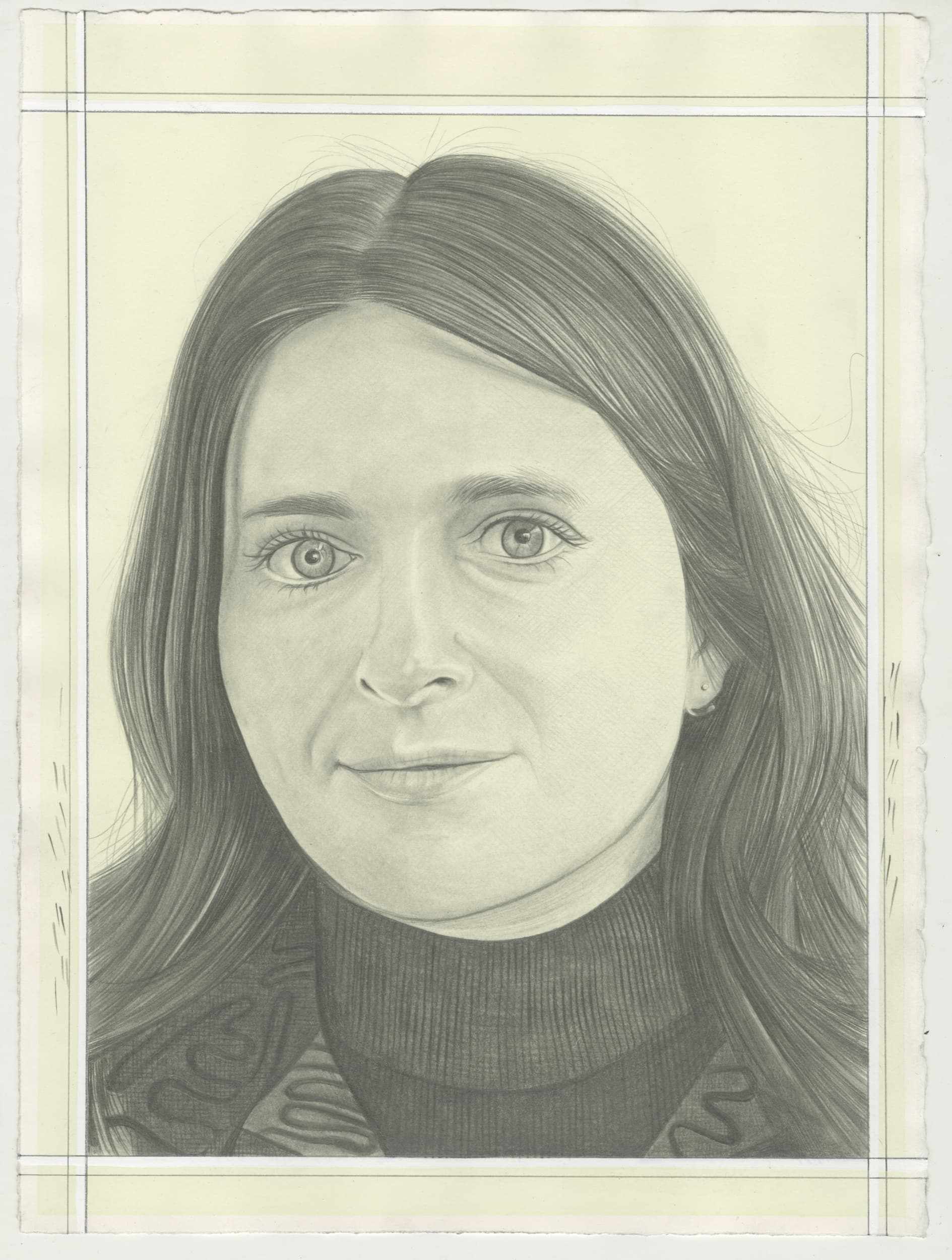
Portrait of Alex Strada, pencil on paper by Phong H. Bui.
Word count: 4673
Paragraphs: 38
October 18, 2025–March 22, 2026
Storefront for Art & Architecture
Lt. Petrosino Square, New York
Alex Strada is an artist who reminds us that our environments are not inert, but constantly made and remade by their inhabitants. Strada’s project Public Address is the result of her position as Public Artist in Residence at the Department of Homeless Services and Department of Cultural Affairs. This public artwork is organized by Storefront for Art and Architecture and curated by Guillermo Ruiz de Teresa. The first Manhattan iteration is currently on view in Petrosino Square and on street corners in all twelve community districts of the borough. Over the next year, the work will continue to grow, iterate and be displayed across the city with larger- and smaller-scale interventions in all five boroughs.
Alex and I had the privilege of having a conversation on the New Social Environment the day after the New York City mayoral election and Zohran Mamdani’s historic win, a significant and hopeful event for an artist embedded in city government, and whose work actively requires creative forms of inter-departmental collaboration. Alex’s work applies rigorous conceptual thought about the function of government and civic service to the logistic and bureaucratic processes required to make anything—from objects to social benefits—happen, while using aesthetics and play to create public spaces that center openness, dignity, and an invitation to make active changes in our shared social realities.

Installation view: Alex Strada: Public Address, Lt. Petrosino Square, New York, 2025–26. Courtesy Storefront for Art and Architecture. Photo: Michael Oliver.
Gaby Collins-Fernández (Rail): It’s a pleasure to get to talk with you, Alex, about your project Public Address and how public art can take on the structure, form, and content of aesthetics and politics simultaneously. It is the day after the 2025 mayoral election, so it’s a good time to think about this as people who love and think about art and the place that we live. Currently, the main installation of Public Address is in Petrosino Park, across the street from Storefront for Art and Architecture, the co-presenter of the project along with the City of New York, where you are the inaugural artist in residence at the Department of Homeless Services and the Department of Cultural Affairs since 2022. There are also elements of the project installed across Manhattan, and it will travel throughout the boroughs through 2026. What was it like working with the city to develop this project?
Alex Strada: Public Address is a project that emerges out of the three years and counting that I’ve been embedded in city government as a Public Artist in Residence (PAIR) and a longform partnership with the project curator Guillmero Ruiz de Teresa. PAIR situates artists in agencies where they are given an ID card, a cubicle, and an email address—but it is up to that artist to decide what to do with their access. It’s modeled after Mierle Laderman Ukeles’s decades-long residency with the Department of Sanitation. I’ve been working with the Department of Homeless Services (I might use the acronym DHS in this conversation and want to distinguish it from the Department of Homeland Security). Previously, I had taught art in shelters.
I stepped into this official role in 2022 wanting to talk to as many people as I could. This entry into the agency overlapped with the time when Governor Greg Abbott of Texas started bussing people seeking asylum to New York. Politically, it was also a very different moment; Eric Adams for a while was saying, yes, please send people, before backtracking. Because of our right to shelter law, the city legally gives a bed to anyone who needs it regardless of immigration status.
City shelters have log books that staff use to record what they consider most important at the end of a shift. I was fascinated by these handwritten records, continuously read and added to, and wanted to create a structure where the meaningful conversations I had with shelter residents could take a public, engaged form. I decided to borrow—and “misuse”—this official record-keeping method, drawing from my experience as an educator to hold log-writing workshops in shelters around the city. In these sessions, participants write down what they find most important on pages from log books. A common theme I heard was frustration at being spoken about rather than listened to. This project offers a space for people to speak for themselves and engage the New York City public directly.
Rail: Your work is notable in the way you use the format of the institution and then switch up its content. In this case, literally using the form of the log book shifts our understanding of who determines the importance of what happened in a day, what kind of story is being told, and how it’s displayed, but in a way that also proposes that that kind of reflection ought to actually be a part of the institutional conception of what we consider in the first place. Throughout your project, your use of institutional formats is also really intentional and particular, from the log book to the production of the signs themselves. How did the idea of correlating signage and the log books come up? It moves us from a more private format, read internally by an institution, to a format whose vernacular usage speaks to directions and wayfinding in public space.
Strada: I wanted to find a way to intervene in public infrastructure and redirect the authority of the city’s voice toward the log book entries. This impulse led to bringing the Department of Transportation (DOT) into the project. Their sign shop in Maspeth is where all municipal signage is made by master printers who continue to screenprint by hand. I like to tell my students that you can have a unionized, professional printmaking job!
NYC DOT Art and the sign shop ultimately agreed to use upcycled aluminum street signs as the surfaces for printing the log book entries. I was drawn to the materiality of municipal signage because of the power it holds: these signs usually issue authoritative directives that shape how we move through public space. I wanted to borrow that same authority and reroute it—to center reflections, advocacy, and drawings from people experiencing homelessness. As we produced the signs, it was interesting to hear from the printers. Everyone in the shop who wasn’t directly working on the project kept asking, “What is this? What are you guys working on?” They haven’t traditionally printed custom shapes, so the project also stretched the material possibilities of city tools and machinery.
Rail: Yes. In the installation at Petrosino Square, there are two immediate impacts: both of the stories that are being foregrounded and of how playful and unexpected it is to see city signage used (misused?) in this way. Thinking about how signs are markers of legality and illegality in the city, and also about how movement is allowed and controlled—when and where can people pause, or stop, without being picked up, fined, taken elsewhere—calls into question our normative idea of homelessness, which is that it is perceived as a crisis when it becomes visible, which shows how little the general public wants to deal with it at all, except as a “problem” to be “fixed.” And, usually, visibility is tied to the dysfunction which we see when the systems we have to address housing and shelters are overwhelmed. Public Address flips the script on this, too, asking the public to care about the experiences of people using shelters in a more interpersonal way.

Installation view: Alex Strada: Public Address, Lt. Petrosino Square, New York, 2025–26. Courtesy Storefront for Art and Architecture. Photo: Michael Oliver.
Strada: In the time that I have been in residence with DHS, sleeping outside became criminalized by the Supreme Court, who issued the City of Grants Pass v. Johnson case in 2024. And while it’s not necessarily enforced in New York City, it could be, and it is being enforced in other places. We are also seeing extreme, increased criminalization of migrants, as everyone knows. When I started my residency, the presence of ICE was not something that people were constantly contending with given our sanctuary laws, and now there are many who are afraid to leave shelters, fearful of even sending their kids to school, because of the possibilities of being kidnapped.
There are other city-level policies that the project contends with. For example, the New York City Department of Parks and Recreation requires that every free-standing sculpture in Petrosino Square be a minimum of 800 pounds, which is very heavy. When I learned that we wouldn’t be able to put the signs directly into the ground, I worked with a trained architect, Ekin Bilal, to come up with ideas to fulfill this criteria while also extending the possibilities of what a sculptural base can be. A number of bases double as seating. There are also materially-related footrests scattered throughout the park—which might be the most popular part of this installation. These are subtle, quiet gestures that are meant to challenge the hostile architecture inherent to the park itself, like benches that prevent people from splaying out on them because of armrests that intentionally bisect them. The footrest is there to try to gently counter that and create a space of rest and reflection in a city that is increasingly privatized.
This insistence on public rest highlights the fact that we have a right to shelter—a law that was fought for through years of advocacy and litigation. We are the only major city in the US to have this kind of law in place. If an adult or family requests shelter, the city legally has to meet this need. In “The Right to the City: Homelessness and Advocacy,” the first public program of Public Address, writer Jennifer Egan and Will Watts of Coalition for the Homeless spoke at length about the limits and possibilities of this protection. The Coalition for the Homeless is the court-mandated monitor of the shelter system. They help to create a system of accountability to make sure various legal guarantees of the Callahan decree are met. The vast majority of people experiencing homelessness in NYC are sheltered. Only a very small percentage are street homeless. This is a very different landscape than other major cities. An important part of this project is to move away from harmful and reductive stereotypes around homelessness, as well as to assert and educate about the right to shelter and the ongoing advocacy in support of people experiencing homelessness, including migrants.
Rail: The fact that in this city shelter is a right is both amazing and also reiterates the importance of talking about both legality and institutional infrastructure in your project. By visualizing the log book writing using the format of city infrastructure, you tie the visibility of the experience of shelters with the visibility of the bureaucracy and logistics of homelessness. I wonder also, as you talk about working with multiple agencies, if your collaboration with them has led to a difference in the relationship between them and whether you see that as an active intention in your work?
Strada: As an artist, I’m interested in engaging the law, but also questioning it. Having a right to shelter but not a right to housing leads to people being stuck in shelter, which especially impacts people who aren’t eligible for the same housing vouchers that citizens are, including migrants or undocumented immigrants. And amidst greater crises of affordability, there’s so much more that has to happen for this law to even begin to fulfill the promise it purports to fulfill. Public Address requires four different city agencies—Homeless Services, Cultural Affairs, Parks, and Transporation—who don’t normally work together, to collaborate to address homelessness.
For example, one of the log entries reads:
My name is Alexander. I consider myself the luckiest guy alive, because I made NYC my home. As a trans guy, it’s hard to be yourself and survive being unhoused. I’m very lucky, because I’m in one of the safest shelters. I have a long way to go before I can have a place of my own and live my truth as the man that I am. But it’s promising, though.
For this log entry to exist in Petrosino Square, many people and systems had to come together to operate differently. I worked with a DHS social worker to organize a workshop where Alexander had the time and space to learn about the project and contribute. Later, the Department of Transportation has to imbue care and time into printing and producing the sign. Parks has to agree to have it on view. All the while everyone is reading and engaging with Alexander’s words. This process ultimately created new mechanisms for listening.
When I started with DHS, several staff members told me that there had been a parade thanking the agencies deemed most essential during COVID—and DHS wasn’t included. They had done so much work to support people throughout the crisis, and I heard real pain, frustration, and resentment around their lack of visibility as essential workers in the city. Homelessness is, in many ways, a tangible expression of multiple failed systems, including the gaps within and between city departments. The only way to move toward a city without mass homelessness is for these agencies to communicate and work collaboratively with public engagement and support. Early on, I understood that whatever form this project took, it couldn’t exist solely within DHS—it had to actively bring other agencies into the process.
There was also funding uncertainty throughout making this work. Around the time when libraries were reducing their hours over city budget cuts, I was essentially given a stop-work order by Homeless Services and Cultural Affairs because the project budget was frozen. At that point, Erica Dean and Beatriz Fritschler of DHS and Kendal Henry of DCLA were deeply invested in the project and knew me well enough to know I wasn’t actually going to stop working. Imagine—I had been running these log writing workshops for years. Hundreds of people had participated, who I had been telling, “What you share is going to be printed across New York City.” The thought of not being able to see the project through was devastating. That was when Storefront for Art and Architecture got involved as a collaborative, curatorial partner. I'd recently had a good studio visit with Guillermo. I was thinking then that maybe they'd be a fiscal sponsor but instead Storefront became a curatorial partner and essential to actually realizing the project. Guillermo has been an important thought-partner in every aspect of presenting the work and meaningfully situating it in public space. In our conversations, we also reflected on Storefront’s history of engaging with issues of homelessness through projects like Homeless at Home—a subject many art institutions have long overlooked—and how this project could contribute to and expand that lineage.
One last thing I’ll add about the infrastructure of this work is that I was able to forge a collaboration with Commonpoint, a nonprofit that does construction job training for people who have recently gotten their work permits. Since the work is continually installed and deinstalled as it moves across the city, we are able to give these program participants experience working with different city agencies and as art handlers. They are paid the same amount as Storefront’s typical professional art handlers. I worked with Storefront’s production manager, Eduardo Meneses, and the project fabricator, Chris Zribes, to train the Commonpoint team as we learn the logics of the work together. It’s a project about systems that has formed its own alternative systems, which is the result of many people coming together over years to engage and sometimes misuse official protocols and conventions.

Installation view: Alex Strada: Public Address, Lt. Petrosino Square, New York, 2025–26. Courtesy Storefront for Art and Architecture. Photo: Michael Oliver.
Rail: It strikes me that there are a few familiar ideas about what might constitute the “art project” of Public Address. The conversation with folks in terms of making the log book workshop sessions is one (social practice); the signs are another (objects and production). As you talk about it, it seems like these more nameable “art” ideas are actually an excuse for a different art project. First, how to get all of these people to work together toward a shared goal, which asks them to use their material resources and their skills in ways that they may not have had the permission or opportunity to beforehand. On the other side of the production, because they’re public artworks and they’re situated in public space, the objects you make have the opportunity to challenge conventions of space and use by becoming chairs or rests, reminiscent of signs. You get both an engagement with the object in terms of what it depicts and “looks like” and also an engagement with the object as an actor in public space. This denies the idea of the spectator as the end audience of art and rather allows for the works themselves to become participants inside of a civic structure that we recognize (and mis-recognize), both in terms of their format and how they communicate their own subject matter. If the objects are representational, it is of the systems you’re talking about rather than of people or subject matter.
The visual elements you are working with are also really exciting. When I visited Petrosino Square last week, it was a gorgeous day. People were resting their feet on the stands, the birds were using the stands for their own purposes [laughs]. I started thinking about the shapes of signs as geometric abstraction that we use as language to tell us how to be and use things in the city. Changing the expected shape of the signs can also change the idea of what we might expect these shapes to communicate. Sometimes, the signs which are drawings hang on either side of the park fence, becoming both signage and a more playful decoration of our public space, allowing for shape and direction to be more expressive than normal. Looking at the stands, I was reminded of the utopian brutalist architecture of many other parts of the world. It feels important to note that all of the visual references you bring into the work are also good teachers and really fun to experience alongside the meaningful experiences of reading the entries.
Strada: Aesthetics are very important to my practice in general, but especially for this work. If there weren’t drawings, if there wasn’t color, if the bases didn’t invite you to sit… it might be hard to get people to actually stay and engage with a subject that is chronically talked about in broad strokes or ignored. This work is nuanced, and it asks you to sit and stay with many different perspectives that are sometimes in conflict.
Another important aspect of the work’s form is its movement and scale in relation to content. As it travels borough-by-borough, there will be one large installation in a city park, with smaller signs installed on driverails and lampposts in every community district of that borough. I put a lot of thought into which sign appears in each district, including conducting mapping research to consider what the entries might mean in relation to the shelter placement, because the distribution of shelters in the city reflects profound inequities.
Community District 2, where the Petrosino installation is located, includes Greenwich Village, SoHo, NoHo, Little Italy, and part of Chinatown, and currently has no shelters. By contrast, neighborhoods in the South Bronx, East Brooklyn, and the Lower East Side—areas still shaped by the legacy of redlining—have many. There is never a monolithic audience, but this first iteration is about inviting people into the conversation. In CD2, there is a history of NIMBYism, with residents working to block shelters or affordable housing—often out of fear that property values will drop. The installation is meant to question this link between real estate and value and to assert that addressing homelessness is part of what it means to live in NYC. This is required, public work both for city agencies and city residents.
Rail: This project is so nuanced and layered that it blooms in the mind the more I learn about your process and these implications. It creates a sense of civic responsibility around itself, maybe through systems, as we’ve been discussing, but more profoundly in the sense that at the heart of the work is a focus on people: who is impacted by homelessness, who works and uses shelters, who works in city government. Housing is so foundational as a part of social organization; our relationship to housing can expose our shared, and often inadequate, understanding of what it means to live together. Obviously, working with city government creates much more access to the kinds of systems we have been talking about. You also work with more direct access structures. I first learned about your work through a project you did at Pratt Institute last year called Collective Mobilities. Can you talk about that project and its impact?

Alex Strada, Collective Mobility, Mutual Aid Mobiles, 2025. Five interlocking sculptures made of wood, castor wheels, steel, cleaned and lightly used donations, and plants, dimensions vary. Courtesy the artist.
Strada: Collective Mobilities was a project initially made at Pratt, where I teach, and I am currently the Fine Arts’ Civic Engagement Fellow. It continues to live on and iterate in different forms. I am part of a mutual aid group that meets every weekend to give out hot food and clothing. The group started meeting in front of Hall Street, which was once one of the largest migrant shelters in New York City, which has since been shut down. It’s turning into condos, unsurprisingly, but we still continue to meet and have a really beautiful, sustained community. Pratt is a private art school where there are a lot of interested students wanting to move beyond the gates of campus. I wanted to come up with a structure that would invite participation in different models of making and redistribution. This led to these “Mutual Aid Mobile” sculptures that are used to collect and redistribute clothing.
Shelters usually don't have capacity to be able to accept lightly used clothing, since this work involves looking through each item and making sure they are clean, seasonal, and ready to wear. The project was a way to help fulfill some of the need for clothes at a moment when a lot of people were coming to New York and were not well-equipped for freezing temperatures. It was a massive collective effort on campus. Each week we would load the mobiles up with the donations that were given and physically move them, traversing sidewalks, bringing them out to the mutual aid site. Usually, clothes are distributed on cardboard on the ground. It’s not as dignified as it could be. This project intended to equip people with clothes that they need, but also choice. A lot of people started coming to “shop” at the gallery, looking for clothes for church, for getting married, for someone’s birthday. I remember someone donated this sequined dress, which I was convinced no one would take. An hour after it was dropped off, someone came and was like, “This is perfect. This is what I need for my friend’s birthday!” [Laughter.] The basic rule of social services is, if you’re supporting one person, you have to be able to support everyone. Mutual aid is very different in the sense that it’s ad hoc, it’s grassroots. You might not be able to help everyone, but you might be able to really help one person fulfill their needs, and you also learn about networks of support beyond governmental social structures.
Rail: It’s also a way of thinking about collective responsibility using multiple, distinct approaches at once. We have both a responsibility to make structures that serve us that might take more time to develop and also a responsibility to be flexible about what the immediate needs of our communities might be. Of course, design can reference various visual ideologies and social programs, too. The mobiles feel like they are riffing on Memphis design. I kept thinking about design in your work as a way to activate historical styles that were also invested in social change. It feels like there are specific hopes or wishes that are embedded in certain kinds of styles and objects that we can reanimate by using them on the surface, and in your case, literally.
Strada: This ties back to the importance of aesthetics—the seduction of color and the desire to create something that invites touch and engagement. Lining the walls of the exhibition were maps that explored different entry points into understanding homelessness, using the same color palette as the mobiles. For example, one map displayed the locations of every non-emergency homelessness-related complaint called into 311 in 2024. As a series, the maps revealed a pattern: neighborhoods with the most vacant or luxury apartments tended to have the fewest shelters and the highest number of complaints about homelessness. By having the maps and the mobiles use the same pallet, I wanted students to understand how data of systemic inequities can be activating—a starting point from which to work as socially-engaged artists.

Installation view: Alex Strada: Public Address, Lt. Petrosino Square, New York, 2025–26. Courtesy Storefront for Art and Architecture. Photo: Michael Oliver.
Rail: This kind of mapping reminds us of how systems are constructed. That there’s a plasticity to how we make our civic life, and that we can use our ideas about art or aesthetics, or what it means to think in a creative way, in the creation of social relations.
Strada: I think that’s so true, and today, especially, feels hopeful with the results of Mamdani’s win. If we had had this conversation last week, it would feel more about reclaiming and rerouting, the work of the undercommons. I hope today, we are welcoming in someone who wants to legislate out in the open in the way we’ve been talking about. My hope is that art and public life will become less and less separate.
Rail: Yes, I hope there can be more of a sense that we can make our city together, and that art should be a part of it, including in the interdepartmental, logistical process. I’m also wondering if you could, at this point, knowing what we know now about these projects, let us know how you became interested in working in this way. What led you into institutional critique and what led you into wanting to work with the city on homelessness?
Strada: I’m very much a New Yorker. I’ve lived here most of my life. I also have people in my immediate and extended family who struggle with a lot of the same issues that some people in shelters struggle with: mental illness, substance use, disability, eviction, housing insecurity, and the difficulties of securing public benefits. I do have pride for our complex, flawed city. I think we should be more proud of the right to shelter and what it offers in terms of a potential promise of a right to housing. By working with DHS, I wanted to understand what it means to fulfill the right to shelter every day and to serve as the “safety net of the safety net.” A central joy that has emerged from this project has been the relationships I’ve built with DHS residents and staff.
Regarding institutional critique more broadly, I think that as a socially engaged artist, as someone who is invested in thinking about systems from different vantage points, the more you engage with different institutions, the more you also realize they’re just people. Systems are socially reproduced, and because of that, they could be reproduced in other ways. The more we demystify this idea of an institution or government as something that is separate from us, the more that we can actually reroute and reclaim power. I am also very much a student of art history, and I’m interested in how to learn from and borrow from artists like Fred Wilson or Martha Rosler and build on those lineages. And for me, it took one hundred emails to get people across city departments to agree to something, but maybe now another artist could do a project that seemed off limits before because there is a precedent. It’s about leaving the door open for people to come with you and keep changing and pushing our work forward.
Gaby Collins-Fernandez is an artist living and working in Brooklyn.