ArtDecember/January 2025–26In Conversation
PAMELA PHATSIMO SUNSTRUM with Amanda Gluibizzi
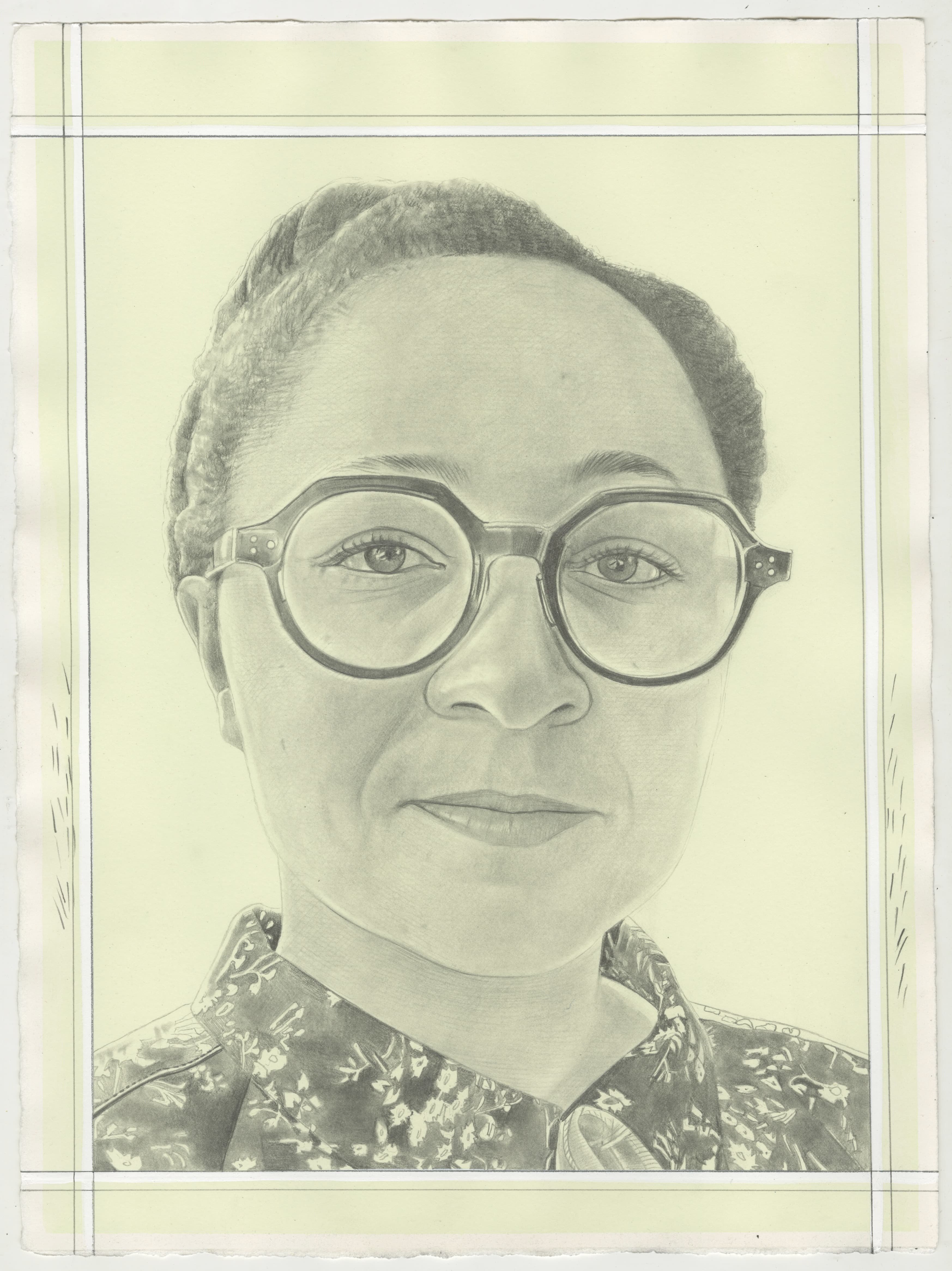
Portrait of Pamela Phatsimo Sunstrum, pencil on paper by Phong H. Bui.
Word count: 4717
Paragraphs: 58
Galerie Lelong
October 30–December 20, 2025
New York
I met with Pamela Phatsimo Sunstrum over Zoom in early November. It was late afternoon in The Hague, the Dutch city of old masters and international diplomacy she now calls home. Sunstrum was sitting in “her corner,” perched before a dark wood cabinet, paneled with glass panes arranged in a diamond pattern, and a vibrant pool-blue oil cloth dotted with what looked like swirling tan baskets or flying saucers. Though cozy, the space vibrated with the motifs and colors surrounding her, potted plants arching over her head and tickling in from the side. We spoke about her newest exhibition of paintings on panel and drawings at Galerie Lelong in New York, Parabellum, and the liminality that adheres to space, time, identity, and growing up. By the time we finished, dusk had fallen, and all I could make out was her radiant face.

Pamela Phatsimo Sunstrum, This is the day of your awakening (Bad News), 2025. Oil on cradled wood panel, 55 ⅛ × 78 ¾ × 2 ⅜ inches. © Pamela Phatsimo Sunstrum. Courtesy Galerie Lelong, New York.
Amanda Gluibizzi (Rail): Where are you? Are you at your studio or your house?
Pamela Phatsimo Sunstrum: I am in my corner in my house. There’s a chair that is just for me, so I am sitting in my corner. [Laughs]
Rail: Tell me about what’s on the wall behind you.
Sunstrum: This is a cabinet that was inherited from my partner’s grandmother. She’s quite a lady; it’s nice to talk about her first. She was a resistance fighter during World War II here. She helped hide and smuggle a lot of Jews who were escaping persecution through the Netherlands, both she and her husband. She was also captured for a time and tortured at the hands of Nazi forces. I didn’t get the pleasure of meeting her myself, but the family is full of stories about her. Now that I think about it, this chair in the corner that is my chair was also her chair [laughter], so it’s a nice corner. My partner and I really like textiles, and this is a wax print. We often can’t resist picking something up if we see it.
Rail: It’s beautiful!
Your show at Galerie Lelong is titled Parabellum, which, as noted in the press release, is Latin for “prepare for war,” and is taken from a longer phrase, “If you seek peace, prepare for war.” Can you start by telling us about the struggles that the women in your paintings are preparing to face?
Sunstrum: I started by thinking about this narrative, this story, the world that these women are preparing for: I wanted the struggles to be like the smoke on the horizon and not the main focus of their lives or their purpose. That was a surprise for me. I thought this was going to be a show full of paintings about rage and battle and struggle, because it was, from its kind of conception, a group of work that was going to be in response to the world at the moment. I thought it was going to be gory and rough. But what started to come out was a bit of distance from those struggles and much more of a focus on the ways that care can happen, the ways that humanity persists, and the microscopic or microcosmic interactions that can exist in a group like this.
I do a lot of “talking to insiders” as a way of letting myself off the hook from being a constant translator of my experiences or my opinions or my views on the world, just to get quickly to the ears and eyes that are already ready to listen. So, whatever struggles are there are kind of already understood. They’re already established.
Rail: It’s interesting to me that it’s a “preparation for,” even though we see these characters engaging in action. You’ve spoken about appreciating liminal spaces; in the past, you’ve talked about them as physical spaces, such as the Curve Gallery at the Barbican where you installed your show It Will End in Tears (2024–25). But here the liminal space is, in fact, a time frame.
Sunstrum: Absolutely. There’s a lot of power to be found in liminality. Think about Gilles Deleuze’s theories on becoming and this idea that a thing is at its most powerful when it is in a state of flux, or in the state of moving from one named thing to another named thing. There is something ungovernable about these in-between spaces, or spaces that are not yet occupied or not yet defined. I think of liminal space as also allowing me to dip into almost a magical realist voice in some of these narratives. I love slipping into a dream-like reference or a not-real space, these in-between zones.

Pamela Phatsimo Sunstrum, It is because I want you to go on, 2025. Oil on cradled wood panel, 55 ⅛ × 118 ⅛ × 2 ⅜ inches. © Pamela Phatsimo Sunstrum. Courtesy Galerie Lelong, New York.
Rail: In what period do you think these paintings take place?
Sunstrum: That’s always fluid. I think there’s a lot in their attire that signals an older time; a time of horses, a time of field battle which isn’t the kind of battle that we experience in contemporary life. As we unfortunately all see, war is now digital and at a distance and devastating but without the kind of face-to-face interaction that battles used to have. But I was trying to be careful not to situate this in anything recognizable. I know the landscape is from a home place that I recognize, from Botswana, but it is also a flat, arid terrain. I didn’t want the attire to be easily placed in any one time or even one culture. So, I took a lot of liberties, while still being very specific about what they are wearing and how I use this to signal something. The black beret in my paintings has wonderful, multiple meanings: in a North American context, it has references to the Black Panthers and Black freedom movements. In a southern African perspective, or even a continental African perspective, it can suggest the first independence movements and ill-fated militia movements that have swept across the continent in different shapes and forms. I love an object like that, that can kind of carry more than one meaning. Multiple skirts were always going to be an important thing. I wanted a garment that just references an accumulation of female power or female energy. And I think wearing many, many skirts somehow does that for me. I was curious about what their weapons would look like, and I knew very quickly that there had to be this long black coat somehow. Some of it comes from an intuitive place, in a way, but there’s always an insistence on specificity that escapes a naming or a category.
Rail: Where in Botswana are you from?
Sunstrum: I was born in a village called Mochudi, which is about an hour outside of the capital city, in a little Dutch Reform missionary hospital in 1980; that’s where my parents were living at the time. My father is Canadian, and my mom was from Botswana, and that’s where they met, and that’s where they got married, and where I was born. When I was around two or three, my parents started working in different kinds of—at the time, it was called international development, but now I’m sure it has a different term—working with mainly Canadian NGOs in different development projects around Asia and Africa. From about age four, we started moving a lot in these two-year stints, until we settled for a longer time in Canada, and then back to Botswana, where I finished high school. And there were a few destinations in between. So that’s the not-so-short answer, I guess. [Laughter]
Rail: When you return to Botswana, does it feel like returning home?
Sunstrum: That’s the question, right? Yeah, I do. I consider Botswana to be a home place, for sure. It is also always where my mother would refer to as home, like when she says, “We are going home,” this is what she would mean. No matter where we were living or for how long we had been away from there, that was home. It’s a little bit fraught because it’s a place that I do identify as home, but it is also a place that I feel I can never actually attain or possess as a real home place. I think what comes through in my work is this longing for home. I think the heroes in my stories are prodigal daughters who are always in the process of leaving home or returning from somewhere to try to get home.
Rail: It adds another sort of complexity to the interest in liminality in your work.
Sunstrum: For sure—
Rail: Home is a liminal place, right? Something that you can’t quite put your finger on.
Sunstrum: Exactly. Yeah, very much so.
Rail: When I was looking at your paintings, I read the sepia tones of these panels as being perhaps aged photographs, rather than thinking about trying to place them into a geographic moment.
Sunstrum: I do see what you mean: it’s great what happens to the tone of the wood as I work it and layer it with oil paint. It does take on this warm yellow, gold tone. It’s a side effect of the materials in the way I use them. As to your question about time, I do like playing with the idea of time travel, that these works come from an older time or reference an older time, and it’s tricky. As a contemporary painter, you’re always already having to confront the history of painting. And I think that’s even more so as a woman, and as a brown woman: there’s a lot of history to face. To give myself permission to borrow freely from Western art history in the look and feel of the work is fun to me, and kind of subversive, I guess, as well. It’s like I’m stealing history, artificially aging my work, or artificially pushing it into a canon.
Rail: Thinking about yourself that way, you become kind of like a Robin Hood for yourself and therefore take your place among your righteous ancestors.
Sunstrum: [Laughs] Yeah, I like that very much. Yes.

Pamela Phatsimo Sunstrum, Do not be afraid, 2025. Oil on cradled wood panel, 27 ½ × 39 ⅜ × 1 ⅜ inches. © Pamela Phatsimo Sunstrum. Courtesy Galerie Lelong, New York.
Rail: You spoke very particularly about the clothing that the women are wearing in these paintings: the beret was necessary, there were always going to be multiple skirts, and then there had to be this big black trench. The words that you’re choosing there: not just, “And I painted this,” but rather, “It had to be this,” suggest there is a compulsion for you. You’re almost seeing this as costuming your figures in a way that allows them to play the roles that then you are going to place them in.
Sunstrum: I’m glad that translates in the work, because there’s a process of play, make believe, the embodying of these characters. I use myself as my model in the studio all the time. These characters and their interactions or conflicts or little dramas only start to emerge once I embody them myself. It’s a private part of the practice. My studio practice in general is rather lonely. [Laughs] There’s nobody there when I’m trying to imagine and dress these characters.
I had a background in dance in another lifetime, and I’ve realized that there’s something important about bringing my body into it to start to make these stories become real to me. So, when you mentioned it as being an obsession, a compulsion, I would say that is quite an accurate description of what my practice is. There’s a beautiful moment where I feel I can drop into play again, which becomes harder and harder as you get older. I’m lucky to be a mom, and I have a child who absolutely loves to make believe still and makes costumes for himself. It’s a great mirror, a reminder of how easy it can be: it doesn’t take much, you just have to give yourself permission to. It’s a very private moment in the studio, just me and the camera and my trunk of costumes, tweaking, finding. Once it’s set, then it makes sense. But it’s not set until it sets itself.
It is a lot of fun. And I realize now that there’s something important about being vulnerable when you’re making something. I think that’s how I try to keep myself honest, or try to keep the work authentic, not necessarily to lay everything bare, but to find something tender and intimate. I’m not an exhibitionist about it, but I think that’s where the truth is for me: that thing that makes me feel like I’ve taken a big risk, and I’ve opened something soft to the world.
Rail: I like the idea of opening something soft.
Sunstrum: Yeah.
Rail: And I think, too, about the clothes that you outfit your women in. For An education (all works 2025), I wondered, “Is this the same person in multiple guises, or is this a uniform, like a school uniform?” The possibility offers a different valence for approaching the paintings, not just that the women might all be experiencing something different, even if they’re the same person, but also that they might be learning how to experience this thing. They’re already outfitted then for what’s to come in a uniform that seems quite pretty—in fact, quite pleasurable.
Sunstrum: I do think of what they’re wearing as a uniform. And I played with this image of the classroom to bring in the element of training, preparation, and boot camp that is a part of military life. But having grown up in colonial schools, it’s not lost on me the similarities between a military training situation and the kind of education we received in colonial school, in British schools. Being dressed uniformly was part of deconstructing the individuality of your identity, devoting your entire appearance to this colonial project.
To your question about the singular or multiple identities of these women, I think one of the nice things about using myself as a model is that I get to play and act, but I also get to embody many selves at the same time. I want them to look like a flock, you know? I think the question you asked is my favorite question: Is this one person? Is this many people? Am I seeing this person at one moment, or am I seeing this person at many moments? Or is this many people at many moments? And my answer to that is: yes, it is. [Laughs] It is my hope that you stand in front of an image of mine and maybe your first thought slips away and is replaced by something else, and then that slips away, and the longer you sit in front of it, the more swampy it becomes.
I think the core of An education is the trauma of being indoctrinated in the negative sense, but also, as you say, the way you learn. You gather together, and somebody gives you knowledge, and this is how you receive it. This is what it looks like to receive knowledge. All of their faces reveal the various processes that go on as you’re forced to receive knowledge in this way.

Pamela Phatsimo Sunstrum, An education, 2025. Oil on cradled wood panel, 55 ⅛ × 78 ¾ × 2 ⅜ inches. © Pamela Phatsimo Sunstrum. Courtesy Galerie Lelong, New York.
Rail: I deeply appreciated that both in An education and also in By the book, there are women who are deeply skeptical about what is going on: not just an indoctrinated person, but also the person who’s working through, “What am I being called to do? What am I willing to do?”
Sunstrum: That doubt, the little voice confronting the big voice is very much at the heart of it.
Rail: You mentioned looking at old master painting, or earlier twentieth century painting, and robbing from it. I think the place where I see that most evocatively is in Do not be afraid, which depicts gun-fighting women using a fallen horse almost like a hide. What’s particularly fascinating to me is that the limbs are everywhere. There are horses’ hooves and women’s arms, there’s a head, and then also, of course, guns sticking out at all angles. It seems to reference things like Peter Paul Rubens’s Adoration of the Magi (1609) altarpiece in Antwerp or Eugène Delacroix hunt scenes, or Pablo Picasso’s Guernica (1937), capturing melee, while also showing an intensity of purpose. How does the composition work in that painting?
Sunstrum: Yes, I do often make reference to classical European paintings. Isidore Pils’s paintings of military encampments were early touchstones. I made a special trip to Amsterdam to see The Battle of Waterloo (1824) by Jan Willem Pieneman at the Rijksmuseum. When I was making Do not be afraid, I was also looking at a lot of early-twentieth-century war illustrators, British war illustrators and American war illustrators. Illustrators make great propagandizers, because there’s no limit to the way that you can romanticize or horrify the facts of history when it comes to war or conflict. I pushed into a graphic novel language of this sudden, horrible, confrontational moment. I kept running across all of these images that show the “best moment” of the war story: The last of them, backs up against the wall, everything against you, no more bullets left, the Hail Mary moment of the battle. That is the glorified moment. It’s the moment of the hero—the one who could subdue the many. I wanted to dig into the bodiliness of that moment, and I wanted to show fear and terror and horror. And it felt like squeezing this down into this tight ball seemed to be best. It had either to be tiny or it would have to be a monolith of a painting to get at that, I suppose.
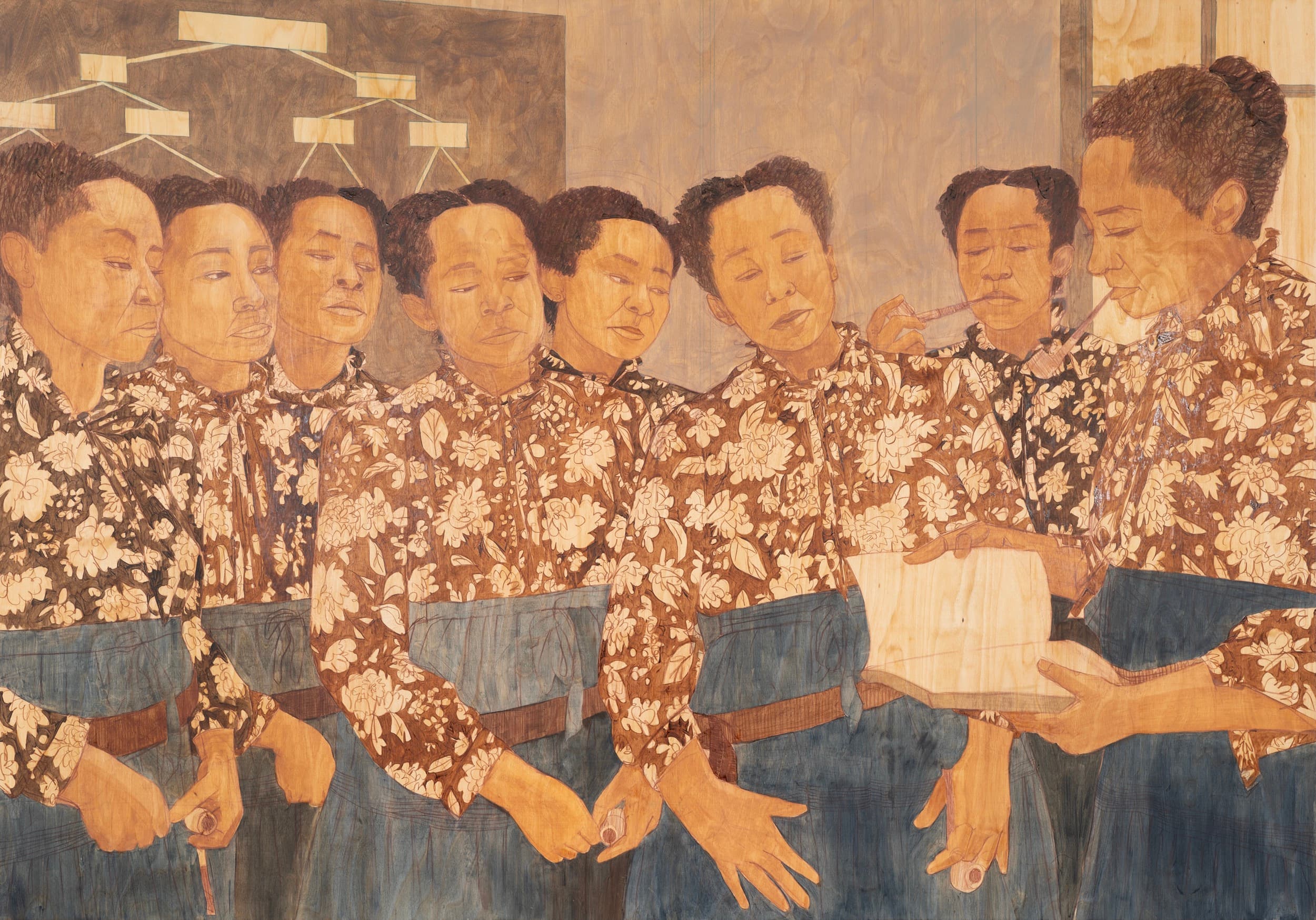
Pamela Phatsimo Sunstrum, By the book, 2025. Oil on cradled wood panel, 55 ⅛ × 78 ¾ × 2 ⅜ inches. © Pamela Phatsimo Sunstrum. Courtesy Galerie Lelong, New York.
Rail: I like the idea of this compression being reinforced by the tree. The branches are bare and arc over the grouping so that it pushes further and further down on it. And of course, the branches themselves aren’t neat. They’re all over the place, so they also have their own chaos going on.
That bowing element of the tree rhymes so nicely with your two paintings that are shaped like altarpieces, which both have curved, arching top halves: Now you are everything, an empty room, which I’m reading almost as a studio painting; and How do we know if we are loved, in which the women are grouped, nude and holding candles, in a cluster. How do they work together? They almost seem to be recto verso.
Sunstrum: They were conceived initially as recto verso. I had an early idea of designing a frame to offer these two in space, so that you would only get one view at a time. And, you know, I may still consider that! [Laughs]
How do we know if we are loved came from a short story that I read maybe a year ago, in a collection of short stories by Isak Dinesen called Seven Gothic Tales. The gothic is a genre that is very near and dear to my heart, so I picked up the book on a whim. There is a moment in one of the stories, and what’s great about it is that it exists like an island because it doesn’t relate to the rest of this story. There is a traveller who arrives at a farmhouse in the middle of the night and asks for a room to stay in. And of course, the gracious host gives this weary traveller the nicest room in the house. She has arrived so late that nobody in the rest of the household knows that she’s there. She’s sleeping, and late in the night, she hears small footsteps coming to her door and slowly opening it, and she sees in the doorway a group of girls, the daughters of the owner of the house. They don’t know that she’s sleeping in the bed, and she feels nervous about scaring them by alerting them to her presence, so she just respectfully stays quiet as they tiptoe into the room. It turns out that since this is the nicest room in the house, it is the only room in the house that has a full-length mirror. These little sisters have padded into the room and taken turns looking at themselves in the mirror, each holding up a candle so that they can regard themselves. It was an image that just struck me as so special and so recognizable: a girls’ world suddenly emerges in this small moment, everything about the uncertainties of girlhood and the threshold that girls walk towards once they kind of leave girlhood and start becoming self-aware, signaling a shift into something that comes after girlhood. And then there’s also the safety of this sisterhood, too: they are holding candles for each other and helping to light each other, and that’s all they do. They just take turns standing in front of the mirror, and then they tiptoe out of the room, and that’s it. [Laughs] And it just stuck with me. There’s such a simple desire to see oneself. What was it like to have a confrontation with yourself in such a rare moment, or to see yourself as somebody else might see you? It was something so rare and magical. I keep wanting to pull out this tenderness: those are strong, brave bodies, about to put everything on the line, about to probably not make it out of this situation. They’re also these soft bodies with desires and dreams and tenderness. I wanted to ask you to think about all of that at the same time.

Pamela Phatsimo Sunstrum, Now you are everything, 2025. Oil on cradled wood panel, 78 ¾ × 55 ⅛ × 2 ⅜ inches. © Pamela Phatsimo Sunstrum. Courtesy Galerie Lelong, New York.
Rail: In Now you are everything, we see some of their clothes, we see the candles, and we see, curiously, almost all of their shoes, which I was struck by. It told me first of all that it can’t totally be a studio painting, because I’m assuming you don’t have seven pairs of the same shoe, [laughter] nor would you need them. But I was also thinking about the ways that worn boots have been so important in painting and to the way we think about painting. So, for example, Meyer Schapiro, writing about Vincent van Gogh’s boots. I’m curious about those boots. What do they tell us about the women, and what does that tell us about this painting?
Sunstrum: The book Van Gogh: Up Close is like a little security blanket in the studio, and there’s definitely a dog-eared corner on his beautiful studies of shoes. Like I was saying about the beret, I love how a simple object can drag so much history with it and suggest so much about a human being without there needing to be any human being in sight. When I’m a hundred years old and people do a big retrospective of my work, they’ll see that I have built in all of these wonderful Easter eggs. These seven sisters, these seven faces, always recur in one way or another in each group of work: sometimes it’s obvious, and sometimes it’s implied. The set number of characters in my universe is seven, the core number is seven: When there’s three, it means something is happening with the four. When there’s four, it means there’s something going on with the three. When there’s two, we’ve got big problems. [Laughs]
I wanted those shoes to link back to those bodies; the vacated shoes signal some kind of transformation in those seven from the related painting. I tried to set Now you are everything up like a classical hunter’s bounty painting, where at first it just presents itself as a still life. But I also wanted it, with the connection to all the figures, characters, and bodies around it, to start to slip into something else. And I think I use the title to help me do that. Titles are a huge part of the way the work grows for me. It reads as a still life, but there’s emptiness and the feeling that this space is still warm with the bodies that just left. Once you let go of this attire, decoration, these accoutrements of power, what remains? I will. When there’s nothing left, then you are everything. Then you do have everything.
Rail: Why is the gothic important to you?
Sunstrum: I think because it allows for magic and spirit. It’s a genre that is about our real, earthly fears, but it allows magic and spirit or spiritualism to amplify that unknown. Its use of religion, superstition, conservative culture—they all mix together to make space for otherworldly or unknowable experiences. One of my favorite writers has been Ben Okri, and I think he’s just a master at that, giving us the blood and guts of real-world suffering, of real-world troubles, while always having these trap doors fall out that send us into parallel worlds. It makes me think about these primal fears again.
Rail: Some of your drawings seem to be sketches, but others seem to be works of art in their own right, not preparation for—or the preparation for the preparation for [laughs]— but rather something else. They exist in their own space. How do the drawings relate to the paintings in this show?
Sunstrum: I still think of my work in the language of drawing, even though it looks much more like painting now. All of that process of drawing that you saw in the drawing room is embedded in layers and layers and layers on the actual paintings. It’s just been recently that I’ve pulled apart that process and allowed myself to generate this body of images, a potential body of images just on paper first. I love situating my work in drawing because, as you say, it’s a provisional language that everybody allows to kind of be rough and loose, because it’s signaling something else. And that’s kind of liminal space, right? It’s a space where I cannot quite be done, not quite have it right, but it holds; it holds something anyways. I’ve found a lot of freedom in that. When I started doing this, working out a lot of compositional issues on paper before working on the panel, I thought that I would then need the drawing side by side as I built the painting, and I discovered that not to be the case. I actually just want to start again with the drawing process on the panel. The familiarity of having worked this composition already is such a great boost when I wheel out the big wooden panel.

Pamela Phatsimo Sunstrum, How do we know if we are loved, 2025. Oil on cradled wood panel (arched), 78 ¾ × 55 ⅛ × 2 ⅜ inches. © Pamela Phatsimo Sunstrum. Courtesy Galerie Lelong, New York.
Rail: I read in one of your interviews that you listen to a set of songs that serve as the soundtrack to the body of work. I wanted to end by asking, what was your soundtrack for this exhibition?
Sunstrum: Oh, that’s a good question! Let’s see. I started by listening to a lot of bombastic classical, like I was doing Vivaldi’s Four Seasons, trying to get into the sort of operatic or orchestral feel of war painting. And when the work started to shift, I started listening to a lot of Lingua Ignota. She has this album called SINNER GET READY, which is, I think, one of the most amazing things I’ve ever heard. It is just crazy. I wasn’t familiar with her music before, and somebody recommended I listen to it. She’s classically trained and basically sings almost screamo metal [laughter] at this point. It was just power: powerful lyrics and risky instrumentation. So, there was a lot of Lingua Ignota, and then a whole lot of Robert Glasper. He’s come out with this beautiful album called Let Go, and, ugh, it’s just sweetness and reassurance and beautiful melody and such skillful instrumentation. It’s the kind of sound that we’re all starved for now, the warmth of real studio recording and real instrumental capabilities just communicating. I often want to thank Robert Glasper for being such a supporter of this body of work, because emotionally, his music very much carried me through, I would say.
Rail: It is so funny to return to songs that were recorded with real instruments. It’s something now that’s so unusual.
Sunstrum: Yeah, they’re actually playing. Imagine, musicians making music!
Rail: And painters painting! What is to come next? That is the truly gothic.
Sunstrum: Yes, yes, yes! [Laughter]
Amanda Gluibizzi is an art editor at the Rail. An art historian, she is the Co-Director of the New Foundation for Art History and the author of Art and Design in 1960s New York (2021, paperback 2025).