ArtDecember/January 2025–26In Conversation
ANSELM KIEFER with Michael Auping
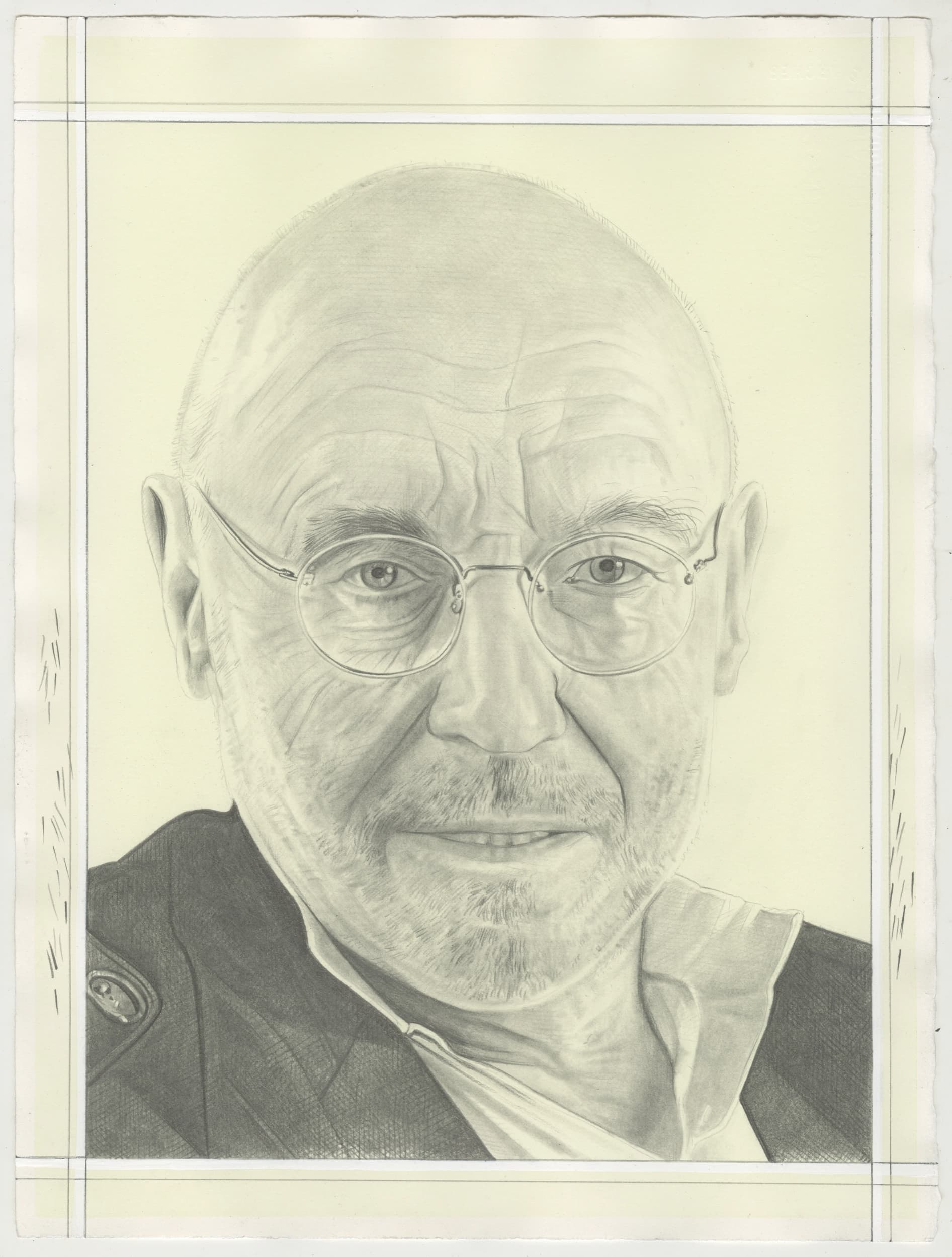
Portrait of Anselm Kiefer, pencil on paper by Phong H. Bui.
Word count: 3409
Paragraphs: 79
Saint Louis Art Museum
October 18, 2025–January 25, 2026
St. Louis, MO
Michael Auping has known Anselm Kiefer since the late 1980s. As Chief Curator of two major museums (Buffalo AKG Art Museum and Modern Art Museum of Fort Worth), Auping has assembled one of the great bodies of Kiefer’s work in America. In 2005, Auping curated the last major survey of Kiefer’s work in the United States, Anselm Kiefer: Heaven and Earth, which opened at the Modern Art Museum of Fort Worth before traveling to other institutions.
On the occasion of the artist’s recent survey at the Saint Louis Art Museum, and site-specific installation of monumental paintings in the museum’s 1904 Cass Gilbert-designed grand hall, Auping visited the museum and spoke to Kiefer. Their conversation touches upon Kiefer’s history with the St. Louis museum, the significance of the Rhine river to his oeuvre, and what it means to be an artist “exploring his context and time.”

Installation view: Anselm Kiefer: Becoming the Sea, Saint Louis Art Museum, St. Louis, MO. © Anselm Kiefer. Photo: Dan Bradica.
Michael Auping (Rail): It’s been many years—at least two decades—since you have had a major exhibition at an American museum. How did this exhibition come about?
Anselm Kiefer: I have a history with this museum and its connection to twentieth century German art. It has an amazing collection. Have you seen the Beckmann works they have? I’m very happy to have my work in this collection and feel a part of the museum’s history.
Rail: Their 1983 exhibition Expressions: New Art from Germany introduced your generation to an American audience. I am old enough to have seen that show. It was the first time I saw one of your works in person. It was a game-changing show.
Kiefer: It was an intense and interesting time. We had no idea what Americans would think of our work, and their interpretation of it was in its infancy. We were trying to figure it out ourselves. When the museum asked me a few years ago to do a show, I wanted to focus on a theme that has recurred in my work throughout the years. And that theme is the river.
Rail: The Rhine.
Kiefer: Yes. It is the beginning, and also marks my earliest childhood memories.
Rail: Your images of the Rhine are almost hidden in the background of your work. But they are a kind of chorus or motif that I’ve always been mesmerized by. The image is a viewpoint and a projection—standing at the edge of the Rhine, looking across to the other side.
Kiefer: There is always another side.
Rail: Rivers emphasize that. When did you do your first image of the Rhine?
Kiefer: As I said, they have been there since the beginning. You see some very early ones in this exhibition. I’ve been looking at the Rhine since I was a child; I did drawings of it. I photographed it as a student. Now I paint it. It has always been a part of both my life and my art.

Anselm Kiefer, Lumpeguin, Cigwe, Animiki, 2024. Emulsion, oil, acrylic, shellac, gold leaf and sediment of electrolysis on canvas; 30 feet 10 1/16 inches x 27 feet 6 11/16 inches; Collection of the artist and courtesy Gagosian 2025.311; © Anselm Kiefer, Photo: Nina Slavcheva.
Rail: What do you think of when you look at the Rhine?
Kiefer: It has different connotations for different people. For my generation, many associate it with fascism, the Nazi party, and the river’s strategic importance to the war. For some, it is a source of fantasy. Others see it historically as an industrial highway. For me, however, the Rhine is a living presence that has been a source of historical imagination: it evokes the people and mythologies that have inhabited it and the many rivers of the world.
Rail: Rivers are a part of nature. What is your general philosophy toward nature (Gerhard Richter has called it unfeeling), and what is the difference between “landscape” and nature?
Do you think of rivers having a spiritual aspect, as some early cultures did? What are your general thoughts on the concept of animism, the attribution of a “soul” to nature and natural phenomenon, and animism as a covenant between man and nature?
Kiefer: Everything I see and perceive always has a spiritual aspect. This also applies to water, rivers, streams, and countries that can both separate and connect at their borders. I am reminded of a quote often attributed to Heraclitus: “No man ever steps in the same river twice, for it’s not the same river and he’s not the same man.”
For a long time, animism was considered an ancient practice, practiced by Indigenous peoples, for example. I am far removed from this anthropocentrism—I believe that even stones have consciousness. This is already hinted at by the Austrian writer Adalbert Stifter, and then especially by German novelist Hans Henny Jahnn.

Anselm Kiefer, Am Rhein (On the Rhine), 2025 ‘Digital print on paper, 21 1/16 × 16 ⅛ × 13/16 inches. Collection of the artist. Courtesy Gagosian.
Rail: This exhibition connects the Rhine to another iconic/great river—the Mississippi. In the grand hall of this beautiful Cass Gilbert building, you have done a series of monumental paintings that create a kind of confluence of these two great rivers. It’s a monumental installation with paintings that are about thirty feet high. They are bigger than large. They are IMAX-like, very immersive. Their size and gestures don’t just illustrate these rivers, they seem to absorb their physicality and essence. Let’s start by talking about the new Rhine paintings. Am Rhein (On the Rhine) (2025) takes us back to your past, but amplifies it.
Kiefer: It involves a kind of quotation of an early painting that reflected my own feelings of being in isolation. I was thinking about where I came from and where I was going.
Rail: I think you are speaking of Mann im Wald (Man in the Forest) (1971). It is such a poignant painting that to me stands out in your oeuvre—a modestly-sized painting depicting a young Kiefer in a night gown, standing alone in the forest, holding a tree branch that is on fire.
Although it quotes Mann im Wald, this new painting Am Rhein feels very different—not just in its magnification, but its immediacy. It has the feeling of a crescendo. Your figure is literally life-size, the forest looks all-consuming, and you stand on the surface of the Rhine as it cuts a path through the forest. The fire on the branch is not like flames.
Kiefer: It is crystalized. The light breaks apart. Jewish mysticism found different ways of depicting and interpreting fire and light. The mystics brought the idea of a complex, spiritual—not just religious—light into the present. In the midst of darkness, I have to invent light in my paintings.
Rail: Can you talk a little bit more about how you begin a painting and the layers that lead to its completion? And expand on our past discussions about the “emanations” in your paintings—i.e., their symbolic content versus their formal presence as a grand gesture. I remember you saying to me many years ago that there is a Jackson Pollock missglückt [failed attempt] under all of your paintings. Gaston Bachelard talks about art having essentially two imaginations—a formal imagination and a material imagination. I’d be very interested in hearing about where those two things meet in a work of art.

Installation view: Anselm Kiefer: Becoming the Sea, Saint Louis Art Museum, St. Louis, MO. © Anselm Kiefer. Photo: Dan Bradica.
Kiefer: Since I want to create a masterpiece, beginning a painting feels often disastrous. It seems impossible. I have many paintings in containers waiting to be resurrected. From time to time, I take these canvases out to work on them further. During this process, they often go through various deliberate, destructive stages, from abstraction to figuration.
Rail: This show definitely represents a new vocabulary of light in your work. In Am Rhein, falling almost thirty feet down from the top of the painting is a waterfall of gold. It is like the emanations from your early works, but those earlier emanations were lead.
Kiefer: Yes, this gold could be a sort of emanation. Emanations have recurrently appeared in my work. They are not necessarily biblical or kabbalistic. Emanations are a part of all creation theories—Neoplatonism, Gnosticism, and Indian metaphysics. Emanations spring from the primordial. I try to represent this in my process. It can be seen as mystical, but it is also what happens during the process of making paintings. Images change their shape continuously. I work on my paintings often over several months and years, and I witness many emanations in different forms over that time.
Rail: What prompted the transition from lead to gold? Is it real gold or gold paint?
Kiefer: It’s gold leaf. The change was not a symbolic change. Emanations can’t be subtle. They have to feel like they have a certain weight. This gold with other substances has a strong presence or weight.
Rail: It’s very intense. It’s not a delicate or pretty gold leaf. It mixes with a lot of other materials in the painting. As always, these new paintings are filled with a lot of materials. Rivers are a perfect metaphor for your paintings. They are both full of debris.
Kiefer: And they both have a kind of alchemy—a mixing of minerals.
Rail: Given your longtime interest in alchemy, and what I would call the “historical imagination,” do you think our contemporary imagination disregards the histories of the past? Is it even possible to understand an authentic primitive imagination today?
Kiefer: There was no specific time when alchemy was replaced by science. Alchemy still exists. And we know that Isaac Newton was also an alchemist. There is no discriminatory distinction between the two types of knowledge. For a long time, I have been interested in string theory. I read much about it and in parallel started to make paintings about those concepts.
Rail: Can you explain to me the medium that is listed on the labels for these paintings: “emulsion, oil, acrylic, shellac, gold leaf, and sediment of electrolysis on canvas.”
Kiefer: That is my invented alchemy: using electrical “fire” to create chemical reactions. Rather than trying to make gold as the early alchemists did, I am trying to change gold into something else—a substance of another level.

Anselm Kiefer, Missouri, Mississippi, 2024. Emulsion, oil, acrylic, shellac, gold leaf, sediment of electrolysis and collage of canvas on canvas; 30 feet 10 1/16 inches x 27 feet 6 11/16 inches; Collection of the artist and courtesy Gagosian 2025.310; © Anselm Kiefer, Photo: Nina Slavcheva
Rail: I know from long experience with you that the practice of painting has always been important to you, but would you agree that your painting practice is part of a performance practice and has been from the beginning? Sometimes it seems to me that your paintings—from the early attic paintings to the sweeping landscapes—are a stage for a type of history painting. The way your photographs and films create stages for implied performances. Do you see your work as a cross between performance art and painting?
Kiefer: No, I wouldn’t say that. Photography stands at the beginning. It continues to remain present in my work. In all of it—my painting, bookmaking, sculptures, and installations—there is a constant continuum, a process.
Rail: There is a feeling of time that seems embedded in all your work. It comes from a destruction of materials. I feel it especially in your photography. I remember being with you in one of your big, messy studios and asking if you had a special clean room for developing and working with your photographs. You said, “You’re standing on it.” I looked down and saw that I was standing on hundreds of photographs.
Kiefer: Yes. I like to walk on my photographs. It gives them a special texture, and I think you are right. It does give a feeling of the forces of time, and that creation often comes out of destruction.
Rail: Speaking of time, when did you first see the Mississippi?
Kiefer: In 1991, I came to help install a complex work of mine which the Saint Louis Art Museum purchased, Bruch der Gefäße (Breaking of the Vessels) (1990). During that visit, I was able to go on a small boat ride along the river. The Mississippi is a very large river, much larger than the Rhine. We went to witness the locks. Have you seen how locks displace water?
Rail: Yes. It’s an amazing process.
Kiefer: It is a tremendous amount of water. I felt the amazement of being a child again—the feeling of awe. To me, it felt like a massive heart pump. That made a strong impression and stayed in my memory. When the museum director Min Jung Kim asked me to do an exhibition at the museum a couple of years ago, I thought it should be about bringing together the river of Germany and the river of America.
Rail: In all of these paintings there are female figures flying over the rivers.
Kiefer: They are water spirits, Indigenous water spirits.
Rail: They are very energized water spirits. It’s hard to make out their bodies. They are blurry and expressionist.
Kiefer: They are thunderbirds with powerful wings. When I was painting these water spirits, I worked with a model. In this case, she wore a caftan, and when she moved and waved her arms, it suggested the motion of wings. The Indigenous peoples believe the water spirits fly over the river, protecting it.
Rail: American versions of Rhinemaidens?
Kiefer: I think the American water spirits are more powerful and less treacherous.

Anselm Kiefer, Sappho, 2025. Bronze and lead, 94 ½ × 59 1/16 × 63 inches. Collection of the artist. Courtesy Gagosian.
Rail: I wanted to ask you about the women that appear in your work. There are a few of the white dress sculptures in this show. Their heads are always cut off. Some people have found this disconcerting, a violation.
Kiefer: It’s because history has not recognized these women as it should have. Their presence erased—faceless. I wish to pay homage to these forgotten women. Sappho, for example, who is represented in this show, was a great Greek poetess.
Rail: And you balance these heavy, lead books that we can’t open on her shoulders.
Kiefer: Her poetry has only been more broadly recognized recently. For me, Sappho carries the burden of not being justly recognized for her work.
Rail: I think some people would be surprised at the fact that women have played a large role in your art, from the High Priestess to Lilith. You seem to be wearing dresses in a number of works. It’s like you are exploring another identity.
Kiefer: You could say that. I have always been interested in female artists, writers, and poets, as well as strong mystical figures who I can identify with. Lilith is a good example. She was a rebel, she operated in a space between the mortal and the spiritual. In alchemical symbolism, Lilith is associated with Saturn and lead. As a result, she has a melancholic character. Artists are described as the children of Lilith. I am also interested in exploring women who have remained in the shadows. Next year, Palazzo Reale in Milan will present an exhibition of mine focusing on women alchemists. I have discovered that the alchemical process that I have often referenced in my art had many prominent women practitioners. They were some of the first doctors and pharmacists, but were often accused of being witches.
Rail: Returning to our discussion about your incorporation of women in your imagery throughout your career: in this exhibition that revolves around two major rivers and the ocean, were you thinking about water as a feminine archetype, symbolizing intuition and transformation and how that relates to artists? And in regards to your sometimes dressing in feminine clothing, would you say that your strategy parallels Carl Jung’s concept of anima, and that there is a feminine aspect in the male psyche?
Kiefer: I imagine that without this feminine aspect, I would feel incomplete.

Anselm Kiefer, Becoming the ocean, for Gregory Corso, 2024. Emulsion, oil, acrylic, shellac, sediment of electrolysis, gold leaf, stones on canvas. 110 ¼ inches × 18 feet 8 7/16 inches. Collection of the artist. Courtesy Gagosian.
Rail: Let’s talk about the title of this show, which to my mind, comes from a surprising source: the poetry of the American Beat poet Gregory Corso. I think of you being associated with poetry—you read a great deal of it—but I don’t associate you with Beat poetry.
Kiefer: I’m not that familiar with Beat poetry. I’m not so interested in movements, but I found this poem some time ago and wrote it on the wall of my studio. It seems to express where I am right now in terms of my life and my art.
Rail: I think the poem you cite in the title of this show—the line “becoming the sea”—is the epitaph on Corso’s grave stone. It reads like a river:
Spir’t
is Life
It flows thru
the death of me
endlessly
like a river
unafraid
of becoming
the sea
It fits the drama of this exhibition. The river waters in these Corso paintings feel very vast, and in some cases turbulent. In your earlier paintings of fields and what looked like scorched or frozen winter earth, there was a “wasteland” aesthetic. These feel related to those, but the water is so alive—particularly in Becoming the ocean, for Gregory Corso (2024). It is full of color and waves and foam.
Kiefer: In that painting you are witnessing my interpretation of the rivers actually entering the ocean.
Rail: Its gestures are really dynamic, Turneresque. How did you get that effect? Did you use a broom?
Kiefer: I work on the floor, so I can move the material around. It can pool up, so sometimes I feel like I’m in a river. It was the best part of painting these works.
Rail: You know, Corso’s poem can be interpreted as the poet returning to mother ocean in the broadest metaphysical sense—but also returning to his birth mother, who had him at a young age and had to abandon him. Corso was very upbeat for someone who went through a lot of emotional trauma. His mother left him. His father neglected him and eventually left him. He became an orphan.
Kiefer: I think we are all our own rivers that find their way through different landscapes. Like Corso, I am not afraid to end in the ocean.

Anselm Kiefer, Grenze (Border), 2024. Emulsion, oil, acrylic, shellac, gold leaf, and sediment of electrolysis on canvas, 12 feet 5 ⅝ inches × 18 feet 8 7/16 inches. Collection of the artist. Courtesy Gagosian.
Rail: The exhibition installation here begins with a powerful painting titled Grenze (Border) (2024). In that painting, you are seen wearing the old German military uniform you wore in some of your earliest works, like the famous “Occupations” photographs from 1969, in which you give the Sieg Heil salute at various points around Europe.
Kiefer: I was young in those days, and was exploring what my relationship was to the war—even though I was born after the war. It’s hard to talk about those works now.
Rail: We don’t need to talk a lot about that piece, other than to say that you seemed to have been trying on an identity that you were trying to understand. In the United States, the painter Philip Guston did that with the Ku Klux Klan around the same time, 1969.
Kiefer: Sometimes when I look back on those works, I feel I was being a little naïve, but mostly I was just an artist exploring my context and time.
Rail: Grenze (Border) shows you have crossed a body of water. The reflection of your back is in the water, as you walk away with your back to us, moving towards a horizon that is foreshadowed by a barbed wire fence. An intensely bright, golden sky looms beyond the fence. To my mind, this is the coda to the “Occupations” series. You have crossed the river to the other side. The gold is so intensely bright that it is hard to tell whether it is a golden moment or a nuclear one. You have talked about your fear of—but also fascination with—nuclear power as being a kind of alchemical phenomenon.
Kiefer: When you cross to the other side of a river, you are never sure what you are going to find.
Rail: Many years ago, you sent me a book you did in the 1970s that was titled Territories and Nations. It was the text of an interview you made up with yourself. It was a humorous piece about borders.
Kiefer: Yes. I remember that. I did some drawings and wrote an interview regarding the borders of nations. Rivers have often changed the course of history. They know far more than the ideas of politicians.
Rail: At the age of eighty, having been engaged with making art for close to sixty years, what matters to you most at this point of time?
Kiefer: I hope that my judgment of my own creations will not diminish and that I will continue to be able to discriminate against my own works. I have been making art for more than sixty years and even have drawings from when I was five years old. And I have to say: I try to achieve the state of directness, carefreeness, and simplicity that I had at that time.
Michael Auping has been a curator of contemporary art for close to fifty years. He has worked with some of the most important artists of our time, including Lucian Freud, Jenny Holzer, Agnes Martin, Bruce Nauman, Susan Rothenberg, Ed Ruscha and Frank Stella.