Gretchen Gasterland-Gustafsson
Word count: 1360
Paragraphs: 4
In my capacity as a member of the local artistic and intellectual community, the Brooklyn Rail invited me to share my view of what is happening in and to our beloved community and art world here in Minneapolis. In ordinary times, I would write with great specificity, being careful to credit where credit is due, but in our current circumstances I am going to write in more general terms to avoid retribution against those who are doing the good work here. There are so many among us who are going about the daily tasks of community care in the face of oppressive occupying federal forces. All of us are primarily concerned with ensuring that our neighbors feel seen, loved, and cared for even when none of us can feel safe. Those occupying forces are continually adjusting their own visibility and tactics to ensure that they reach their arbitrary quotas while avoiding the force of public outrage. Of course, our local creative community has stepped up and made the necessary tools for the visible, audible, and palpable forms of expression of public protest and solidarity: 3-D printing thousands of whistles (I have now received four), stickers (I have received two), designing elegant posters and banners for use in public demonstrations (I have several and have seen many!) and knitting Norwegian style red resistance hats (I am about to cast one on the needles). There is an outpouring of shared generosity everywhere I look. My friends and family were able to attend a general strike event at a local arena a couple of weeks ago during which a DJ played bangers to raise our spirits and a very talented local singer songwriter performed some of his soothing work while neglecting to play F*ck This, his one-minute profanity laden but liltingly lovely screed against our oppressors, because there were children in the audience. We were probably all singing it in our heads.
I teach at an institution of higher learning that serves a broadly defined population of creatives and makers, located within reach of the tear gas pervading the air in the wake of Alex Pretti’s murder. Our students have enjoyed so many Glam Doll donuts provided by faculty as end-of the-semester treats in the past. Neither a warm donut nor a new record from Cheapo can assuage our students’ grief and fear right now, even if they felt secure enough to go to these revered businesses along the portion of Nicollet Avenue we call Eat Street. Already prior to the murder, one of our beloved staff members was abducted and shipped off to multiple out-of-state holding cells (can we call them concentration camps yet?) without having been charged with a crime, and with no word on how and when they might return. Our community members raised money to support them and their family. We came together to ensure observed passage for our students as they came to classes that started the day after MLK in the sub-zero cold. In spite of temperatures so cold that classes had to be cancelled that Friday, we participated in the January 23rd general strike, march, and rally, in huge numbers, with my friends, colleagues, and students all visibly represented. Someone I did not recognize, but with whom I shared a smile, gave me an Ice Out beaded bracelet they had made. I have not yet taken it off. As we left the arena at the close of the rally and spilled out into the crowded streets, some kind Somali neighbors handed my mother and I the most delicious chai I have ever tasted. They were serving everyone out of large thermal urns from the back of their van. The community love was abundant, radiating from every point, filling our hearts with hope for a brighter future because we knew we could make one together.
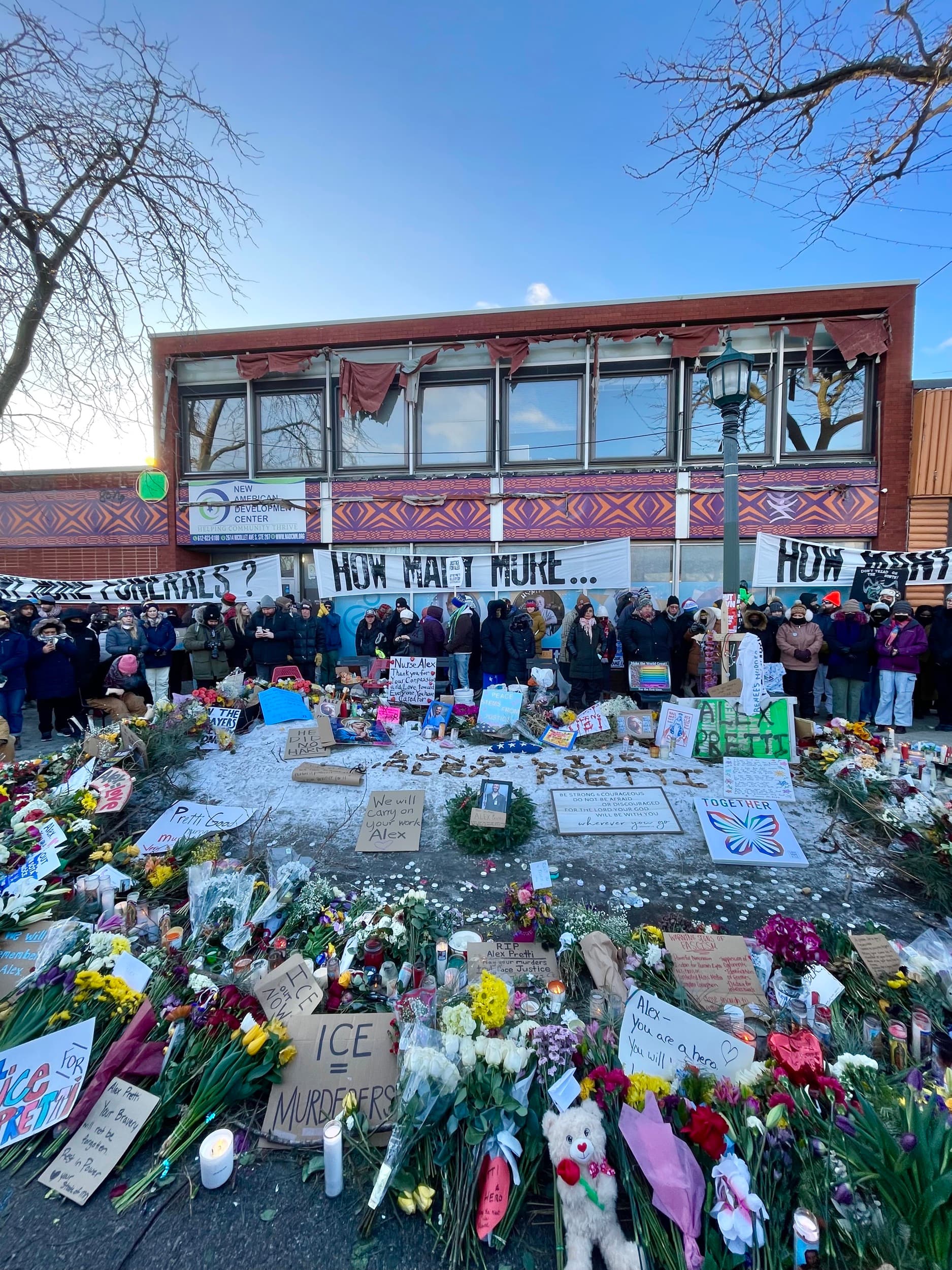
The following day, VA nurse Alex Pretti was executed for assisting a woman who had been knocked to the ground by DHS forces. We have all seen the videos from every angle as recorded by brave observers, some of whom are now threatened and can no longer leave their homes. As is well known, Pretti’s last words were “Are you OK?”. The murder was not only shocking and horrifying, it felt retaliatory. Our collective answer to Pretti’s final utterance is that we are not OK, but we are trying to help each other. My institution of higher learning wisely cancelled classes for the following week so that we could pivot to Emergency Remote Teaching until February 14th. We have just completed the first of those two weeks as I write this. My students are unfailingly generous, helpful, and motivated to get through this period of generalized turmoil and educational adversity together. None of us wanted to be remote, most of us have lingering dread from pandemic-era remote learning, but in light of the federally imposed dangers, remote learning seems more universally equitable than hybrid learning would be, for now. The administration will reassess our situation next week and decide whether we can safely reconvene our classes in our classrooms, and I and my students will abide by whatever decision they make.
We are not OK, but one of the many actions we are taking to heal and fortify our community involves staff and faculty working together to establish a mutual aid table for food, hygiene products, and OTC medicines. We have all coordinated these efforts together, volunteering our time and resources to assisting our community, however far that community stretches. The mutual aid table is located within our key card accessed buildings, but whatever is on the tables is available to everyone who needs it, and I hope the goods are finding their way to those who do. When dropping off some food I encountered some students who were talking about how they might use some of the available ingredients. One remarked that the pasta package might be too much for them. Without thinking, I interjected “if it’s too much for you, just cook for your friends!”. The students answered that they were already doing just that, every day. These young people certainly do not need any lessons in generosity from me. They are already so generous, caring, and kind, as evidenced by the critiques we share in class. Competition has been so emphasized in education with all of our grades and contests, and my students seem to be overcoming these obstacles and finding ways to be more collaborative and less competitive with each other. I have witnessed a sea change in student attitudes since I first began teaching at the college level about 25 years ago. Collectively we may be suffering right now in Minneapolis, but I am pleased to report that the kids are alright. Maybe not right now, but they will be. I am immensely privileged to be able to work with them. In the wise words of that great Minnesotan and fellow professor, Paul Wellstone, “We all do better when we all do better.” We are currently trying our very best to make that so, and the young people are showing us the way.
Amid all of the chaos, the art world is attempting to press on and do what we can to continue to share transformative experiences. I was able to take part in a group critique at my favorite local residency program last week with three hard-working, thought-provoking, and wildly talented emerging artists. I will attend another friend’s opening tonight. An opening next week has been postponed, but we are hopeful that it will happen in April. Other openings, events, and gatherings are scheduled and may need to be adjusted as we continue to forge ahead and find ways to support each other and ensure that our local art scene can continue to thrive, even if we are hurting right now. Tomorrow I will attend a public memorial for the poet Renee Good who was also murdered by federal forces. I anticipate another outpouring of creative vitality as we remember her life and mark her passing. I am cautiously optimistic about a brighter future as I observe all of this community effort to bring it to fruition.
Gretchen Gasterland-Gustafsson is a Professor of Liberal Arts at MCAD.