Jonathan Goodman

Jonathan Goodman is a teacher and author specializing in Asian art, about which he has been writing for more than twenty years.

Nathalia Edenmont’s Out of Body, a starkly simple but moving exhibition of egg-shaped sculptures and photographs, makes great use of a primal visual form. The egg is an ur-form in the art of both ancient and contemporary cultures, and it is not hard to see how it signals, quite literally, the birth of creatures such as birds and snakes and, millions of years ago, dinosaurs. So our present experience of the egg as a basic ovoid form dates way back, to the beginnings of the world as we know it.

Nathalia Edenmont, Out of Joy, 2024. Photograph on Canson. 47 1⁄4 x 38 1⁄2 inches. Courtesy the artist and Nancy Hoffman Gallery.

Lee Bae, a remarkable Korean sculptor, also makes dramatic paintings on paper, working with a charcoal ink, resulting in a thick, viscous substance. In his current show, Between, at Perrotin, a large work on paper hangs at the center of the gallery’s Lower East Side space.

Installation view: Lee Bae: Between, Perrotin, New York, 2024. Courtesy the artist and Perrotin. Photo: Guillaume Ziccarelli.
The legacy of the contemporary artist is increasingly difficult in practical terms. Today, there are many, many artists who, finding themselves below the radar, strive during the course of their careers to gain recognition. But what about their reputations after death? This is a thorny problem, leaving artists with the unhappy consequences of anonymity after lives spent not receiving enough interest from others.
Installation view: Accommodating the Object: Bosiljka Raditsa and Elizabeth Yamin at Milton Resnick And Pat Passlof Foundation, 2024. © 2024 Milton Resnick and Pat Passlof Foundation, New York. Photo: Jason Wyche.
The Georgian artist Elene Chantladze’s two exhibitions at Anton Kern and kaufmann repetto consist of small, highly emotional works painted in a highly suggestive, but very loose, manner. The artist uses copy paper, cardboard, and other inexpensive, non-art sources, which lends the art its ad hoc ambience.
Elene Chantladze, Untitled, 2021. Gouache on cardboard, 11 5/8 x 7 7/8 inches. Courtesy the artist and Anton Kern Gallery, New York.
Aaron Curry is a mid-career sculptor working with figures made of light wood, often on chest-high pedestals of the same material, usually embellished with colored pencil and some paint. The figures, divided into two small rooms in the gallery, start out at first like examples of 20th-century modernism, but there is another current: often the faces and bodies of the figures look a bit eccentric, as if their inspiration came from cartoons.
Aaron Curry, Strange Tree (Antenna to Dracula's Dungeon), 2023. Oil, colored pencil on wood, 74 3/4 x 15 x 14 inches. © Aaron Curry. Courtesy Michael Werner Gallery, New York and London.
Her clay sculptures, treated with casein paint, include such oddities as a pair of small broccoli heads, connected by a thick stalk traveling down the middle. The smaller connections between stalk and head create something very like a lung system in dark green. Then there is the pepper taken over by swathes of subtle color, or the parsnip, parted into two segments and painted an off-white—all are examples of Fox’s expertise.
Judy Fox, Broccoli, 2023. Terra cotta, casein paint, 4 x 10 x 7 inches. Courtesy the artist and Nancy Hoffman Gallery.
This very good group show at the gallery’s main space on 57th Street, includes a bit of everything: drawings, paintings, sculptures, videos, small installations.
Installation view: Downbeat, 2023, at Marian Goodman Gallery. Courtesy Marian Goodman Gallery.
Melancolia, Alexis Rockman’s fifth show at Sperone Westwater, concerns a series of iceberg paintings on the first floor. On the second floor is a selection of slightly earlier work, concentrating on brilliantly detailed, surreal images of flora and fauna. Rockman has long been recognized for the attention he pays to nature, finding in it not only visual tropes of the most remarkable kind, but a cautionary tale emphasizing our ever-increasing vulnerability to damages brought about by climate change.
Alexis Rockman, Chattermarks, 2023. Oil and cold wax on wood, 48 x 60 inches. Courtesy Sperone Westwater, New York.
Les Enfants d'Ouranos, translated into English as “The Children of Ouranos,” references Ouranos, the heavenly deity who fathered the Titans. As a personification of the sky Ouranos might be understood both as progenitor and protector of the anonymous, beleaguered children seen in JR’s works of art.
JR, Les Enfants d'Ouranos, Bois #9, 2022. Ink on wood, oak frame, 53 x 41 1/2 inches. ©JR. Courtesy the artist and Perrotin. Photo: Guillaume Ziccarelli.
Juan Francisco Elso: Por América at El Museo del Barrio not only includes the limited work Elso produced before passing away, but also the art of more than thirty artists from Cuba, the Caribbean, and the Americas.
Installation view: Juan Francisco Elso: Por América, El Museo del Barrio, New York, 2023.
Tony Cragg, who has been working since the 1970s, makes sculpture characterized by an effective diversity. In his show Incidents, currently on view at Marian Goodman Gallery, Cragg’s sculptures occupy a middle space between the abstract and the figurative; the extreme plasticity of his work results in forms that move back and forth between suggestions of a recognizable figure and sensuous abstraction.
Installation view: Tony Cragg: Incidents, 2022. Marian Goodman Gallery, New York. Photo: Alex Yudson.
The two decades covered by this show—1965 to 1985—were filled with experimentation and change in art. Important movements such as Minimalism and Conceptual art achieved maturity, along with performance art and installation work. Moreover, the influence of Pop art hovered over the different visual undertakings, pushing art in the direction of a demotic accessibility that had not been visible before.
Installation view of In the Balance: Painting and Sculpture, 1965-1985 (Whitney Museum of American Art, New York, October 19, 2022 – March 5, 2023). From left to right: Lynda Benglis, Contraband, 1969; Dorothea Rockburne, Balance, 1985; Mary Ann Unger, Water Spout, 1980-81; Jane Kaufman, Untitled, 1969; Judy Chicago, Trinity (Outdoor Version), 1965/2019. Photograph by Ron Amstutz
Born in Japan, Leiko Ikemura left for Spain to study language and art before moving to Switzerland and eventually to Germany, where she currently works. An artist of subtle feminist assertion, Ikemura has chosen in most paintings to represent women and in some instances children. Ikemura is well known in Europe and has shown extensively there, but this is her first exhibition in America. Her painting style tends to be diffuse and sensuous, in a manner not so distant from the art of someone like Marlene Dumas. Her training directed her toward a compelling mixture of figuration bordering on abstraction, even when she is rendering people.
Leiko Ikemura, lamento, 2020. Cast glass6 5/16 x 11 x 7 1/10 inches. Courtesy Fergus McCaffery.
The artists in this show cannot be characterized as sharing communal values, either in form or theme. But that is exactly the point; the works are meant to display the pluralism present in contemporary art. What the artists do share is a determination to question the traditional, both in the sense of artistic legacies and codes of acceptable behavior.
Julie Curtiss, The Sinner, 2022. Oil and acrylic on canvas. 18 x 14 inches. Courtesy the artist; Anton Kern Gallery, New York; and White Cube, London.
Intellectual, critic, and art historian Robert C. Morgan also makes paintings, and has been doing so for most of his long career. The current show, on view in the large, high-ceilinged main space of the Scully Tomasko Foundation, consists of a series of drawings called “Living Smoke and Clear Water”: small, mostly black-and-white works, of both an abstract expressionist and calligraphic nature (early on in life, Morgan studied with a Japanese calligrapher).
Installation view: The Loggia Paintings: Early and Recent Work, Scully Tomasko Foundation, New York, 2022.
Born in 1950, Sacks would have known well the social struggles generated by apartheid. This show portrays his strengths in double fashion—as an abstract artist and as a political memorialist.
Installation view: Above Our Lands, Sperone Westwater, New York, 2022. Courtesy Sperone Westwater.
In 2012, Musa Mayer initiated the Guston Foundation, dedicated to maintaining the legacy of her father, artist Philip Guston (1913–1980). It had become evident that Guston’s life and work needed to be available both to researchers and the general public. His reputation, always strong, continues to rise; even among the major New York School artists, Guston’s place in the canon is now seen as distinctive. Today, he is regarded as a painter of consequence, one whose interests included clearly asserted social concerns, among other themes. At ten years old, The Guston Foundation is likely the best resource to seek support for the factual study of Guston and his work.
Guston signing Gemini G.E.L. Lithographs in his studio, 1979. Photo: Sidney Felsen
Now an octogenarian, Japanese-born sculptor and multimedia artist Kazuko Miyamoto lives downtown, in the East Village. Originally from Tokyo, the artist came to New York City in 1964, studying at the Art Students League from 1964 to 1968. Lacking money, Miyamoto took on restaurant jobs and manual labor to pay for her education and living expenses.
Installation view: Kazuko Miyamoto Works from 1966 to 2005. Courtesy of Zürcher Gallery, New York/Paris.
It is a mystery how the twentieth-century French painter Marguerite Louppe has escaped the recognition she has deserved for so long. Born in 1902 in eastern France, Louppe and her family moved to Paris shortly after her birth. Louppe studied at several academies there, including the Académie Julian, where her fellow students included Dubuffet, Duchamp, Bourgeois, and Maurice Brianchon, whom she married in 1934.
Marguerite Louppe, Compotier et vases bleus, n.d. Oil on canvas, 35.75 x 28.38 inches. Courtesy Rosenberg & Co.
Tomas Vu, born in Saigon in 1963, moved with his family to El Paso, Texas, at the age of ten. He received his BFA from the University of Texas at El Paso, and took his MFA at Yale. Currently, he is head of Columbia University’s print-making center. His current show, The Man Who Fell to Earth 76/22 is taking place at The Boiler, a non-profit showing space that is part of the Elm Foundation, located in Williamsburg.
Installation view, Tomas Vu: The Man Who Fell To Earth 76|22 at The Boiler, 2022. Courtesy The Boiler.
Dewey Crumpler’s excellent show at Derek Eller Gallery comprises many paintings given to his compelling mixture of imagery: quotations of major modernist art, groups of faceless figures in gray hoodies, and science-fiction designs or templates that skew toward something approaching an otherworldly realm.
Dewey Crumpler, 20th Century Fountain, 2021. Acrylic and collage on canvas, 20 x 24 inches. Courtesy Derek Eller, New York.
Tabboo!, legendary for his drag performances in the eighties on the Lower East Side, is showing recent cityscapes at Karma’s two sites, located in the East Village where the artist still lives, and at Gordon Robichaux.
Tabboo!, Spring NYC, 2020. Acrylic and glitter on linen, 60 x 48 inches. Courtesy Karma, New York.
Now 90 years old, Duane Michals continues to make striking, idiosyncratic images that range in influence from modern and contemporary art to works that celebrate authors of major recognition. His current show indicates he is in full strength, usually creating staged photos and, in this show, sculptures and films whose force comes from a humorous surrealism close to the absurd.
Duane Michals, Self Portrait as Unicorn, 2022. Chromogenic print20 x 24 inches. Courtesy DC Moore Gallery.
Georg Baselitz, now in his 80s, continues to produce remarkable expressionist art, usually of figures seen upside-down. Born in Eastern Germany and educated in several art schools there, he moved to West Germany, where he first encountered abstraction. In 1969, he showed, for the first time, a painting with an inverted figure. Since then, this motif has been a signature element of his style.
Georg Baselitz, Ohne Titel, 2020. Ink and gouache on paper, 97 3/4 x 69 1/2 inches. © Georg Baselitz. Courtesy the artist and Anton Kern Gallery, New York.
It is a bit difficult to characterize Ramírez’s structures—not quite buildings, but clearly aligned with them. Although the artist worked at a time that saw the beginnings of our contemporary culture, there is something both ancient and properly modernist about his efforts.
Martín Ramírez, Untitled (Trains and Tunnels) A, B, c. 1960–63. Gouache, colored pencil and graphite on pieced paper, 20 x 89 inches.
This show makes it clear that Guccione was an artist of visionary imagination, creating geometric drawings, employing colored pencils and graphite, that usually document angular, futuristic buildings, seen from both the outside and from within.
Domingo Guccione, Untitled, ca. 1930-55. Colored pencil and graphite on paper 25 1/2 x 19 5/8 inches. Courtesy Ricco/Maresca Gallery.
Katz’s sense of color remains highly original and highly effective, as does his understanding of what takes place in the span of a composition. Now in his mid-’90s, the artist shows no sign of slowing down; the paintings are as energetic and as vibrant as ever.
Alex Katz, Purple Landscape, 2020. Oil on linen, 108 x 216 inches. © Alex Katz / VAGA at Artists Rights Society (ARS), New York. Courtesy the artist and Gladstone Gallery.
While the scene is locally situated in Cape Town, one of the major accomplishments of this very good show is Samson’s ability to express a much larger view, universal in its portrayal of the tragic but often powerfully attractive nature of violence, its nearly erotic allure.
Cinga Samson, Lincede 4, 2021. Oil on canvas, 17 3/4 x 13 3/4 inches. Courtesy FLAG Art Foundation, New York.
This show at Marc Straus, a combination of large and small compositions and several assemblages, gives us a good idea of how Stout, a gifted artist, is proceeding. Her work is varied and not given to sequential repetition, but the artist stays close to Black life and culture. Her vision is not always sanguine, being taken with the vicissitudes of Black culture and its capacity for joy.
Renée Stout, Device for Stopping the Evil Eye, 2020. Wood, mixed media, and found objects, 3 1/2 x 4 x 1 inches. Courtesy Marc Straus, New York.
Raquel Rabinovich, now 92, is an artist working in Rhinebeck, New York; born in Buenos Aires, she moved to the United States in 1967. The artist is known for her monochromatic painting and glass sculptures, as well as her ecologically influenced works, likely the result of her proximity to the Hudson River.
Raquel Rabinovich, Tabletop Glass Sculpture (Untitled 1), 1974. Grey plate glass and silicone adhesive, 38 x 18 x 10 inches.
Gina Werfel, originally a New Yorker, has spent the last 21 years teaching art at the University of California, Davis, but she maintains a residence on the edge of Harlem and has been a long-time member of Prince Street Gallery. She makes ebullient, enthusiastic New York School paintings that can best be described as free-form versions of Lyrical Abstraction.
Gina Werfel, Plunge, 2020. Oil on canvas, 60 x 48 inches. Courtesy the artist.
Tales of Manhattan celebrates the quarter-century history of the gallery as a place for innovative art and an exemplar of the internationalism that has been central to New York’s remarkable longevity as a cultural center.
Anne Collier, Woman Crying (Comic) #32, 2020. C-print, 61 7/8 x 49 3/4 inches. © Anne Collier. Courtesy the artist and Anton Kern Gallery, New York.
William Eric Brown’s ColorStatic is a highly innovative show of TV screen-like tablets, spotted with random shapes that look both like abstract paintings and the static ones that used to be found on televisions.
Installation view: William Eric Brown: ColorStatic, The National Arts Club, New York, 2021. Courtesy The National Arts Club/Caleb Miller.
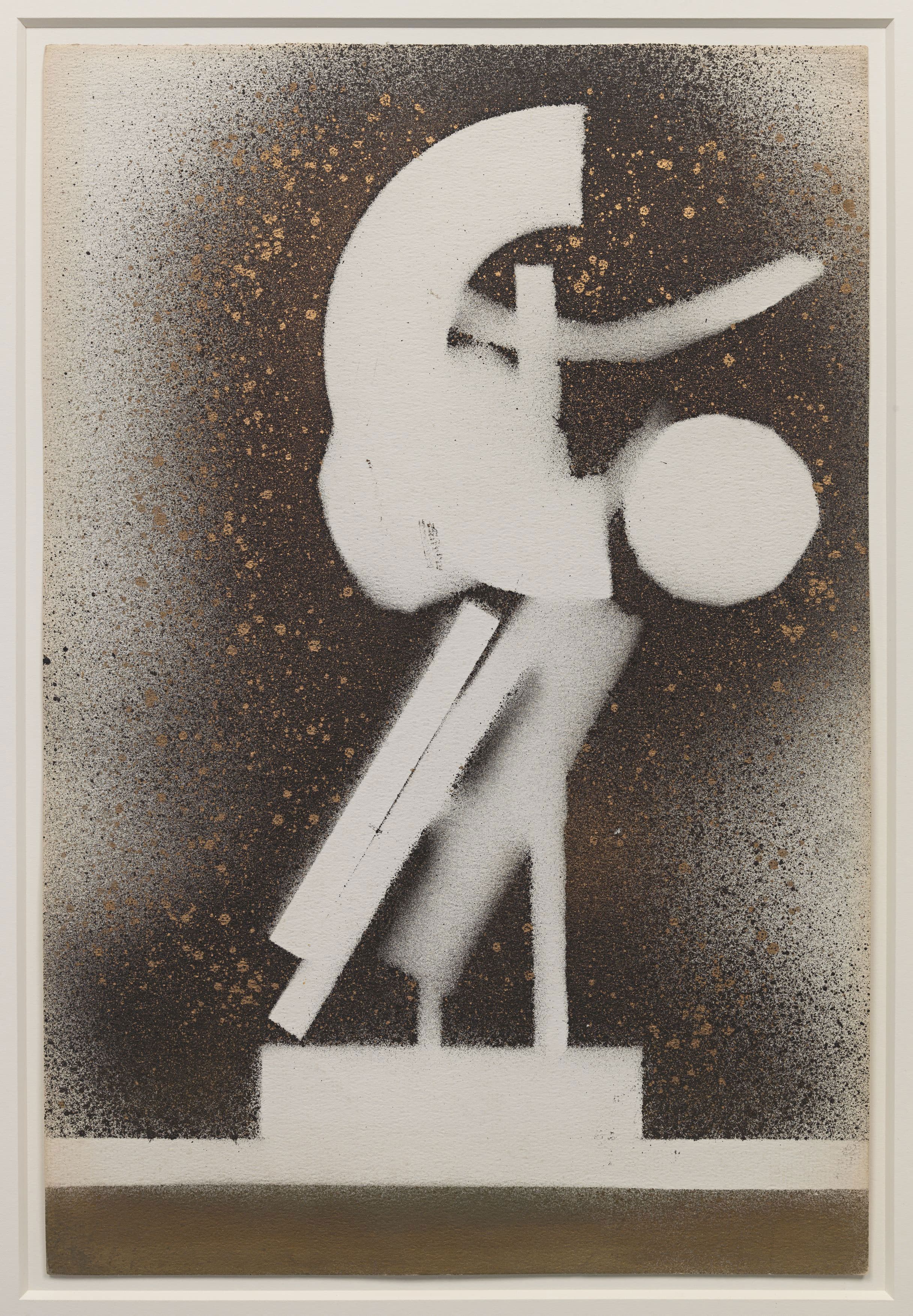
Smith knew sculpture for what it was: an object in its own right, and, traditionally, a memorial to those who preceded those currently living, now gone. At the same time, his abstraction moved his art into a field of pure form, tending at times to reference nothing but itself.
David Smith, Untitled (Arc), 1959–60. Spray enamel on paper, 17 1/4 x 11 1/2 inches. The Estate of David Smith. Photo: Genevieve Hanson. © 2021 The Estate of David Smith / Licensed by VAGA at Artists Rights Society (ARS), NY.
The night, the past recalls the past (Edit 1–2) (2019), is a video by South Korean artist Kim Juwon (b. 1981) about the artist’s personal life from the years 2007 to 2019.
Installation view: Kim Juwon: The night, the past recalls the past, DOOSAN Gallery New York, 2021. Courtesy the artist and DOOSAN Gallery New York. Photo: Kim Juwon.
Ecologically-minded art like Abe’s reminds us, in poetic fashion, not only of what we have lost, but what we can keep alive of nature in our imagination.
Installation view: Tomoko Amaki Abe: Respire, A.I.R. gallery, New York, 2021. Photo: Sebastian Bach.
At Geary Contemporary, Sun You makes a very good show out of demotic objects—wire, magnets, clay forms, cardboard—proving that works constructed from poor materials can attain an elegance we had not expected.
Sun You, No Title, 2020. Polymer clay, cardboard box. 13 x 22 x 6 inches. Courtesy the artist and Geary Contemporary.
Like the artists who shaped movements such as Constructivism and Suprematism, Sacks seeks to ally abstraction with social commentary, even a radical view. Here, the social implications of Sacks's outlook are linked to a complex collage of different sources of cloth: his materials come from all over the world, as if proposing a kind of internationalism that might be able to respond to the limits imposed by the isolation and xenophobia of many around the world.
Peter Sacks, Republic, 2019-2020. Mixed media on canvas, 96 x 220 inches. Courtesy Sperone Westwater, New York.
Freilicher, a quietly brilliant painter of interiors, is represented here with 15 still lifes that show the full spectrum of her work from the 1950s to the early 2000s. The muted hues of her paintings, combined with a high lyricism for which she was known from the beginning of her career, invests her work with a poetics that can only be admired, on both a thematic and a technical level.
Jane Freilicher, Seashells and Forsythia, 1983. Oil on linen, 20 x 22 inches. Courtesy the Estate of Jane Freilicher and Kasmin.
Tom Sachs, in a mid-career show—his first at Acquavella Galleries—is offering “handmade paintings” aligned with classic American, mostly commercial iconography: a reproduction of the Reese’s Peanut Butter Cup wrapper, the McDonald's Golden Arches, an American flag. These images are so ubiquitous as to have taken on definitive status, giving them an authority nearly ethical in their quality; all this despite the fact that Sachs’s paintings are mostly of logos of things to be sold.
Tom Sachs, Reese’s, 2019. Synthetic polymer and palladium leaf on plywood 84 x 84 x 4 1/2 inches. Courtesy Acquavella Galleries.
Bahar Sabzevari is an Iranian-born, New York-based painter who mostly produces self-portraits that echo the greatness of the Persian past. A painter of unusual technical skill—Sabzevari studied at the New York Academy of Art—the artist regularly paints her own features, with embellishments that look back to her country’s history and culture.
Bahar Sabzevari, Demon of the Day, 2019. Ink and watercolor on paper, 13 1/4 x 17 1/4 inches. Courtesy Leila Heller Gallery.
Gabriel Orozco, now close to 60, is a permanent part of the contemporary art landscape. Coming out of conceptualism, often working with photography (but also with other mediums), Orozco is offering at Marian Goodman paintings large and small made in Tokyo. One can only wonder at the unusual facility of the artist: somehow, he has turned these paintings into innovative, exploratory statements, even while working within the by-now-established history of abstract art.
Gabriel Orozco, Ochiba, 2020. Tempera and gold leaf on linen canvas, 78 3/4 x 78 3/4 x 11/4 inches. Courtesy of the artist and Marian Goodman Gallery, New York. Photo credit: Gerardo Landa.
ot quite a painting show, not quite a show of sculpture, not quite a show embodying an installation, Korean artist Park Kyung Ryul’s Tense is taut with possibility. Developed from her residency at the DOOSAN Gallery, Park’s sophisticated show seeks to expand the flatness of painting to a three-dimensional degree.
Installation view: Park Kyung Ryul: Tense, DOOSAN Gallery New York, 2020. Courtesy the artist and DOOSAN Gallery New York. Photo: Jiwon Choi.
Organized by art writer and curator Paul Laster, An Alternative Canon: Art Dealers Collecting Outsider Art presents nearly 75 artworks collected by some 30 dealers. The range of the works, shown salon-style in Edlin’s space near the New Museum, is remarkable.
Bill Traylor, Black Horse, 1939-42. Pencil and poster paint on cardboard, 14 x 22 inches. Courtesy Andrew Edlin, New York.
A Pittsburgh native, Thaddeus Mosley, now 94 years old, makes organic abstractions from leftover wood: trees from Pittsburgh urban woods, as provided by local governmental sources (the Forestry Division); wood taken from local sawmills; and reclaimed building materials.
Installation view: Thaddeus Mosley, Karma, New York, 2020. Courtesy the artist and Karma, New York.
Karla Knight is interested in conveying an extraterrestrial symbolism that is informed by both canonical modernism and outsider art. She is a trained contemporary artist, with a degree from the Rhode Island School of Design, whose father was the author of books which dealt with UFOs and extrasensory perception.
Karla Knight, Fleet 1 (Gray Matter), 2019. Oil, flashe, colored pencil, and graphite on ledger paper mounted on linen, 44 x 80 inches. Courtesy Andrew Edlin Gallery.
Martin Roth, an artist who has often worked with nature—in 2009 one of his projects, I lived with sheep in Europe, consisted of living with a herd of sheep in Europe—excels at combining the outside world with sophisticated insights into politics and its relations with art and life. At his midtown exhibition at the Austrian Cultural Forum, In May 2017 I cultivated a piece of land in Midtown Manhattan nurtured by tweets, the pungent scent of more than two hundred lavender plants leads the viewer down two flights of stairs, into the basement of the Forum’s building on East 52nd Street near Fifth Avenue.
Martin Roth, “In May 2017 I cultivated a piece of land in Midtown Manhattan nurtured by tweets.” (Photo © David Plakke/ACFNY)
Increasingly, the Irish-born, New York-based Sean Scully is viewed as one of the most gifted artists of his generation. Likely best known for the painting series “Wall of Light,” Scully has practiced a variation on the New York School, giving it a European sadness as well as continuing the American penchant for expressiveness.
Sean Scully, BLUE NOTE, 2016. Oil and acrylic spray on aluminum. 110 x 320 inches. © Sean Scully. Courtesy Cheim and Read.
The man sits pensively, smiling and looking up at them as they travel freely through the sky. What is he dreaming of?
Sandro Chia, Looking At, 2017. Oil on Canvas. 39 x 39 inches. Courtesy the artist and Marc Straus Gallery.
Born in 1939, Siah Armajani has become one of America’s most venerable sculptors. Originally from Iran, the artist came to Minnesota in 1960 to study at Macalester College, where he has since stayed and, over the last fifty years, produced a remarkable body of work closely tied to the American democratic tradition and poetry.
The argument in which craft is diminished as art is by now cliché. The shift in art-making of the last two generations has been toward a complete expansion of what art can be, and craft is included in this widening of art’s definition.
Installation view: Peter Shire, A Survey of Ceramics: 1970s to the Present. Derek Eller Gallery, New York, September 8 - October 9, 2016. Courtesy Derek Eller Gallery, New York.
The Korean artist Chung Sang-Hwa, now in his mid-eighties, is best known as a participant in the Tansaekhwa, or Korean monochrome painting movement. He has traveled greatly in the West and spent extensive time in Paris, where he first moved in 1967 and likely picked up some of the abstract painting concerns facing Western artists at the time.
Installation view: Chung Sang-Hwa, Greene Naftali, New York, June 1 - August 5, 2016. Courtesy the artist, Greene Naftali, New York, Dominique Lévy, New York, and Gallery Hyundai, Seoul. Photo: Elisabeth Bernstein.
At a time when the genetic modification of foods is a genuine threat to human well being, Brooklyn-based artist Naomi Campbell has created a hybridization of her own, merging her scientific interests with a creative investigation of genetics and technology. Her recent exhibition, Bread and Circuses, reflects her ongoing interest in engineered food staples, most especially corn, which, according to Campbell, has existed for 80,000 years.
Naomi Campbell, River (Yangtze), 2015. Grains of rice, pigments, paint, adhesive, metal, and canvas. 118 x 26 x 8 inches. Photo: Jiin Ahn.
Carol Szymanski, a talented and established sculptor and conceptual artist, who has worked both in New York and London, put up her fourth solo show at Elga Wimmer Gallery.
Installation view: Carol Szymanski: A Distance as Close as it Can Be. Elga Wimmer, April 1 – 31, 2016. Courtesy Elga Wimmer.
The work in Matt Kleberg’s two recent exhibitions—brightly-colored, striped paintings that describe interior or architectural spaces—slowly but surely takes over the viewer’s attention.
Matt Kleberg, LL Bean Boudoir (2016). Oil stick on canvas, 60 x 48 inches. Courtesy the artist, Mulherin New York, and Morgan Lehman Gallery.
Qiu Xiaofei, who lives and works in Beijing, studied painting there at the Central Academy of Fine Arts, receiving his degree in 2002. Although he first began as a figurative artist, his art now is a luxurious mélange of abstraction, geometric forms such as spheres, and luscious impasto highly reminiscent of the New York School.
Qiu Xiaofei, Temple Base, 2014-2015. Acrylic on canvas mounted on board, old white porcelain hook, plastic mesh bag, wood balls. 82 11/16 x 56 3/4 x 5 5/16 inches. Photo courtesy the artist. © 2016 Qiu Xiaofei Studio.
Jean Shin is well known for her large installations consisting of accumulated objects—disparate artifacts such as prescription pill bottles, sports trophies, sweaters, and swathes of fabric—given to her by people in the community where the art environment takes place.
Jean Shin, Surface Tension 2A, 2B, and 2C, 2016. Paint on wood. 91 3/4 × 143 7/8 inches. Courtesy the artist and Cristin Tierney Gallery, New York. Photo: Etienne Frossard.
Swedish-born, Berlin-based sculptor Carl Boutard is currently living in New York City on a residency at the International Studio & Curatorial Program (ISCP). His exhibition, Life is Elsewhere, installed in the long, somewhat narrow space of TURN Gallery, consists of eight sculptures made from paper and cardboard, rather than the bronze and wood he usually works with for both indoor sculpture and outdoor projects.
Installation view: Carl Boutard, Life is Elsewhere, Turn Gallery, New York, February 24 to April 10, 2016. Courtesy Turn Gallery.
Martha Diamond: Recent Paintings is a terrific show of forty-one small abstract paintings, done since 2002, continuing her ongoing exploration of a world characterized both by rough figuration and abstraction. She is a true New York artist, a veteran of the still active and productive decades of the New York School whose work demonstrates a predilection not so much for the lyric, gestural abstraction we know so well in the city, but a more uncouth reflection of urban life.
Martha Diamond, Untitled Structure, 2014. Oil on panel, 12 x 10 inches. Courtesy Alexandre Gallery, New York.
As the gallery essay points out, Paula Modersohn-Becker was more or less unrecognized as a painter when she died at the age of thirty-one in 1907. But her posthumous reputation rose quickly, in Germany today, she is looked on as a major presence in modern art (although awareness of her achievement is not so well established in America).
Paula Modersohn-Becker, Portrait of the Artist's Sister Herma with Amber Necklace, ca, 1905. Oil on canvas. Private collection; courtesy Galerie St. Etienne, New York.
German-born, Berlin- and New York-based artist Bettina Blohm paints gouache and acrylic works that rely on their lyricism to affect the viewer. Her designs are simple but never simplistic; the resolutely abstract works may stem, as she puts it, from “something seen,” but she takes care to “collect visual ideas” and produces colorful, emotionally compelling paintings through rhythm and repetition.
Zin Helena Song is a painter of real precision and technical acuity. For the past few years, she has been painting on wooden sculptures, whose angles and structure reach out from the wall in the direction of her audience. In this very good show she continues to make similar pieces, but adds to her repertoire flat pictures, also done on wood.
Zin Helena Song, "Origami 1 No. 28," 2014. Mixed media on wood. 17 x 17 x 6".
Hiba Schahbaz was trained as a miniaturist painter by the National College of Arts in Lahore, Pakistan. Her early work, as well has her art now, powerfully combine high technical skill, a sense of the female position in Muslim Pakistan, and a slightly troubled, troubling feeling for herself as a painter who has moved from a highly hierarchical culture to America, where aesthetic pluralism can confuse a classically trained artist.
Hiba Schabaz, The Guard, 2014. Tea, gold leaf, collage, gouache and watercolour on wasli, 45 x 35 inches. Courtesy the artist.
Ford Crull is a mature painter who has been involved in the New York art scene since the 1980s. His sprawling, attractively disheveled abstract work shows strong feelings for the nonobjective style, in which random patterns and complex densities of paint build up to a surface of intricacy and abandon.
Ford Crull, Crossroads, 2014. Oil, enamel, cotton, on canvas, 40 x 30 inches. Courtesy the artist.
or an artist to cross over from his or her own milieu to making expressively raw art is hardly new. It no longer matters who makes the art, so long as we see it as possessing life, integrity, and (some) craft. Still, ever since the exuberant artworks of East Village in the 1970s, we tend to identify roughness, energy, and charismatic intensity as the purview of the young artist, who, for the most part, has identified with a rough-and-tumble persona—a far cry from the exquisite nuance and sensitivity we typically ascribe to the historical, cultured painter.
Josh Jefferson, Big Red, 2015. Acrylic, Flashe, gouache, and ink on canvas, 48 x 60 in. Courtesy Turn Gallery.
In a small but attractive space in Dumbo, Korean painter Kyeung Mook Choi presented ink paintings that bridge traditional Asian art and the knotty necessities of contemporary painting.
Kyeung Mook Choi, Chaos 1 (triptych),. Ink on paper, 70 x 150 inches. Courtesy Ray Gallery.
Choong Sup Lim is a mature Korean artist who has spent many years working in New York City, where he has lived since 1973. Lim has a studio in Tribeca, where he puts together his quietly original sculptures and makes paintings that acknowledge Western abstraction, even as he places an emphasis on traditional Asian imagery and painting techniques.
Choong Sup Lim, Luna: Thousand River  & Thousand Reflections, 2015. 1000 yards of traditional Korean cotton thread, rice paper, wax, wood, kinetic system, D.V.D., rocks, 12 x 15 x 9 ft. Courtesy the Korean Society.
Type as Image, organized by a young, New York-based curator named Jill Coklan, did an excellent job of presenting three artists who work with typefaces as part of their imagery.
Lynne Avadenka, Occom's Alphabet Black, 2009. Relief print from wood type. 12 × 28 in. Courtesy the artist and Art Mora Gallery.
he New York School persists in the lively abstractions of New York painter Serena Bocchino. Inevitably, her work calls to mind the 1940s and ’50s, when gestural abstraction governed the art scene.
Serena Bocchino, Soar, 2015. Enamel paint and mirrors on canvas, 28 × 34 in. Courtesy the artist.
The title of Margaret Evangeline’s show was An Injured Armory. In this body of work, the artist, whose son served in the Iraq War, has turned to allegorical protest rather than specify the particulars of an actual historical conflict. So her exhibition, which was small but powerful, consisted of several stainless-steel panels that incorporated randomly spaced puncture holes, resulting from bullets fired by Evangeline herself at a military shooting range.
Margaret Evangeline, "The Girl of the Golden West, for Puccini" (2013). Gunshot on stainless steel, plated with 24K gold, 46 x 23". Courtesy of the artist.
For more than a year now, curator Lisa Banner, who graduated with a doctorate on 17th-century patronage and collecting in Spain from the Institute of Fine Arts, has been curating contemporary art exhibitions in two small vitrines found on the steps of the Institute’s Great Hall.
Benjamin Cottam, "Staged Kill 1" (2014). Wax crayon on Smythson featherweight paper, 6 1/4 x 8". Courtesy of Klemens Gasser and Tanja Grunert, Inc., and the artist.
Brenda Goodman spent many years painting remarkable self-portraits, in which she is sometimes thinner but usually heavy, in her studio on the Bowery in lower Manhattan. But in recent years she has moved to the Catskills, where she continues to practice her art.
Brenda Goodman, "Stone Memories" (2014). Oil on wood, 74 x 80". Courtesy of the artist.
Hisako Kobayashi has lived for many years on the edge of the East Village, where she also maintains a studio.
Hisako Kobayashi, "One and Only Force" (2014).
Oil on canvas, 22 × 28˝. Courtesy of the artist.
As an Asian-American painter of mixed background, Laura Kina creates work that is as culturally relevant as it is emotionally resonant. Her father, who is of Japanese descent, grew up in Hawai’i, where he worked on sugarcane plantations before moving to the American mainland to become a doctor.
Laura Kina, "Cane Fire" (2010). Oil on canvas, 30 × 45". Courtesy of the artist.
A space without a permanent home, the International Fine Arts Consortium— temporarily located on Delancey Street on the Lower East Side, is showing the collage work and correspondence of Joanne Grüne-Yanoff, an American artist who lives and works in Stockholm. The smallish individual works nicely reflect Grüne-Yanoff’s ongoing interest in nature: small butterflies decorate the letters written between herself and Monica L. Miller, a professor of American and African-American literature at Barnard College; they discuss the imagery from an earlier show by the artist that Miller saw in Stockholm.
Joanna Grüne-Yanoff, "November Letter JGY-MLM" (2014).
The flurry of reviews accompanying the opening of Indonesian artist Entang Wiharso’s solo show indicates that the New York art world is now ready for an influx of culture from Southeast Asia.
Entang Wiharso, "Inheritance" (2014). Graphite, resin, color pigment, thread steel, life-size installation. Edition 1 of 2.
Collaborators Will Corwin (a contributor to the Brooklyn Rail) and Neil Greenberg have put together an interactive project called The Great Richmond. Installed in the lounge of Staten Island Arts at the Staten Island ferry termi, the installation re-envisions Staten Island through sculptures by Corwin and schematic maps by Greenberg.
Still in grad school at Hunter College’s fine arts program, the artist Derek Fordjour has nonetheless pulled off a terrific, completely professional show of paintings and sculptures.
Derek Fordjour, "No. 85" (2014). Acrylic, oil pastel, charcoal on newsprint, mounted on canvas, 30 × 24 ̋. Courtesy of Storefront Ten Eyck Gallery.
Lee Bul presented a striking body of work for her recent show, which included an installation, several individual sculptures, and India ink and acrylic paintings. All the works in this compelling exhibition address visionary attitudes toward form, inspired in one case by the German architect and urban planner, Bruno Taut (1880 – 1938), whose idealized drawings influenced Weimar buildings.
Lebbeus Woods’s death in 2012 was a considerable loss to the architectural world, as the fine new show of his drawings and maquettes at The Drawing Center demonstrates. Woods’s capacity as a gifted technician and radical theorist of contemporary architecture resulted in a singular body of work that undermined current notions of how to successfully create places in which to live and work.
Leslie Wayne’s sharp show of new work continues her interest in paint not as an embellishment on canvas but rather a physical material in its own right. She’s always done fine things with the medium, but in this exhibition, entitled Rags, the artist takes her ongoing, nearly obsessive interest in oil paint to a new level, draping paint so that it bends and folds as fabric might.
Leslie Wayne, "Paint/Rag #27," 2013. Oil on panel, 15" x 9" x 3 5/8".
William Pangburn’s strong show, consisting of an installation and a sequence of small paintings, has water as a major theme. Pangburn, a longtime resident of Tribeca, New York’s venerable art neighborhood, belongs to the tradition of the New York School. Sixty years old, he represents the still-vital energies of a legacy some might feel is moribund.
Despite their differences in themes and materials, the three female Brooklyn-based artists—Fay Ku, Hiba Schahbaz, and Manju Shandler—in Gallery HO’s New Originals share a common premise: the use of challenging subject matter, public and private, for the creation of contemporary art.
Saul Fletcher’s striking black-and-white photographs were taken last year in his studio in Berlin, where he has recently moved.
In this solo show by Emi Anrakuji, her fourth at the gallery Miyako Yoshinaga, the artist has entitled the exhibition O Mapa, which translates to “The Map” in Portuguese.
Anne Truitt’s career looks larger and larger as time goes on. Born in Baltimore, educated at Bryn Mawr in the suburbs of Philadelphia, and working most of her life in Washington, D.C., Truitt developed a radically spare aesthetic, which slightly prefigured the sleek, industrial forms of 1960s Minimalism.
Some 20 years ago San Francisco artist Barry McGee was part of the art scene’s graffiti movement there. Posted on the walls of the city, his images of bums and aboriginal faces were so good that one inevitably felt he would go on to larger, more mainstream recognition—and so he has in this show at Cheim & Read, his first New York gallery exhibition in eight years.
Barry McGee, UNTITLED 2013. Acrylic on wood panel; 72 elements, 86 1/2 x 120". CR# MY.32574.
Cai Jin, famous for a 20-year-long obsession with the banana plant, has changed her focus. In her recent show with the Beijing satellite gallery of New York’s Chambers Fine Art, she has concentrated on what she calls landscape paintings.
Cai Jin. "Landscape No. 17," 2008. Oil on canvas. Courtesy of the artist and Chambers Fine Art.
About 15 years ago, Beijing-based photographer Liu Zheng was in the midst of a project of epic proportions: a photographic survey of the Chinese people that took him to morgues and nunneries, among other places.
Liu Zheng, "A Nude by River," 2008. Courtesy of the artist.
Under the auspices of the exhibition series Raw/Cooked, Michael Ballou presents a smart and challenging installment within the Brooklyn Museum’s institutional walls.
Michael Ballou. Installation view of Dog Years, 2013. Blue foam, urethane foam, plaster, and paint, dimensions variable. Photo: Brooklyn Museum.
The concept behind Susanna Heller’s affecting and evocative exhibition at MagnanMetz is based on her husband Bill’s suffering.
Susanna Heller, “Old Souls (Pink and Aqua),” 2013. Oil on canvas, 44 x 77”. Courtesy of Magnan Metz.
Zaun Lee is a young, New York-based abstract painter who comes from Seoul, South Korea.
Zaun Lee, "BORDER 03," 2009, Acrylics on Wood Panel. 9 x18". Image courtesy of the artist.
A.R. Penck has been part of the German imagination since the early 1960s, when his interest in information systems and all manner of signs was ahead of its time.
A.R. Penck, "Vorstoß (Advance)," 2010. Acrylic on canvas. 63 x 47 ¼". Courtesy Michael Werner Gallery, New York.
Peggy Cyphers has put on a show of startling originality at the Proposition.
Peggy Cyphers, “Animal Spirits – Floaters,” 2012. Acrylic, sand and gold on canvas, 46 x 42”. Courtesy of the Proposition Gallery, NYC.
For those of us still interested in keeping the practice of painting flourishing, the show by Devin Powers, located in the front room of the Lesley Heller Workspace, makes it clear that the art form is indeed live and well.
Brian Belott’s enthusiasm for glittering decoration is amply evident in this excellent show, which proves that even preciousness can be transformed into something inspired and forceful, that is, if you parody your own treatment of materials.
Brian Belott, "(Dirty) Sock Bling--------red---," 2012. Reverse glass technique, 21 x 17". Photo Credit: ©Adam Reich. Courtesy of Zürcher Studio, New York.
Louise Fishman’s new show substantiates, yet again, her importance as an Abstract Expressionist painter. Her current group of paintings, in which blue and, to a lesser extent, green predominate, have been inspired by her residency at the Emily Harvey Foundation in Venice.
Louise Fishman, "Zero at the Bone," 2010. Oil on linen. 70 x 60". Courtesy Cheim & Read, New York.
Whitney Claflin is a young, Yale-educated painter who creates raw effects that remain in the thoughts of her viewers long after they have made their way from the gallery.
Whitney Claflin, "Web of Lack/ IT IS MY GRAVE," 2012. Mixed media on found fabric, 23 x 15". Photo: Andreas Vesterlund. Courtesy the artist and Thomas Erben Gallery, New York.
It looks like there is an increasingly vital art scene in some of the tough urban areas of New Jersey, most especially Newark and Jersey City, where the cost of studio space is much more reasonable than in the chic, art-oriented neighborhoods of New York.
Material Tak, Installation view, Kati Vilim (left) and Peter Fox (right). Courtesy LDO Photo.
Aaron Curry has created an allover environmental installation for the relatively small gallery space at Michael Werner. Yet, despite the boundaries of a limited room, or perhaps because of them, he has successfully created an environment whose mixed influences demonstrate just how well the artist has done with internalizing other artists’ visions and making them his own.
Aaron Curry. L-R: "Buzz Kill," 2012, painted aluminum, 124 x 288 x 317"; "Buzz Kill (Woman)," 2012, collage, gouache on board, 19 ¼ x 16 ½"; "Hang Head," 2012, painted aluminum with spray paint and tape on silkscreened cardboard with rope, 115 x 38 ½ x 106"; "Zuzz Tuk," 2012, ink, silkscreen and spray paint on wood and cardboard on painted aluminum base, 119 x 37 x 34". Courtesy Michael Werner Gallery, New York.
Taiwanese contemporary art has always suffered in comparison with the work of China—not only because the two cultures are different, but also because the West has been entranced by the imperial impulse of the mainland.
Along Ching-Yuan Chen, "Let's Talk about Something 3," 2009. Acrylic on canvas. 20 x 20". Courtesy Rooster Gallery
First things first: You are still missed as one of the most interesting abstract painters working after the Second World War. Your work shows a prescient regard for painting issues that are still ongoing today, and there is a purity in your efforts that is memorable.
Michiel Ceulers, "Stark ausgeprägte und sehr stark unterdrückte Sexualität / Ein Triptychon der Fragen," 2012. Left: acrylic, oil, spray paint, & screws on artist-made panel and canvas, 33.1 x 22"; right: wooden board, 28.9 x 17.7". Courtesy of Ana Cristea Gallery.
Born in Germany and living in Berlin, artist Thomas Scheibitz is a solidly established painter who is pushing abstraction into new directions. Not unlike our Thomas Nozkowski, Scheibitz seeks patterns that relate to the world beyond the self.
Thomas Scheibitz, "ohne Titel (No. 619)," 2011. Oil, vinyl, ceramic paint, and pigment marker on canvas, 27 1/2 x 19 3/4 inches; 70 x 50 cm. Courtesy the artist and Tanya Bonakdar Gallery, New York.
Peter Gallo’s interests are literary as well as painterly, frequently if not always including words or phrases in his eccentric but enjoyable art.
Peter Gallo, "Ship of Health," 2011. Oil on linen on found wood. 20 x 24" / 50.8 cm x 61 cm. PG115. Courtesy of Horton Gallery, New York. Photo: Mark Woods.
Mexican-born, New York-based Bosco Sodi’s exhibition of recent canvases falls in between the categories of sculpture and painting. Each of the 12 paintings on view has a thick surface whose crust has, in many areas, broken away from other parts of the painting.
Installation view of Bosco Sodi: Ubi sunt
© Bosco Sodi. Photo by: G. R. Christmas / Courtesy The Pace Gallery.
Born in Decatur, Indiana, David Smith (1906 – 1965), arguably one of America’s greatest 20th-century sculptors, came from a tradition of craftsmen; his great-grandfather was a blacksmith, and his father an engineer and inventor.
David Smith, "17 h's," 1950. Painted steel. 44 1/2 x 29 x 12 1/2". The Estate of David Smith. © The Estate of David Smith/Licensed by VAGA, New York. Photo courtesy of the Estate of David Smith, photo by David Heald.
Brooklyn artist Lori Sikorski recently staged an interactive exhibition that looks at our current military involvement in the Middle East, initially begun as a response to the destruction of the World Trade Center, a local event, but which passed quickly into long-term, distant hostilities.
"Drawing Attention." Detail of installation, digital photos with written responses.

Close

Home