Jillian Russo

Jillian Russo is a Brooklyn-based curator and art historian.

In the midst of the feminist movement in New York City in the 1970s, Joan Semmel began working both with models and photographs she took of her own body to overturn art historical conventions for representing the female form. Using cropping and birds-eye view perspective, Semmel created nudes that are unidealized, intimate, and sensual.
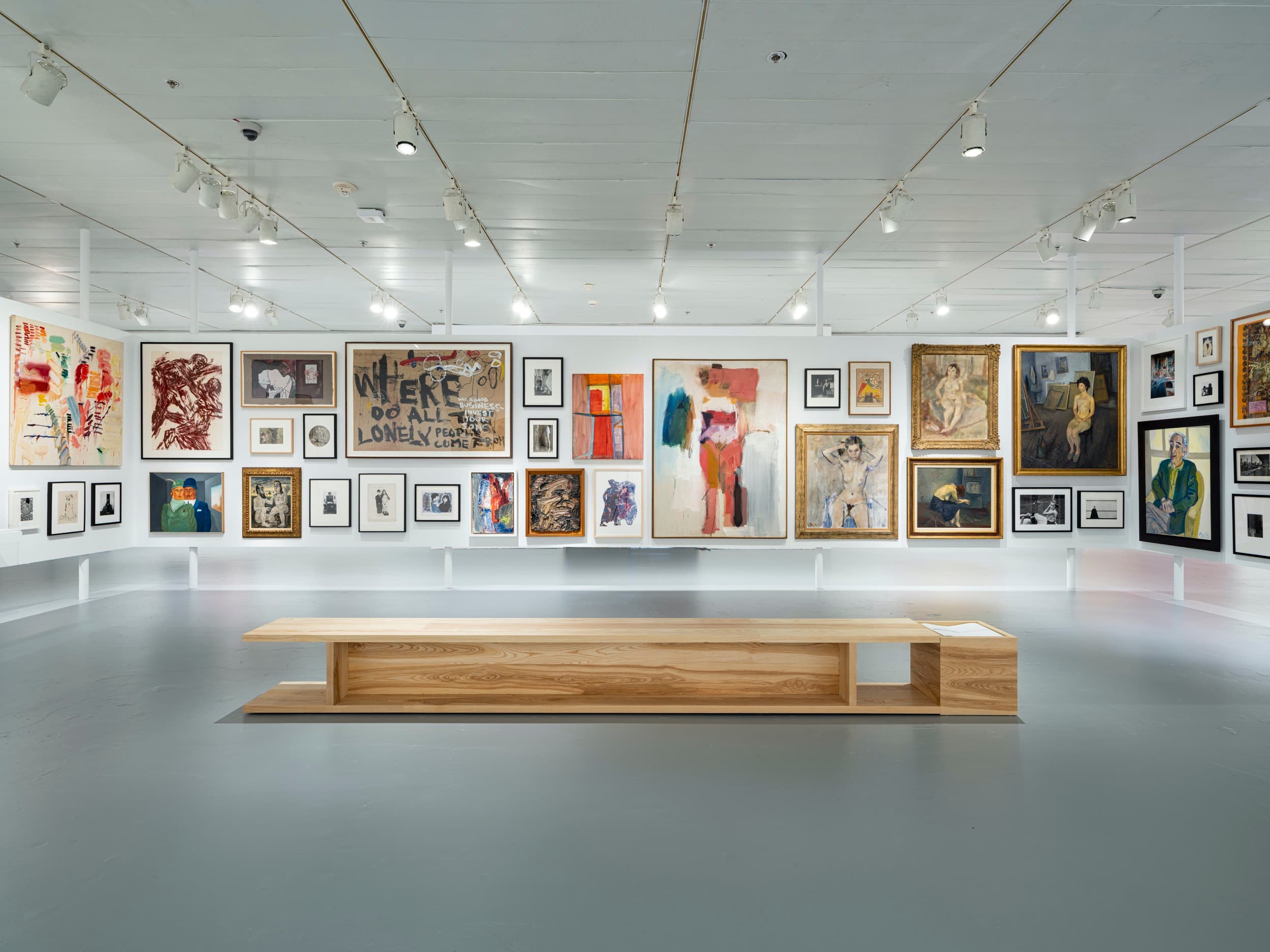
Installation view: Joan Semmel: In the Flesh, the Jewish Museum, New York, 2025–26. Photo: Kris Graves.

Comprised of more than 450 prints, Constellation offers a fresh perspective on the career of photographer Diane Arbus (b. 1923–1971), interspersing her most acclaimed images with works that have never been published before, and challenging the predominant conception of her as a chronicler of the socially marginalized.

Installation view: Diane Arbus: Constellation, Park Avenue Armory, New York, 2025. © The Estate of Diane Arbus. Courtesy the Collection Maja Hoffmann/LUMA Foundation and Park Avenue Armory. Photo: Nicholas Knight.

Collection View: Louise Nevelson, now on view at the Whitney, re-examines the influence of the cityscape on Nevelson’s work. The exhibition uses the east-facing glass façade of the fifth-floor galleries to place more than fifteen sculptures in dialogue with the surrounding architecture on Gansevoort Street.

Louise Nevelson, Rain Forest Column XXIII, 1964–67. Painted wood and steel, 81 3/8 × 11 1/4 × 10 3/4 inches. © 2025 Estate of Louise Nevelson/Artists Rights Society (ARS), New York. Courtesy Whitney Museum.

Printmaking duo Zorawar Sidhu and Rob Swainston’s exhibition Flash Point intermingles three new bodies of work addressing current political and environmental crises.

Zorawar Sidhu and Rob Swainston, A Great Meeting in Support of the Government, 2024–25. Silkscreen and woodcut on Coventry Rag paper. Unframed: 52 5/8 x 41 inches. Courtesy Petzel.

The first museum presentation of Michelle V. Agins’s photography, Storyteller brings together sixty-eight images taken over the course of her career as a photojournalist for the New York Times, encouraging a reflection on the connections forged with art history.

Michelle V. Agins, Prince in his Act 1 concert at Radio City Music Hall in New York City, 03/24/1993. © 2024 The New York Times Company.
Drawn from a singular collection, the Rosenberg & Co. exhibition is the first solo presentation of Françoise Gilot’s work in New York since her death in 2023. Her career spanned nearly eight decades bridging the circle of Gertrude Stein, post-war California, and late twentieth-century New York.
Françoise Gilot, Variation, 2009. Oil on canvas, 36 x 24 inches. Courtesy Rosenberg & Co.
Will Ryman’s exhibition New York, New York at Chart Gallery celebrates the city’s absurdity, vitality, grittiness, and beauty with ten sculptural works conceived as vignettes of street life.
Will Ryman, Utopia, 2022. Steel, resin, aluminum wire, paint, newspaper clippings, 59 1/2 x 21 x 22 1/2 inches. Courtesy the artist and Chart Gallery.
Eliminating many of Rivera’s intricate details, Klos leaves empty space in which the figures float. As a result, the composition doesn’t read as entirely resolved. This is possibly suggestive of the bonds still forming between Klos and his family, but it also gives the collage a Dadaist quality.
Yashua Klos, OUR LABOUR, 2020–21. Woodblock print on muslin and oil-based, relief block ink on dropcloth, mounted on canvas 186 x 456 inches. © Yashua Klos. Photo: John Bentham.
Thoughtfully co-curated by Gerry Beegan and Donna Gustafson, a selection of posters, print media, courtroom sketches, artwork, and photographs document the construction of Angela Davis’s public image by mainstream and alternative media. Interspersed with the archival material are works by contemporary artists who continue to build upon Davis’s philosophies of freedom.
Wadsworth Jarrell, Revolutionary, May 20, 1972. Color screenprint on paper, 33 x 26 inches. Courtesy Lisbet Tellefsen Archive. © Wadsworth Jarrell.
The exhibition Normal Fault at Kasmin Gallery features thirteen relief paintings and one small diorama, all created in 2021, exploring ecological and geological systems.
Roxy Paine, Topographic, 2021. Wood, epoxy resin, urethane, stainless steel, lacquer, oil paint, 60 1/2 x 84 x 8 inches. Courtesy the artist and Kasmin, New York.
Leonardo Drew’s exhibition at Galerie Lelong & Co. pairs a monumental site-specific installation with nine recent sculptures, creating a magical, immersive environment. The works on view reflect Drew’s various approaches to his materials, including wood, cotton fabric, and aluminum, which he cuts, distresses, and paints, giving them the quality of found objects. Drew is known for repurposing previous sculptures to create new ones, mirroring natural cycles of decay and transformation.
Leonardo Drew, Number 305, 2021. Mixed media, dimensions variable. © Leonardo Drew. Courtesy Galerie Lelong & Co.
An exhibition of 13 video works addressing today’s most pressing global concerns, Wandamba yalungka/Winds change direction, takes its title from the traditional language of the Waanyi aboriginal people of Queensland. The language is on the verge of extinction, spoken by only 16 people as of 2016. Expertly curated by Maura Reilly for the Performa website, the exhibition brings together an international and multi-generational group of artists.
Wangechi Mutu, The End of carrying All, 2015. Courtesy Performa.
Parsing out what you know and what you don’t know from archival material is an intrinsic part of research. Archives and other primary sources are generally considered more reliable than secondary sources, such as art criticism, theoretical studies, and historical texts, because they are first-hand accounts.

Close

Home