Michelle V. Agins: Storyteller
Word count: 1094
Paragraphs: 12
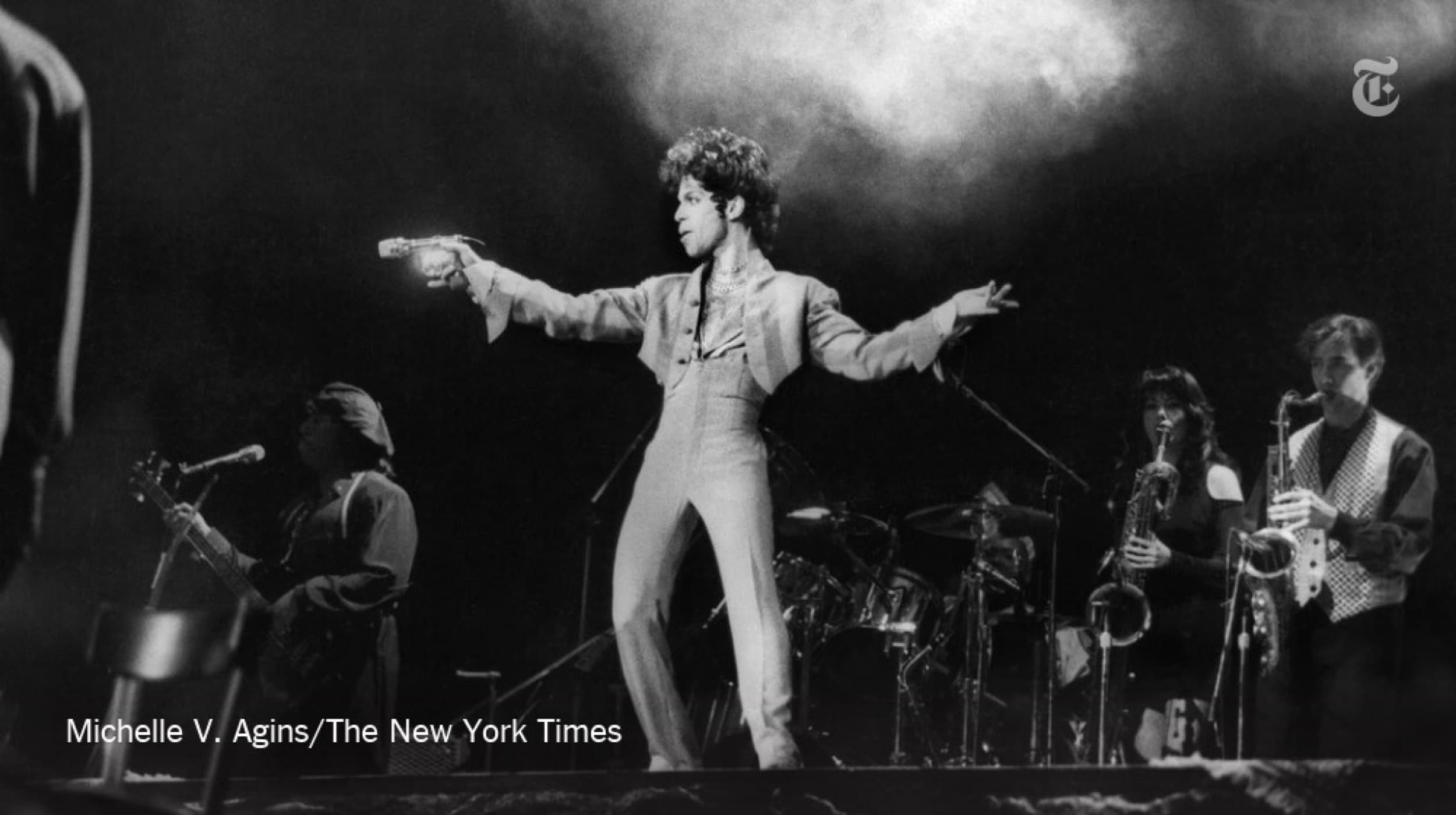
Michelle V. Agins, Prince in his Act 1 concert at Radio City Music Hall in New York City, 03/24/1993. © 2024 The New York Times Company.
Zimmerli Art Museum, Rutgers University
March 6–December 8, 2024
New Brunswick, NJ
The first museum presentation of Michelle V. Agins’s photography, Storyteller brings together sixty-eight images taken over the course of her career as a photojournalist for the New York Times, encouraging a reflection on the connections forged with art history. It often takes decades for a photojournalist’s oeuvre to enter the canon. (Lee Miller, who died in 1977, didn’t receive a major museum retrospective until the early 2000s, and Gordon Parks, despite his notoriety as a Life magazine photographer, did not have his first retrospective until 1987, more than forty years after he began working professionally). Agins’s compositions are full of art historical references, once you start looking for them, although these associations are not consciously part of her practice. Like Miller and Parks, she is fearless in recording American life, allowing us to witness the beauty even in the darkest aspects of the human experience.
Agins began taking photographs after her grandmother presented her with a Kodak Brownie box camera. Her first pictures were of the South Side Chicago neighborhood in which she grew up, including a photograph of Martin Luther King Jr. taken during a visit to Liberty Baptist Church. In the 1980s, Agins persuaded the mayor of Chicago to hire her as his official photographer and in 1989 she became the second Black woman hired as a staff photographer at the New York Times. She traced the social transformations of late twentieth and twenty-first centuries through her coverage of race relations, celebrity culture, politics, and sports. Agins treats all her subjects equally—from icons including Prince, Aretha Franklin, and Serena Williams, to everyday New Yorkers.
The exhibition opens with a 1983 portrait of James Baldwin at a launch party for his book Evidence of Things Not Seen at the Chicago home of Lerone Bennett Jr. Agins and Baldwin had been having dinner when he suddenly remembered he was late for the reading. When they arrived, guests were grabbing their coats and the hosts were cleaning up. Agins pulled out her camera and captured Baldwin giving his remarks to a small group gathered around the kitchen table. He leans forward with his left hand outstretched and his face dramatically illuminated by the hanging light above.

Michelle Agins, James Baldwin introduces his new book “Evidence of Things Not Seen” at the home of Lerone Bennett in Chicago, 1983. © Michelle V. Agins.
Maura Reilly, Director of the Zimmerli, who organized the exhibition with Maura Foley, Picture Editor of the New York Times, pointed out to me the compositional references to Leonardo da Vinci’s Last Supper (1495–98), and I began to notice echoes of the iconic painting in small details, such as the partially open rectangular window shutters that frame the scene. Agins’s centering of action around the table, shaped by contrasts of light and shadow, also evokes Caravaggio’s The Calling of Saint Matthew (1599–1600). Along with these Renaissance and Baroque references, it is also possible to see this image as a forerunner to Carrie Mae Weems’s groundbreaking “Kitchen Table Series” (1990)—which examines the multifaceted roles of Black women—and to the concept of “kitchen table” politics.
A painterly use of light characterizes several of Agins’s portraits of Black women, both famous and anonymous. A photograph of Anita Hill at the 2019 PEN America Literary Gala, where she was honored with the America Courage Award, captures Hill at the threshold between a private moment of reflection and a public moment of recognition. A soft spotlight illuminates her face as she looks upward, about to emerge from behind a black curtain. Agins was covering the US Open when Serena Williams was defeated by Naomi Osaka. She waited patiently for Williams’s composure to break, documenting the brief moment when tears, gleaming under the stadium lights, streaked her face.
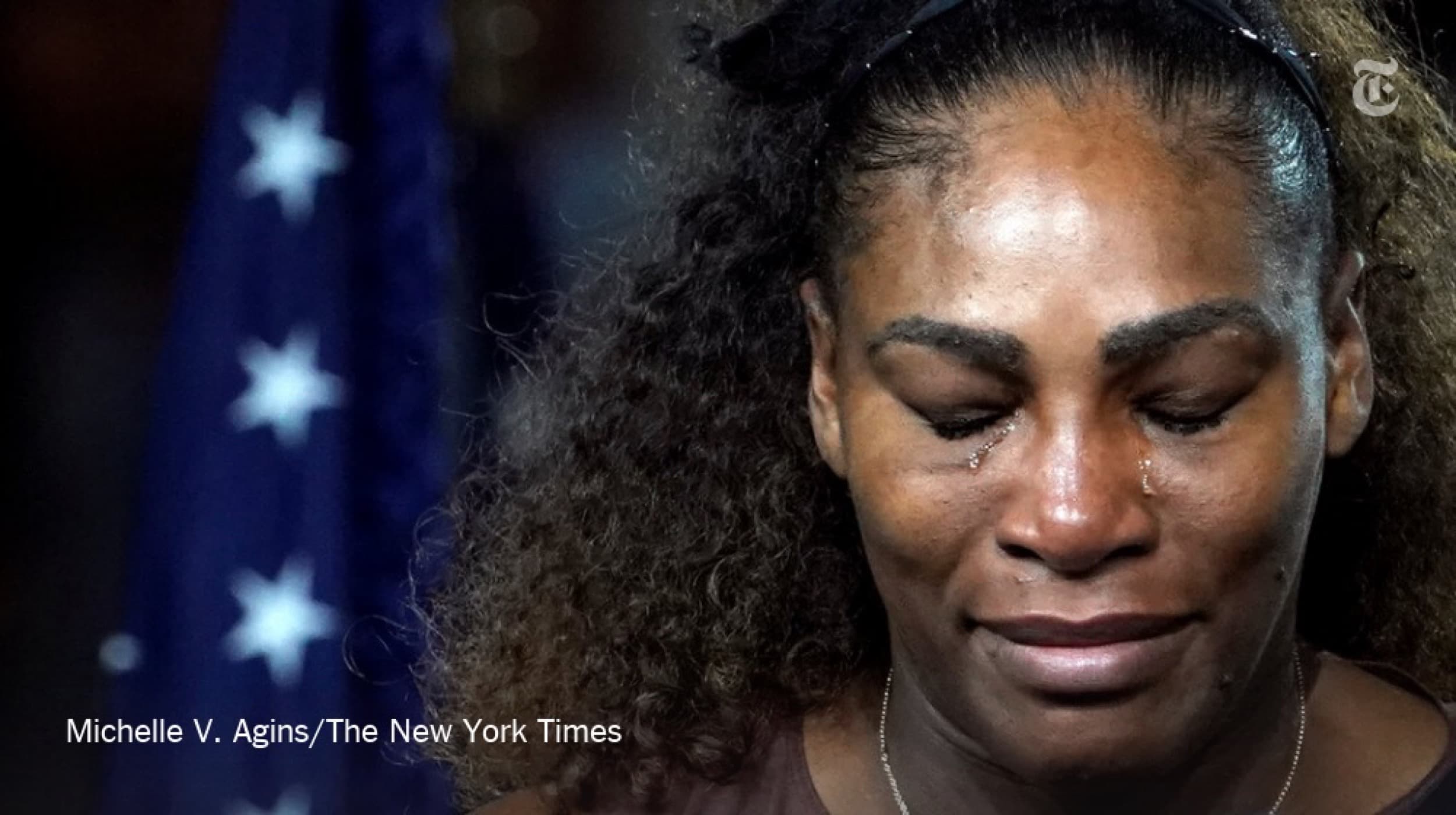
Michelle V. Agins, US Open, Day 13, Women’s Final. Serena Williams defeated by Naomi Osaka at Arthur Ashe Stadium. Date: 09/08/2018. © 2024 The New York Times Company.
Agins describes her practice as historic storytelling and frequently builds trust with her subjects over weeks, months, or years. In 1998, while covering the New York Liberty women’s basketball team, she tried for days to gain access to personal, off-the-court moments. Finally, the players embraced her presence and she photographed Vickie Johnson soaking her legs in an ice bath. Johnson wears her uniform. While the subject at first seems light-hearted, Agins reclaims the art historical trope of women bathing. She presents it as an act of female power and professionalism, as Miller did in her famous photograph of herself in Hitler’s bathtub.
For her 1994 series “Another America: Life on 129th Street,” Agins embedded herself within the Harlem community for months to chronicle the effects of gun violence. Among the people that she developed a friendship with, and was given permission to photograph, was Vikki, a drug and gun trafficker who was acting as the legal guardian for three children whose drug-addicted parents had placed them in foster care. Framing the image from the neck down to conceal her identity, Agins composed a Madonna and child image. The child’s bare bottom rests on Vikki’s forearms, which are covered with scars. The forearm is so carefully modeled with light and shadow that it almost appears sculpted out of stone, and the scars are subsumed in the solidity of the body.
Agins has a way of transforming the horrific into the magnetic, enabling us to confront things that we would rather look away from. In 1989 she covered a protest organized by Al Sharpton against the murder of Yusef Hawkins, a sixteen-year-old black teenager who was shot by a mob in Bensonhurst, Brooklyn. While marching alongside the demonstrators, several Italian men tried to grab Agins and taunted her with a watermelon while shouting racial slurs. Rather than move away, she captured the menacing group head on. One man is crouched on a tree branch, mouth agape with rage, and another has his fist raised and the watermelon on his shoulder. A group of police at the left turn their backs on the scene.
In another instance, a further study into the effects of gun violence, Agins sought out a family that would allow her to photograph a funeral. The picture that resulted, a view into the casket of fifteen-year-old Teraya Stanes, could have been macabre. Instead, Agins constructs a delicate and powerful shot of the deceased’s hands sheathed in white-lace gloves and surrounded by flowers and family Polaroids.
The photographs included in Storyteller represent a small selection of the hundreds of stories Agins has put on record over the last thirty-five years. In a short film accompanying the exhibition she recounts them in her own captivating words. Storyteller brings us closer to understanding her photographs not only as staff reporting, but also as works of art.
Jillian Russo is a Brooklyn-based curator and art historian.