Robert Longo

Robert Longo, Bodyhammer: Uzi, 1993. 96 × 48 inches, Graphite and charcoal on paper. Siegfried and Jutta Weishaupt Collection | © Robert Longo / Bildrecht, Vienna 2024. Photo: Robert Longo Studio.
Word count: 689
Paragraphs: 15
September 4, 2024–January 26, 2025
Vienna
Starting with “Men in the Cities,” I imagine Robert Longo’s non-moving pictures akin to the methods of Giuseppe Fiorelli, who in 1860 was appointed Superintendent of Excavations for Pompeii. Fiorelli’s innovation was to make life-like plaster casts of the ashen cavities where the corpses from the eruption of 79 AD had decomposed. The famous sculptures of Fiorelli faithfully recorded the final instant of each living person and animal, a testament to the city’s tragic fate.
Growing up in suburban Long Island, Longo has stated he first explored the world from the flickering cathode ray of 1960s television, rather than reading. As a young artist he immersed himself in the gritty emerging culture of eighties downtown New York, which shaped the style for his breakout series, “Men in the Cities.” Longo credits the final frames of a shootout scene in R. W. Fassbinder’s 1970 gangster film, The American Soldier as the direct inspiration to “Men in the Cities.”
At the Albertina, one can examine the metamorphosis from Longo’s 1980 black and white charcoal drawings, each of which are Untitled (and named parametrically Eric, Cindy, Frank, and Gretchen) leading to 1989’s multi-media Combine, Now Everybody (For R.W.Fassbinder).
Robert Longo, Untitled (Copenhagen, February 14, 2015), 2017. 97 × 115 inches, Charcoal on mounted paper. Private collection in Germany | © Robert Longo / Bildrecht, Vienna 2024. Photo: Robert Longo Studio.

In Now Everybody’s monochromatic human-scaled sculpture of an anonymous convulsing man, there are echoes of the gestures of the “Men in the City” drawings. The statue is placed against a monumental polyptych backdrop that has replaced the white ground of Longo’s early drawings. Given the date of creation, the artist may have sourced his background image from Bierut, where scenes of explosive urban ruins set amongst modern buildings were prevalent, but the image could just as well represent Gaza, Ukraine, 9/11—or by 2024 any city on the planet.
Longo’s career began with near punk aggression and stylish violence, ubiquitous in both the artworld and popular culture, creating a ripple effect for the films American Psycho, Reservoir Dogs and his own forays into music videos and feature film. Meanwhile escalating nascent events in the real world redirected his output, transforming early stylistic flourishes into a sobering tone of moral rage.
At the Albertina, a conscious overall montage effect dictates Longo’s installation via metric intervals of deceptively random singular images, which en masse makes visible the underlying violence. In 1993’s “Bodyhammer” series, we see gun barrels aimed directly at the picture plane and thus the viewer, a force reciprocated in the shattered glass of Untitled (Bullet Hole, Earth Day, 2017, UA in Huntsville).

Robert Longo, Untitled (Raft at Sea), 2016–2017. 140 × 281 inches, Charcoal on mounted paper. Siegfried and Jutta Weishaupt Collection | © Robert Longo / Bildrecht, Vienna 2024.
Another comparison makes one wonder if the mid-century nuclear angst of 2014’s Untitled (After Pollock, Autumn Rhythm: Number 30, 1951) is an even match for the tragic events surrounding Untitled (Protest for Mahsa Amini; Iranian Embassy, Brussels; September 23, 2022) in 2024.
What should we conclude from 2014’s Untitled (Guernica Redacted, After Picasso’s Guernica, 1937) or Untitled (The Haunting) (2005) in which Longo fragments each with graphic intervention? In Guernica, Longo redacts the image of his drawing, a reduction akin to Picasso painting Guernica in monochrome mimicking the black and white war photos he encountered in 1937.

Robert Longo, Untitled (The Haunting), 2005. 89 × 144 inches, Charcoal on mounted paper. Siegfried and Jutta Weishaupt Collection | © Robert Longo / Bildrecht, Vienna 2024. Photo: Robert Longo Studio.
Robert Longo strategically perverts’ pictures, making transparent how in our culture the dutiful procession of images not only informs, but also normalizes violence, mayhem, and war.
In Untitled (The Haunting) we see two planes headed over downtown NYC towards the center of the drawing, which like the redaction in Guernica has been blacked out by the artist. More than a third of the center portion of the picture is consumed in Longo’s dark gravitational singularity, crushing one’s expectations with the presence of the absence.
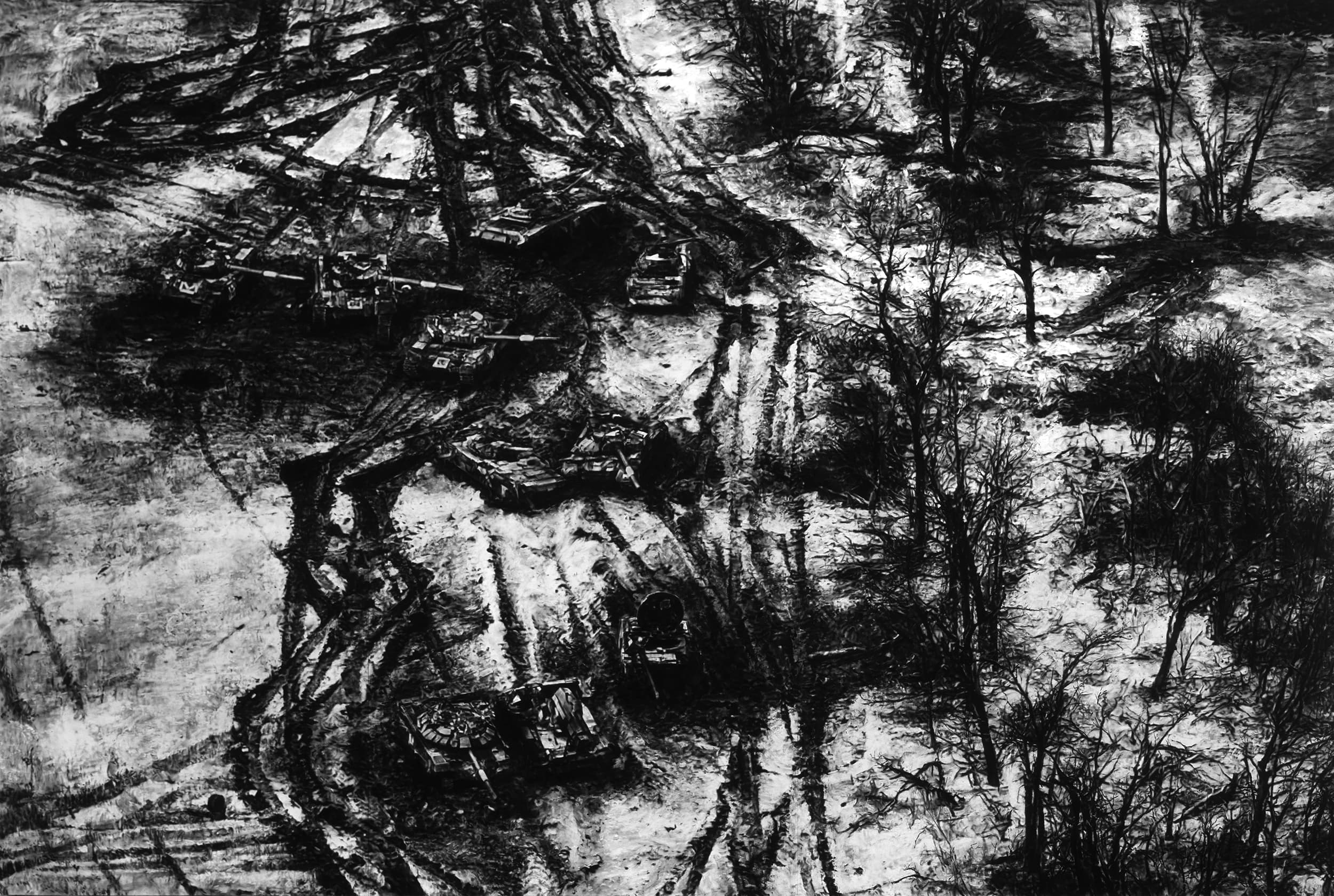
Robert Longo, Untitled (Ukrainian and Russian Tank Battle), 2023. 96 × 144 inches, Charcoal on mounted paper. Siegfried and Jutta Weishaupt Collection | © Robert Longo / Bildrecht, Vienna 2024. Photo: Robert Longo Studio.
Most of Longo’s works hanging in the Albertina are named “Untitled,” followed by source information in parentheses. The untitled annotation works like anesthesia preceding the painful precision of the title’s portion within parentheses. Ironically, none of these subjects jolts the viewer proportionate to the actual events they portray, which is partly the point.
Highly aware of the problem of art’s susceptibility towards the law of diminishing returns, Longo’s work is an unsettling reminder of our expendability (and fragile existence, framed in parentheses).