Rebecca Schiffman

Rebecca Schiffman is a Brooklyn-based writer, editor, and art historian.

Our pets and how we treat them are a sign of the times, and in Joseph Jones’s latest show, at Chapter NY, intimate portraits of cats (and one dog) appear cuter than ever, thriving under contemporary conditions of attention and care.
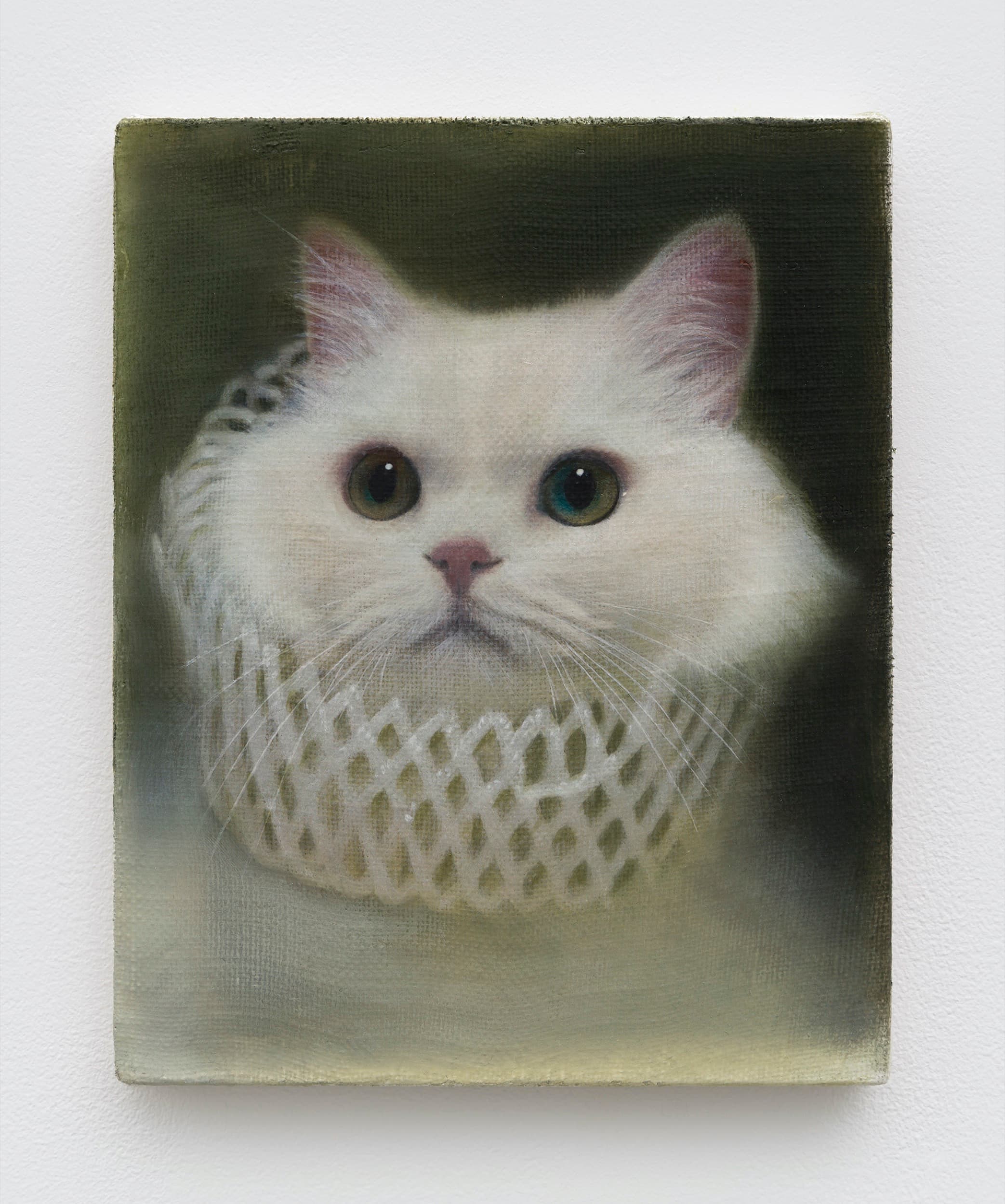
Joseph Jones, Cat in a fruit net, 2026. Oil and acrylic on linen, 10 × 8 inches. Courtesy the artist and Chapter NY.

Henri Rousseau, an artist known for his dreamlike jungle scenes and uncanny portraits of identical mustachioed men, has long fascinated art historians. Yet his life and work remain, at heart, enigmatic. A Painter’s Secrets, now on view at the Barnes Foundation, resists the impulse to decode him.
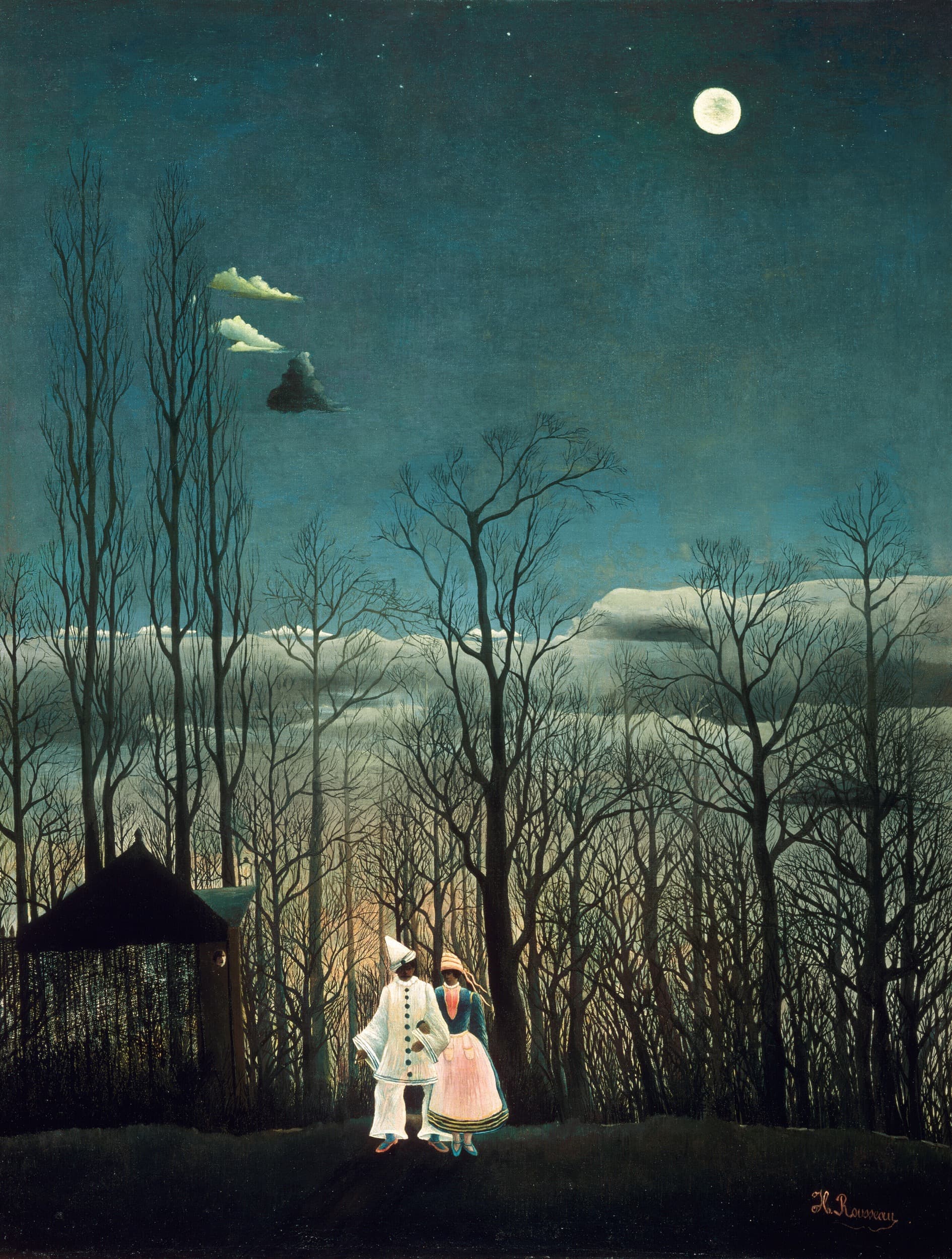
Henri Rousseau, Carnival Evening, 1886. Oil on canvas, 46 ¼ × 35 ¼ inches. Courtesy the Philadelphia Museum of Art.

Cohen’s paintings reflect a balance between the rigor of decision-making and allowing chance to guide the work, resulting in work whose layered marks, swaths of color, and subtle shifts in depth create a luminous complexity.

Cora Cohen, Veronica's Veil, 2022. Acrylic mediums, colored pencil, Flashe, and watercolor on cotton duck, 61 × 59 inches. Courtesy the artist and Greene Naftali. Photo: Júlia Standovár.

Ernest Caramelle is quiet in his gestures, which are expansive in their resonance. On the top floor of Ernst Caramelle: two dots one line at the Austrian Cultural Forum, his 2007 video work, horizontal split, distills this approach.

Installation view: Ernst Caramelle: two dots one line, Austrian Cultural Forum, New York, 2025. Photo: Kevin Noble.

Before art is shaped by culture, it emerges from human development. This trajectory is especially pronounced among modernist artists. How else could they so dramatically depart from conventional representation if not for a deep understanding of the fundamentals first? By that logic, how can we, as viewers, understand these works without first understanding the artists themselves? Gottlieb/Rothko: The Realist Years, on view at 125 Newbury, Pace’s Tribeca gallery, offers that very opportunity, bringing together forty-five formative works that reveal the disciplined beginnings behind the artists’ later breakthroughs.

Installation view: Gottlieb/Rothko: The Realist Years, 125 Newbury, New York, 2025. Courtesy 125 Newbury. Photo: Peter Clough.

Engaging with centuries-old iconography and esoteric traditions, Elizabeth Colomba reconfigures these established visual languages not as acts of nostalgia but as critical interventions, transforming familiar tropes into potent, subversive forms. With roots in Paris and Martinique, formal academic training, and a cinematic sensibility shaped by years working in film, Colomba inserts Black women into the historical and mythical narratives from which they have long been excluded.

Elizabeth Colomba, Spring, 2018. Oil on canvas, 72 x 36 inches. Courtesy the artist and Venus Over Manhattan, New York.

Lisa Yuskavage has long occupied a polarizing position in contemporary painting, her work dismissed at times as anti-feminist, crude, or even aggressively indifferent to the expectations of taste. Her hypersexualized figures—plucked from a space between Renaissance paintings, religious iconography, and pornography—provoke discomfort, their exaggerated forms neither easily objectified nor simply categorized.

Lisa Yuskavage, Painter Painting, 2024. © Lisa Yuskavage. Courtesy the artist and David Zwirner.

What makes Robert Rauschenberg so special (and so worthy of frequent revisitation) is that each new move he made was a foil to the last. He continuously built, adding and forming new chains of reactions that were not only groundbreaking during his time but are still relevant and timely today.

Robert Rauschenberg, Arcanum VI, 1979. Solvent transfer, fabric, and watercolor on paper, 22 7/8 x 15 5/8 inches. Courtesy Gladstone Gallery.

Alice Maher and Rachel Fallon’s The Map, on view at the Irish Arts Center, cartographizes the institutionalization and incarceration of women throughout Irish history. The work literally maps landscapes of oppression and resistance that have shaped women’s lives.

Installation view: Alice Maher and Rachel Fallon: The Map, Irish Arts Center, New York, 2024. Courtesy Irish Arts Center. Photo: Stephanie Powell.
This tradition of doing whatever it takes to be able to create is often glorified, but it stems from the less-glamorous impact of the high cost of living and modest government support for artists. Day Jobs at the Cantor Arts Center at Stanford University focuses on this aspect of artists’ lives, exploring how their day jobs can influence the visual art they create.
Installation view: Day Jobs, Cantor Arts Center at Stanford University, 2024. Courtesy Cantor Arts Center at Stanford University.
Emilija Škarnulytė as a mermaid, siren, or water nymph named Æqualia serves as a symbol of the interconnectedness of all things, blurring the lines between the known and the mysterious.
Installation view: Emilija Škarnulytė: Æqualia, Canal Projects,  New York, 2023. Single-channel video installation. 9 mins. Courtesy the artist, Commissioned by Canal Projects and the 14th Gwangju Biennale. Courtesy Canal Projects. Photo: Izzy Leung.
The trope of a woman in a white gauzy tunic, leisurely lying down in a landscape is classical in its iconography: perhaps she is a water nymph or an ancient Roman or Greek woman. But in typical Picasso fashion, though she may be a classical figure, she is rendered with Cubist notions in mind: her body is bulbous, with shoulders and legs of awkward proportions, and her figure reads as immensely heavy, as if she is not human, but rather a chiseled giant sculpture in relief.
Pablo Picasso, The Spring Fontainebleau, 1921. Oil on canvas, 25 3/16 × 35 7/16 inches. Moderna Museet, Stockholm. Gift of Grace and Philip Sandblom. © 2023 Estate of Pablo Picasso / Artists Rights Society (ARS), New York.
“What should I be afraid of?” asks Ceija Stojka. “Auschwitz is my overcoat, Bergen-Belsen my dress, and Ravensbrück my undershirt.” Stojka, a survivor of the Porajmos, the Romani Holocaust, is remembered in a beautifully haunting exhibition at the Austrian Cultural Forum New York. This collection of artworks, videos, books, and ephemera underscores Stojka’s profound message against hate and intolerance of all kinds while urging us to never forget her and the millions of Jews, Sinti-Roma peoples, and Slavs and their struggles.
Photograph of Ceija Stojka, 1995. Courtesy Austrian Cultural Forum. © Ceija Stojka.  Photo: Christa Schnepf.
The exhibition pamphlet for Anna-Eva Bergman’s first major retrospective at the Musée d’Art Moderne de Paris begins with a blunt, but necessary, assertion: “Although celebrated and exhibited around the world in her lifetime, [Bergman’s] work needs to be more widely reconsidered today.” This ethos is carried through the entire exhibition, which spans eight galleries and features over two hundred works by the artist, rightfully securing her place as a major post-war artist.
Anna-Eva Bergman, El generalissimo, 1935. Mine de plomb sur papier, 17.24 x 13.3 inches. Fondation Hartung-Bergman, © Anna-Eva Bergman / Adagp, Paris, 2023. Photo: © Claire Dorn.
In the eyes of the profound American artist Georgia O’Keeffe (1887-1986), a single artwork can’t always fully express the complexity of its subject: sometimes it takes a few tries. Up now at MoMA is a wonderful expansion of that idea in Georgia O’Keeffe: To See Takes Time, featuring more than 120 works on paper spanning five decades of the pioneering artist's career.
Georgia O'Keeffe, Over Blue, 1918. Pastel on paper, 28 × 22 inches. Memorial Art Gallery of the University of Rochester. Bequest of Anne G. Whitman. © 2023 Georgia O'Keeffe Museum / Artists Rights Society (ARS), New York.
Unlike films, these works do not have any narrative, peak, or climax. Instead, they force viewers to take notice of the small, minute shifts of the quotidian life in these untouched natural zones and ecosystems.
peter campus, sinusoid, 2021. Videograph, 6:10 minutes, looped. Courtesy the artist and Cristin Tierney.
Escobar is known for his extended reflections on what it means to be an artist from Guatemala. By repurposing popular and commercial objects, he gives us an opportunity to rethink Guatemalan history and culture in a global context.
Dario Escobar, Mensajes cifradoes No30, 2022. Metal, pigments and gold. 57 x 57 x 2 inches. Courtesy Almine Rech. Photo: Dan Bradica.
At Esteban Jefferson’s first exhibition with 303 Gallery, he has created a space that can serve as a site of education and contemplation for how monuments function, through the extent of the 2020 protests.
Esteban Jefferson, May 29, 2020, 2023. Six photographic prints, 4 x 40 inches, 4 x 6 inches each. © Esteban Jefferson. Courtesy 303 Gallery, New York. Photo: Justin Craun.

Close

Home