Joseph Jones
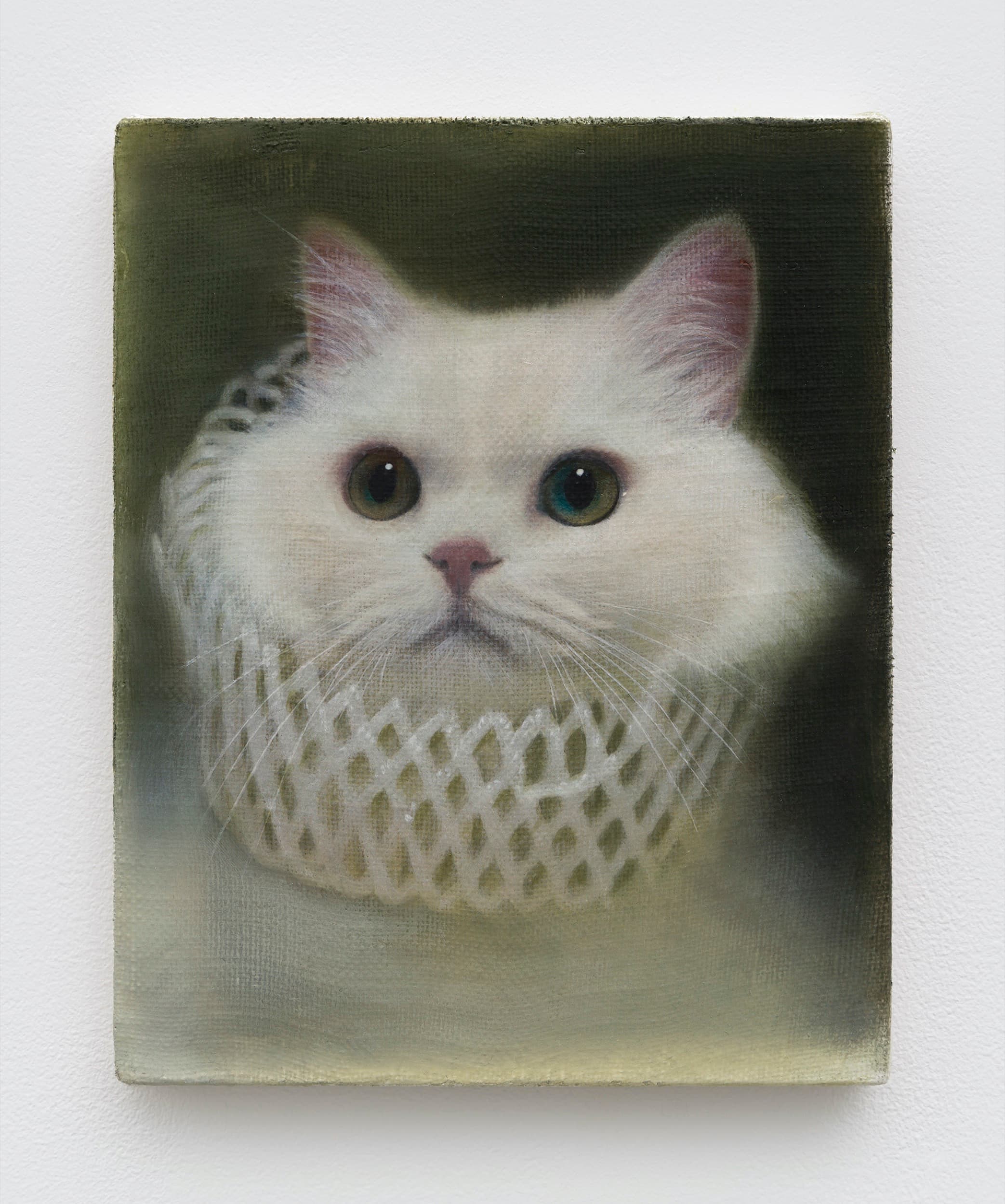
Joseph Jones, Cat in a fruit net, 2026. Oil and acrylic on linen, 10 × 8 inches. Courtesy the artist and Chapter NY.
Word count: 656
Paragraphs: 7
Chapter NY
January 9–February 21, 2026
New York
Our pets and how we treat them are a sign of the times, and in Joseph Jones’s latest show, at Chapter NY, intimate portraits of cats (and one dog) appear cuter than ever, thriving under contemporary conditions of attention and care. Part metonymy for contemporary life, part art-historical citation, part internet vernacular, Jones revitalizes the feline motif by situating it at the intersection of these registers where animals are treated as royalty and duly granted their own portraits. His cats are as indebted to the canon as they are to meme culture: solitary, inscrutable, and dense with projection.
Long associated with independence and cultivated taste—French lexicographer and publisher Pierre Larousse once claimed that “a pronounced taste for cats . . . was an indication of superior merit;” Jones’s felines inherit this legacy while absorbing newer forms of devotion and excess. In Gold cat (all works 2026), a snowy white Siberian cat looks aloof and a little tired. He sits in the arms of an anonymous figure wearing a satin gold Adidas tracksuit. A similar cat being held, without convictions can be seen in Glitter cat and White cat with a silk shirt. In these works, humans are reduced to cropped shots of arms, while the unbothered cats take center stage. Ironically, the presence of these peripheral humans who hold, pet, and love these cats are felt at every stage, from the construction of these images to their circulation online, and eventually, to their deceleration into paint.

Installation view: Joseph Jones, Chapter NY, New York, 2026. Courtesy Chapter NY.
The cats are rendered with an uncanny photorealism suffused by an almost artificial glow, an effect produced through Jones’s meticulous process of priming, painting, and sanding. He begins by coating thick linen with clear acrylic, allowing the weave to remain visible; after painting the image, he sands back sections of the surface, imparting a print-like texture that resists slickness. The resulting paintings feel both flattened and gently saturated, as if lit from within. In Cat in rainbow light, a white cat sits within a dulled, Lisa Frank-esque spectrum—a technicolor, dreamworld-like illumination that underscores the work’s quiet refusal of true photorealism, foregrounding artifice over illusion.
Historically, pet portraits have functioned less as likenesses than as projective screens for human affection and desire—a tendency Jones amplifies by constructing his images from vast digital archives rather than singular encounters. Drawing from thousands of reference images, he composites his subjects into figures that feel familiar without being specific. Pampered and embellished, the portraits elevate these animals to the status of royalty, translating care into ornament. Jones stages this devotion in varying registers: in one work, Cat in a fruit net, a white cat wears an Asian pear’s styrofoam net, casually repurposed as an Elizabethan ruff; in another, Cat in a gold hood, the plush white subject is fitted with a yellow knitted balaclava––a trendy accessory designed for humans and meticulously adapted for an animal body. Elsewhere, in White cat with gemstones, plastic rhinestones stud the cat’s face, a gesture Jones links to Joris-Karl Husmans’s 1884 novel Against Nature , though its visual logic also recalls pop star Olivia Rodrigo’s 2021 SOUR album cover. The distinction across these adornments is telling: where the net signals improvisation, the balaclava implies time, labor, and intention, underscoring the degree to which human care reshapes these animals into mirrors of our own attachment, regardless of their evident indifference.

Joseph Jones, Gold cat, 2026. Oil and acrylic on linen, 10 × 10 ½ inches. Courtesy the artist and Chapter NY.
Alongside the feline portraits is a small series of flower paintings—quiet, carefully rendered studies that ultimately fall flat against the conceptual friction that animates the cats. Where the flowers remain as exercises in surface and composition, the animals carry the full weight of Jones’s inquiry, absorbing layers of projection, care, whimsy, and excess. It is in these portraits that the exhibition is most persuasive: the cats, elevated and embellished, remain quietly unmoved, mirroring a culture that lavishes attention without expecting—or receiving—anything in return.
Rebecca Schiffman is a Brooklyn-based writer, editor, and art historian.