Brandt Junceau
Brandt Junceau is a sculptor, currently teaching at the New York Studio School. Instagram: @brandtjunceau
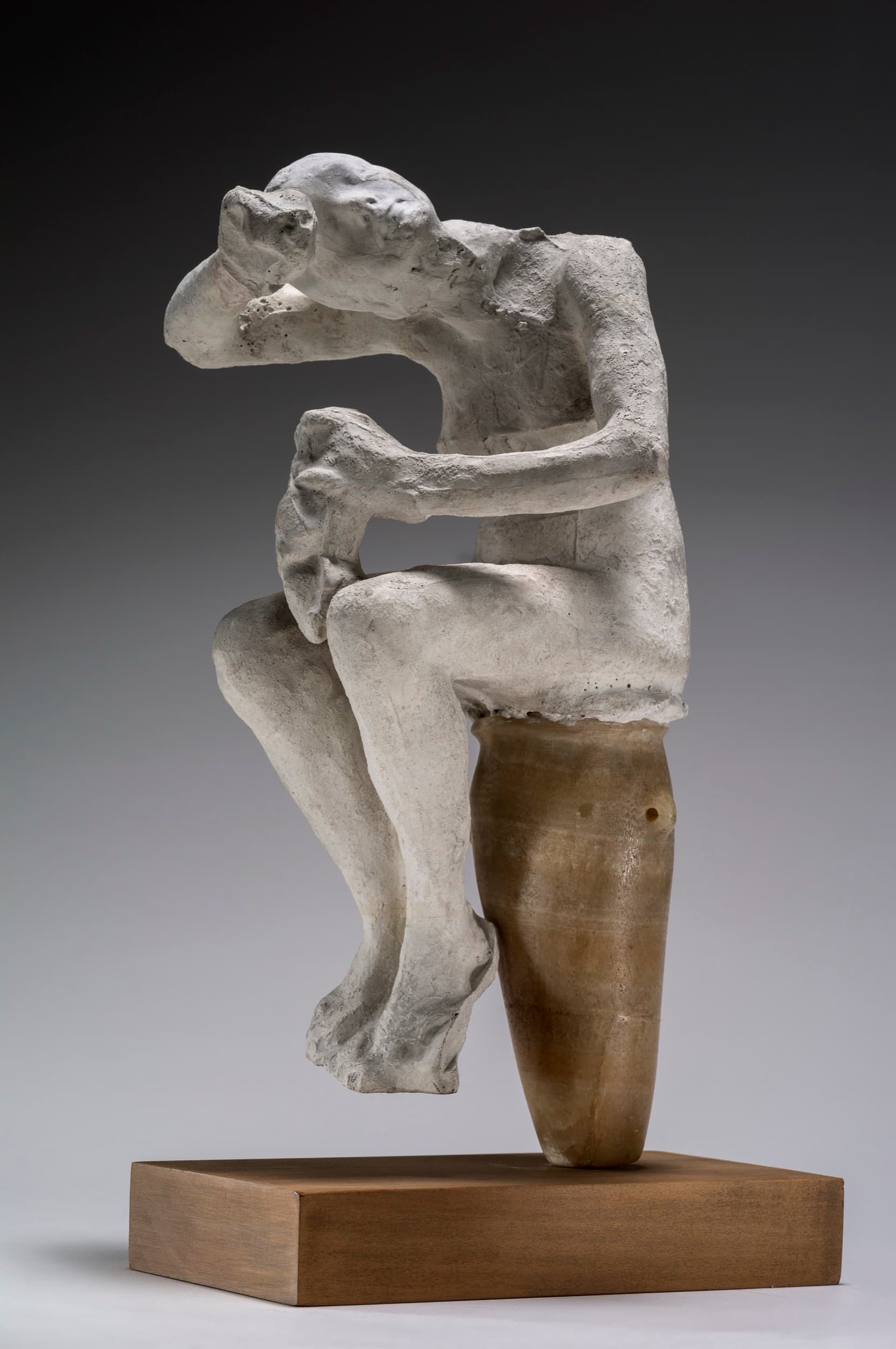
Rodin’s Egypt introduces Auguste Rodin the collector. It may surprise you that he had accumulated thousands of Egyptian, Greek, Roman, Indian, Asian, and pre-Columbian artifacts, but then a hundred years of Rodin exhibition and scholarship had quite ignored all that.
No One Thing, the current exhibition at Hauser & Wirth is, in effect, an estate sale. The seven items—all steel, all painted, 1961–64—are among the last in circulation. One is very glad to see them but does not mistake this group for a historical exhibition, which in various aspects it pretends to be. In its miscellaneous heterogeneity however, the exhibition is as close to the lost fields as we may ever get, and by a special power of the artist—nothing short of magic, he is present here as if in person. A busy-minded formalist who said, “I don’t edit;” these works were checked off Smith’s exhaustive must-do list. Some are almost unbearably personal.

The current Hans Josephsohn exhibition at Skarstedt uptown through October 28 is a grab bag. One is glad to see it but reminded that a gallery is an art store, with a stock. It happens not to include any of the artist’s reliefs, which are the inmost core of his art and very likely great.

In New York this new year, the exhibition with the most argument, conjecture, and consequence is the Metropolitan Museum’s Chroma. This somewhat sly intervention means to reintroduce the presence of color in classical art.

This artist’s life stares back at the would-be biographer, like a gorgon. The author turned a mirror on it. The tale is made to tell itself, witness by witness, snapped off in an unblinking chain of hard short chapters, almost voice by voice. By conscientious decision, maybe a matter of self-preservation, Brenson is a laconic guide rather than interpreter and thankfully, no explainer.

Confronting the Modern begs a question the exhibition does not mean to ask: just what is Rodin’s modernity? Which comes down to who was Auguste Rodin, really?

Existential sculpture as practiced by Alberto Giacometti, his via confrontational and often desperate portrait objects that stare back unblinking, or howl open-mouthed—has been little exercised since. It sleeps like a buried high-voltage line, as perilous as a third rail. No artist who isn’t perfectly serious, and tinged with gallows humor, should touch it either.

The centerpieces of the exhibition are seen from afar, backlit by the Lehman Ring rotunda: back-to-back terracotta and marble versions of Jean-Baptiste Carpeaux’s La Négresse, later entitled Why Born Enslaved! (modeled 1868, carved 1873). The installation is a set piece, and there is no mistaking the occasion as a marker—henceforward, the Metropolitan intends the collection to mix in the now, outside the walls, in the street, if possible.

An inspired paucity is the vehicle of the artist’s latest style. Perhaps he no longer needs much from the outside world. Maybe he gave too much already.

Craig Starr Gallery’s Myron Stout and Cycladic Art confronts the artist and the ancients, for the first time, face to face. The exhibition is quite literally museum-quality, including four of the iconic black-and-white paintings (that’s a lot—there are only 21 in total), three charcoal drawings in similar format, and a number of the later less-celebrated graphite drawings, startlingly small, in tones ranging from near-fleshy paper to smoky and smokier grays: no black, no white.

Our beloved Edward Hicks (1780-1849), painter of 62 Peaceable Kingdoms, was, we learn, maybe not so easily loveable. He was trouble, to put it lightly. And an early master of appropriation, pastiche and transhuman identity—he needed all that and more, to stand his ground and say his say.

Louise Bourgeois, Freud’s Daughter, an exhibition of 47 objects including sculpture on pedestals, in suspension and multiplying in vitrines, plus large freestanding vitrine-pieces, a very large “Cell” installation, paintings, collage, drawings, notes, plaques, and reliefs by Louise Bourgeois, with a selection of especially eloquent quotations from Sigmund Freud, is an event that each of its subjects might have wished for, maybe even demanded.

The Museum of Modern Art considers Modern from the Start the story of a relationship to its first and only “house artist.”

Authors say that writing sometimes writes itself, notably when their characters seem to speak out in their own voice. Visual artists claim a pristine silence for their own, which they prize, eye and hand alone together gladly, no words. The word that breaks that silence is often recriminatory, and resented. It came upon a scene uninvited, that should not have been witnessed. Words, they say, compromise sight, and the silent work of the eye.
When the poet-draftsman Lequeu loved a thing, he drew a section of it. An axial slice down the middle, revealing an unseen interior space, was surely his favorite go-to graphic sleight of hand. A section, which is a purely imaginary concept, makes anatomy out of every subject.

The exhibition is an eye-opener, in part because, quite as Marini had feared, this kind of thing just isn’t done anymore. These figures come to us from another world, although it really wasn’t so long ago. We are now accustomed to objects that are just that, but here every “piece” is a person.

The panel is more than precious; it is a relic, not of the saint, but the artist. The installation presumes that we will understand it to be a masterpiece, one of only six securely attributed to Leonardo’s hand.

Marino Marini is not my master. I was not that fortunate, but he is for me an exemplary artist.

You really have got the old man,” Kenneth Clark told John Pope-Hennessy upon reading his study of Michelangelo. The “old man” (1475–1564, painter, sculptor, architect, and poet) seems always to have been the old man, always at the top.

In 1937, Elie and Viola Nadelman's Museum of Folk and Peasant Arts was an original in practically every way. Today, the contents are still quite delicious; every piece exceptional, acquired while practically nobody else was looking, each cousin to a common aesthetic purpose.

Gian Lorenzo Bernini wasn’t always our Bernini. He was self-made (a ferocious infighter at the Vatican), and dominated baroque Rome with hard work, not simply by being the best man for every job.

I am lucky to have read Le Corbusier uncritically. I was sixteen, and I began with the big linen-bound Oeuvres Completes 1910-1965.

Michelangelo, the Man and the Myth might be more plainly called “Michelangelo Drawings from the Casa Buonarroti.” Fully half the checklist items are hagiographic materials of greater or lesser interest, which better portray the artist’s public perception and the lending institution’s holdings than the artist himself.
