Benjamin Clifford

Benjamin Clifford is an Art Editor at the Brooklyn Rail. He received his Ph.D. from NYU’s Institute of Fine Arts in 2019.

At first blush, the selection of Chuck Close’s pulp paper works now on view at Pace Prints provides little reason to recall that the artist came of age in the shadow of Abstract Expressionism.
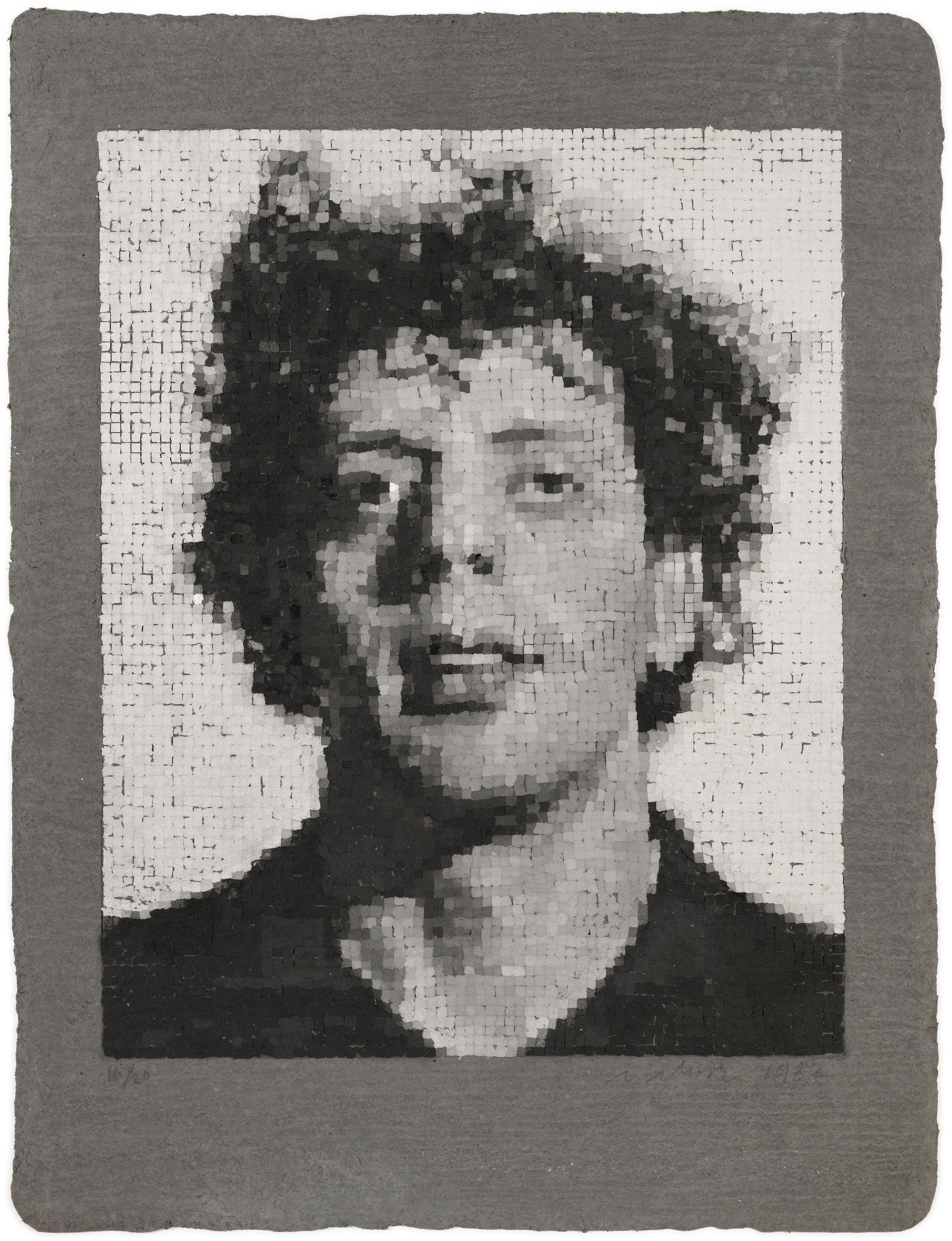
Chuck Close and Pulp

The literal meaning of the Afrikaans word apartheid is “separateness.” This was the guiding principle of the white supremacist regime that dominated South Africa from 1948 to the 1990s, according to which strict structural segregation between “White,” “Bantu” (Black), and “Coloured” South Africans was imposed through forced relocation and control of movement. It was under this system that photographer David Goldblatt, currently the subject of an extensive retrospective at the Yale University Art Gallery, grew up and came to maturity as an artist.

David Goldblatt, Methodists meet to find ways of reducing the racial, cultural and class barriers that divide them, 3 July 1980, 1980. Carbon ink print, 19 3/8 × 19 3/8 × 1 5/8 inches. Courtesy Yale University Art Gallery, New Haven, CT.

The Bruce’s wide-ranging chronological look at Blanche Lazzell’s career, which stretched into the 1950s, begins with four works from the late 1910s that show her experimenting with Fauvist color and divisionist paint handling.

Blanche Lazzell, Hollyhock, 1917. Oil on canvas, 25 ⅝ x 18 ⅛ inches. Art Museum of West Virginia University Collection, gift of Nancy Watkins in memory of James F. McKinley and Nancy W. McKinley. © Estate of Blanche Lazzell.

Looking at Sunset Enso from GMAC’s entrance in Hap Tivey's Perception is the Medium, it’s easy to see why the work of Light and Space artists like Tivey have so often been described as a kind of West Coast Minimalism. 

Installation view: Hap Tivey: Perception is the Medium, George Merck Art Collection, 2024–25, Palm Beach, Florida. Courtesy the artist and George Merck Art Collection.
The first thing a visitor to Mary Heilmann’s Daydream Nation sees is the artist herself. Immediately opposite Hauser & Wirth’s elevator, curator Gary Simmons has installed Untitled Watercolor Study (Self Portrait) (ca. 1989), a work which presents Heilmann’s profile silhouette over an irregular checkerboard.
Installation view: Mary Heilmann: Daydream Nation, Hauser & Wirth New York, 2024. © Mary Heilmann. Courtesy the artist, Hauser & Wirth and 303 Gallery, New York. Photo: Sarah Muehlbauer.
It’s February 2020 and I’m looking at two prints laid side-by-side on a work table in the Museum of Modern Art’s Department of Photography. Each shows a wooded pond in Westchester County in the dark of night, the moon rising, shining dimly between the trees that line the far edge of the water. In each case it is the same scene—the same brute visual information—and both images are rendered in soft focus, with a similarly Romantic atmosphere. But they are different.
Edward Steichen, Moonrise - Mamaroneck, New York, 1904. Platinum, cyanotype, and ferroprussiate print, 15 1/4 x 19 inches. The Museum of Modern Art, New York.© 2023 The Estate of Edward Steichen / Artists Rights Society (ARS), New York. Digital Image © The Museum of Modern Art/Licensed by SCALA / Art Resource, NY.
Although the people that populate the FCCB’s photographs may at times exist in Romantic solitude, the built environment and mass-produced goods around them proliferate relentlessly—these are unmistakably images of urbanism at mid-century.
Gertrudes Altschul, Lines and Tones (Linhas e tons), 1953. Gelatin silver print, 14 7/8 x 11 inches. The Museum of Modern Art, New York. Acquired through the generosity of Amie Rath Nuttall. © 2021 Estate of Gertrudes Altschul.
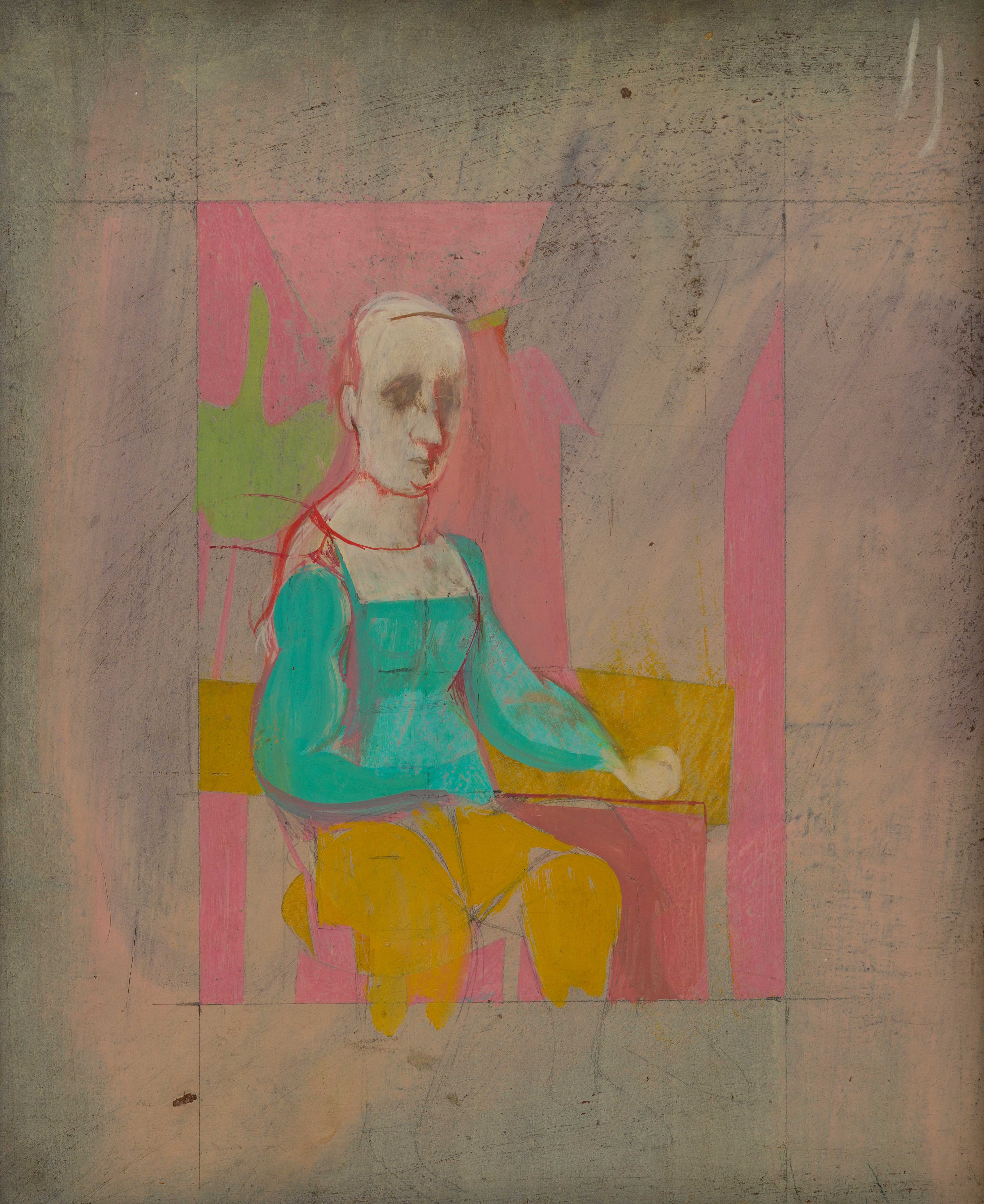
Willem de Kooning’s practice never stood in place for long, a sustained creative restlessness that is plain to see in a pair of exhibitions currently on view, one at Craig F. Starr and the other at Matthew Marks.
Willem de Kooning, Figure, 1944. Oil on masonite, 19 1/2 x 16 1/8 inches. © 2021 The Willem de Kooning Foundation / Artists Rights Society (ARS), New York.
The first impression made by Nour Mobarak’s solo debut in New York is celestial: several roughly spherical objects are scattered throughout Miguel Abreu’s Orchard Street gallery, like an eccentric solar system in miniature.
Nour Mobarak, Sphere Study 6 (Old Money), 2020. Trametes versicolor, wood, 11 1/4 x 12 1/2 x 12 1/2 inches. Courtesy the artist and Miguel Abreu Gallery, New York. Photo: Stephen Faught.
Both shows largely eschew the raw and overbearing aggression that Serra is best known for. Instead, they are finely judged installations that manipulate the relationship between a sculptural object, a display space, and a mobile viewer with great sophistication. The overall effect is thoughtful and, at times, even seductive.
Richard Serra, Nine, 2019. Forged steel, nine rounds: 84 inches high, 76 3/4 inches diameter; 78 inches high, 79 3/4 inches diameter; 72 inches  high, 83 inches diameter; 66 inches high, 86 inches diameter; 60 inches high, 91 inches diameter; 54 inches high, 96 inches diameter; 48 inches high, 102 inches diameter; 42 1/2 inches high, 108 inches diameter; 38 1/4 inches high, 114 inches diameter. © 2019 Richard Serra/Artists Rights Society (ARS), New York. Photo: Rob McKeever. Courtesy Gagosian.
The collages by Deborah Turbeville currently on view at Deborah Bell draw mainly from the photographer’s work in fashion. Turbeville’s images are shrouded in a gothic atmosphere of deep shadows and Romantic decay, and her models typically convey alienation or psychological dissociation—not precisely the glamour we expect of luxury advertising.
Deborah Turbeville, Passport, 1977. Collage of eight gelatin silver prints mounted on paper, 18 x 13 inches. Courtesy  Deborah Bell Photographs, New York.
Radicalism thinks through this dialectic within Japan itself and on an international scale. The show features boundary-pushing artists who worked in areas remote from Tokyo—the seat of the art establishment after World War II—while proposing the terms “connection” and “resonance” to describe, respectively, concrete links and conceptual parallels with figures in Europe and the United States.
Matsuzawa Yutaka, On Another Work in Another Container, or On Cutting, 1963. Brochure, 7 3/8 x 5 1/8 inches. Keiō University Art Center, Tokyo;Takiguchi Shūzō Papers, ca. 1945–1979.
Raha Raissnia’s atmospheric new paintings, drawings, and projections share much with the work she exhibited at The Drawing Center last winter.
Installation view: Raha Raissnia: Galvanization, Miguel Abreu Gallery, New York, 2019. Courtesy the artist and Miguel Abreu Gallery, New York. Photo: Steven Faught.
The title of the Met’s new ongoing installation, Epic Abstraction: Pollock to Herrera, suggests a revisionist take on the history of abstraction since World War II. However, the show is drawn almost entirely from the permanent collection, which is simply not broad enough in this area to fulfill such an ambitious promise.
Jackson Pollock, Number 28, 1950, 1950. Enamel on canvas, 68 1/8 x 105 inches. © 2018 The Pollock-Krasner Foundation / Artists Rights Society (ARS), New York.
The selection of work by members of the Japanese art collective Gutai at Hauser & Wirth 69th Street aims to highlight the importance of painting to the group’s avant-garde practice. Active from 1954 to 1972, Gutai’s interest in this medium was idiosyncratic, and many of the works displayed here were not intended as self-sufficient pieces. Instead, they were intimately linked with public performances or other bodily actions.
Kazuo Shiraga, Kaku Rou (Threatening Wolf), 1963. Oil paint on canvas. 91.4 x 116.8 x 3.2 cm / 36 x 46 x 1 1/4 in. © Kazuo Shiraga. Photo: Genevieve Hanson.
The varying texture of local stone, the colors of a specific landscape, the ephemera of regional commercial culture—Orozco’s work finds its enduring vitality in the slippages and incongruences that emerge from these factors.
Gabriel Orozco, Orbit’s Trace (Primal), 2018. Tempera on gesso on wood
24 3/4 x 24 3/4 x 3 1/4 inches. Courtesy of the artist and Marian Goodman Gallery. Photo: Cathy Carver.
This presentation of thirteen works by David Salle focuses on the ten years following his establishment in the art world—a period that saw the painter’s compositions grow denser and more complex in their staging.
David Salle, Old Bottles, 1995. Oil and acrylic on canvas, 96 1/8  x 128 1/8. © David Salle / Licensed by VAGA, New York, NY.
Acquavella’s The Worlds of Joaquín Torres-García is a wide-ranging and substantial look at the Uruguayan master’s career, drawing on material executed as early as the artist’s youth in the late nineteenth century and as late as 1949, the year of his death.
Joaquín Torres-García, Arte constructive universal [Universal Constructive Art], 1942. Tempera on wood, 60 9/16 x 60 1/2 inches © Alejandra, Aurelio and Claudio Torres, Sucesion J.Torres-García, Montevideo 2017.
The Guggenheim’s concisely titled Josef Albers in Mexico explores Albers’s experience of the eponymous Latin American nation, focusing on his frequent visits to pre-Columbian monuments and archeological sites.
Josef Albers, To Mitla, ca. 1940. Oil on Masonite, 53.3 centimeters x 71.1 centimeters. Courtesy of The Josef and Anni Albers Foundation. © 2017 The Josef and Anni Albers Foundation/Artists Rights Society (ARS), New York.
In his most characteristic works, Nuvolo stitched fragments of fabric together with a sewing machine to form an asymmetrical but carefully balanced grid.
Nuvolo (Giorgio Ascani), Untitled, 1960. Sewn canvas and deerskin, 55 x 72 cm. Collection Renghi, Cittàdi Castello. Courtesy Di Donna Gallery.
The works that make up Serra’s current show reveal an approachability that’s surprising for a figure commonly associated with aggressive, even overwhelming, effects.
Richard Serra, Four Rounds: Equal Weight, Unequal Measure,  2017. Installation view, Richard Serra: Sculpture and Drawings, David Zwirner, New York, 2017. Photo by Cristiano Mascaro. © 2017 Richard Serra / Artists Rights Society (ARS), New York. Courtesy David Zwirner, New York/London.
Kairos, the title of Pat Steir’s most recent exhibition at Lévy Gorvy, is taken from an Ancient Greek word that refers to the right or opportune moment for action.
Pat Steir, Kairos, installation view. Courtesy of Lévy Gorvy. Photography by Tom Powel
Minimalism and Beyond takes its title seriously: an emphasis on ‘beyond’ informs Mnuchin Gallery’s liberal selection of works, and lets surprising, productive connections develop. That said, the conventional narrative of Minimalism’s origins in the early 1960s and its evolution into Postminimalism later in the decade is well represented.
Installation shot of Minimalism and Beyond. Photo Tom Powel Imaging. Courtesy Mnuchin Gallery, New York.

Close

Home