Mary Heilmann: Daydream Nation
Word count: 1305
Paragraphs: 9
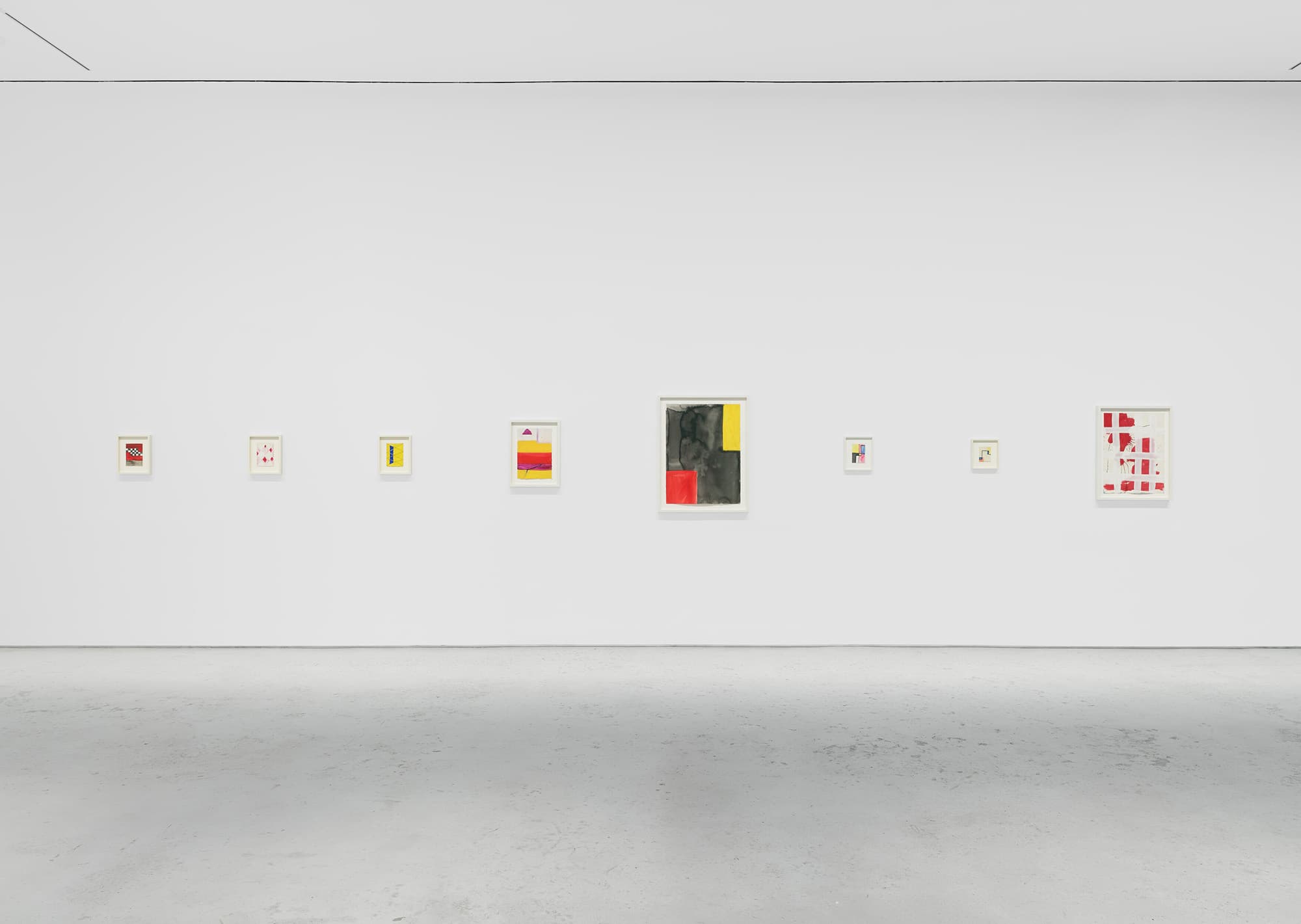
On View
Hauser & WirthDaydream Nation
May 2–July 26, 2024
New York
The first thing a visitor to Mary Heilmann’s Daydream Nation sees is the artist herself. Immediately opposite Hauser & Wirth’s elevator, curator Gary Simmons has installed Untitled Watercolor Study (Self Portrait) (ca. 1989), a work which presents Heilmann’s profile silhouette over an irregular checkerboard. The color of her outline shifts from one square to the next, oscillating between white and black as it winds its way across the composition. The work’s placement is appropriate, as it embodies themes that have preoccupied the artist throughout her long and distinguished career. How can the anonymous language of geometric painting visually coexist with the presence of an artistic self? How do we grasp the meaningful relationships between an artwork in itself and the environment in which it exists? Throughout the exhibition Heilmann’s work raises these questions, and, like the shifting profile of Self Portrait, our search for answers continuously changes direction as she reframes the terms of engagement again and again.
Heilmann made her first paintings in the early and mid-seventies after growing dissatisfied with the reception of her sculptural works. In those preliminary acrylics, Heilmann made clear, if subversive, use of grid composition and the primary colors—motifs that are not only associated with the tradition of aesthetic modernism, but are often taken to emblematize its self-critical rejection of the world beyond the framing edge of the canvas. Over the following half decade, putting pressure on this way of thinking about painting became an important aspect of Heilmann’s work. Crucially, she exchanged the grid for the image of the frame itself, the literal line of division between art and the world around it, restating this quadrilateral structure within her compositions in ways that increasingly break down the distinction between an interior and exterior. This process reached its initial culmination in 1978, when Heilmann abandoned the expressively neutral primary colors for black, silver, and electric pink, a punk-rock palette that opened her work to popular meanings drawn directly from her experiences in the music scene of late-seventies New York.
Daydream Nation picks up on this moment with a notable early work, an Untitled Study (ca. 1978) whose composition is built from two overlapping squares: one small, silver, and set in the bottom left corner of the other, a significantly larger form divided along the diagonal into pink and black triangular halves. Images built from such inset or superimposed quadrilaterals abound in this exhibition and in Heilmann’s work more generally—it is a format she has explored in many different contexts. Two untitled watercolor studies (ca. 1983–1986), for example, make use of similar inset compositions, structuring them around a meandering black line that sections off red, yellow, and blue quadrilaterals as it traverses the paper, like a rectangle that has been opened up and unspooled. Islands (1988), too, returns to the primary colors of the mid–seventies, staging a red square in the bottom left corner and a yellow rectangle at upper right. Between them is an expanse of black wash whose form suggests two rectangles overlapping, a subtle implication of spatial depth that fractures the self-contained integrity of the picture plane.
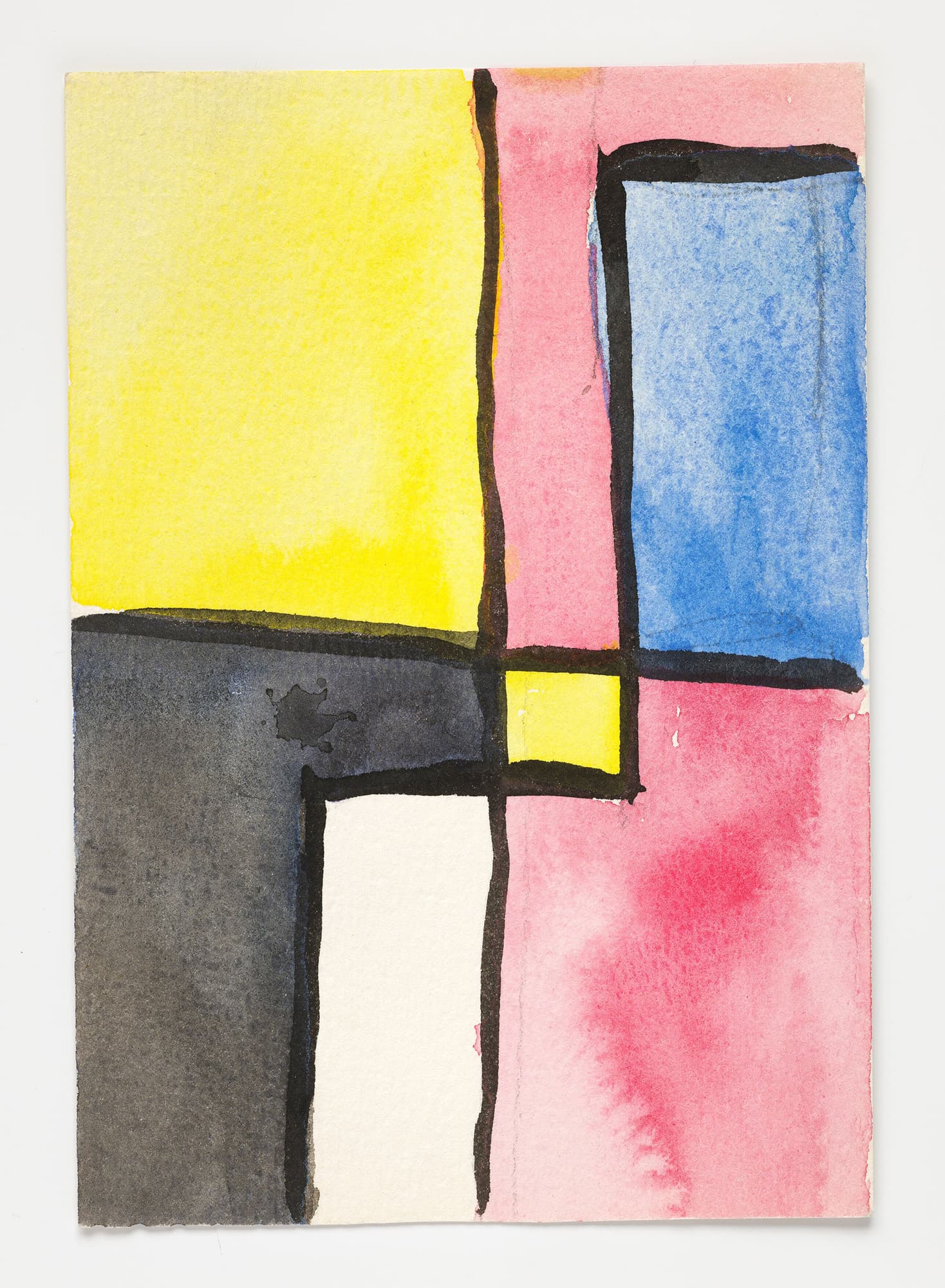
Numerous works included in Daydream Nation are structured around two squares overlapping or touching at the corners; called a “slipped square” by the critic Terry Myers, this format is a trademark of Heilmann’s later career. In Converge (2007), for example, Heilmann heightens the motif’s implication of pictorial depth by filling it with a recessive perspectival grid in several shades of blue aquatint. The notional vanishing point of this system would be found somewhere above the slipped square’s upper left corner, and indeed that terminus point is provided to us, although in an unexpected way. Above the slipped square, the artist placed an inkjet print of a highway receding dramatically into depth, its own vanishing point located more or less where we would have expected to find that of its abstract aquatint companion.
With this work Heilmann makes explicit some of the questions that usually remain buried beneath the surface of her work. How does the construction of an image relate to experiences beyond it? Can you map one onto the other, and if so, how? As Heilmann’s career has developed, she has pushed the exploration of these issues beyond discrete works. They inform the overall scheme of this exhibition. Consider the chairs, designed by Heilmann, that are scattered throughout the gallery. Constructed like wood boxes, the parallel painted squares that make up their sides and arms double for the overlapping quadrilaterals of Heilmann’s signature slipped square format. As if daring us to make the connection, two untitled watercolor studies included here inscribe the image of a dining chair on pictorial grounds that take the form of slipped squares.
This cunningly installed show goes further still, suggesting slippery congruences between Heilmann’s works and the architecture of the gallery. This occurs most dramatically with a monumental wall drawing in the exhibition’s main room. Here, Heilmann’s composition is made up of a black slipped square, flanked at upper right and lower left by rectangles in washes of aquamarine. Pushing past the simple gambit of working directly on the wall, Simmons and Heilmann make the complex relationship between architecture and painting explicit by hanging the Untitled Watercolor Study (ca. 1982–1984) from which the wall drawing is derived on the wall itself. At upper left, we also find Tea Garden (1984), a work whose grid pattern includes a watery teal that closely resembles the aquamarine of the wall drawing, further highlighting the dialogue of Heilmann’s work with its architectural setting.

In these works, the aquamarine flows. Whether due to its application in loose gestural brushstrokes or what appear to be watered-down washes, the paint acts like a wave in the ocean. This is another recurring theme of Heilmann’s work, and emerges from early experiences as a competitive diver and then a participant in the Santa Barbara surf scene. In Line Up (1995) and Close Out (1995), blue horizontal bands alternate between the near-black of stormy waters and the cool off-white of spume in abstracted evocation of the crashing surf. Two untitled watercolor studies (both, also from 1995) go further, flirting with a straightforward representation of swells breaking into foaming crests and troughs.
One of these “wave” paintings is found on the opposite side of the wall on which Heilmann’s silhouette Self Portrait hangs. It is one of four plainly representational works clustered together to close the exhibition. The largest and most dramatic of these, Palm Tree (ca. 1996), stages its subject against an ambiguous off-white ground, attenuated trunk reaching up the right side of the page to a burst of foliage near the top. I can’t help but see this composition as a clever echo of the Sonic Youth album that gives the exhibition its title: the cover, a Gerhard Richter painting titled Kerze (Candle) from 1983, shows us a slim candle set near the right edge of an ambiguous, neutral ground. Equally, I can’t help but see Palm Tree as an unusual kind of self-portrait, folding the exhibition back on itself as it folds Heilmann’s life back on itself, layering the Santa Barbara surf onto New Wave New York. In this way Heilmann’s tree is a kind of abstraction, a depiction of the self that seems appropriate to her consistently elusive and challenging body of work. Here is an image that operates only by implication, providing no dramatic gesture of self-expression, and not even so tenuous a trace of the artist’s physical presence as the delicate outline of a simple silhouette.
Benjamin Clifford is an Art Editor at the Brooklyn Rail. He received his Ph.D. from NYU’s Institute of Fine Arts in 2019.