Amber Jamilla Musser

Amber Jamilla Musser is professor of English and African Studies at the CUNY Graduate Center. She is the author of Sensational Flesh: Race, Power, and Masochism (NYU Press, 2014), Sensual Excess: Queer Femininity and Brown Jouissance (NYU Press, 2018), and Between Shadows and Noise: Sensation, Situatedness, and the Undisciplined (Duke University Press, 2024).

Thomas J Price’s Within the Folds (Dialogue 1) (2025) is not quite the first sculpture that greets viewers in the gallery, but it is the tallest. With Resilience of Scale, Price has assembled five of his immense bronzes—three women and two men, each a Black person, unconcerned in their own way with the world around them. These bronzes are immediately striking not only for their size, but also for their casual attire and relaxed postures. Composites of figures who one might glimpse on the street, they call to mind the quotidian textures of Blackness.

Thomas J Price, Time Unfolding. Bronze, 108 × 34 7/8 × 37 1/2 inches. © Thomas J Price. Courtesy the artist and Hauser & Wirth. Photo: Keith Lubow.

What first looks like a moody expanse of chocolate and burnt umber with hints of green and rose gold gives way, upon closer inspection, to a set of underlying patterns. At evenly spaced intervals, lighter shades of mauve produce long narrow islands snaking their way from the bottom to the top of the painting. Looking closer still, one can find a few partial pale horizontal fragments of lines.

Kemar Keanu Wynter: Rücken-

David-Jeremiah asks viewers to feel the emotional drama of what it is to be a spectacle. Ultimately in I Drive Thee, he is the “I” in the exhibition, serving as our navigator through this fraught terrain.

David-Jeremiah, I Drive Thee, 2022. Mixed media, manila rope, spray paint and oil-based enamel on wood panel, 60 × 60 inches. Courtesy the artist.
What happens when whiteness is put on display? This is the question at the heart of King Cobra’s White Meat, a show that illuminates the sadism, power, and playfulness of the artist even as it portrays varieties of whiteness as threat, as diseased, and as contagion.
Installation view: King Cobra: White Meat, JTT, New York, 2023. Courtesy the artist and JTT, New York. Photo: Charles Benton.
Kyle Dunn’s Night Pictures offers quiet, intimate scenes that hum with depth. Under the rubric of domesticity—cocktails, dogs, and fashionable garments—the show brings together a wealth of ambivalent emotions, seemingly brought about by the day’s slide into night.
Kyle Dunn, A Night Off, 2023. Acrylic on panel, 30 x 24 inches. Courtesy the artist and P·P·O·W.
Representation can trap, but, Marshall suggests, there is also always a lot more going on underneath the surface. Excavating these corpses reveals portions of the (exquisite) breadth of permutations (past, present, and futural) for Black life and Black ways of living.
Kerry James Marshall, Untitled (Exquisite Corpse Rollerblades), 2022. Acrylic on PVC panel. 78 x 120 x 2 inches. © Kerry James Marshall. Courtesy the artist and Jack Shainman Gallery, New York.
Amber Jamilla Musser sits down with Jennifer Packer to discuss Blackness, painting, and temporality. The lively conversation roams through art history, Black feminisms, and the political import of shifting hierarchies of valuation.
Portrait of Jennifer Packer, pencil on paper by Phong H. Bui.
In a world that feels more constricted with climate catastrophes and social restrictions, how does one lift? How does one get beyond the borders of a compressed body, a compressed language of the self? How does one begin to transcend to a space of release, to a space of flow, to a space of euphoric joy?
Installation view: Get Lifted, Karma, New York, 2021. Courtesy Karma, New York.
Amber Jamilla Musser speaks with Mickalene Thomas about the artist’s processes of art-making, collaboration, and portraiture.
Portrait of Mickalene Thomas, pencil on paper by Phong H. Bui. Photo: Andrew Mangum
Amber Musser profiles the Fountain House Gallery.
Mural formerly on view on West 34th Street. Courtesy Fountain House Gallery.
All three exhibitions manifest theorist Donna Haraway’s concept of sympoiesis and use the forms of the book to enlarge what constitutes knowledge and being together. In these profound (and profoundly different) engagements with sensing, we realize that the book not only contains knowledge, but also invites ethics—how can and should humans engage?
Kristoffer Ørum, Signal Crayfish (2021). Photographed by Sean Davidson.
As this year’s QUEERPOWER commission, Chitra Ganesh has filled 10 panels of Leslie Lohman’s façade with images of queer activism, joy, and meditations on history, possibility, and gentrification.
Chitra Ganesh, A city will share her secrets if you know how to ask, 2020. Site-specific QUEERPOWER public art installation. Courtesy Leslie-Lohman Museum of Art. Photo: © Kristine Eudey, 2021.
Chase uses the laundromat to illustrate how practices of the quotidian—washing, here—can bring together individual needs and vulnerabilities into a form of collective possibility, showing the ways that care (both of the self and others) is fundamental to community.
Installation view: Jonathan Lyndon Chase: Big Wash, in collaboration with The Fabric Workshop and Museum, Philadelphia, 2020. Photo: Carlos Avendaño.
In this moment of institutional and personal reckoning about the legacy of settler-colonialism and violence against Indigenous people, Kent Monkman’s work invites provocative intersections with the canon of Western European and American art history while exploring themes such as sexuality, colonization, loss, and resilience. Monkman is an interdisciplinary visual artist and member of the Fisher River Cree Nation in Treaty Five territory, Manitoba.
Portrait of Kent Monkman, pencil on paper by Phong H. Bui.
Tell Me A Story, I Don’t Care If It’s True is comprised of portraits of Black people made from colored pencil, graphite, and ink. These are not images of capture—no one seems to acknowledge the viewers.
Toyin Ojih Odutola, 10 Minutes, 2020. Colored pencil, graphite, and ink on Dura-Lar, 33 1/2 x 41 1/2 inches. © Toyin Ojih Odutola. Courtesy of the artist and Jack Shainman Gallery, New York.
Without many of its external markers, the phenomenology of time has been profoundly altered: we exist in a constant negotiation between realities and temporalities. In its excavation of memory—both personal and collective—Maureen Catbagan’s recent painting series plumbs the psychological space of this uncertainty.
Maureen Catbagan
These are frantic times defined by uncertainty, emergency, and dread. Worse, there is seldom space for anything else. Johnson ’s drawings capture these heightened emotional states, but instead of producing catharsis, they keep viewers hanging in the air.
Rashid Johnson, Untitled Anxious Red Drawing, 2020. Oil on cotton rag, 38 1/4 x 50 inches. Courtesy Hauser & Wirth.
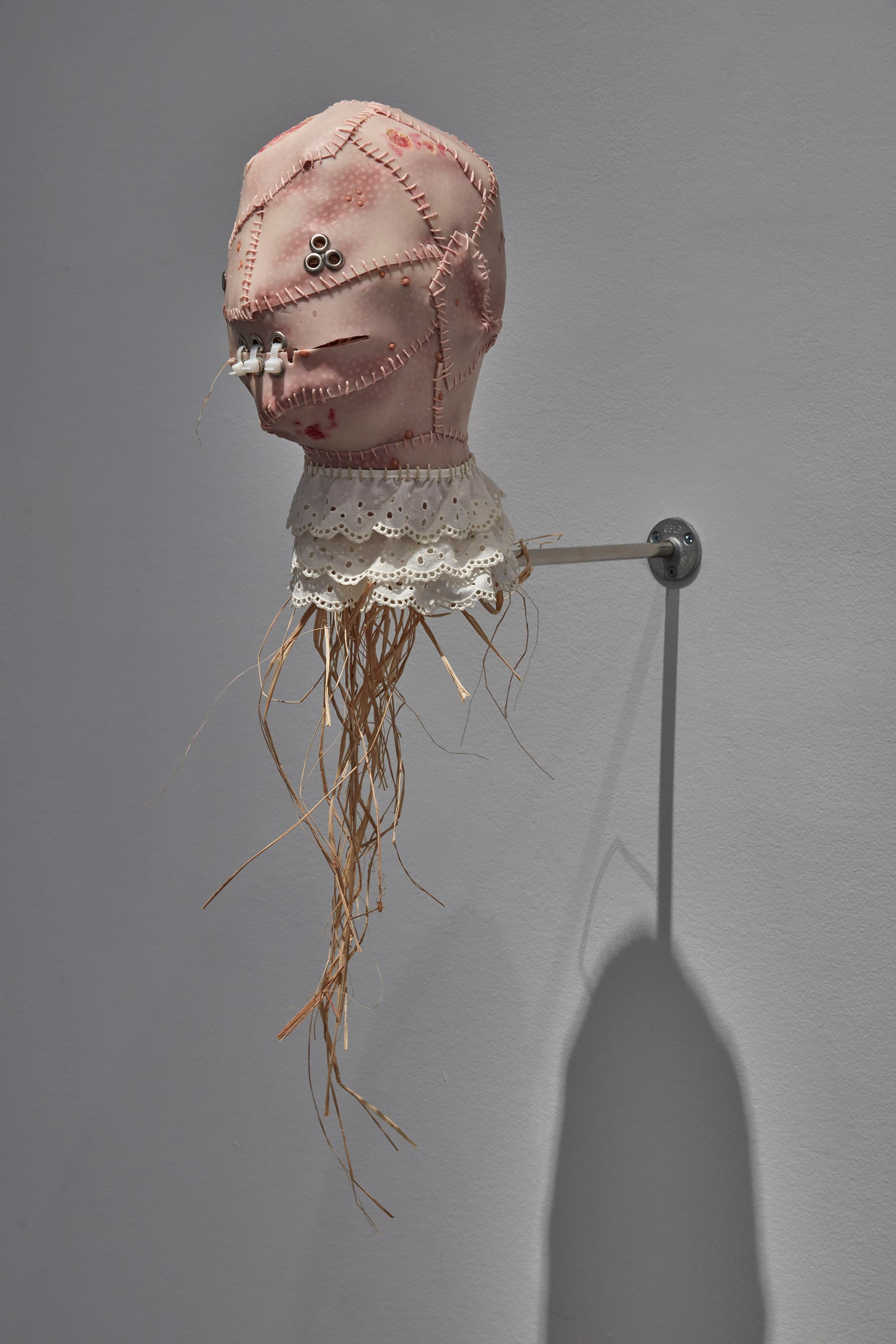
In the back room of JTT, held by subtle spotlights, there is a gathering of flesh: it is arranged package-like so that each side folds over to almost meet in the center, revealing a tender interior. This is Doreen Garner’s meditation on Black gender, a theorization that moves us toward multiple valences of enfleshment.
Doreen Garner, After Her Tomb, 2020. Urethane foam, silicone, steel pins, pearls, 27 x 23 1/2 x 7 1/4 inches. Courtesy the artist and JTT, New York.
What we do see throughout Room for Living, however, are numerous forms of indebtedness—to the canon and, importantly, to Satterwhite’s mother. Elements of Patricia suffuse the exhibit. The LED texts that surround several sculptures are made from her words and handwriting, the drawings of bathtub, penises on wheels, and shoes are taken from her notebooks.
Jacolby Satterwhite, in collaboration with The Fabric Workshop and Museum, Philadelphia, Room for Doubt, 2019. 5-channel HD color video, insulation foam, expanding glue, resin, fairing filler, plywood, faux-leather vinyl, double-faced chiffon, polyester rope, thread, automotive paint, and inkjet print on synthetic cotton, 93 x 96 x 96 inches. Courtesy the Fabric Workshop and Museum, Philadelphia.
Sonya Clark illuminates the profound entanglement between our current moment and the Civil War by putting her body on the line.
Sonya Clark, in collaboration with The Fabric Workshop and Museum, Philadelphia, Reversals (detail), 2019. Photo: Carlos Avendaño.
The mood is somber and monumental. Blue ink washes over icebergs, enlarged strips of newsprint, and images of Black women.
Lorna Simpson, Blue Dark, 2018. Ink and screenprint on gessoed fiberglass, 102 x 144 x 1 3/8 inches. © Lorna Simpson. Courtesy the artist and Hauser & Wirth. Photo: James Wang.
It's the green that really catches my eye; it forms the texture of the sitter's pants. As I keep looking, I notice other details—the couch cushions, the strong profile, the palm fronds in the background. The background is warm and diffuse, but rather than look at the viewer, the sitter is paying attention to something—a phone?—in his hands. This is a portrait of absorption; it is also one of intimacy. I'll be honest, the sitter reminds me of my brother.
Jennifer Packer, M. Heller, 2018. Oil on canvas, 12 x 16 inches. © Jennifer Packer, courtesy Sikkema Jenkins & Co., New York.
Yukultji Napangati paints timelines—yellow and orange dots connected by undulations that curve and spiral, submerging the viewer within the immensity of a vibrating sea. Time through lines, and yet outside of time.
Installation view, Yukultji Napangati, Salon 94, New York, 2019. Courtesy Salon 94, New York.
What does history look like? Jacob Lawrence's series of fifteen prints on Toussaint L'Ouverture, displayed at DC Moore gallery, invites us to contemplate the complexities of a historiographic intervention within the context of aesthetics.
Jacob Lawrence, Toussaint at Ennery, 1989. Silkscreen on paper, 18 5/8 x 29 inches. Courtesy DC Moore, New York.
The sound of James Baldwin’s voice greets visitors first. It originates from a Victrola record player, unceremoniously placed on the floor in the back of the first room, which plays a 1932 recording on vinyl of Baldwin singing “Take My Hand, Precious Lord.”
Richard Avedon, James Baldwin, writer, Harlem, New York, 1945. © The Richard Avedon Foundation. Courtesy David Zwirner
In its presentation of innocence that isn’t quite, Sable Elyse Smith makes criminality the absent center of the show; it haunts, but is not depicted.
Sable Elyse Smith, Room One: The Watcher, 2018. 6-channel synchronized video, monitors, sound, custom floor, paint in timid white, dimensions variable. Courtesy JTT New York.
This is not an exhibit that insists on presenting wealth as loud and spectacular. Rather, wealth is what permits contemplation.
Toyin Ojih Odutola, Heir Apparent, 2018. Pastel, charcoal and pencil on paper, 63 1/4 x 42 inches. Courtesy Jack Shainman Gallery.
PÒTOPRENS is a feast for the eyes. Occupying three floors at Pioneer Works in Brooklyn, the show brings together twenty-five contemporary artists working in different mediums in order to showcase Haitian art, much of which has not previously been displayed in the United States. This breadth is a deliberate curatorial choice; it reflects the city’s geography and the resultant microcosms of artistic communities, and is a confirmation of the vigor and aesthetic prowess of Haiti’s artists.
Installation view. PÒTOPRENS: The Urban Artists of Port-au-Prince. Curated by Leah Gordon and Edouard Duval-Carrié. Pioneer Works, New York, September 7 – November 11, 2018. © Dan Bradica.
Mulvey shows us that the power of the gaze operates by producing or reifying distance between the one who watches, who is presumed to have power, and the object of the gaze, who is assumed to lack it.
Tracey Moffatt, Spanish Window (from the series Body Remembers), 2017. Digital print on archival rag paper, 60 x 89 1/2 inches, Edition of 6. Courtesy Tyler Rollins Fine Art.
Now is the time to rethink the relationship between race and representation. This is not about simply increasing the number of minority artists, critics, and art consumers, but a question of re-imagining what representation could look like when we think expansively through the affective parameters of race.

Close

Home