Jem Calder’s I Want You to Be Happy
Word count: 892
Paragraphs: 10
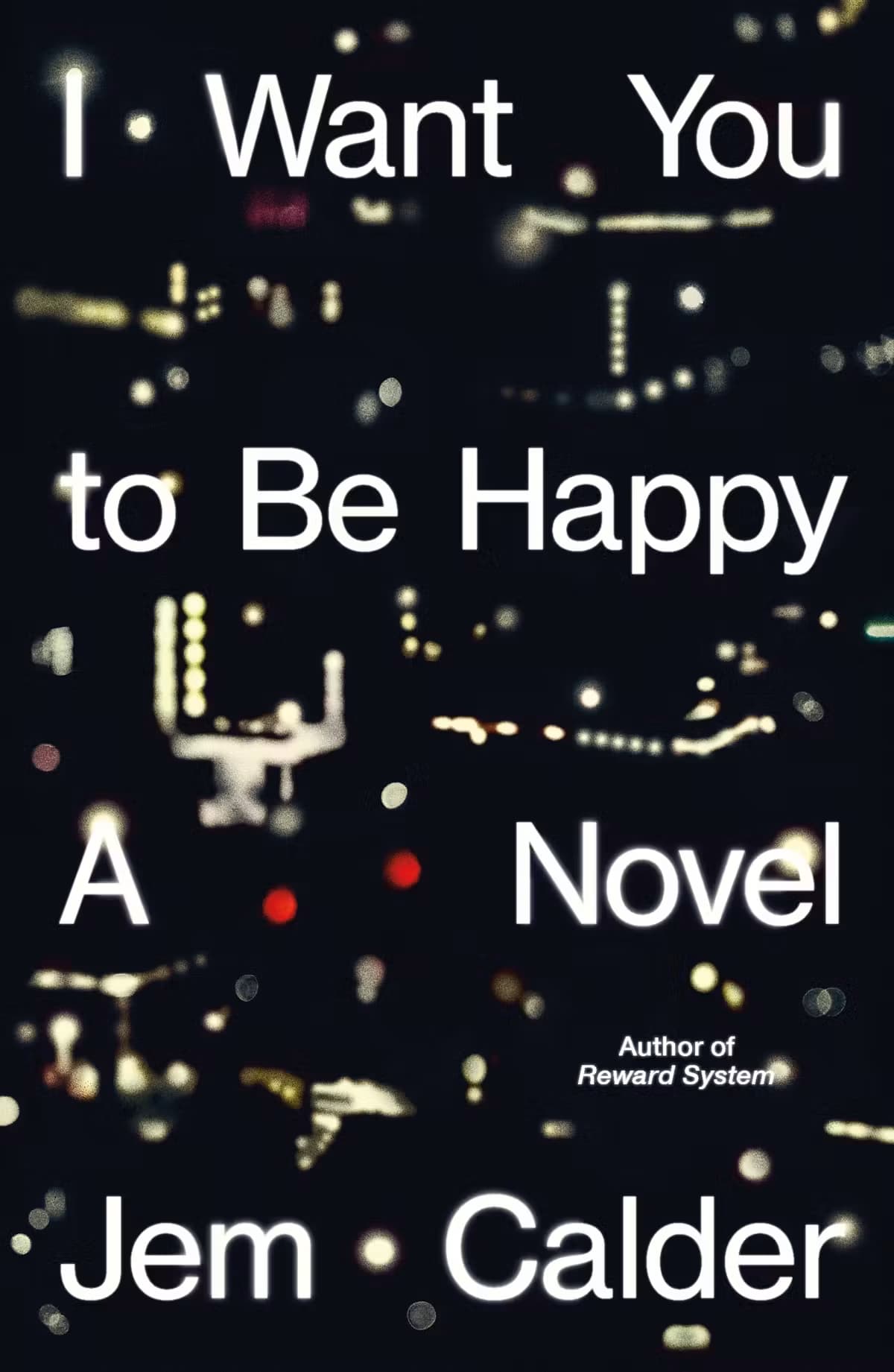
I Want You to Be Happy
Farrar, Straus & Giroux, 2026
During and after the pandemic, my main literary taste were novels on Lexapro; their narrators were glassy-eyed, their prose bare. The characters write poetry and fiction, but mostly look over their poetry and fiction in Google Docs. They are invited to parties by people they sort of know and have somewhat enjoyable times. They overanalyze how many exclamation marks they send in a text and get reprimanded at work via passive-aggressive Slack messages. They’re cynical, bored, and sometimes cruel. Sally Rooney comes to mind, but also Halle Butler, Lauren Oyler—anyone whose protagonists existed to crudely depict modern life while also enjoying lying down. You can almost always sense these novels being guided by the North Star of My Year of Rest and Relaxation.
So when I read Jem Calder’s I Want You to Be Happy, I waffled on whether his debut novel was dated or a continuation of a glum universe—a simplicity achieved in his glowing short story collection, 2022’s Reward System. One could slip into one book after the other just as easily; his writing remains crystal-clear and eagle-eyed, even though his characters merge into a clump of grumpy millennials. The world, Calder suggests, doesn’t need pomp and circumstance. Our behavior alone is enough to create a story.
I think I would agree with this. Some of my favorite writers, Jennifer Egan and David Sedaris (and Calder’s friend, Rooney), rely almost exclusively on the human condition and all the silly things we do under stress or love or pressure or desperation. But Calder has the benefit of an anchor in Reward System—he’s true to this, not new to this. Even so, it’s risky to write a sentence where Joey “put in her earphones and streamed a new album by her favorite singer-songwriter: the album’s release having been brought to her attention via push notification earlier that day.” In 2026 it’s more than reasonable for someone to roll their eyes at an aversion to proper nouns.
Despite this somewhat gray world, I Want You to Be Happy’s charm is its magnetism and relatability. Chuck, a copywriter, and Joey, a barista, meet at a bar. He’s around a decade older than her, which gets some laughs from her friends. He gets erectile dysfunction when he brings her home, but she’s kind about it, and stays over. She goes from his place to work, where she scrolls Instagram. The book remains at this adrenaline level the entire time—Chuck nods off at work and is demoted on a project, Joey works on her fiction with light encouragement from him. (He snoops on her stories, published on now-defunct websites.)
While their bar chatter and bedroom foibles are more satiating than expected, they aren’t the most interesting couple—one can throw a stone in Brooklyn and hit five dudes who have yammered on about their ex on a first date, as Chuck had. This might be the point—these people are simple yet understandable. Reading Calder’s fiction is just as easy as operating within the rhythms of life. His stories mirror existence; that alone is a talent, even if you’re looking for a gaudier narrative.
Even so, the book’s realism is sometimes a detriment; Joey and Chuck are gentle waves, not tsunamis. The novel’s highest peak is when the couple travels to the country over the winter to dogsit for Chuck’s brother. One night lounging at the fireplace, Chuck reveals he’s finished his novella, and goes fishing for her feedback—“I can just print you off a PDF. It’ll take you, like, two hours to read?” He erupts after her review is less than laudatory. For what it’s worth, Joey’s right; Chuck’s writing is loopy and indulgent: “Could X and I ever truly know one another? We were, after all, each enisled in the solipsism of our atomised selves,” he writes—yes, that is “enisled,” as in, to make into an island, or isolate. The novella is titled Paradigms, for Christ’s sake.
The couple’s first and last major argument is knotty and real—an asshole writer up in arms over the slightest bit of feedback. His volume scares both Joey and the dog. This is what the novel had been building to all this time, and the couple fractures immediately after. An insecure writer shooting himself in the foot is the most egregious thing that could be done in a novel where most conflicts arise over the duration between text messages. Things fizzle out with them, and so does the book.
On one hand, it’s interesting to read a straight-shot account of a relationship—no frills, just the facts. Even if its structure evades truly memorable moments, it is charming to think of Calder as the internet age’s chronicler-in-residence, almost as if he’s working off a transcript from an actual couple. A more bombastic novel might not be his thing, stylistically, but his astuteness here suggests the possibility for something more detailed and dramatic in the future. Maybe his master’s degree in pragmatism will run its course. But amongst the uproarious, the absurd, the calmness of I Want You to Be Happy is somewhat of a novelty—the opposite of the dopamine hits Joey and Chuck constantly chase. In a way it felt hypnotizing, like a long story from a friend you always have good banter with.
Sam Franzini is a fellow at Moment magazine as well as a literature and music journalist whose work has been in the Los Angeles Review of Books, Hobart, NYLON, Soft Union and elsewhere. He is writing a novel about American Jewry.