Arden Levine’s Spoke
Word count: 1099
Paragraphs: 13
Spoke
The Word Works, 2026
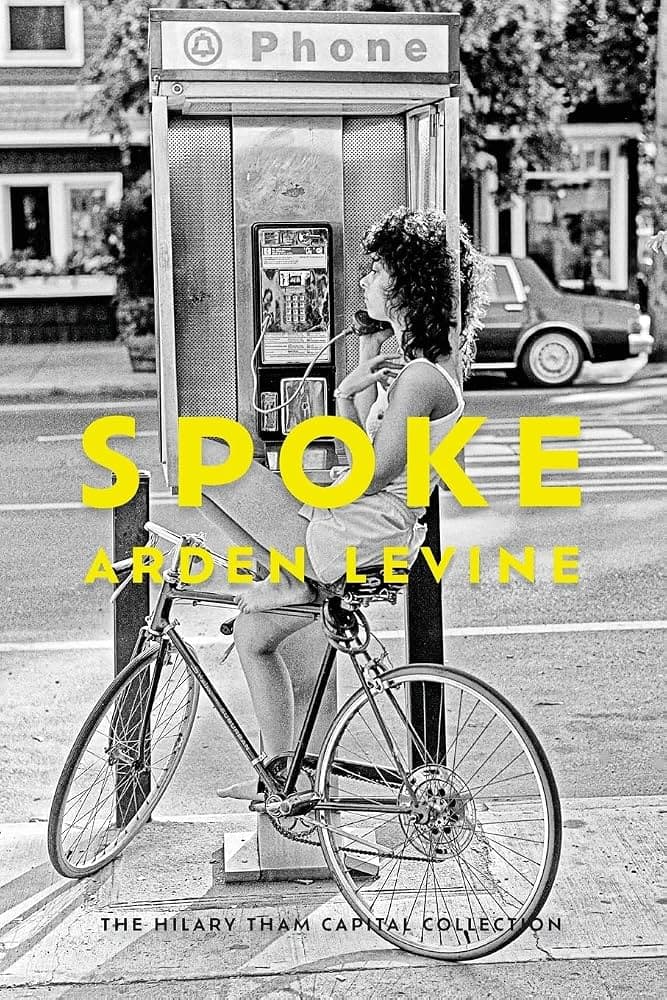
One way to approach Spoke, Arden Levine’s striking debut collection of poems, is through a consideration of its cover art, where Ron Terner’s sexy and evocative 1980s photograph captures a young, leggy, bare-footed woman seated on a “male” ten-speed bike at a payphone in City Island, New York. That woman’s bold yet vulnerable demeanor—still palpable four decades later—furnishes the confident, unapologetic poems in Spoke with an apt visual equivalent, for in these very poems Levine’s confrontation with a bygone world, its memories and losses, provides the means through which she articulates and navigates the present. If a male gaze frames the female body in Terner’s Girl on a Bike, Levine’s decision to reframe it as a controlling metaphor for her collection is at once homage and reclamation. Through a ruthless, unsentimental confrontation with near and distant pasts, Levine exposes “the familiar uncomfortable and / the accustomed unpleasant” (“X-ray”) we attach ourselves to as a way to stanch our unbearable hurt.
The finest poems in Spoke seize upon concise yet epiphanic moments with photographic force. In “Playground Accident,” a child hits the pavement, opens one of her eyes and sees “a light bulb sun shattered / its reflections raining a graveyard of shells.” In “Remaining Evidence,” a woman, slowly accepting the loss of a former lover, observes “Crumbs pattern the plate // like footsteps in snow.” Elsewhere (“Disease”), the speaker recalls that her father, “once pointed out delicate maggots, like freshwater pearls, debriding the open oyster of a kneecap.” Such details clarify turbulent visceral experience with economy, yet suggest, beyond the controlled borders of pressurized language, vast regions of unexposed feeling. In “Kitchen Counter Prelude, 10:00 P.M.,” a woman and a man “leave the bed for a moment / hungry for apples.” The man, a musician, slices the fruit on a plate in “curves the size of a child’s grip.” His two sons (who visited earlier that weekend) may be absent, but their existence is felt in his current attentions. Following the snack, a session at the piano leads to a bout of lovemaking, after which the woman contemplates that way in which “he cut the offending seeds / from the severed core of the fruit // and discarded them quickly.” In just a few lines, Levine vividly captures one’s man’s psychology—the way he segments portions of his life to ensure their separateness. Whether those discarded seeds refer to his lover or to his sons is left ambiguous, a problem for the poem’s speaker (and the reader) to ponder. Such uncertainty is often jarring, always exciting—and sometimes heartbreakingly beautiful. “A Dress” is another case in point. Here, as the speaker takes a Friday night walk with a man over the Williamsburg Bridge, he tells her of a former lover, a woman for whom he bought a dress she would not wear. “I tell him if he bought me a dress, // I’d wear it just because he’d bought it.” But instead of accepting the obvious gift she has made of herself, the man looks ahead in silence: “His eyes are held at some point / near the end of the bridge, the other side.”
Another compelling through-line in Spoke is evident in Levine’s “father” poems, many involving the presence of a bike. The first of these, “(Bicycle: 1984) Abandon” is quoted in full:
A child is attached to a child’s seat of a bicycle.
A bicycle leans on a parking lot fence.
A bicycle is not attached to anything.A father is elsewhere in a parking lot.
A father is not attached to a child.
A child detaches herself.A child and a bicycle fall. (Is it hurt?)
A child runs to a father.
A child is not attached to anything.
A father is attached to the bicycle.Why did you leave the bicycle?
Where is the bicycle?
Twelve terse lines telescope a moment of tension and trauma with cinematic urgency. The arrival of the neutered pronoun at the end of line seven shifts the poem from a sad yet ordinary scene, in which an unsupervised child incurs an accident, to a moment of chilling disavowal, where a father rejects his daughter’s plea for attention so he may “re-attach” himself to an object he feels the child has neglected. At no point does Levine provide comment, yet a powerful point of view is established through torqued phrasing and careful arrangement of detail. Indeed, “(Bicycle: 1984) Abandon” recalls, consciously or otherwise, Terese Svoboda’s “Bridge, Mother,” another powerful child-parent poem of pressing brevity that interrogates boundaries and definitions without providing resolution or comfort. Certainly, a larger tradition is at work here, yet Levine never strays too far into theory or hypotheticals. In “Prospect Park In 10 Speeds,” she admits: “My father finds his way into my poems about any man. It is the bike.”
Where there is a father, often there is a mother as well. The mother appears less prominently in Spoke, but still her presence proves significant. In the extrapolated sonnet “Cages,” the mother collects birdcages before she takes any steps to fill them. However, since “Nature abhors a vacuum,” the father attempts to do just that, resulting in repeated failure. After these birds die, the father follows, and neither mother or daughter are inclined to fill them again. Inertia and circumstance inform that decision, but perhaps so does recognition: certain dreams are not meant to be realized. What was once acquired like a hope chest becomes an inhospitable container for a certain set of expectations. “Small Circles” extends the story of the father’s death, noting the particular effect it has had upon the mother: “Before the lid closed, my mother had / reached into his coffin, removed / his wedding ring, dropped it onto // her thumb and forgot it there.” Later, during the wake, the speaker notices her mother’s hand gestures weighed down by that extra band. While death creates absence—that “abhorred vacuum”—it stamps its mark, its weight upon those left behind. In this way, Levine’s presentation of the mother suggests mutual feeling, the recognition of a shared female grief, and the way in which women may be bonded by it.
Certainly, more could and should be said about Arden Levine’s Spoke. Confident and self-assured, it is a crackling, cracking first book. Not everyday do we encounter such surprising language as one does here, such as when a jilted lover’s voice becomes “a hotel room medicine cabinet, / mirror waterlogged at its edges” (“Small Circles”) and where “a body /irrelevant” (“Gulf/Daughter”) may have the potential to be anything, but not irrelevant.
Tony Leuzzi is a writer and a visual art maker. His most recent collection of poems, Fog Notes, was a 2023 finalist for the Big Other Poetry Award. Passwords Primeval collects twenty of his interviews with American poets. He is a frequent contributor to the Brooklyn Rail.