BooksJuly/August 2026In Conversation
JULIE BUNTIN with Hannah Burns
Word count: 3507
Paragraphs: 36
Famous Men
Random House, 2026
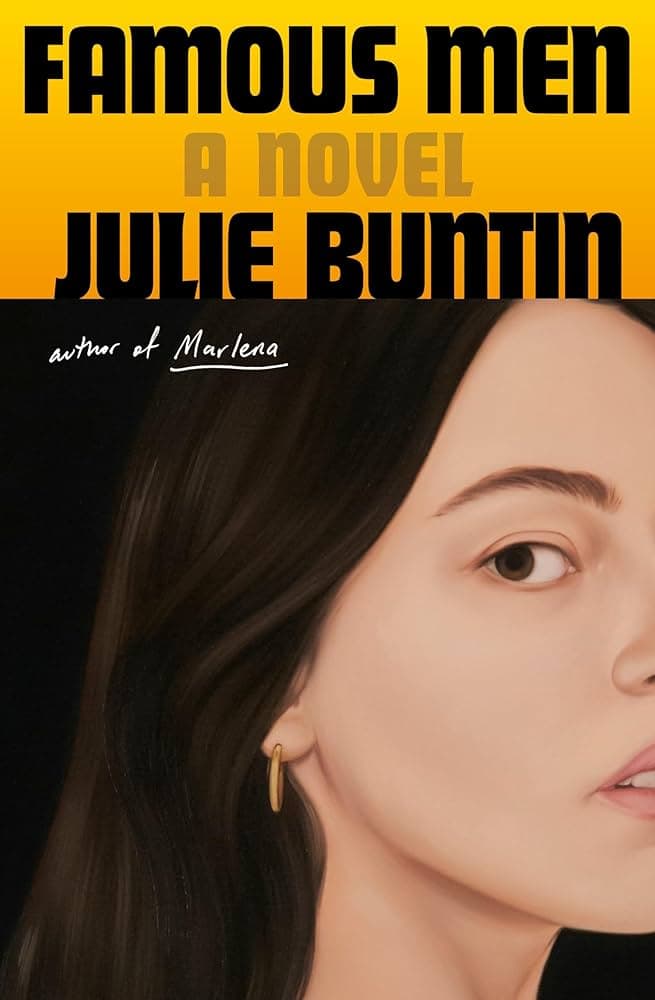
Will Miles is a young girl from Northern Michigan that is used to stories being told about her. She is a meek wannabe-writer, starting fresh in New York. She is a young woman that finds herself malleable in the hands of Nathaniel Fellow. Of course she is, she has read his work—every printed word. Famous Men tells the story of a woman committed to becoming a writer and finding her voice in the #MeToo era. Talking with Julie Buntin about her characters felt like talking about our mutual friends. We also chatted about Phoebe Bridgers, parasocial relationships, the way time moves in New York, and breaking the rules in storytelling.
Hannah Burns (Rail): So I need to talk about the second epigraph as a Phoebe Bridgers fan. I’m starting from the very beginning, the quote from “Scott Street”: “Do you feel ashamed / When you hear my name?” I’d love to know why you picked it and how you felt like it resonated.
Julie Buntin: Yeah, it’s funny. Epigraphs are kind of magical, right? I work with MFA students in my day job, and sometimes students will say, “I’m looking for my epigraph,” or “I’m trying to find an epigraph for my book.” And I always get a little tingle of anxiety when they say that because in my experience, you don’t go looking for your epigraph, you experience your epigraph in the world, and then experiencing it makes you realize something about the project that you’re working on. And I liked that question, at least for the characters in the novel. It can apply to a lot of different characters and a lot of different moments in the novel. It very straightforwardly speaks to maybe one relationship, but it also can kind of speak to other relationships too. So, yeah, part of the thrill of writing a novel for me is that moment when your epigraph finds you and you’re like, “Oh, there it is.” And also now I know a little bit more about what I’m doing and how I can get to the end of it.
Rail: Yeah, I think that’s totally true, that it finds you and becomes incorporated in the work. I think that’s how you know it’s a good epigraph.
Buntin: It felt tonally appropriate too. I also do have a soft spot for epigraphs. Well, most people say one is enough, but I like when there are two and they’re sort of different registers.
Rail: Hell, I even like three. If you put four epigraphs in, I’m eating that up. I could take one in the beginning of every chapter actually. Yeah. I’d be a fan of that.
Buntin: I also think it’s one way of knowing if you’re stylistically aligned or aesthetically aligned with the writer in advance. If you open up a book and see an epigraph that tickles you or that is something you too like, you can have a sense of like, okay, maybe we’re on the same page here in some manner…
Rail: Continuing the Phoebe Bridgers thread just for a moment, I want to talk about the part of the book where Will meets Nathaniel for the first time. You write: “Here he was, not a character I’d invented, but a man, a person I knew nothing about except for what he’d made publicly available. I felt, in a word, mortified.” This exchange really made me think about the concept of being a punisher, and this initially parasocial relationship between Will and Nathaniel. I wondered if you have resonated with this fan behavior or devotion, you know, in a personal way.
Buntin: I feel like the conversation about parasocial relationships was kind of bubbling up in culture during the time that I was writing this book. It surely did seep into my awareness of the novel, but I also feel like I wrote this book at a time of great isolation from the culture. I started this book just before COVID. I wrote a lot of the first, early drafts during deep COVID times when I was also living in a new city where I knew nobody and also had no ability to make friends. And then I was also pregnant or postpartum for the rest of it, two different times. So I was sort of only distantly aware of things, yet still, in my way, taking stuff in.
But I was not, growing up, a person who had really intense sort of fandoms around musicians or actors or things like that. But I did, I have always, and still probably, maybe I don’t know if I want to admit this on the record… sometimes I still have this feeling of reading a book, discovering a text and feeling a really strong sense of connection or intimacy with something about the book, which can kind of extend to the writer a little bit. A sense of like, I know who you are, or we understand something about the world in the same way, or you said the thing I’ve always wanted someone to help me understand, and now we are connected forever. I have had a very powerful kind of relationship with texts like that. And I certainly was kind of drawing from some of those feelings and thinking about Will, and thinking about just how intense that can feel, especially if you don’t have any kind of mitigating factors in your life to keep you from pursuing that all the way.
I do think that writing is so intimate and vulnerable… the kind of feelings I had about teachers or people who read my work in early stages when I was kind of coming up as a writer, it’s not always straightforward, right? Like, you’re like, are you judging the story, are you judging my personality? Like, are you, what are you weighing in on? Like, what’s at stake here? Like, what’s in conversation? I definitely do think all of that was kind of swirling around in my mind, and how easy it is to make a story out of very little when you have some kind of idea of who somebody is based on what they write or what they’ve made.
Rail: I do feel like we don’t hear about it as much, at least on the topic of parasocial relationships, how easy it is to feel a kinship with an author because it is such a vulnerable act. There is so much given of a person, you know, when they write a book.
Buntin: Yeah, and I think, too, a book is sort of completed by the reader. It’s like you make this thing and then the reader completes it in their imagination, and this is why some books work for some people and don’t work for others. The same book can be totally different because some people’s imagination doesn’t spark on it in the same way, right? It’s not for them. But if it’s for you, you’re almost engaging in this act of sort of participation with the text, which is such a bond. And I think we sometimes think that the writers are more part of that than they actually are at the end of the day. It’s actually more in our own imaginations than it is to do with them, but it’s hard to separate that. You want to kind of give them credit for the thing that they made you feel.
Rail: Do you have a particular book that was the first you felt kinship with in that way?
Buntin: Oh, that’s so interesting. I feel like I had a really strong relationship with Who Will Run the Frog Hospital? by Lorrie Moore, which was sort of a foundational text for me. I read it in early adulthood and felt like it said something about the kind of primal intensity of adolescence and how—I don’t know if I truly believe this, but I sometimes do—how the rest of life doesn’t ever compare. Or like the luster of that time is so bright and can kind of shine through everything that comes in this interesting way. It’s funny and musical and profound and sad and, you know, the sentences knock you over, and it’s wise. I mean, it just felt powerful to me in all of those ways. And so I did feel like I sort of knew Lorrie Moore, which I never did, but I did meet her later. And I think I told her some version of this, and she’s very nice, so she didn’t think it was too weird.
I think I have had that experience more with poets, because the transmission is so pure with poetry, right? It’s like such a direct… the experience of a poem can be so transcendent sometimes, and I remember feeling that a little bit with Elizabeth Bishop’s poems when I first read them. That poem “In The Waiting Room,” where she thinks, “you are an I,” and how unlikely that I should be myself is essentially what she’s saying. I didn’t know how to express that I thought this, but this is, like, the durable, overriding question of my entire life. You have said it, so I feel connected to you in this way.
Actually, when I was growing up, I grew up in a small town in Northern Michigan not unlike Will, but it’s a fictionalized, very different version of that place. But it’s Ernest Hemingway country. It’s like where the Nick Adams stories were written in the Walloon Lake area. And there was also this sense of Hemingway’s presence as being part of the town. And that always made him seem like someone, not that I knew, but who was like a grandfather of the town, who might be on this street corner. Like, there were plaques in the bar, at the restaurant, and this sense of his presence as being really active. It gave us a sense of sort of accessibility to him in some way.
Rail: That’s so interesting that you kind of had your own Nathaniel in the town that you’re from.
Buntin: Yeah… that’s not like a very usual thing to happen, but it happens that in this place where I grew up, there’s a lot of regional pride about his existence. There was a sense of… he was here and what does it mean for this place that he was here? And this place is special and, like, elevated in some way, because he talked about it, you know? Because he wrote about it and memorialized it.
Rail: Right, just like Nathaniel did. So thinking more about place, I did feel like New York and Michigan were so distinct and so tangible as settings. And I wanted to know how it felt to write about each place. Specifically Michigan, you know, with returning home. I guess I’m asking: how does it feel to write about home?
Buntin: Yeah, I love that question. So with my recent book, I just went a lot farther with my fictionalization of the place and, like, really did kind of create a distinct town that I have my own concrete sense of geography around. Like, I know where it would be in relation to these other sorts of landmarks in my mind. I know towns like this very much. It’s kind of like where I grew up, but it’s a little bit different in some ways. And that gave me a lot more. It just, I was able to be in the fictional Michigan landscape that I love. I live now in Ann Arbor, but I grew up more like where Will is from. It’s like four and a half hours north. Which is quite far, and it’s hard to get up there when you live a busy life, but I long for it and miss it a lot. I miss it more as I get older. So I like to kind of go there in my mind and I also recognize that I had to leave there to survive, much as the characters in my novels have had to do that. So the feelings I have about it are quite complicated, and I find they’re rich. I like the setting, I’m interested in it. It’s an interesting setting. It’s so beautiful. It’s so kind of hard to get to. There’s so much economic disparity. There’s so much wealth and so, so much kind of poverty that is sort of hidden in some ways. So all of those things about it make it really appealing to me.
And then I also found with my first book that writing about Michigan was very momentum-generating when I lived in New York and really wanted to go home all the time. But now I really miss New York. I miss it more than I thought I would. So I got to kind of do the same journey that it was my first book, but in reverse. I got to go back to the place I had just left, and then I also was writing about a period of time. Will’s early twenties in New York are so challenging and difficult. But I think, even if you are making better choices than she is, and you have different opportunities, everyone’s early twenties in New York are so challenging and difficult.
Rail: Yeah, you had a line that was essentially saying that everyone’s first year in New York is hell. And my friend and I were just talking about that. We were like talking about our first years here and we’re like, oh my god, we really survived that.
Buntin: That was like a bad time. It’s so bad. But then, Hannah, then it gets really good. It does. It gets amazing. It’s so bad. But then you’re like one of those bonsai trees that grows in the container… New York probably doesn’t adapt to you. You just adapt to it. It feels like it adapts to you. And then it’s amazing. And when I left New York—I was there for fourteen years—and when I left, I couldn’t do the things people who live there can do. I was so completely a New Yorker. I was like, what is going on? I feel like I miss Michigan, but now I’m back in Michigan, and I have no understanding of this suburban place that I’m living in. It was nice to retreat to a place where the concerns of life were really different. I wouldn’t want to go back to those years, that kind of time, you know, the kind of turbulence, sort of early years of your adulthood when things are so uncertain and everything feels so high stakes. I think maybe I just write a lot out of homesickness, various kinds.
Rail: There’s a lot of momentum in that. I think that’s definitely true. Definitely true for me. I also wanted to ask you a little bit about the structure, and how you arrived at breaking the novel into these sections. I’m always curious about what scaffolding was in place when you were in early drafts versus how you ended up presenting the story.
Buntin: I actually always thought of this novel from the very earliest stages as a novel in parts, less so than in chapters, if that makes sense. I thought of it really as movements, there was the movement of Will’s life in Greening, then there was like the New York section in my mind. Then there was this section of rapid life in New York, but the sense of like, when Will is getting in over her head, this section of this character who has lost her grip on herself as being its own kind of movement, and then I was really interested in playing with this book. Like, maybe one of the other kind of motivating impulses for me, aside from the kind of questions of the novel and what it’s about, was actually a desire to think differently about time in a novel, to write a novel that took place over a long period of time, where you’re on a journey with a character. I can’t predict how readers will feel about it, but I wanted to give the reader the experience of I’ve ended in a place I didn’t expect to end, and yet it was always gonna end here.
Rail: Right, you know, the expected surprise.
Buntin: Yeah, exactly. And I also was thinking about playing with things like a writer’s biography, right? Like, what does it mean for a character like Will to get her childhood section, her early adulting section, to take her all the way through like that? And because I don’t think that the story of what happened with Nathaniel is Will’s entire story, I think that the story of what happened with Nathaniel could not have happened if Will hadn’t come from the specific circumstances that she came from, so it felt really crucial to me to show that dramatically and not have it be, like, wedged in as little jolts of flashback. I wanted to take the reader through from her mistaken belief about who he was to her through these kinds of early experiences of gaslighting, really, and just the kind of confusion of specific kinds of sexual trauma that can’t be easily categorized. To show how her grooming, in a way, started before this. So, so, so, so far before the relationship that actually, it wound up derailing her life in a more complete way. And so in my mind, these movements became almost like mini novellas in themselves, like, the “We were very tired, we were very merry” section, which is the short section in second person was my, “What does it feel like if I try to capture in a novel the feeling that you sometimes have in New York where time is moving so quickly?” I don’t understand how years have passed, and I just moved here, or how I got through that horrible first year. And now I’m standing here and I’ve changed in all these ways. And yet I haven’t changed. And there is something, I think, specific about time in New York in that way.
Rail: I felt like the compression of time in that section was totally mind boggling because, yeah, I told a friend whenever he moved here, I was like, be prepared to never be bored again. You just won’t have a second to be bored.
Buntin: And you kind of don’t notice, right? That your life is going along. And then you’ll blink and then it’s been four years or ten years. Yeah, so I was really interested in that. I liked breaking it up into parts in that way because it allowed me to play a little bit with style. It’s a straightforward, first person retrospective narrator. Especially with a long book like this, I like to play a little bit, tonally and stylistically, and those breaks and sections allowed me to think a little differently about what the voice might do in each section. So in “Office hours,” the rupture in the part allowed me to access a different facet of Will’s voice and show her aging in a different way or her different elasticity to the retrospection.
Rail: Yeah, it’s interesting to think of them as these novellas, but in this sort of drop-down, Wikipedia-page way of “early life” and “New York years.”
Buntin: Yes, I think structurally, especially, there are notes for yourself and they’re not really legible to readers, right? But this idea that this was like a play on Will’s biography, that was really fun for me.
Rail: I think it is legible, because even that first section of her early life and what you’re saying about how she needed to have these experiences and this particular context in order to be the person she was to be groomed. You know, it was essential to have that section. And I think Will even says that Nathaniel would advise her to cut that section and that her backstory would ruin the pacing in some way. And it feels like it’s like the ghost of Iowa Writers’ Workshop or something being like, “No, no, no, this is not how you do it,” but she has this perspective looking back at her own life. She has the confidence as a character and as a storyteller to say this context is essential. This is part of my story. So it’s going to be here.
Buntin: Yeah, yeah. That’s really true too. I really was interested in that. Like, what writing rules can I break? What writing rules about telling the past can I break? What writing rules about using second person can I break? Like, what have I been bound by or constrained by as a writer that I can, through this conduit of Will, smash up a little bit here?
Hannah Burns, originally from Charleston, SC, received her MFA in Fiction from the New School. Her writing can be found in Atwood Magazine, The Crawfish, Public Seminar, Platform Review, Y’ALL! Zine, KGB Lit, and the Brooklyn Rail. She lives in Brooklyn and works for the Urbane Arts Club.