Marcel Duchamp
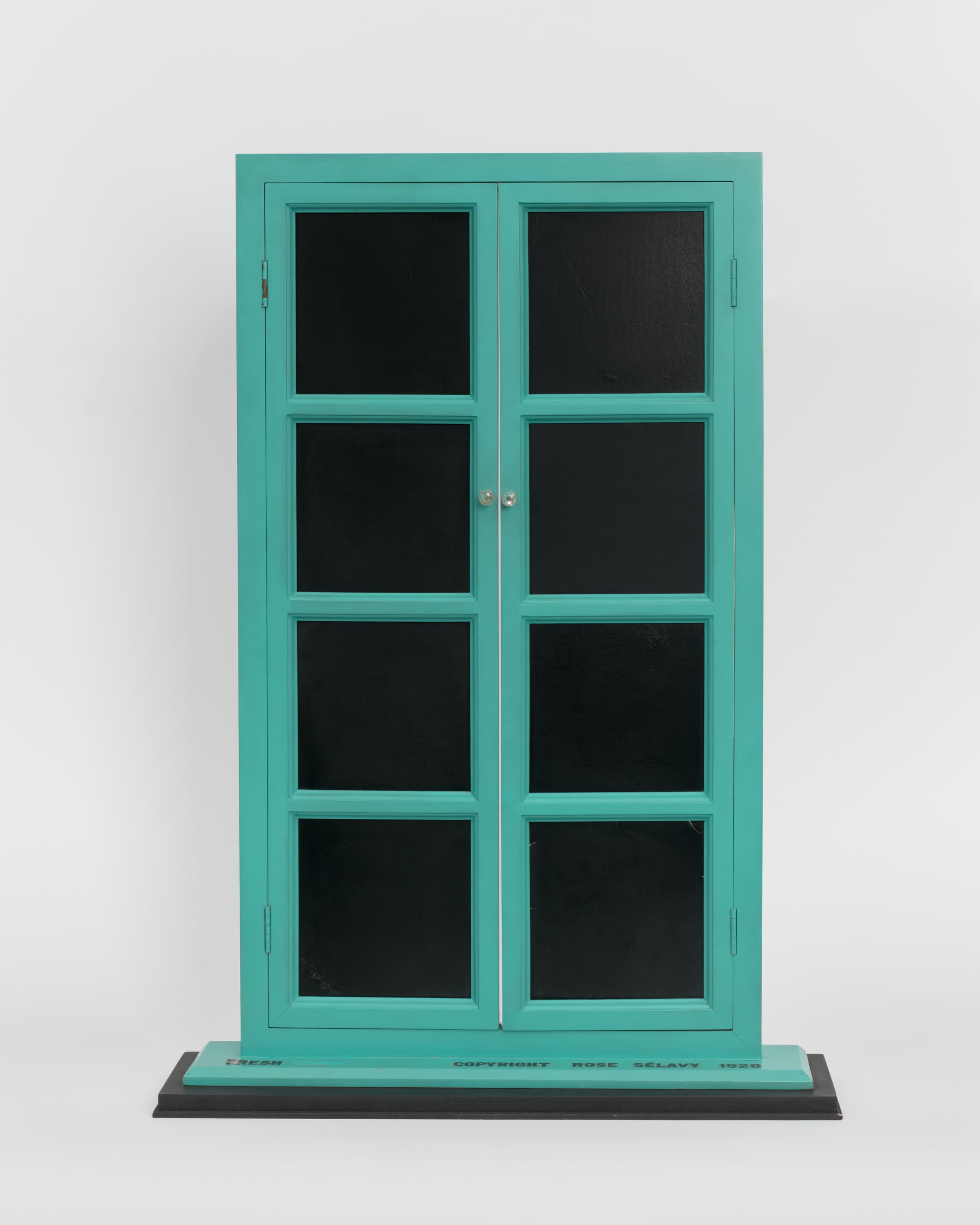
Marcel Duchamp, Fresh Widow, 1964 (after 1920 original). Paint, wood, metal, leather, and glass, 31 ⅞ × 22 ⅝ × 5 ¾ inches. © Association Marcel Duchamp/ADAGP, Paris/Artists Rights Society (ARS), New York 2026. Courtesy Gagosian. Photo: Owen Conway.
Word count: 1170
Paragraphs: 16
April 25–July 31, 2026
New York
Gagosian’s Marcel Duchamp is an exemplary exhibition of the artist’s archetypal readymades that will delight generalist and specialist audiences alike. The show includes numerous Duchamp classics: a 1964 iteration of the much-theorized Fountain (originally executed and rejected by the New York Society of Independent Artists in 1917), the well-known In Advance of the Broken Arm (1964; after lost 1915 original), Duchamp’s ampule of Parisian air (1964), and his upturned bottle rack (1964). These are flanked by lesser-known readymades, including a painted plaster cast of Female Fig Leaf (1951)—rumored to be a cast of an unknown lady’s genitals—and the Underwood typewriter cover–cum–fanning skirt, Traveler’s Folding Item (1964).
One of the few quasi-paintings is a reproduction (and thereby arguably a kind of readymade itself) of the enormously important Nude Descending a Staircase, No. 2 (1912). This original work was famously the subject of controversy at the 1912 Salon des Indépendants, in which Albert Gleizes, Jean Metzinger, Henri Le Fauconnier, Fernand Léger, and Alexander Archipenko denied the work entry into the Cubist room due to its architectonic parceling of movement in time. The hanging committee argued that, lest Duchamp amend its title, Nude Descending facilitated resolutely Futurist rather than Cubist thematization. Duchamp’s rejection precipitated the work’s showing at the 1913 Armory Show in New York, where it was met with great acclaim (albeit not without further controversy).
One of the most delightful inclusions in the exhibition, Fresh Widow (1964; after 1920 original), belongs to the class of works that Francis M. Naumann has described as “semi-readymades,” a category distinct from both “assisted readymades” like Why Not Sneeze, Rose Sélavy? (1921) that assemble and compound found objects, and what one might deem “readymades proper,” meaning worldly objects co-opted in their entirety. In Dada, Surrealism, and Their Heritage, William Rubin described Fresh Widow—a miniaturized French window lined in a teal chassis—as “a translation of the … world of pictorial illusion to that of objects.”

Installation view: Marcel Duchamp, Gagosian, New York, 2026. © Association Marcel Duchamp/ADAGP, Paris/Artists Rights Society (ARS), New York 2026. Courtesy Gagosian. Photo: Owen Conway.
Most of the works featured in this show have been the subject of salutary scholarship. Yet Fresh Widow—its title a punning variant of “French window” and its construction, executed “by a carpenter following Duchamp’s instructions”—has largely escaped the theoretical analysis it deserves. Yet this sculpture is the philosophical centerpiece of the Gagosian show. Its philosophical fruit, however, is borne from its departure from the tenets of the Duchampian readymade and its appropriative stimulus. In its approximating bona fide French windows, the constructed “semi-readymade” more aptly prefigures what Arthur C. Danto, in his 1986 The Philosophical Disenfranchisement of Art, identified in Andy Warhol’s art-history-ending work, Brillo Boxes (1964). Following Danto, Brillo Boxes’s enfranchisement into the art world had nothing to do with the object’s visible qualities, insofar as it was (slight dimensional differences aside) optically indiscernible from its real-world counterparts stocked in myriad American supermarkets. Its art-world status belonged to its embodied and expressed meaning, as articulated by a historically-situated theory of art that could encompass Warhol’s gesture. By displacing the modernist paradigm, which trafficked in medium-specific criteria and the perceptual conceits that proceeded from them, Warhol had not only inaugurated the post-modernist era, in which the status of art was detached from surface features, but also stopped the teleological modernist project—and, therein, all coherently progressive narratives of art history—in its tracks.
No longer could a dominant visual tendency claim to reveal the transcendental conditions of an artform, as neither painting nor art tout court belonged to the realm of the visible. Art history, in short, had been dislodged by philosophy, as the question of whether a particular object could be considered art was shown to be the domain of meaning and rendered interpretation. But then again, Warhol exhibited his Brillo Boxes in the Stable Gallery in 1964; why had Duchamp’s readymades, executed several decades prior, not halted the modernist project, still burgeoning and yet to reach either its apex or nadir? Had Duchamp the maverick simply undertaken this theoretical provocation too soon?
That Duchamp was similarly interested in embodied meaning is made clear by his 1961 lecture at the Museum of Modern Art, “Apropos of ‘Readymades,’” in which he remarked:
A point which I want very much to establish is that the choice of these “Readymades” was never dictated by esthetic delectation.
This choice was based on a reaction of visual indifference with at the same time a total absence of Good or Bad taste… In fact a complete anesthesia.
One important characteristic was the short sentence which I occasionally inscribed on the “readymade.”
That sentence instead of describing the object like a title was meant to carry the mind of the spectator towards other regions more verbal.
Despite Duchamp’s admonition, it is not uncommon for readymade viewers to be allured by the siren grips of aesthetic temptation. This exhibition, which dramatically suspends Porte-chapeaux (Hat Rack) (1964; after lost 1917 original) from the ceiling such that its talon hooks cast dramatic arachnean shadows, is no exception. But this must be resisted. Duchamp reminds us that, though a readymade like Fountain might strike us as flaunting what, in his recent Duchamp’s Telegram, Thierry de Duve, following Alfred Stieglitz’s assessment, calls “Arp- or Brancusi-like curves,” such aestheticization is ultimately incidental and ought to be abjured.

Installation view: Marcel Duchamp, Gagosian, New York, 2026. © Association Marcel Duchamp/ADAGP, Paris/Artists Rights Society (ARS), New York 2026. Courtesy Gagosian. Photo: Owen Conway.
Fresh Widow—ineluctably worldly and hardly subject to misplaced beautification—ably avoids such aesthetic sequestering. It also avoids a common mistaken interpretation that “readymades proper” bring about. The readymade is a real-world item that becomes embodied with intentionality and meaning. How it does so, however, is not immediately apparent. That this appropriation seemingly involves contextual commandeering has often invited institutional theories of art like those proposed by George Dickie. But to my mind, these (ultimately circular) arguments are less helpful than Danto’s expression theory. Duchamp’s remarks say nothing of institutional conferment. Fresh Widow, constructed and quotidian as it is, is philosophically exemplary because it resists both aesthetic and institutional bracketing. Why, then, did Fresh Widow not achieve that which Brillo Boxes did decades later?
Paradoxically, the answer lies in the authorial index that grounds Duchamp’s redirection of the viewer toward “regions more verbal”: the signature. At Gagosian, one frequently finds perfunctory signatures of “R. Mutt” and “Rrose Sélavy” carefully inscribed on readily visible areas of the readymades. Fresh Widow follows suit; it is, in fact, signed three times over. A copper 1964 Arturo Schwarz edition plaque embossed with “DUCHAMP” is flanked by Duchamp’s wending jet-black signature. On the opposite side of the semi-readymade’s base, printed text reads “FRESH” and, some fifteen centimeters beside it, “COPYRIGHT ROSE SÉLAVY 1920.” In pointing our attention toward verbal-cum-philosophical meaning, these lexical marks distance the work from its real-world counterpart. For those French windows lining cottages or stacked upon hardware store shelves are, one and all, unsigned.
Thus, though it failed to displace the modernist project, the conceptually rich work conditioned modernism’s eventual sublation. Occupying an art historical inflection point, Fresh Widow is a rare instance in which art not only does philosophy but does it well.
Ekin Erkan is a writer, curator, and researcher whose writing has appeared in the Journal of Value Inquiry, the International Journal of Philosophical Studies, and Hyperallergic, among others.