Fairfield Porter: What Everyone Knows
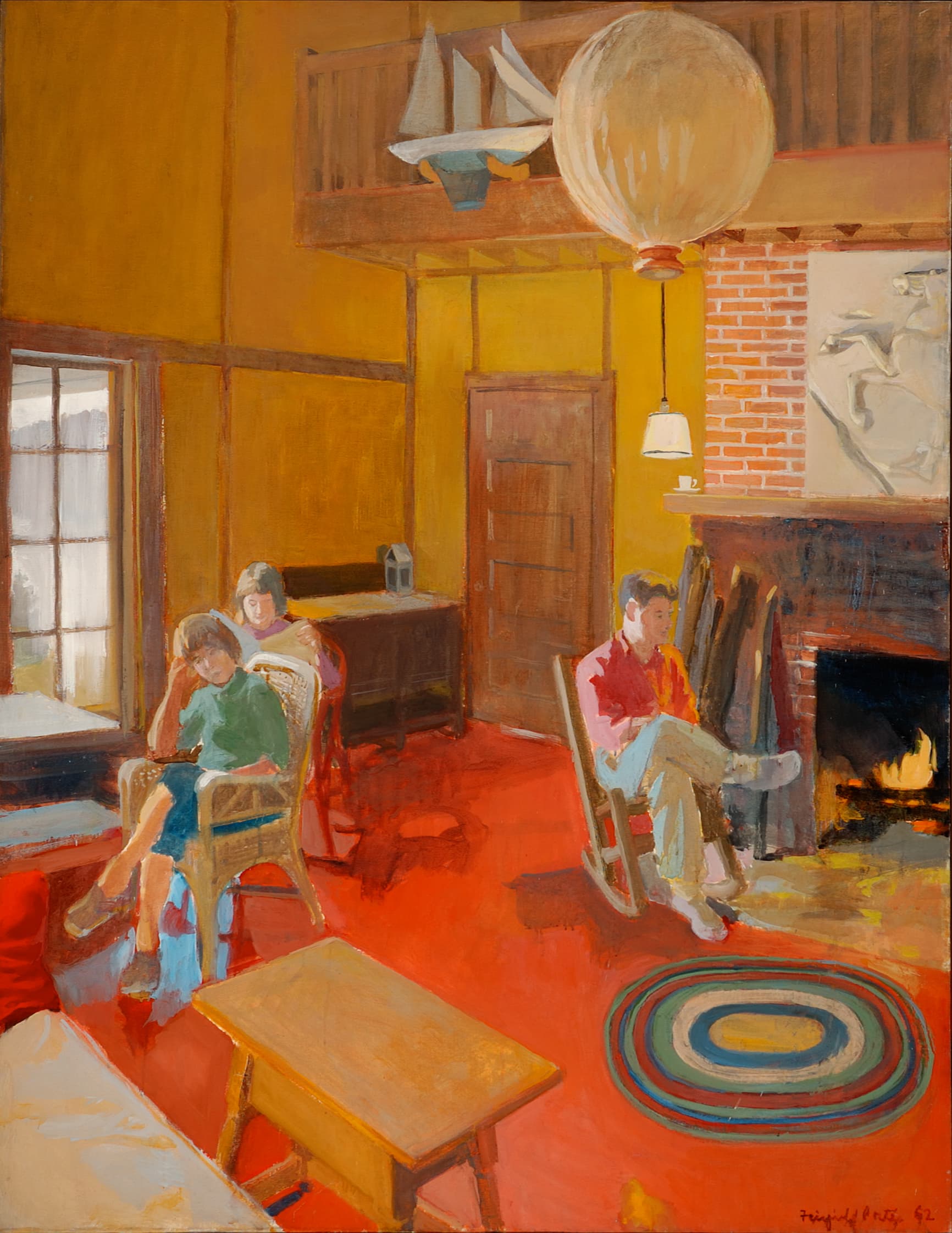
Fairfield Porter, A Day Indoors, 1962. Liquitex on canvas, 71 ¾ × 54 ⅞ inches. Courtesy Parrish Art Museum, Water Mill, NY.
Word count: 1021
Paragraphs: 9
Art Students League
June 5–August 18, 2026
New York
Though Fairfield Porter’s work can present itself as almost disarmingly bucolic, or psychologically detached, this first large-scale exhibition of the artist’s work in New York City in twenty-five years stages Porter as a figurative painter, operating where the dominant tendencies of the fifties collide and are renegotiated. Each of Porter’s canvases orchestrates these collisions, and in each case, realism is less a retreat than the point of re-entry where those pressures are brought back to ground. It is a mode of verité: the point at which abstract decisions are compelled to pass through the description of things. In Porter’s case, that double address generates a friction between formalism and lived experience that is neither resolved nor synthesized but is the condition under which the work proceeds. Self-criticality and medium specificity are folded into the paintings’ construction, which turns on color relations, scale, and the negotiation between flatness and depth. Like Édouard Manet’s realism, Porter’s is the site at which formal problems must answer to perception.
Across Porter’s pictures of interiors, yards, family gatherings, and coastal views, his ambition to redeploy Abstract Expressionism’s flatness, all-overness, and compositional structures within the genres of domesticity and landscape becomes apparent. Each canvas replays this situation from the inside, as Porter sets French intimism against the New York School’s brashness, high formalism against the order of a lived domestic milieu, and avant-gardism against the pastoral. Straightforward description, at the level of its construction, is a motif internalizing abstract painting’s strategies, so they can no longer operate in isolation. What appear to be different pictorial problems—a still life, a portrait, a landscape, an interior—are variations on the same underlying question: whether paint can simultaneously sustain its abstract conditions and its descriptive obligations.
Paintings such as Katie (1969), in which the ground is structured through a series of abstract motifs, neither disavow nor emphasize these conditions. Rather, they provide the context within which formal, painterly, and perceptual problems are worked out. Realism becomes a point of re-entry. The social world depicted in these paintings is not opposed to the abstract but forms the condition through which it repeatedly returns to experience. The snapshot quality is one means by which Porter injects realism into the work, preventing its modernist terms from stabilizing as autonomous and continually folding them back into the pictorial situations which they describe.

Fairfield Porter, Double Portrait (Mr. and Mrs. Reynold Hardie), 1970. Oil on canvas, 24 × 28 inches. Courtesy James Barron Art, South Kent, CT.
Painterliness, foregrounded by the debates of the fifties and sixties when painting had consolidated around critics for whom the abstract was the only viable path, informs Porter’s canvases. Though as a figurative painter he remains committed to realism, as a critic Porter writes in defense of Abstract Expressionism, arguing for its seriousness—but against its conversion into dogma. Each work negotiates between what critics prescribe and what painting actually offers: conditions that cannot be fully reduced to principle. His distance from much contemporary figurative painting becomes legible at this level. Unlike Porter’s paintings, the recent return to image-making has become naively anecdotal, even literary, collapsing into illustration and generalized stylistic effects.
Realism, for Porter, is not a style so much as a working method. It names the point at which convention is interrupted by observation and where abstract decisions must answer to what is seen. The room, the yard, the coastline resist becoming symbols or ready-made motifs; they remain situations to be negotiated through paint. Porter demonstrates that the interior and the garden can sustain a high degree of pictorial complexity precisely because they permit abstraction and description to remain in continuous exchange. In the Art Students League installation this becomes especially apparent: a sparsely furnished room in which flat zones of color and abrupt shifts of value align with Post-Impressionist structure; a yard in which hedges and trees echo the all-over rhythms of Abstract Expressionism, as in Oak Tree (1969), while remaining stubbornly readable as hedge, house, and tree. Each painting re-performs this encounter between paint as material and image as description. In the manner of informal family snapshots, Porter frequently takes on figures caught mid-gesture and distributed almost incidentally. Rendered in stiff paintings with muted, low-contrast palettes and ambiguous light sources, his subjects feel awkward, almost frozen, as if ill at ease. The effect is not anecdotal so much as a registering of a particular petite bourgeois lifestyle organized around reading, conversation, and temperate weather. These domestic scenes are thick with markers of class and milieu. In today’s parlance, it would be said that he depicts the world of white privilege; yet for Porter, it was the space of everyday life, the given within which he negotiates between the abstract and the mimetic.

Fairfield Porter, Oak Tree, 1969. Oil on canvas, 22 × 20 inches. Courtesy Smith College Museum of Art, Northampton, MA.
Perhaps the clearest sign of the conflicts inherent in Porter’s work is the unresolved relation between finished and “unfinished” that runs through his imagery. Many canvases leave underpainting exposed, allow contours to fray and brushwork to wander, and stop short of conventional closure. At the same time, composition is anything but casual: the placement of masses, the balance of tones, and the pacing of marks are carefully weighed. In this, Porter fractures without segmenting his imagery: planes, patches, and bands of color break it into discrete units but never tip into full abstraction. Academic concerns and painterly spontaneity occupy the same surface, where near-abstraction appears inside ostensibly straightforward themes. Provisionality is built into the way he paints from observation, re-entering the motif as something seen over time rather than captured in an instant.
Porter resolves none of these conflicts, instead leaving us with a series of unresolved attempts that maintain the tension between abstraction and figuration; formalism and the perceptual; theory and practice; finish and incompleteness in a genteel manner. Instead of retreating from the abstract, he is applying it to rooms, objects, bodies, and landscapes—where it remains active, not denied. Each painting passes through the same conflicts, and each solves its specific problem. Realism here is not what one returns to out of nostalgia but conviction, a structural mechanism that applies painting’s concerns to things in the world, where they can no longer operate as pure positions.
Saul Ostrow is an independent critic, curator, and Art Editor at Large for BOMB magazine.