Gerhard Richter: Landschaften
Word count: 1056
Paragraphs: 8
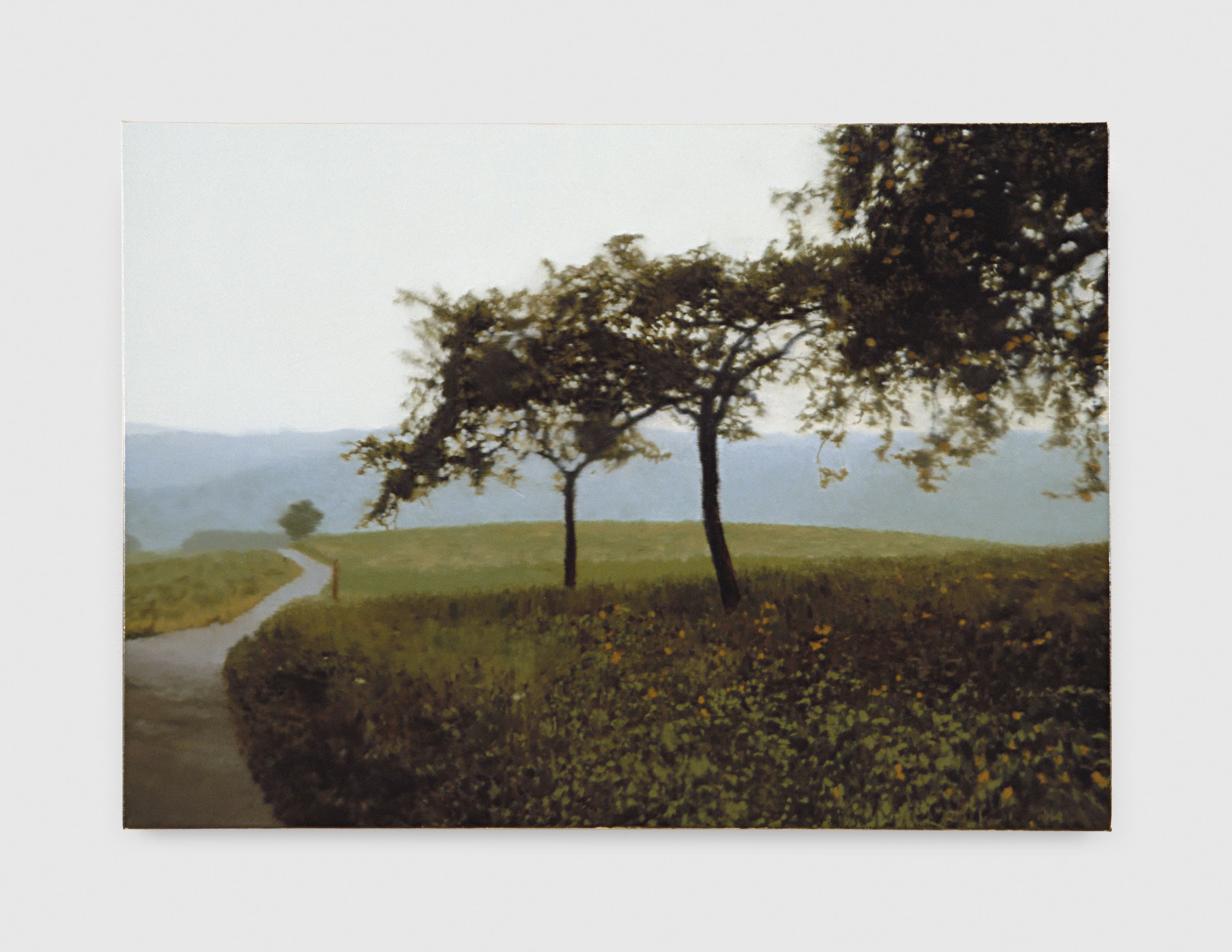
Gerhard Richter, Apfelbäume [Apple Trees], 1987. Oil on canvas, 26 ⅜ × 36 ¼ inches. © Gerhard Richter.
David Zwirner
May 7–July 10, 2026
New York
In his classic study of perception in the industrial age, The Railway Journey, Wolfgang Schivelbusch described the visual blur that accompanied the view out the window from a moving train: the world encountered at a speed humans had not previously known. This was based on perceived distance, in which topographical features in the background remained stable while foreground and middle ground elements moved across one’s visual field at different rates of speed, what he called “panoramic perception.” Since the advent of the railway, artists from J.M.W. Turner to Umberto Boccioni have attempted to convey this effect on vision, until the automobile sadly rendered terrestrial transportive wonders both pedestrian and solitary. The confluence of the railway with the late-Romantic age and the onrushing advent of photography meant that artists could not only get access to more places and experience those journeys at speed, but they were able also to share their visions in photos and subjective artworks. From those impetuses came such divergent approaches in landscape painting as the fine-focus polychromatic realism of the Pre-Raphaelites and the fractured opticality of the Impressionists, with each group’s adherents persisting across all media through the twentieth century.
Gerhard Richter’s exquisite landscapes fall somewhere in the middle: camera-derived but not photorealist, personally experienced scenes marked by irresolution and level tonalities, with surfaces that retain legibility but deny clarity. This largely chronological show features twenty-six oils in four galleries dating from 1965 to 2005, when he moved away from the genre. Many are, unsurprisingly, technically intricate. Seestück (Gegenlicht) of 1969 in gallery one mimics the combination printing in Gustave Le Gray’s composite ocean photographs of the 1850s, wherein he used separate plates for the sky and the sea in order to control the lighting. In this 6 ½ foot square painting derived from two photos, Richter produced astonishingly backlit clouds in the broad sky as in El Greco’s View of Toledo (ca. 1599–1600), with a Turnerian sunburst at upper right, and a swelling illuminated ocean surface with reflections that do not quite line up with the solar entity above. It is the depopulated Northern European sublime, its format and glow reclaimed from Mark Rothko’s signature works. At distance it resolves into defined imagery, but up close the brushwork is blended and edges elided, thwarting focus.

Installation view: Gerhard Richter: Landschaften, David Zwirner, New York, 2026. Courtesy David Zwirner. © Gerhard Richter.
Bonley-Landschaft (1970), largely drained of color, is from a photo taken during a trip to the Canary Islands, although the title does not have a specific geographical reference. There is a surprising level of impasto on the surface, with the paint forming furrows across rises in the landscape. In the earliest work on display, Grosse Sphinx von Gise of 1965, Richter blew up a black-and-white postcard and included the descriptive text in the lower border, in contrast to the sphinx and pyramid of Cheops above, where the wet paint has been exclusively dragged horizontally to gently blur the forms. But unlike in subsequent works, bristle marks remain visible.
Richter’s “Landschaften” project combined responses to places he visited or where he lived, in no matter how neutral a manner, with a theoretical and procedural exploration of the meanings of mark-making, recognition, and subsumed cultural history. Gallery two develops this idea in an iceberg that channels Arnold Böcklin, oil on panel and jewel-toned images of Mount Vesuvius, as well as a canny installation of two works measuring 6 ½ feet tall by nearly 10 feet wide: Abstraktes Bild of 1977 and Seestück from 1975. Abstraktes Bild is a multi-hued illusionistic abstraction with a predominant yellow haze, prismatic shafts of light, and passages of dark whose massings recall awe-inspiring Biblical Romantic paintings by Turner or John Martin. It conveys what John Ruskin called “mountain glory” without recognizable crags or peaks. Seestück is a landscapeless seascape—seemingly all cloud, as if Caspar David Friedrich’s Monk by the Sea (1809–10) lost its Rückenfigur of a monk and sands and birds and just became atmospherics.

Gerhard Richter, Buche [Beech Tree], 1987. Oil on canvas, 32 ¼ × 44 ⅛ inches. © Gerhard Richter.
Rhineland views from the mid-1980s in gallery three are more highly hued—the photographic equipment has changed. They celebrate the cultivated landscape and other traditions in central horizons, cows as in Golden Age Dutch art, and Jean-Baptiste-Camille Corot–like shady trees with tall foreground grasses. They move away from the sublime towards the pastoral, the picturesque, while retaining Richter’s all-over blurred sfumato. In 1986 the cover of the DuMont catalogue of his work featured his studio with large abstractions lining the back wall and, at center, the painter’s empty chair and a cabinet-sized Venice landscape on his easel, as if to foreground the genre in his practice. But by 2005 he’d painted his last ones. These modest, monochromatic, portrait-format views of Northern Germany in gallery four are somewhat overshadowed by the two grand and assaultively chromatic abstract works Netz and Fenster (both 1985) but should not be overlooked. Flanking the entry, they are titled Juist-Skizze and Juist, referencing an island in the North Sea, and mark a brief return to the limited tonalities of the 1960s and ’70s, with a lack of pyrotechnics that remind me of the small-scale work of the nineteenth-century Norwegian Peder Balke and the calculated colorism and luminism of Matvey Levenstein. They feel sculptural, and in the darker final version, shadowy foreground village buildings repel the suggested sun above. Perception has given way to something approaching feeling. It was time to move on.
It has been a good year for landscape paintings in New York City: April Gornik delivered her Long Island’s South Fork-inspired signature grandiose and stunningly lit canvases as well as more modest images at Miles McEnery; Tessa Greene O’Brien showed roughly limned and stitched-together visions of Maine bearing a symbolist cast at Candice Madey and Alexandre; Doron Langberg surprised with ambitious, variously scaled works that ran the gamut of art history from John Everett Millais to Emil Nolde to Pavel Tchelitchew to Richter’s own abstractions at Jeffrey Deitch; and Pace exhibited the late David Hockney’s “Moon Room” iPad paintings. But for my money, the most beautiful landscape in New York in this period has been those framing snippets of Tuscan hillsides and Cinquecento rural architecture in the background of the Alba Madonna (ca. 1509–11) in the Metropolitan’s knee-weakening Raphael show. Nonetheless, for a contemporary take on atmospheric perspectives and panoramic perception, Richter’s eloquent and unmissable works speak in their own, inimitable, semi-decipherable language.
Jason Rosenfeld, Ph.D., is Distinguished Chair and Professor of Art History at Marymount Manhattan College. He was co-curator of the exhibitions John Everett Millais (Tate Britain, Van Gogh Museum), Pre-Raphaelites: Victorian Avant-Garde (Tate Britain and the National Gallery of Art, Washington, D.C.), and River Crossings (Olana and Cedar Grove, Hudson and Catskill, New York). He is a Senior Writer and Editor-at-Large for the Brooklyn Rail.