ArtJuly/August 2026In Conversation
NANCY RUBINS with Neil Baldwin
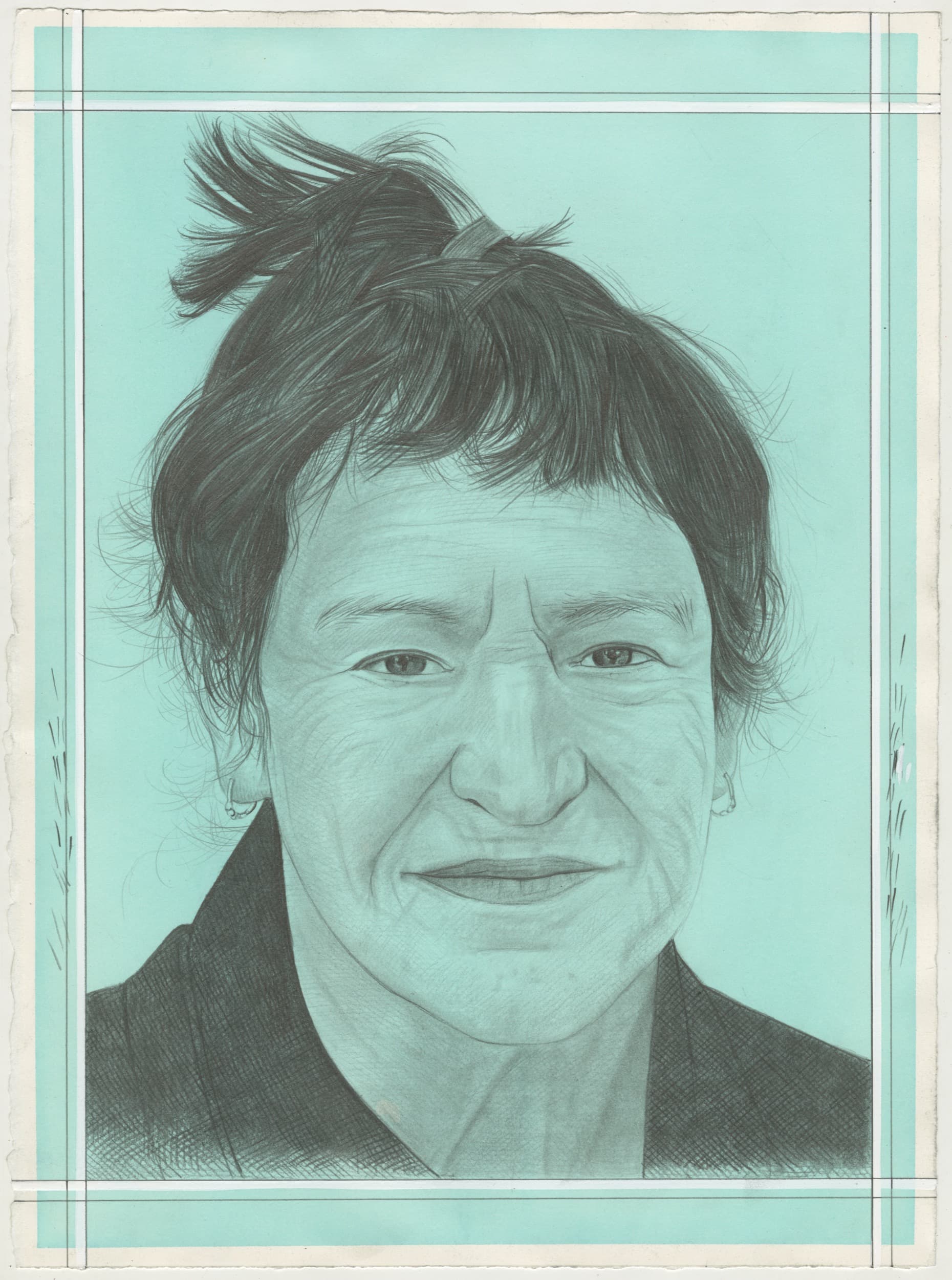
Portrait of Nancy Rubins, pencil on paper by Phong H. Bui.
Word count: 4669
Paragraphs: 118
The Ranch
June 27–November 15, 2026
Montauk, NY
The Ranch
June 20–July 22, 2026
Montauk, NY
If you ask her about discipline, Nancy Rubins will tell you she is extraordinarily determined. That sense of determination comes through in her monumental sculpture. Rubins works with objects such as airplane parts and hot-water heaters, lashing them into formations that radiate outward. On the occasion of her exhibitions at The Ranch, where Rubins installed a gargantuan sculpture in a field as well as an indoor presentation of drawings, the artist spoke with the art historian, Neil Baldwin. In the conversation that follows they discuss how Rubins calibrates the monumentality of her work, the importance of flexibility in her decision-making process, and the qualities of boundlessness she sees in the cross-hatching techniques of one of her favorite artists, Albrecht Dürer.

Nancy Rubins, Friends of Pluto, 2026. Aluminum canoes, Jon Boats, rowboats, stainless steel armature, stainless steel wire cable. 396 × 528 × 396 inches. Courtesy Max Levai Gallery / The Ranch and the artist. © Nancy Rubins. Photo: Ollin Culbert.
Neil Baldwin (Rail): You can probably tell from my voice, I’m still feeling a little out of breath after walking around Friends of Pluto (2026) with you. At one point, I felt this incredible necessity: how important it is to be able to perceive the dimensions from all different sides.
Nancy Rubins: Because as you walk around, it changes continuously. You can’t see the whole thing at once, so you put it together in your mind. As you’re walking around, you’re getting different facets of this huge thing that you can’t really take in all at once. It’s something you put together in your mind, because as you turn, it’s like a completely different object. You wonder, “Is that the same thing? Yes, it’s made out of the same elements, and it’s gargantuan, but is that really the same object that I was just looking at?” Because it is so very different as you go around it, and that is really interesting and important to me. It’s something that I have to take in also. I’m still taking in that walk—
Rail: Right now? While we’re sitting here? Didn’t you tell me that you just finished it, what—two days ago?
Rubins: That’s correct.
Rail: You also told me that your body was still adjusting to the physicality of doing the thing.
Rubins: Well, everybody carries tension in their body. Truly. I carry it in my shoulders. It’s not that I’m doing such physical work. The crew is doing all the physical work, but I’m running around like six or seven miles a day, walking and looking, and looking and walking—and I’m looking up a lot of the time. I’m just starting to relax a little bit.
Rail: I wanted to talk about how you calibrate monumentality. When I called you on the phone a few weeks ago you talked about a “ballet of cranes,” which I thought was fantastic. You have a crew of four or five people, and they are executing your concept, but how do you calibrate or measure their actions? Or do you think of it as managing their actions? How do you do that?
Rubins: First, I have great faith in my engineer, who designed the structure, which I know is extraordinarily flexible.
Rail: By structure, you mean—
Rubins: The stainless-steel armature. It’s bolted into concrete set in the ground. When I started working with this particular engineer on this project to design these structures, I asked her to build a structure that can live anywhere, because I wanted to be able to use it repetitively over time in different configurations. And she did that. These structures are incredibly solid and can hold almost any condition. So I feel really confident in the integrity of the object. We have these things called the Ts, and they are—
Rail: Like the letter T?
Rubins: Yes. It’s a stainless-steel structure that bolts on to the big inner structure, so that we can build out cantilevers in various spots that I deem in the moment. So there’s great flexibility for on-the-spot decision making.
Rail: This is just one of many unusual traits that I see in your work, which is that on the one hand there is premeditation or preconception, and on the other hand there’s room for improvisation and modification.
Rubins: Absolutely. The way we go about that is we have this collection of objects, and the ones that are the biggest and the heaviest are what we deal with first.
Rail: Like the hot-water heaters or—
Rubins: Airplane parts or trailers or whatever. It’s a logical thing, but those are the first decisions I make for the work, and that’s the hardest part: entering the work and making those first decisions. Because after that, the work guides me to make the next decision.
Rail: Do you have any premeditated ideas about how one part will lead to the next?
Rubins: Well, with this work—and it’s often the case—I tend to build up the higher parts first, even though logically I should start with the lower parts. But for me to make a sculpture, I need to see how it’s going up there before I address these other parts. So we found the largest boats that I had brought in—
Rail: For this work in particular?
Rubins: Yes, and we started installing those first. They were the most colorful ones in this upper area, and then those guided me to where the other stuff started going, and someone said to me, “Well, what are we aiming for here? Is this a flower? A bouquet of flowers?” And my response is, “That’s what you are seeing now, and I like hearing that you’re seeing that, but I don’t know where it’s going, and we’re going to discover it together.” I told them that, because I truly don’t know. Someone else will ask, “Well, what shape is it going to take?” I don’t really know. And for me, that’s what I love about it. I love seeing this thing evolving in front of me, and I’m learning from it as I go. Something is being revealed to me, and I figure if it’s satisfying to me, hopefully that can be shared with the next person who sees it. So it’s kind of a way to talk to myself first, and then I figure I can have that conversation with others.
Rail: Absolutely.
Rubins: I don’t know how to say those things in words, but if I can communicate in this visual way, then I feel I can accomplish something.

Nancy Rubins, Our Friend Fluid Metal, 2014. Aluminum, stainless steel armature, stainless steel wire cable. 204 × 500 × 279 inches. © Nancy Rubins. Courtesy the artist.
Rail: This is another example of something I find unique: this kind of evolutionary thought-process. It’s not like a landscape painter out there trying to capture something they can see. We’re talking about the realization of an idea, and what that requires spatially and physically. So to circle back and kind of put the punctuation on this question: can you tell me how you speak to your team?
Rubins: Oh, that’s easy. I’ve worked with this team for quite a long time. I started working with my chief installer in 1992 using hot-water heaters. He was a graduate student at UCLA, and I was working with some other graduate students at that time—nobody wore face shields or safety goggles—it was all gloves and tennis shoes. [Laughter] Over time, this team evolved, and I can say to them, “Okay, let’s find the first one: the biggest, heaviest boat. How is it going to fit into the structure?” You want that first element that’s going up to be really sound, because you know a lot of other elements are going to be cabled to it.
Once an element is chosen, I discuss where it’s going with my chief installer. He, in turn, discusses and informs the crew who are helping him to receive it and the crane operator. Two team members are climbing within the sculpture to receive the work, and two team members are on an articulated boom in the air. We all have walkie talkies. The chief crew member informs the crane operator where he would like to receive the boat and the angle we think it will be going. And my team attempts to install the boat according to the direction I’m imagining in a sound and secure way. Often, as the element is travelling through the air in the crane, I will see a new direction for the element to live in the sculpture, or, my crew will show me a different direction for the element to live in the sculpture, and often that’s more interesting than my initial plan. And these subtle changes become compelling gifts along the way. Once the element is correctly sited, my team then uses compression and tension of custom-sized and twisted stainless steel wire cables held into space, at which time, other elements can begin cabling and cantilevering from those first elements.
Rail: So it’s a foundational—
Rubins: It’s a structural and visual decision. You want it to be seated at the right angle with the correct tilt, so that it’s kind of setting the first beat for the rest of these elements that are going to be joining in.
Rail: When you were doing Friends of Pluto, did you have the boats all laid out on the ground?
Rubins: Yes, it’s like a palette. I’m kind of a painter in that way. It’s a form of making these marks, and some of these objects are already marked up from their own history. So a patina comes in with them, and as the light changes, those marks also change throughout the day. You’re always getting a different experience. Years ago I used to think, “Oh, that’s a Paul Cezanne landscape”—what a weird thing for me to be thinking as I’m building this sculpture. But I keep thinking I’m seeing that sometimes in a work.
Rail: Could you talk a little more about that? I’ve never heard that before.
Rubins: Sometimes with those little squiggly spring animals, I kept thinking I was seeing early Philip Guston. You know, those little wiggly marks that are early Guston? Sometimes I would see Willem de Kooning. It was odd. It wasn’t direct, but it had some connection with the drawings. I went to the Albertina once. A curator took me into the basement and was pulling out these lovely things to look at, and she brought out Rembrandt’s elephants, which were amazing, and then she brought out Albrecht Dürer’s drawings of the praying hands and the bunny, and the little clump of dirt, and the clump of dirt just took my heart.
Rail: Because?
Rubins: It was just a clump of dirt with some weeds growing in it, but the weeds were still alive, you know? Here it is, hundreds of years old, and the weeds are still alive, and the bunny is still alive, and the hands are still praying. And then she brought out another drawing, and she said that it was debated as to whether Dürer made it—that it could have been one of the pupils. The second I looked at it I said, “It’s a student, it wasn’t him.” It was like an immediate response.
Rail: What happened then?
Rubins: I looked at it again, and I realized why I said it—and I was right, by the way. There it was, a clump of dirt, but I could tell it was possibly made by someone in his shop, taking after the master. In that clump of dirt all the plants had a line circled around them like a cartoon. You know how when you’re a kid and you’re told to draw inside the lines? It was like that, with outlines containing that clump of dirt. But those little leaves and things—in Dürer’s work there is no outline. There’s crosshatching that just goes out and out, and that’s why the rabbit looks like it’s still wiggling, and hands look like they’re still praying, and the plants look like they’re still going in this continuum that feels like it’s going on forever.
Rail: I was going to ask you about influence, but now that you’ve said that, I’m curious in a different way. The artists you’ve mentioned—de Kooning, Cezanne, Dürer—might they be influential because of their dynamism or their technique? Is that what you’re getting at?
Rubins: They’re boundless. Those works feel boundless to me.
Rail: As in, they’re not contained by the frame? Or in terms of the real thing that they’re supposed to portray?
Rubins: They feel like they could go on forever.
Rail: In what way? Time-wise? Space-wise? Both?
Rubins: Yes, all ways. I built a piece many years ago called MoMA and Airplane Parts (1995), and in my mind’s eye that thing could have kept growing. It was kind of lurching out toward the garden of the Modern, and there was Pablo Picasso’s little goat, and it felt like it could keep going out on the block and around the corner.
Rail: An artistic epidemic.
Rubins: Yes. [Laughter]

Nancy Rubins, MoMA & Airplane Parts at Forte Belvedere Florence, Italy, 2003. Airplane parts, steel, black tie wire cable. 324 × 504 × 300 inches approx. Courtesy the artist. © Nancy Rubins. Photo: Nancy Rubins.
Rail: That makes me think of a very interesting interview you did where someone made an analogy between your work and the work of John Chamberlain. You responded that his form of expression was one of compression, whereas yours is about expansion.
Rubins: Yes, that’s true. He uses machines to crunch objects and make these dense things. You feel the weight of the smush and the crunch. And the abstraction is in those crunches, generating that intense density—they’re all like that. What I’m doing is closer to those Dürer drawings, with those lines that radiate outward, endlessly. There is a density to it, but there’s also this outward pushing energy. So we may have similar material components—refuse objects, basically—but the energy and the actual working of the core of the sculpture is very, very different.
Rail: Thank you. I understand that much better now. When we were outside walking around, you were making reference to the light, the wind, the sky—are these kinds of context always at the forefront of your thinking?
Rubins: Installing here at The Ranch is very different from installing—
Rail: In a plaza or building.
Rubins: Yes, exactly—where there’s architecture to work with.
Rail: Of course.
Rubins: It’s an important relationship. When I build on site, I might respond to a line I see over there, or a doorway, or the shape of a building, or the train going above you. But out here I’m in nature, where it’s this kind of vast openness, and the natural environment is a harder space to hold.
Rail: Rather than public art?
Rubins: Yes. I did a piece in 1990 called Table and Airplane Parts. A friend had an old worktable—it was a big heavy worktable that he had to get rid of—and he offered it to me. I thought, “I don’t really use worktables; I go on the floor and make stuff. But it’s such a good table, I can’t let it go, you know?” I’m a hoarder. [Laughter]
Rail: You know a good table when you see one!
Rubins: [Laughter] It was a good quality table—you can’t let it go! So I thought, hmm, and I had these airplane parts, so me and a graduate-student assistant started cutting big holes in that table and shoving those airplane parts through the table and using that as our structure. Airplane parts are very strong, so I could build these incredible cantilevered forms coming out of that table. We built it in my garage studio, and then at one point I installed it in a gallery in Los Angeles. I tried to maintain the form that we built it in in the garage studio, and it was just a god-awful mess. The structure of the wires wasn’t working, so we cut the wires. Now we’re trying to hold the chunks up and we’re putting duct tape around them to keep them all together—it was just ridiculous.
So, when we shipped it to France to be shown at the Consortium in Dijon, we cut all these elements apart. I ended up building a whole fresh new sculpture using those first couple gestures. Certain long wings needed to go through the holes in a certain way, so I could cantilever off that, but then after that it was free-floating, making a new work, and it was really fun. Every time we reinstalled it, it took on a new shape. However, I was always highly conscious that the table was a marvelous stand-in for a piece of graph paper or a building.
Rail: In another piece I read, you refer to how every time you see one of your works it looks different to you.
Rubins: That’s true.
Rail: The work itself, certainly the ones that are large-scale, but also the drawings—I feel like they actually want to be different.
Rubins: Again, if the work is doing its job, then when you go to look at it, it does something in your mind. I mean, it has room for you to place your mind into it, as your mind is at that moment—do you know what I mean?
Rail: It’s situational?
Rubins: Right. I believe that if a work of art is going to last through time, it has to be a fresh experience each time you look at it. That’s what I yearn to have in my work.
Rail: A yearning—that’s a very eloquent way of putting it. So to retrace one’s steps, another impression I get from talking to you is that you’re highly disciplined. Do you think that’s accurate?
Rubins: I think that’s funny. “Discipline.” I mean, as a child, I was always in trouble. I can still hear adults saying, “She does not listen; she cannot pay attention.” [Laughter]
Rail: Oh, artistic trouble.
Rubins: I was a hyper kid—always being told “Sit still! Sit still!”
Rail: How old are we talking? Six? Seven?
Rubins: I didn’t learn to read until I was in high school.
Rail: Okay.
Rubins: Disciplined isn’t the word. I can be highly focused in odd ways. Even now I’m a painfully slow reader. I like audiobooks. But I’m extraordinarily determined.
Rail: Yes, determined.
Rubins: I think that’s what makes me disciplined, because I want to get this stuff done. My dad was an engineer, and he often repeated the Thomas Edison phrase, that invention is one percent inspiration and ninety-nine percent perspiration. Anybody can have lovely ideas and a big imagination. I always had a big imagination and a little too much energy, but I was able to focus that and find a way to bring those ideas into reality, and that has been my discipline.
Rail: You’re talking about a high level of motivation to execute something.
Rubins: So I can see it. And then if I’m happy with it, that’s the most satisfying way. But I need to see it.
Rail: Do you think that your yearning to see is intensifying as you go along?
Rubins: That’s always been there. I just get better at it, I think. As I get older, I’m able to hone things down. I’ve always built things, and I really needed to build things at a certain scale, but I had no means of storing those things. What do you do when you build something so big? I used to call my early works my “Christmas floats,” because it was like you put all this energy into making a Christmas float, and then Christmas is over, and the float disappears. I was making these huge pieces, like Worlds Apart (1982) or a 45-foot concrete appliance wall, and they were there for a period of time, and then we brought in the sledgehammers and put on dust masks and got the work out of there.

Nancy Rubins, Drawing, 2026. Arches Paper, graphite. Dimensions variable. Courtesy Max Levai Gallery / The Ranch and the artist. © Nancy Rubins. Photo: Ollin Culbert.
Rail: I want to shift topics and talk about your drawings. When I first saw the drawings, it was in a catalogue. My first question was, “Why is she calling it a drawing?” I hope that’s not too reductive.
Rubins: Let me tell you a story. I grew up on the East Coast, and I got into graduate school at UC Davis, which was a very competitive school at that time. I really wanted to go there because it seemed like my art school education was grooming me to go to New York. I was artistically mature, but as a human, I was immature. I was an immature person, and I really was not ready to take on New York. I really wanted to go far, far away and kind of evolve.
Rail: You were so self-aware. How old were you?
Rubins: I was probably twenty or twenty-one. Graduate school was a lovely umbrella. To be able to experiment and do stuff and not have to take on that responsibility—it’s a kind of gift for an artist.
Rail: That’s true, very true.
Rubins: It was perfect that way for me. My sister and her husband lived in the area of San Luis Obispo, California, and they had a house in a town called Los Osos. They went to Europe for the summer, and I was taking care of their house and their dog. I had a waitress job at this community called Morro Bay. It was a beach community, and my waitress job was boring. But out there in the water was a leftover volcano forming a lump in the water—but it was a leftover volcano. It was a volcanic thing that had eroded away, and I was enamored with it.
I thought, it’s just a soft hill, but it’s a volcanic thing with all this history. I would just stare at that thing for hours. It was enigmatically mesmerizing for me, and I thought, “When I get to graduate school, I’m going to make this into sculpture. I had a sketchbook and I made tiny drawings about these enigmatic lumps that I was going to build when I got to graduate school.”
Rail: You knew they were for the future.
Rubins: Yeah.
Rail: Consciously?
Rubins: Yeah. I didn’t know how I was going to make these sculptures, but I was going to make sculptures. So I was in California, and I saw adobe for the first time. Now, I had come out of a ceramics education. My sculptures were clay things that I didn’t fire—I just made them. So I made these concrete and mud and straw mounds, and they were just terrible. They were not interesting. They didn’t have that enigmatic energy, but the drawing still worked for me that way. I thought maybe I should go back to those drawings, and so I started making the drawings again. I realized, “Wow, this is just a lousy piece of paper and some pencil.” And I figured out if I drew on the floor, I could put all my weight on the pencil.
Rail: I see. That’s important.
Rubins: And I could develop this weird deep space. It wasn’t a line. I began questioning what a drawing is. “Is it a puddle? Is it deep space? Is it a picture of something?” And so I was making these paper pieces that I was really excited by, but I didn’t know what to do with them. “What am I going to do with it now? Is it something? Is it a flat thing?” So I started to build sawhorses, oversized sawhorses, and flop them over that.
I didn’t know what to do with them. It was like a material I was inventing, making this weird deep space, but I didn’t know what to do with it. So I think that is the beginning. That is the origin of the evolution of the drawings.

Nancy Rubins, Agrifolia Majoris, 2017. Cast aluminum, brass, bronze, stainless steel armature and stainless steel wire cable. 171 × 231 × 213 inches. Courtesy the artist. © Nancy Rubins. Photo: Brian Guido.
Rail: The way you’re talking about it, it becomes organic. It has its own autonomy. Could you talk about how these particular works—which are graphite on torn paper—are installed? How is it done?
Rubins: Initially I make the drawings, and it takes a fair amount of time. And then it takes just a few minutes to figure out the form somewhat and get it on the wall. I do it very, very fast. I do it so fast that I don’t want to catch myself. Do you know what I mean?
Rail: That’s part of the process.
Rubins: I do it so fast. I think that is just my own kind of energy, you know? I have a lot of energy, and there’s some anxiety there, and I just want to get it done. I don’t even stop and look. I just put it up, and then take a minute to breathe, maybe adjust a little thing here or there, but not too much.
Rail: Is that why pushpins are used?
Rubins: Yes, the pushpins are perfect that way.
Rail: Because you can—
Rubins: I can just tack them up fast. I get nice long pushpins—like, half-inch long pushpins. I get these things, it’s just a common pushpin, and then I can install them very quickly and sit back and take it in. It’s not a super controlled thing. It’s something that kind of happens. I’m not saying, “Okay, this needs to be a little bit higher,” you know?
Rail: So you spend a laborious, painstaking time—
Rubins: It’s not painstaking. It’s just long. I’m not a meditator. I swim, that’s as close as I’m going to get to that kind of thing. But perhaps this is close to it too, because I’m just watching those layers of stuff go down and watching that deep space evolve.
Rail: Okay, but then you throw it up;, you pin it up there. Do you ever step back and correct?
Rubins: Like I said, I might adjust a little something here or there, but not too much.
Rail: No radical corrections.
Rubins: Very rarely.
Rail: And it stays that way. So then how is it replicated?
Rubins: We make photographs, and a map. The map shows you where it goes on the wall. We trace it on a piece of plastic, and then you know where the folds are. But does it adhere to that one-hundred percent? No. It comes close enough, and then I can kind of bring it into a satisfactory form.
Rail: Is it very high quality?
Rubins: It’s Arches paper.
Rail: I see. And you are using regular pencils?
Rubins: They’re called General’s Sketching Pencils. It’s a rectangular pencil. I made friends with people at the factory. They would sell me cosmetic defects, and I would buy them in bulk. So instead of paying ninety-five cents a pencil, I could pay ten cents a pencil. The lady who used to sell them would call me and say, “We have a batch of ten thousand,” and I’d write her a check. So I have enough pencils for the rest of my life, basically. [Laughter]
Rail: So we have the fabrication methodology, and we have—for lack of a better phrase—the display methodology. Do these works preclude interpretation? I mean, do they not require interpretation? When I was saying, “Oh, that looks like this, and that looks like that,” you replied, “That’s very amusing, that’s very nice—”
Rubins: It depends upon the viewer. The viewer is going to bring whatever they want to the experience. I can’t dictate to the viewer what to think, what to bring to their experience. I wouldn’t ever want to, either.
Rail: Do you think that your monumental works and your drawings exist on two poles of an arc? Is there any way in which they contradict or complement each other? Or do you think of them as just two types of expression that you use to make your work?
Rubins: I don’t know. I don’t even try to think about that. I know that I do them both, and they both give me a lot of satisfaction in their own ways. I don’t really know how they relate to each other. And I don’t want to try to explain it either. I just accept it, to tell you the truth.
Neil Baldwin is an Editor-at-Large for the Brooklyn Rail.