ArtJuly/August 2026In Conversation
ANICKA YI with Christopher Y. Lew
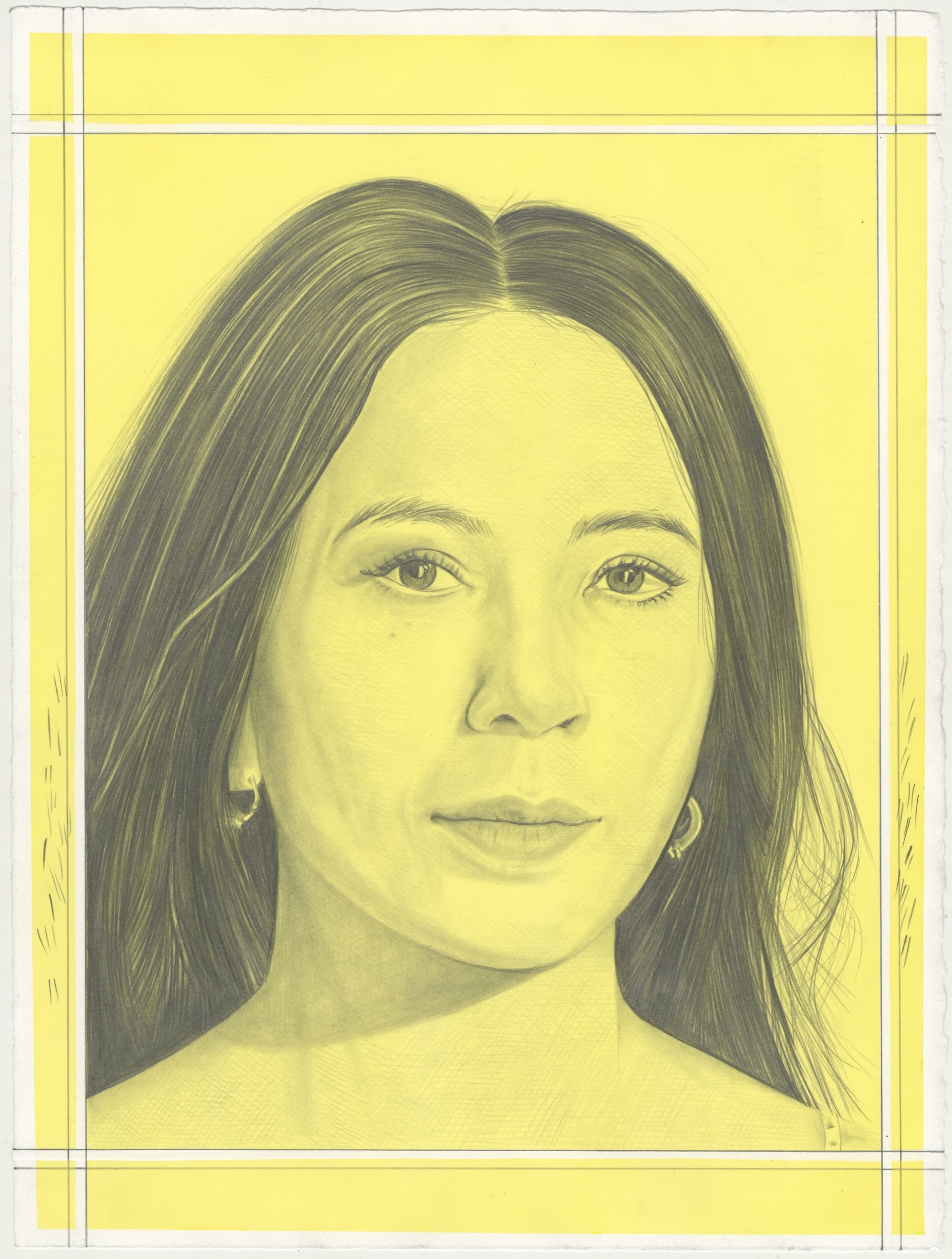
Portrait of Anicka Yi, pencil on paper by Phong H. Bui.
Word count: 4342
Paragraphs: 66
Storm King Art Center
May 17–November 9, 2026
New Windsor, NY
Anicka Yi wants her audience to be active participants, not passive viewers. Drawing on scientific processes and establishing multi-temporal relationships that dynamically extend the experience of her artwork, Yi is not an ocular-centric artist. Instead, Yi's work engages senses often disregarded, and activates relationships outside the realm of aesthetics. On the occasion of her installation at Storm King Art Center, Yi spoke with the curator Christopher Y. Lew on the New Social Environment (Episode #1360).

Installation view: Anicka Yi: Message from the Mud, Storm King Art Center, New Windsor, NY, 2026. Courtesy the artist and Storm King Art Center. Photo: Jeffrey Jenkins.
Christopher Y. Lew (Rail): Hi, Anicka. I’m excited to be in dialogue with you. Having been long-term friends, collaborators on some projects, and following your work from an early phase, I think it’s a great opportunity to talk about your latest project, Message from the Mud, which just opened at Storm King. Before we dive into the work itself, I wanted to ask how you conceived of this work, especially since it’s your first large-scale outdoor installation. Did those conditions make you approach this in a different way than previous works?
Anicka Yi: I’ve lived in New York City for thirty years, and I’ve been going to Storm King throughout that time. I’ve always regarded Storm King as one of the most lush, gorgeous, bucolic sites for art—but admittedly I did see it as a kind of temple for modernism and these minimalist sculptures on a monumental scale, and I am definitely a non-monumental artist. So I thought, “Well, I don’t think my work would ever fit in this environment, this ecosystem,” and I just appreciated it for what that was. But when I was in conversation with Nora Lawrence, who’s the executive director, I started thinking maybe it is possible, and intuitively I thought, “We have to go deep into the land.” I didn’t immediately think about Land art or Earth art, but of course I think that was a natural entry point for me.
Rail: And in those early conversations with Nora—who has been with Storm King for so long and really knows the history—did those things come up in terms of what other artists have done? Were there certain ideas she was planting with you, or was it more of an open invitation?
Yi: Well, Nora understood what kind of artist I am—that I’m not an artist who needs a lot of prompting. [Laughter] So I was like, “Let me metabolize this, let me just think about this.” She never said, “Oh, well, why don’t you try this or that or the other?” She gave me a lot of open space, you know, literally and figuratively to think this through. But I knew early on what I wanted to do. I was pretty decisive.
Rail: And what is that exactly? If we can jump into the work itself: what is Message from the Mud?
Yi: Message from the Mud is a site-specific installation that’s responding to its environment. What you’re seeing is a kind of archeological site, what I call a prehistoric biofiction, and what that means is that biology also wants a biography to be written; these sort of systems and processes and theories also can be thought through a narrative lens. With the pre-history, I wanted to situate this deep time, deep history—so we dug up quite a bit of soil from the Storm King site.
In fact, when I was there recently, I remembered digging up this former parking lot that they were excavating. They are trying to re-wild the area and put a stream in, and I thought, “That’s the site. We have to dig up this kind of post-industrial relic of parking lots—a system of parking and transit.” Then they were like, “No, we need to turn this into a stream and lovely hills.” [Laughter] And so we dug up the soil, and we placed the soil in these acrylic cylinders called Winogradsky columns. They were invented by a biochemist, Sergei Winogradsky, who was essentially the father of modern soil science. This was in the 1800s.
So we filled the containers with soil we dug up from Storm King, and then we added some chemical friends: carbon in the form of shredded newspapers; calcium in the form of eggshells; some egg yolks for sulfur, as well as some other chemicals like diatomaceous earth and a whole host of other nutrient-charging elements; and of course, we topped it off with a healthy dowsing of pond water from the nearby pond. Then you just kind of let it cook for two years; that’s what we did. It gets activated from light and temperature and climate, and what you see through pigmentation are microbes. You’re seeing a variety of strands of microbes, and that’s what allows for pink and ochre and purple and blue flourishes. The green is algae, and that just continues to sort of season throughout time.
Rail: So it’s not so much cooking as it is just actually growing?
Yi: It’s growing, it’s metabolizing. There are all these microorganisms—microbes being one of them—but there are these other microorganisms from the deep fragrant life that’s happening beneath your feet. All of this creates intersections of time. There’s geological time in the form of the sand and the soil. There’s algal time—algae being in the form of cyanobacteria, which is one of the earliest forms of life on this planet. It helps to oxygenate the planet, turns our skies blue—it’s the largest biomass producer we know about. And then you’ve also got human time, of course, and animal time.
I don’t know if you’re familiar with the concept of terroir in winemaking, where you have all of these different environmental ecological influences that contribute to the health of the soil, so when you’re drinking that beautiful pinot noir, you’re really drinking the environment and all the influence: be it industrial or animal influence, geological influence—all of that is alchemized in the form of a glass of wine. That is what’s happening in these Winogradsky columns.
Rail: It’s kind of like an ecosystem, but it points backwards to, say, the beginning of life, and all the way to where we are now, if not into the future.
Yi: Precisely.
Rail: And what about the water in the pond—the formation that the sculpture sits in? Because the columns weren’t grown, or cultivated on the site, right?
Yi: No. They were incubated in a barn at Storm King. We produced about thirty of these columns, and we continue to monitor them and nourish them. My director of exhibitions went to Storm King every week for a while and made sure they were healthy and thriving. We were very fortunate to be able to work on site throughout this period.
Rail: Yeah, it’s quite a bit of dedication from your team and Storm King—well before it comes into the site and becomes public in that way.
Yi: It’s a beautiful way to work. Because we’re working with an installation that deals with deep time, we had to invest in that deep time on our own terms. We had to settle into this very intimate relationship with the growth to have that kind of nurturing, fostering dynamic. That’s how we’re able to symbiotically metabolize the process as well as what’s happening with the organic elements.

Installation view: Anicka Yi: Message from the Mud, Storm King Art Center, New Windsor, NY, 2026. Courtesy the artist and Storm King Art Center. Photo: Jeffrey Jenkins.
Rail: Did you know what you were going to get? I mean, did you know you’re going to get these greens and oranges and various striations? It’s so painterly.
Yi: That is something that attracts me to columns: they have this kind of painterly quality to them. Sometimes it seems like Abstract Expressionism, other times it’s more like pointillism. There’s a kind of mashup of a lot of different painting styles that these works conjure for me. [Laughter] But did I know what to expect? You know, you try to go in with some amount of, let’s say control, but when you’re collaborating with living organisms, there’s only so much you can do. You have to acquiesce, and you have to let go, but that’s really when the magic and alchemy happens.
So: yes and no. There are certain strands of bacteria that we introduced that we knew would allow for a certain sort of pigmentation to flourish. Sometimes it works, sometimes it doesn’t. To be quite frank, that’s the dance we do with these living collaborators. It forces you to just accept the limitations of what you can control and how contained something can be—and then you have to adapt.
Rail: Can you go a little deeper into this idea of control? There are some artists who want to control everything in their work, even if it’s seemingly impossible. And there are others who set certain parameters and just see how things play out. I’m thinking about some of your past works that involved living organisms, like ants at the Guggenheim, or even bacterial colonies from samples from a hundred women that you collected early on. Some things grow, some things don’t; some things survive, others don’t. Were there Winogradsky columns that you were cultivating, but didn’t put on display because they didn’t look the way you wanted? How much of that are you directing?
Yi: So over the course of the twenty-some years I’ve been developing my practice, it’s become a kind of spectrum, right? When you’re working with these living organisms, of course you have to have an agile and nimble mind around these sorts of systems. So I have learned to try to set up a foundation, or a springboard into studying these life forms, and then allow them to flourish and do what they do, acknowledging that I can’t contain or control them that much.
That’s what I would call the biosphere aspect of my practice. But we all are entangled in multiple spheres, so when I work with digital, algorithmic-based work, there’s a different rubric for thinking through stability, consistency, and control. It’s a funny thing: occasionally, in conversation, the C-word, “control,” does come up, but I rarely think about it in an emphatic way. It’s really more like teasing out a storyline—a narrative, if you will—and creating a certain syntax, so that a sentence or a paragraph may kind of emanate and flourish, and so it’s really about different kinds of syntaxes. I think about these kind of like syntax, and early on, my practice was definitely informed by certain kinds of language-structures as well, and metaphorically sort of drawing from that.
Rail: And that takes us back to the notion of biofiction you mentioned before.
Yi: Precisely. You know, I used to feverishly write backstories for all my artworks. I would just ask myself, “Well, what is their story? How do they come to be? If we’re trying to birth something that doesn’t exist in the world or we’re building worlds as artists do, then what’s the story of this world? What’s the origin story?” I’m not saying there can only be one version, but it’s playful and very charged for me to think about this through these questions: Why does this need to exist? Why does it come to being?
Rail: And in this case it’s this world building, but it’s kind of like you’re building with what’s already there—thinking about the soil and the land that you’re working from.
Yi: A journalist recently asked me about speculative fictions, and I replied, “Oh no, I don’t traffic too much in speculative fiction, because I have to be accountable to this world.” Even though I’m trying to build these new worlds, I have to be accountable to our world. I’m living in this world with you and everyone, and so I want this to be about a shared responsibility of how we can onboard these ideas in tangible ways, rather than be spirited away in some fantastic, alternative universe.

Installation view: Anicka Yi: Message from the Mud, Storm King Art Center, New Windsor, NY, 2026. Courtesy the artist and Storm King Art Center. Photo: Jeffrey Jenkins.
Rail: With that in mind, can you talk about the pond formation? The landscaping? I feel like that’s as important as the Winogradsky columns themselves.
Yi: Yes. So, there’s a fair amount of dramaturgy going on. [Laughter] There’s the archeological site, and, you know, I wanted to make this very distinct contrast with the bucolic green, anticipating there’d be all this fresh bright green in the spring when the project opened. So I imagined this green against the idea of these ancient ruins, this potential civilization—but also that there’s a collision of timescales, because there is something futuristic about this as well. So you’ve got this ancient kind of scenography. And in this language around that there’s this kind of lost world, lost civilization, and that’s also a nod to humanity. But then you’re juxtaposing that against the incubation of this almost alien life that could be transpiring and growing out of not just the columns, but from the pond too. It’s important to note that this pond I designed is critical in that it is kind of a birthing pool—birthing new ideas, new life forms—and this hearkens back to water and humanity’s primordial origin story, our primordial home: we all evolved from the ocean, and eventually migrated onto land.
Rail: I’m imagining organic molecules mixing in the early waters, and this is what rises out of it, in that sense. I mean, it’s interesting to think of it as this kind of future-past collision, and I know you’re also very interested in thinking beyond a human perspective—
Yi: Yes, since very early on.
Rail: At one point we were talking about how you were anticipating other animal species interacting with this too, right? So in that way, it wasn’t made just for humans.
Yi: Okay, there are a couple things to note. I mean, I was so tempted to go to Petco and put some turtles and frogs in there and drop them in for the opening. [Laughter] But I was told that eventually they will migrate from the nearby pond, and I was very excited about that. I was also concerned that bears would tip over the columns, or a family of raccoons were just going to park on the site. I thought, “Let it be, let it all happen.” Now, I’m quite excited about the work being a kind of interspecial party zone over at Storm King. [Laughter]
And yeah, I think this is where things will get interesting, you know? I did my part—my team, we did our part—and Storm King did their part, and we’re going to see fairly quickly how this will transform and evolve, because biology has a way of happening very fast and then slowly. It encompasses all these different timescales, and that’s something that I really wanted to speak to with this installation.
Rail: It’s kind of an experiment in itself in that way, right?
Yi: It’s kind of an omnidirectional M.C. Escher drawing. [Laughter] I wanted to not capture, but be able to pull a little focus around that which we can’t contain, and all of the teaming energy and life around us and underneath us.

Installation view: Anicka Yi: Message from the Mud, Storm King Art Center, New Windsor, NY, 2026. Courtesy the artist and Storm King Art Center. Photo: Jeffrey Jenkins.
Rail: Related to that: Could you speak about the sense of collaboration with scientists on the project? Were you talking to people who were developing other Winogradsky columns?
Yi: Yes. So I spoke with two very pivotal consultants. One is Frank Cusimano, who is a microbiologist. He really helped us and guided us. He was sort of the chef, if you will, of these columns, and he is a frequent collaborator. We worked together on the Guggenheim show in 2017. He helped with the microbial diorama there. So he is really our Winogradsky doula. [Laughter] I also consulted with a specialist and director at the Exploratorium in San Francisco. They have this very flat-paneled Winogradsky that they’ve been growing for, I don’t know, at least ten years or so. I thought that was the gold standard of this monumental Winogradsky work. And Denise King, she advised us as well.
Rail: You made an important distinction, which would be interesting to hear more about, in that this is not a scientific experiment. Despite working so closely with these experts, the work does something as an artwork that science does not do.
Yi: I think that opens up a lot of philosophical, existential areas. You know, I don’t illustrate science—what would be the point of that? That would not make for compelling art, in my opinion. You know, science is also very subjective—a neuroscientist told me that recently. The outcome may be objective, but your approach to science is purely subjective. You get to choose what you’re prioritizing, how you’re going to organize your research, what gets filtered, what doesn’t—it’s very similar to the practice and process of an artist. So there’s a lot of parallels, a lot of shared insights and practical considerations, but to me, science is also a space for interrogation. It is not something that is absolute. Science is the hypotheses that we have, and over humanity’s history, how many times have we refuted certain theories? I find that very potent, the mutability, you know?
But I think science has also become the modern era’s religion, right? I mean, it’s taken over a lot of theological preeminence. Consider the Big Bang—that’s science’s version of our origin story, which is precisely the kind of story we used to get from religion. And then the scientists are like, “Oh no, here’s where we came from,” but it’s like “Hmm, did we though?” [Laughs] So there’s a lot of rich material to work with narratively—and it’s not that I’m being disrespectful or that I’m just playing with fingerpaint around these scientific theories. I think it’s important to appreciate the interesting potential and the mutability of these ideas.
Rail: Or it’s like the mutability of knowledge, or knowing that what we understand today may not necessarily hold in the future. I’m thinking of how we shifted from a geocentric model of the planetary system to a heliocentric one. And we can build from there, right? I think one of the interesting things is how this corresponds to the scientific method, which is predicated on the idea of asking a question, having hypotheses, and then testing them. But with art, I feel like it’s about raising those questions, but it’s not about achieving an answer the way that science wants to do, or does, you know?
Yi: Well, that’s what’s so liberating, right? I can simultaneously be reading about three opposing theories around consciousness, and in that milieu there will not be any agreement. It’s like, are you in the biological camp, which states that consciousness comes from biology? Are you in the panpsychist camp? Are you in the physicalist camp? You know what I mean? I’m actually inclined to think that there are real merits to a lot of these ideas, but I don’t have to choose. It’s not about being didactic.
That’s what’s so liberating. I don’t have to prove something in order to create an experience to bring these compelling ideas forward. It’s about asking the right questions, as you said. It’s not about the answers so much, but I think that—dare I say—it can be something that’s even transcendent from that need to know the right knowledge base around these ideas that I’m drawing from. It’s not about being right or wrong. It’s kind of a middle way, and art can be transcendent in that way. It can occupy a non-conceptual space, it can be pre-cognitive, pre-verbal—pre-assigning symbols that we create through language and through data. It can be something that’s much more holistic.

Installation process view: Anicka Yi: Message from the Mud, Storm King Art Center, New Windsor, NY, 2026. Courtesy the artist. Photo: Peter Pak.
Rail: Kind of primordial in this case, but I think it’s also like you can hold conflicting ideas in the air, and it’s not that they’re canceling each other out or even opposing each other in that sense.
Yi: Isn’t that how life functions? All its myriad contradictions, and we’re still standing—you know, until we aren’t. [Laughter]
Rail: It’s true. Speaking of transcendence, I wanted to read a quote from you to turn some of your words back to you.
Yi: Oh dear. [Laughter]
Rail: From a recent Artforum piece, which is also about Messages from the Mud, you wrote, “Current research tells us that awe is extremely healthy for us to experience, because it not only brings us joy and a kind of peaceful experience, almost similar to meditation, but also connects us to a broader ecosystem that’s much larger than ourselves.” Reading this I’m like, “Oh, Anicka is such a romantic in that classical sense!” [Laughter]
Yi: Well, okay, um—thank you for calling me out. I read a book on awe. In fact, I was with a dear friend who’s a brilliant artist, Mel Chin, at a retreat that he hosted in North Carolina a couple of years ago, and he had the author of this book, Awe, Dacher Keltner. We were able to hear him speak about his theories and ask some questions. So then I read the book, and I realized it’s actually really healthy for you to be standing in the bowels of the Grand Canyon, where you’re feeling this Kantian sublime—it does something to your chemicals. It connects you to the bigger, broader ecosystem, the ecology, and you’re feeling that you’re part of this complex, vast system. I think that’s so important to my installation, because it is about interdependence. It is about how there is no natural phenomena that exists in isolation or autonomously, and that no phenomena can be the creation of itself. Everything is interconnected, and I feel like that’s been a consistent thesis for me in my practice from day one.
Rail: It’s this kind of entangled awe—
Yi: Yes, it allows us to feel what’s really happening in the universe. All this entanglement and quantum entanglements—it is very much top of mind for me.
Rail: If you want to take it that way: it’s also about conflicting ideas, because in a quantum model, you can be in two different states at the same time, right?
Yi: Which is phenomenal! I mean, you’re traveling in opposite directions in vast distances, and depending on the observer, a particle or a wave can appear as each other—that is absolutely astonishing, and very liberating.

Installation view: Anicka Yi: Message from the Mud, Storm King Art Center, New Windsor, NY, 2026. Courtesy the artist and Storm King Art Center. Photo: Jeffrey Jenkins.
Rail: And to go back to the Artforum quote: the following idea is to go beyond privileging sight. So much of your work is about going beyond the visual. Could you speak a little bit about that, and how that fits within this sensation of awe?
Yi: I’m not an ocular-centric artist; I never have been. I don’t privilege sight over other senses. Early on in my practice, I was trying to cultivate this notion of what I call the biopolitics of the senses. Even though historically we’ve evolved away from our sense of smell and taste and have really privileged and prioritized vision and sight—especially in art, which is associated and synonymous with being able to control various systems through sight, and that’s been attributed to the masculine realm. Whereas with something like smell, we’re dealing with the invisibility of scent molecules to the human eye, and that it is woefully under-researched. We don’t even have a really cogent theory that we can agree on.
It is like the key-and-lock theory, or the wave theory of how we measure and receive smell. There’s still some debate around that, and how it functions through the limbic part of the brain, which we attribute as a feminine characteristic. It’s inscrutable, it’s invisible, it’s mysterious, and we project and transfer these sort of value judgments around gender, around race, around other kinds of orientations onto the body and biology—so then it becomes highly politicized, right? And that was something I was really interested in exploring early on in my practice.
Rail: It’s shifting how you encounter or experience an artwork in that way.
Yi: Yes, and there’s so much potential. I consider smell to be so sculptural. You can deal with so much volume, and the air is a very potent material for sculpting—very charged. Especially during the recent pandemic, I mean, it was very palpable. I think people became a lot more conscientious about the air that is around them, and how the air always contains risk, and even though we don’t see it, it is there. It brings up notions of different kinds of quality of air, and who gets to breathe the good air. So you’re dealing with a lot of socio-economic questions. This is not an accident; these are constructed. Even the air can be so charged politically.
Rail: It can carry contagion, but it also can carry perfume. So, there’s danger and beauty—
Yi: But also, speaking of deep time, these scent molecules never really go away. So we are still ingesting the scent molecules from Joan of Arc’s fiery pyre, you know? The notion of “fresh air” kind of tickles me, because these swirling molecules are always ever-present. I mean, talk about the collision of timescales, and this melding and metabolizing through these molecules. It really supports the idea of interdependence—of interconnection as well as the lack of autonomy.
Rail: Right. When we smell, these molecules are literally entering our bodies. It’s not like sight, where we’re just looking at light bouncing off the surface of something.
Yi: No, and in that sense, I’ve always found that for my work and other work—what I call metabolic art—you have to be an active participant in order to experience it. You can’t be a passive viewer and just say, “Okay, there’s the painting,” and I’m here, six feet away. The work inoculates you, and I think that’s a good metaphor to think about art in general. It’s a form of inoculation, right? It’s a cultural, political, social inoculation. It’s a spatial inoculation, and when you ingest these molecules into your body, is it voluntary? Not necessarily. So you’re being inoculated, and therefore you become a participant in this experience. You cannot be a passive, disinterested viewer.
Christopher Y. Lew is founder of The Curatorial Office.