ArtJuly/August 2026In Conversation
CRISTINA IGLESIAS with Brooke Kamin Rapaport
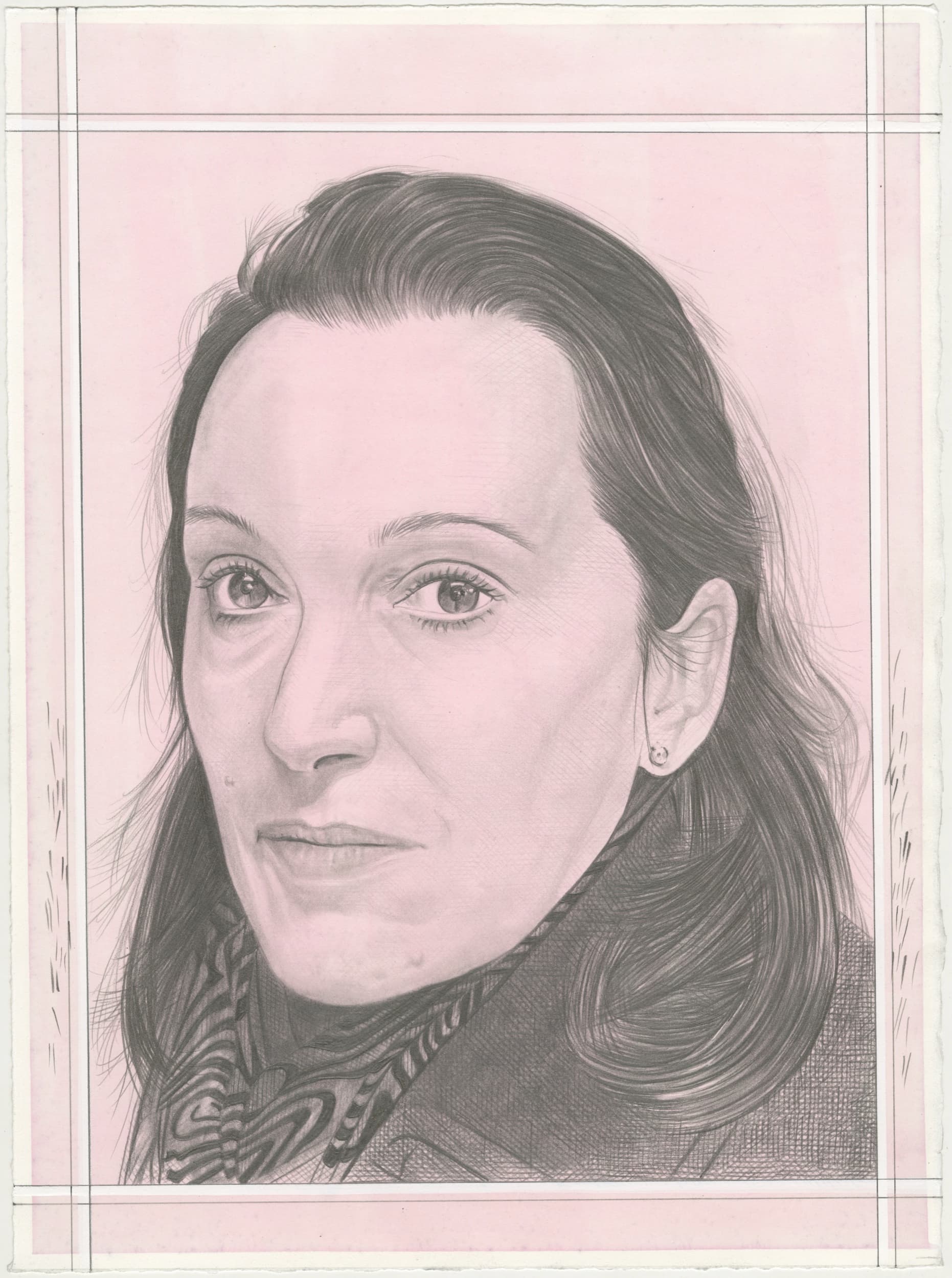
Portrait of Cristina Iglesias, pencil on paper by Phong H. Bui.
Word count: 4783
Paragraphs: 61
Princess Estelle Sculpture Park, Royal Djurgården
Inaugurated June 2, 2026
Stockholm
In a clearing within a vast forest in Stockholm, Cristina Iglesias’s cast aluminum and colored glass work, Aurora Borealis Star Dome (2026) emerges. The sculpture appears to rise from bedrock at the highest point of the Princess Estelle Sculpture Park, part of the 2,500-acre Royal Djurgården. The site is open to all every day of the year, twenty-four hours a day, and welcomes around fifteen million annual visitors. Iglesias described the newly installed commission as an “intimate moment of stillness and wonder.” Its inauguration prompted this conversation with curator and writer Brooke Kamin Rapaport about Iglesias’s project in Northern Europe, the practice of discovery, and the intensity of research that informs her creativity. In 2022, when Rapaport was Artistic Director and Martin Friedman Chief Curator of Madison Square Park Conservancy, she commissioned the artist, who is based in Madrid, to realize a major public art project, Landscape and Memory (2022): five bronze sculptural pools, gently flowing with water, that unearthed the forgotten terrains and geographic history of the New York City site. Their discussion begins by recalling a poetic essay by John Berger on Iglesias’s work.

Cristina Iglesias, Aurora Borealis Star Dome, 2026. Aluminum, stainless steel and coloured glass, 3 feet 3 ⅖ inches × 23 feet × 23 feet. Princess Estelle Sculpture Park on Royal Djurgården Stockholm, Sweden. © Örjan Furberg. © Cristina Iglesias, VEGAP, Madrid, 2026. Courtesy the artist and Hauser & Wirth.
Brooke Kamin Rapaport (Rail): You are one of a handful of women included in Portraits: John Berger on Artists, the 2015 book of Berger’s collected essays edited by Tom Overton that reads like a contemporary response to Giorgio Vasari’s mid-sixteenth century Lives of the Artists. Berger was considered a great public intellectual, although women were clearly not the focus of this writing. The volume included you and Vija Celmins, Frida Kahlo, Käthe Kollwitz, Lee Krasner—yet Krasner is partnered with Jackson Pollock. That group of artists was among Francis Bacon, Caravaggio, Paul Cezanne, Albrecht Dürer, Michelangelo, Piero della Francesca, and Cy Twombly. Berger explained that “Iglesias is not a didactic artist. She is a silent singer who transports the listener to an elsewhere, which is hidden but familiar, and which encourages a personal quest for meaning. Her songs are the places she makes.” What do you think he meant about what’s hidden in your work?
Cristina Iglesias: John always wrote beautifully about looking, which was very important. I believe that when John Berger spoke of the hidden, he was referring to that elsewhere we all carry within us—the world of our own minds and memories. So, for me, art begins with a question, and space is always at the center of it. My work tries to open a kind of threshold into something that is already within us. It invites a moment of attention where what is hidden can become familiar through a shared experience of perception. I believe that.
Rail: You work intentionally to place your sculpture in almost hidden spaces. It is evident, especially in the new commission, Aurora Borealis Star Dome, which you’ve just installed in Stockholm. People must make a journey to a remote place within those 2,500 acres. Does the experience of being concealed impact this project?
Iglesias: I’m interested in constructing places that provoke our senses. Even if the journey to it is short, it implies a sort of surprise or discovery. The idea of the journey, of course, in Aurora Borealis Star Dome is more evident because you really have to walk to find it in a forest. For other pieces I’ve done, like Hondalea (2021), on a little island in the middle of the city in San Sebastián, you must take a boat. The journey is part of the piece, also. The idea of the hidden is in many other pieces, as a more abstract idea of what is not evident.

Cristina Iglesias, Hondalea (Marine Abyss), 2021. Bronze and hydraulic machinery and water, 33 ½ (+19) × 37 ⅖ × 36 feet. Lighthouse of Santa Clara Island, San Sebastián, Spain. © José Luis López de Zubiria. © Cristina Iglesias, VEGAP, Madrid, 2026. Courtesy the artist and Hauser & Wirth.
Rail: That derives from the materiality of the work—in having a physical experience in the space of the sculpture, and intellectual and emotional involvement. You touch and embed all those senses through the sculpture you create. Can you tell us about the project in Stockholm? The Princess Estelle Cultural Foundation has commissioned public sculpture there since 2020. How did it come about?
Iglesias: The foundation invited me to visit the Royal Djurgården in 2024, and I went in January 2025. It was the first time I went to Stockholm. They invited me to be inspired and find a spot for the possible piece in this immense park. The park belonged to the royal crown in ancient times but has been public for a long time. Walking through the forest, I came across a place where light was filtered through the trees in a very particular way. It felt like a discovery for me, though it has been there for ages. The site is known as the hunting star because there is a natural rock; it has an undulation but is in the middle of this forest at the highest and most historic point in the park. It was once used by the crown as a meeting point before hunts. I was interested in transforming that history into something open and shared, a situation for everyone.
The sculpture rises from the ground as if it were part of the landscape itself: its organic cast-aluminum forms emerge and connect with what lies beneath this big natural rock, growing vertically and gradually unfolding into a more geometric structure that altogether forms a cupola. It is a place to enter. There is glass within these geometric forms with greens and blues that are inspired by the northern lights, creating an atmosphere that feels both constructed and natural. The piece is suspended between illusion and reality. It is constructed like a small pavilion, and people could lie on this bottom stone and look to the stars and the light, and to the colors coming through, inhabiting that atmosphere.
Rail: I’m interested in the light as a metaphor. Every era of human existence succumbs to actual and symbolic darkness, and simultaneously engages with light, inspiration, exhilaration. Over the course of your practice, your sculpture has gone down deep and plunged to the darkest spaces on the ocean floor. That project, in Baja California Sur, Mexico, was called Estancias Sumergidas (2010). You have uncovered bottomless spaces in the land, literally unearthing what moves beneath the ground plane, as in Deep Fountain (2006) in Belgium. And you’ve reached high heights with a work like Hondalea, that propels the viewer skyward within the vessel of the excavated lighthouse that holds your sculpture. As your work exudes these layers of darkness and light, what are you thinking of today for your sculpture? Are you ever compelled to layer social and political meaning into the imagining and making?
Iglesias: Yes, of course. My focus is on creating situations where an experience can unfold directly, without mediation, but there is a quiet political dimension in defending spaces within cities as stages to create a dialogue with citizens and open into something shared. I’ve done several pieces defending this concept. I believe it is a political attitude. I am not a didactic artist—as John Berger also said—but I do believe in public space as a place for encounter and reflection. What matters to me really is that people can inhabit it in their own way—walking, resting, meeting, being surprised—and that the work moves them and leaves behind that trace that becomes part of their memory. That’s what I mean as a social and political engagement.
Rail: Does the external political, social landscape impact or transform your work?
Iglesias: Yes, of course. But I mean, not the only intention. I assume that because that’s life. That’s why you do art. That’s why you construct a piece that you want others to perceive, to attend. In Forgotten Streams (2017), for the Bloomberg headquarters in London, private space becomes public. I don’t like to say that is educative, but it has to do with knowledge—transmitting to people to feel free to interpret.

Cristina Iglesias, Landscape and Memory, 2022. Bronze, mirrored stainless steel, hydraulic system, water and grass, 5 pieces, 2 ⅗ × 10 ⅖ × 10 ½ feet approximate each. Madison Square Park, New York. © Rashmi Gill. © Cristina Iglesias, VEGAP, Madrid, 2026. Courtesy the artist and Hauser & Wirth.
Rail: You opened two major public projects in 2022: Wet Labyrinth (with Spontaneous Landscape) (2020–22) in the courtyard of the Royal Academy of the Arts in London, and Landscape and Memory in Madison Square Park, New York. It was my great honor to work with you in New York. Both were physical manifestations of your command of bronze, appearing in public space as a living power. You demonstrated this sculptural ferocity because you then transformed that material and critiqued it, by embedding living, growing greenery in, on, or around each of those works. In London, the work rose above the ground plane, to invite people into a maze-like room. In New York, the work was a series of five pools with water tenderly coursing over the bronze surface. Was one project a vessel for living and contemplation, and the other coffin-like—reflective of death or departure?
Iglesias: I wanted to destabilize them by introducing elements that are constantly changing, like water, vegetation, and time. To create a fictional vegetation with imprints of reality in bronze is a way to talk about the importance of memory. In Landscape and Memory, those underground spaces feel like a discovery of an ancient world, I believe. But they represent nature. It existed below the streets and buildings in Manhattan, running towards the Hudson River, as we looked at maps of the city that you facilitated in the New York Public Library. Today, they share that space with cables, roots, mushrooms, and diverse organisms. It is also about the importance of communication. Bronze also has the quality of being able to resist the process of time by reacting with oxidation—that actually protects the material—and to be a vessel for all those organisms that grow with plants and water. The fountain grass that you remember—we planted between the five elements, drawing the stream of water as if the humidity of that water underneath was present. The viewer, the citizen, completed the piece in their imagination.
I don’t think in terms of life and death as opposites, but rather as part of the same cycle. So the works are not meant to represent one or the other, but to hold that ambiguity: something that was solid and fragile, still and in movement, open to transformation—belief in what is under the land.
In Wet Labyrinth (with Spontaneous Landscape), the overlapping of the fictional, the reflection, and the real vegetation created a journey of certain dislocation, or a sense of being lost, maybe, and open to different perceptions. It is an idea of a labyrinth: different pockets inside created moments of intimacy between Piccadilly and the entrance to the Royal Academy.

Cristina Iglesias, Wet Labyrinth (with Spontaneous Landscape), 2020–22. Phyllite stone, bronze powder with resin, stainless steel, mineral draining floor, closed water circuit mechanism, water and landscape, 9 3/10 × 21 ⅘ × 29 feet (Pavilion). Royal Academy of the Arts, London. © Prudence Cuming Associates Ltd. © Cristina Iglesias, VEGAP, Madrid, 2026. Courtesy the artist and Hauser & Wirth.
Rail: You’re creating or imagining a new space within these existing spaces. We’re entering an anticipated space and then come upon the unexpected.
Iglesias: Absolutely. Like a space that is somehow out of this world. In Wet Labyrinth, there was water running down along the walls—a little bit of water, not much, but you could see it and touch it. All the walls are wet.
Rail: It was as if those walls were sweating. They had a human impulse about them.
Iglesias: Again, it was an atmosphere that you could feel.
Rail: We’ve spoken about outdoor work and shared spaces. Your sculptural inquiries also transform indoor locations. There’s a piece that’s now a permanent installation in Centro de Arte Hortensia Herrero in Valencia, Tránsito Mineral (2023). It creates a natural world in a gallery space because of the light-colored material, jesmonite—which is a type of resin—and powdered marble. Did you see that work as a transition or a new movement within your practice?
Iglesias: It is a mineral landscape. The other I was talking about was a fictional vegetation space. This is more a mineral one, with reflections: part of the material that also holds the elements is stainless steel and in some parts becomes a mirror. The notion of a passage or threshold—a transition between one space and another, between different conditions inside and outside, natural and constructed, interior and exterior—is present. My intention is to create a situation that affects perception and leaves a trace, a memory. In that sense, Tránsito Mineral continues a line of thought. It explores how materials and environments can shift from one state to another, and how a viewer moves between what is seen and what is felt. It is less about transition as a theme than transition as an experience.
Rail: The viewer, the audience, the onlooker, are within that transition, both physically and emotionally.
Iglesias: Yes.

Cristina Iglesias, Transito Mineral, 2023. Jesmonite with marble powder, mirror polished stainless steel and amber light, 9 ½ × 32 ½ × 9 ½ feet. Centro de Arte Hortensia Herrero, Valencia, Spain. © Cristina Iglesias, VEGAP, Madrid, 2026. Courtesy the artist and Hauser & Wirth.
Rail: We were speaking a moment ago about water in your sculpture. I’ve seen many examples of your work, and water is present either as a pool gently flowing across a bronze surface or dripping from one of your vegetal rooms as a metaphor for sustenance for people, for the planet. When you incorporate water, do you consider it as a material that you’re working with or as a passageway to counteract the immutability of bronze? Did water first captivate you in your youth? What brought you to water in your sculpture?
Iglesias: I come from San Sebastián, a city that is by the water. I’ve been by the sea, the ocean. I’ve been very much related to it, and that was an inspiration. But also, the weather conditions changed so much: how water behaves and changes. The ideas of change and time, movement, are present. Of course, there are the historical fountains in cities as a place to meet. It’s also about showing power and symbols. But, yes, introducing movement, sequences, and reflection into materials that are always otherwise solid—not only bronze, but also aluminum and stone—is a way of using those dimensions as an added material. It creates a shifting surface, something that is never fully fixed. Looking to the sea when I was little, I could feel always how the weather conditions change everything. Water was something that I wanted to bring into the sculpture, along with the use of light. I began to use light and the colored glass as materials of the sculpture in the very early pieces. I have begun to think of light in a similar way, as a material that flows and filters and transforms perception. Light passing through glass can feel almost liquid. I don’t use these elements only as metaphors in a literal sense, but as ways of constructing environments where I make water and light become unstable—somewhere between reality and illusion. I was not initially drawn to water like we were talking now in a biographical sense, but rather as a special condition that allows sculpture to extend beyond its physical limits. I create sequences that work with time and then go beyond what you see or what happens, because you start imagining the flow going further than what you see.
Rail: You call on light in the same way you call on water. I don’t think there’s a hierarchy in the material selection: all seem on the same plane in terms of your facility and imagining the different forces of materiality within the work.
Iglesias: The material always is very expressive. On the other hand, it’s also true that experimentation takes place.
Rail: You use that word, “experimentation.” So where does the longing for experimentation enter the process of making work? Can you experiment in bronze? Is the capacity for experimentation something that you can summon immediately, during the welding or the fabrication process? Or do you experiment beforehand, as a preamble, in preparation for making bronze or metal work? Do you experiment through photography, drawing, or the maquette?
Iglesias: Experimentation begins with the encounter of the site—how I’m motivated by it. It is a way of reading a situation and suggesting a direction. The process is so important for me. I’m an artist who works a lot along the process of the making of the pieces, and many other pieces appear around the one that I’m concentrating on because of that experimentation. My process moves between drawings and works on paper and the models that I photograph. I work on them to construct illusionary spaces. It’s never strictly linear. Each stage informs the next. What interests me in the process of the moment is when something shifts, when a form begins to hold both something organic and something constructed, and the work starts to define its own internal logic. It is in that tension that the piece becomes something open: something that can be inhabited, rather than simply observed.
This is something that also can happen in a room in a museum or in a corner on a wall of any given room. It is not only in the outdoor places, in the public pieces.
Rail: It’s breathtaking how you describe all of this, the constant interplay of the making and the materials and the selection.
Iglesias: There is something that is important. For example, you mentioned bronze, and it is not only bronze, but also all the metals and types of resins. I model, imprint, and cast motifs that are fragments after the idea of what I want to construct. Then comes a moment of composition with all those elements to create the illusion I want to provoke. This way, the pieces are unrepeatable, unique. I don’t do a model and go to the foundry and say, “Well, let’s do the same as the model.” I can change things during the process. Even in bronze at real scale, I erase or extend a form.

Cristina Iglesias, Inner Landscape (the Lithosphere, The Roots, The Water), 2020. Bronze, water and hydraulic mechanism, 3 ⅗ × 49 × 34 ⅘ feet. Museum of Fine Arts Houston, Houston, US. © Jeremy Hamilton-Arnold. © Cristina Iglesias, VEGAP, Madrid, 2026. Courtesy the artist and Hauser & Wirth.
Rail: Sculptors often talk, when they look at other sculpture, about “flow.” I love that word. There’s a material aspect to it, but also a performative or impromptu aspect of creating and seeing. There is the intensity of flow when the artist is constructing the work, but also for the viewer, as they explore and walk through or gaze onto your sculpture.
Iglesias: Certainly, absolutely. Yes. There are many ways of thinking about flow within the work and within us. On one hand, I have played with the flow of water, playing with sequences of time. The water flows for a while and then changes the rhythm. This happens with rivers that erode their riverbeds with time, and their form becomes different. Beatriz Colomina talks about Tres Aguas (2014), my piece in Toledo, Spain, and refers to the neuroscientist Sebastian Seung to make an analogy with the “‘connectome,’ the dense place of connections in our brain where memories are recorded.” Our memories flow and get impregnated by new ideas or transformations. Our hands flow with that information. The flow of ideas implies a connection of concepts and structures that we convey in our communication language. This is important in the way we connect our memories with our hands, in terms of improvisation or experimentation with the flow of materials we know, or new ones. Everything is connected.
Rail: I want to shift a little bit. Are there artists or writers to whom you look for inspiration?
Iglesias: The Michelangelo stairway at the Laurentian Library in Florence that is so baroque, so illusionistic in how it defines a space is a whole work in itself. Many other references are in architecture, in art, from the Étant donnés (1946–66) by Marcel Duchamp, to the writings by Clarice Lispector or Rachel Carson, to Jorge Luis Borges or Fernando Pessoa, or the poems of Emily Dickinson and José Ángel Valente, and many others. Because we were talking about this room, this fog, I think of the capacity of J.M.W. Turner to represent an atmosphere—something that is so intangible. He was a master in painting, but how to get close to that with sculpture?
Also Michelangelo Antonioni, the filmmaker, for the psychology he is capable of creating. In L’avventura, everything happens on an island, and a woman is lost in this group of people. There is this tension that is constructed. It’s about landscape, there, in that island. There is this tension and this psychology that I think good pieces of art have.
Rail: We should mention too, that another element in your work is sound; sometimes gentle, rhythmic sounds of the water flowing or coursing, or the intrusive, unplanned sounds of the environment, like the city surrounding your piece, or people raising dialogue in a museum space. Your brother, Alberto Iglesias Fernández-Berridi, is a composer of music for films. Do you think through ideas of sound with your brother? Have you thought of working together? Or maybe you have?
Iglesias: Yes, yes. We always have been talking about abstraction and sound, because, like light, sound contributes to the atmosphere I try to construct. My brother as a composer works with rhythm and time, in films and also in compositions that he does for concerts. I work with a special rhythm: the way our body moves or becomes aware of silence within a situation, as you were saying—even surrounded by the sound of the city. We talk a lot about sound and music and visual art. We have worked already on doing something together. How to create an environment where perception becomes more attentive—where sound, the music, is not added, but already present? We discuss these things, but also how to work with complexity, so that you feel it is simple.
Rail: To transform complexity into—
Iglesias: Something that enters in you. Music has that capability.
Rail: The films he has worked on with Pedro Almodóvar, for example, and how those scenes are heightened with saturated color. The audio, the music, and composition take you through the intensity of those spaces.
Iglesias: It’s true, music is very important in films. I’ve learned a lot about film construction and editing by being close to Alberto and watching films. Also, with the music he has done for pieces like The Constant Gardener or The Kite Runner. He studied African music. A lot of his music is so rich. He has collaborated with musicians that he studied with and invited them to be with him in his compositions.
Rail: What does it mean to be a woman artist?
Iglesias: Well, I’m a woman, that’s for sure. I feel it, but I don’t approach the question in terms of identity only. I am aware that the condition of being a woman artist has historically shaped how one works and is perceived, but rather than focusing on identity itself, I think in terms of the responsibility towards public experience that you have being a woman, and my interest. I feel being an artist, my best way is to do good work. My interest has always been to create situations that are open and shared, where people can enter without instruction, and experience them in their own way. There is a quiet sense of caring—that attention to how our work can hold different bodies, movements, and ways of being. If anything defines my position, it is that desire to build environments that are open. I think that probably women feel closer to perceive my work and the attention that the work requires. I have been lucky to have found women and men that attended to my work and have offered to work with them—like you.
Rail: Thank you. That’s a generous response. You spoke about your upbringing—San Sebastián and water—and that has had an impact on your thinking and your work over years. Where do you travel? Do you travel to inspire new work or new ideas, or do you travel in your mind, in the studio?
Iglesias: I travel a lot in my mind, in my studio, for sure. When I travel for work or for curiosity, I find inspiration in other works of art that I may see or in a sudden experience in nature or in a city. That often happens in specific sites, like in Stockholm. The first time I went to this city, I saw so much water through and around, and so many little islands—the archipelago. These moments are less about traveling in a literal sense, and more about attention. It’s true how a place can open a line of thought, and you start dreaming about it. And that is why my work, many times, implies a journey in itself.
Sometimes it’s a literal journey that you have to take, but also a journey in your mind to an invented place. The studio allows me to move through memory, through accumulated perception, and experiences of my own. Many times with the bas reliefs, I use a bas relief that I've already been working on and transform it into another one. So there is metamorphosis, and sometimes it shows in the same piece. I think there is a tension between a physical encounter with a site and an inner process of reflection where something can emerge.

Cristina Iglesias, Forgotten Streams, 2017. Bronze, water, stone, stainless steel and hydraulic mechanism, 8 × 10 ½ × 3 ⅗ feet. Bloomberg Building, London, UK. © Thierry Bal. © Cristina Iglesias, VEGAP, Madrid, 2026. Courtesy the artist and Hauser & Wirth.
Rail: Your sculpture and drawings are in major international collections, including Guggenheim Bilbao, the Hirshhorn Museum and Sculpture Garden, Centre Pompidou in Paris, and Tate Modern. You represented Spain in the Venice Biennale twice, first in 1986 and again in 1993. You were included in the Carnegie International in 2003 and the SITE Santa Fe Biennial in 2006. There are commissions of your work all over the world, including Forgotten Streams at the Bloomberg building in London, and Inner Landscape (the Lithosphere, the Roots, the Water) (2020) at the Museum of Fine Arts, Houston. And because we’re having this conversation within the pages and the online space of the Brooklyn Rail, there are etchings from 2008 in the New York collections of the Metropolitan Museum of Art and the Museum of Modern Art. This fall, you will open an exhibition of new work at Hauser & Wirth in New York.
Iglesias: I feel grateful that my work is present in some major international collections, but also in private ones. I am presenting a major piece outdoors at the Serpentine in London in spring 2027. I am also preparing a show in an institution in Paris for spring 2028. I will have outdoor and indoor pieces together. What matters most to me is that the work continues to be lived and experienced in different places.
Rail: I want to return to the start of the conversation. You have realized major international works in indoor and outdoor settings—projects that brave the depth of exploration and reach the heights of human potential. What is your dream project for the future? Where would it be and in what materials? What would it look like?
Iglesias: My dream is always to find the next situation that would appear. You are all the time working from the inspiration of the work, or the somebody that asks you to. I mean, a city or a museum or a private person, an architect. There are projects that I’m working on that still are not visible. You don’t even know if you will realize them—they’re like hidden works in myself. My dream is always to find out that next situation where space can suggest a new possibility. I imagine a work that emerges from that condition rather than being imposed on it, you know. So I don’t know what would be the next landscape that I construct.
Rail: One final question. This fall, you will turn seventy years old.
Iglesias: How does that sound?
Rail: That sounds important. When the architect Renzo Piano turned seventy, he told a friend that he felt that life naturally should be 210 years long: seventy to learn, seventy to do what you’ve learned, and seventy to teach others what you’ve learned. I think that you are constantly learning and teaching and doing through your work. What do you think?
Iglesias: Well, I think that for now, I’m not expecting to and I don’t want to live 210 years. But, you know, I feel that I’m still very much in the process of learning. So I’m in the first seventy, even if I’m going to touch the seventy number. Each project begins again from zero, from a different site, a different set of conditions, and in a different way of thinking about how to create something that did not exist but could exist. So like Renzo Piano suggests, there is a continuous movement between learning, doing, and transmitting what one has learned. For me, that experience happens through the work itself—constantly, as you just said. The work, I think, has the potential of doing so. What remains constant over the years is the desire to create experiences that allow people to become more aware of their surroundings and of themselves within a situation. In that sense, I see the world not as something fixed, but as something that continues to teach me through the process of making it.
Rail: Stunning.
Iglesias: So that’s how I feel about becoming seventy.
Brooke Kamin Rapaport is a curator and writer. brookekaminrapaport.com