ArtJuly/August 2026In Conversation
MARY ELLEN CARROLL with Chloe Stagaman
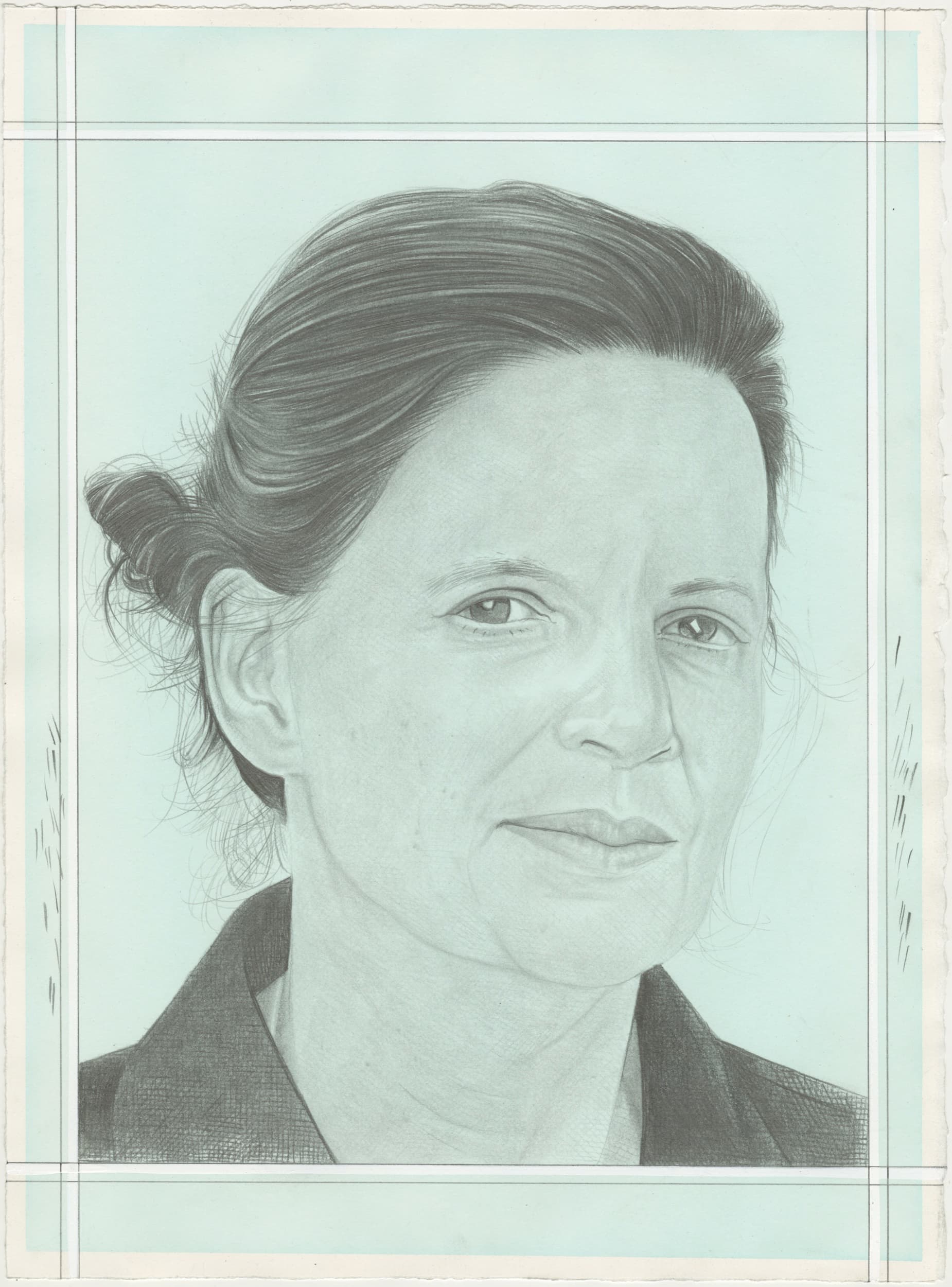
Portrait of Mary Ellen Carroll, pencil on paper by Phong H. Bui.
Word count: 5480
Paragraphs: 51
Contemporary Arts Museum Houston
May 22–November 1, 2026
Houston, TX
For four decades, the artist Mary Ellen Carroll has asked with a wry smile: what do we consider to be a work of art? Is crashing a 1985 Buick Riviera into the Staatliches Museum für Völkerkunde München a “suitable” artist commission for a group exhibition titled wir arbeiten immer noch daran, nicht mehr zu arbeiten [we keep working, to no longer work]? Is craning a stolen red car into the center of the woods at Art Omi, so that it appears as if it’s always been there, “furthering the field?” Or what about climbing a smokestack in Memphis, dressed in a polar bear mascot costume selected by the comedian Demetri Martin, to pour some of the artist’s father’s cremation remains from an Illy espresso can down its chimney? And these are just a few of their performances, let alone what Carroll has built through photography, activism, and policy. They’ve documented the blocks of Manhattan from a camera on their back, filmed both sides of the Los Angeles Federal building for twenty-four hours with approval from the FBI, and rotated a single-family house 180 degrees in Houston, Texas. If you’re having trouble believing these descriptions, that suspension of disbelief is the point. And while Carroll’s work has often been described as eschewing a signature style, could the artist generate answers to their driving question with any remit but multiplicity?
The artworks described above, and many more, are currently on view in Carroll’s first survey How To Talk Dirty and Influence People at the Contemporary Arts Museum in Houston (CAMH), curated by Rebecca Matalon. I’ve known Carroll for more than a decade, and yet circulating the show with them on a rainy day in May was the first time that I had seen many of their works in person. Perhaps even more generous is the way in which the exhibition is installed. Hung across “italicized,” open scaffolding, the show invites endless associations between Carroll’s artistic outputs while resisting a straight chronology or autobiography. What lingers after leaving CAMH is Carroll’s astute awareness of the thin line between a self and everyone else around them, their sharp sense of humor, and their trust in art as a process. In early June, we met on the Rail’s New Social Environment program to talk about their work on the occasion of the show. The following is an edited version of our conversation.

Installation view: Mary Ellen Carroll: How To Talk Dirty and Influence People, Contemporary Arts Museum Houston (CAMH), Houston, 2026. Courtesy CAMH. Photo: Sean Fleming.
Chloe Stagaman (Rail): Mary Ellen, it was great spending time with you in Houston at your current survey. How long has this exhibition, and its accompanying catalogue from CAMH and Dancing Foxes Press, been in the works?
Mary Ellen Carroll: Thank you for coming down. You were in Houston at a key moment when the scaffold structure was going up and my work was being put into sections. The curator Rebecca Matalon and I have been in dialogue for nearly seven years, not only about my work, but about process, and one of the key things that we decided early on was that we would have somebody come in as an exhibition designer. CAMH is a parallelogram designed by Gunnar Birkerts with 22-foot ceilings, and we wanted to use that architecture. The exhibition designer Juliana Ziebell had worked at Lina Bo Bardi’s Museu de Arte de São Paulo, which also has a clear-span structure, albeit in a different material.
With the support of the museum’s team, we wanted to make things not only transparent but apparent to the viewer. I didn’t want drywall to make walls, so we decided that we would try to come as close as possible to creating zero waste. This was not about virtue signaling, because there’s so much being destroyed right now. We did it because we could. We ended up getting a sponsorship from the scaffolding manufacturer Layher, and if scaffolding can be beautiful, theirs is. Thanks to how agile CAMH’s team is, and with support from the museum’s head preparator Jeff Shore, we developed a library stack meets Costco warehouse meets Ken Isaacs modular design that creates something new for the viewer. It was Juliana who realized that the scaffold needed to be italic, aslant and drawing from language. The installation and execution of the exhibition is a new work, titled SHALL (2026), and the book coincidentally happened in parallel, with a design by Teo Schifferli.
Rail: When you enter the show, there are many different places where it “begins.” One of the first things I saw was a large red neon letter “A.” You’ve often said that all of your work is rooted in language, and I wonder if you can talk a little bit about the specificities of language to your process, as well as your card catalogue index that you’ve used since 1988 to organize your ideas in the studio.
Carroll: Sure. Of course, you begin with thoughts and ideas, right? But then, what do you translate those into? And for artists, there’s a myriad of materials, but I think that once I started to understand my process, it always began in language. I think that the idea of having some kind of consensus of understanding and meaning means also that there can be mistakes, failures, or moments where understanding doesn’t occur. So I started to develop a card catalogue system. The cards are these subjects that I’ve developed that could be ideas or an instruction for a work of art.

Mary Ellen Carroll, indestructible language (Glasgow), 2021. Neon, 8 × 500 × 4 feet. Courtesy © MEC Studios. Photo: Dougie Lindsay.
Rail: Sometimes words become the work of art, like with indestructible language (Pulaski Skyway, New Jersey) (2007) for the Precipice Alliance, which the neon letter “A” that I saw was once part of.
Carroll: Yes, Donna Wingate and Joel Sternfeld had created an organization aptly called the Precipice Alliance and they were commissioning large-scale works on pressing issues. The first was global warming and, for me, the work had to be in language. It had to remain. And at that point it was so early on, Chloe, that the work was about awareness. The original site was on the Pulaski Skyway, and millions of people ended up seeing it because of all of the different modes of transportation. At one point, a friend was on a plane and the airplane was circling to land at Newark, and the pilot said, “Hey, look at that thing. Can anybody figure out what that means? Let us know.”
It said “IT IS GREEN THINKS NATURE EVEN IN THE DARK.” Any of the poets reading this will understand. It takes time for that to appear, but it remains a work of art. It’s not didactic. It’s not declarative. It presents the language and the significance of each word. When the economy really fell apart in 2008, organizations were deeply impacted, and this included the Precipice Alliance, but you don’t title an artwork indestructible language for it not to exist in the world. It is now permanently illuminating the skyline on The Schoolhouse after it was recreated by SOLAS Neon for the UN Climate Change Conference in Glasgow (COP26).

Mary Ellen Carroll, Corrections, 2001. Silk screen on Arches paper, 48 × 96 inches. Courtesy © MEC Studios.
Rail: It’s interesting to think about that work in comparison with an earlier work of yours called Corrections (2001) because they approach language from different directions. With indestructible language, you generated language as a way to open up towards an audience encounter. Corrections involved ten years of reading different newspapers and cutting from their corrections columns, cataloguing and sorting existing language in any one journal’s mistakes. One of the corrections you gathered read: “Sunday Styles on June 10 erroneously reported the marriage of Virginia Marie Defina and Steven Robert Scott. In fact, as Mr. Scott informed The Times yesterday, the wedding never took place.” So these are pretty major factual errors, right? They’re funny and awkward. But they pull at the seams of the arrangement between published media and ourselves.
Carroll: I’m always interested in mistakes. I made Corrections at the height of print media. The work is not, and I am not, nostalgic. In those sections, I was looking at what the mistakes were and where they were made. Was it something that was factual? Was it something that was societal? There ended up being all of these different ways in which I could classify the mistakes, so then it was a matter of putting them together as a giant facsimile of the New York Times. And then I had an exhibition of the facsimile in 2001 and of course the New York Times made a mistake when they reviewed it. The correction was made and that was the work of art.
Rail: You’ve talked about creating conditions in this work, setting up the facsimile towards that ultimate correction from the Times related to your show. I’m wondering about working conditionally. What would have happened to Corrections had the Times’s correction never come about?
Carroll: Well, the work still would have existed. The piece was done, and then it was about how it was disseminated, when, and where the work of art existed. Now even more so, I think the methods of distribution matter. We see that with Marcel Duchamp.
Rail: I’m glad you bring up Duchamp because you share his interest in doubling, among other things. We can see that in Corrections and in its accumulation of this parallel world of mistakes that coincides with that of the originally published newspapers. But we can also see it in your ongoing series, “The Doppelgänger Tapes,” in which you invite other people to be you and in which you are, sometimes, other people. This occasionally involves inviting someone to be a bodyguard for the person who you are being, or planting a notable person in the audience of a talk that you’re giving. Can you talk a bit about this series, perhaps in the context of ME vs. I, part one: Divine in South Africa (2000)?

Mary Ellen Carroll, ME VS I, part one: Divine in South Africa, 2000. Video (color, sound), 13:58 minutes. Courtesy © MEC Studios and Galerie Hubert Winter, Vienna.
Carroll: It’s about the replication of things, and the relationship between the original and the copy. There have been many artists who have made works with doppelgängers; this isn’t something new. It’s not an impersonation. It’s being someone or something else. There’s that Whit Stillman quote: “You know that acting thing you do? Don’t do it.”
In 2000, I was invited by my gallerist in Vienna, Hubert Winter, to do an exhibition. At that time, Jörg Haider was leading the far right neo-Nazi party in Austria. There was a call to boycott and not to exhibit in Vienna, and I was in conversation with a number of friends about it. I decided to go and to participate in the protests and engagement there, bringing myself and another self. My casting director at that point, Todd Thaler, and I went through all of these audition tapes. Then one day he called me, he said, “You have to come right now, I have the perfect person.” It was Katherine Wallach, who is the daughter of Anne Jackson and Eli Wallach—who you might know from the film The Good, the Bad and the Ugly. So she came to Austria, and everything that we had and wore was in duplicate. There was a film crew with us. We’d sit down each morning and I’d be like, “Okay, you’re supposed to go and meet this curator,” or, “You’re supposed to go and have this meeting with this politician. There’s a protest. At this point, you have dinner.” And then she’d go and the film crew would follow. The only instruction was that she could do and say whatever she wanted, she just had to identify as Mary Ellen Carroll, so I had no idea what the footage was going to be like. When you choose someone for a doppelgänger piece you don’t want to determine it, because otherwise you’d be doing it.
Rail: Definitely. That freedom feels essential to the relationship between you and any other self, and then there’s the matter of everyone else. Each of these works puts pressure on the circumstances of the given arrangements that they’re a part of. In the case of ME vs. I, part one, the microscope is on the artist’s invitation to do an exhibition abroad and the various expectations, meetings, and labor that accompany that task. What’s interesting about the resulting film of the two Mary Ellens for ME vs. I is that it divides that work visually, conceptually, and literally. The artist is in two places at once. That transparency of labor and arrangement recurs throughout the doppelgänger series, often revealing where and how cultural capital is accrued. Sometimes things boil over. For example, with Judi, Judi, Judi (2007) when you were artist Judi Werthein at a panel discussion presented by Creative Time ironically titled “Designing Your Social Engagement,” the organizer wasn’t having it. In earlier interview with Hamza Walker you’d said that his response was something like, “Who the fuck are you?”

Mary Ellen Carroll, Judi, Judi, Judi, 2007. Inkjet print, 30 × 5 inches. Courtesy © MEC Studios.
Carroll: Yes, and obviously the organizer Joshua Decter wasn’t happy about it. But the intent wasn’t to pull something over on somebody. An agreement had been expressly made between Judi and me. I had wanted to make a doppelgänger work where the artist or the work wasn’t somebody or something that I was previously familiar with or interested in. Being Judi fulfilled that condition. That was our complicitness and our agreement. And yes, then there were the circumstances of the other people. The artist Rick Lowe was on that panel, who I’ve known for a long time. He was like, “MEC, what are you…?” Michael Rakowitz was also there scratching his head. But I was delivering the actual content. The material and the understanding was there. I put a great deal of time into studying Judi’s work on a deep level. The piece was generative. You’re talking about capital and cultural capital, and of course, it created that, maybe even to a greater degree because somebody from the outside came in who could be both the subject and the object.
My Struggle: A Noun Acting Like a JPEG (2014) is a similar work conceptually, in that it embraces the viewer and their subjectivity. It comprises 438 unique silkscreen works that were realized in Robert Rauschenberg’s studio in Captiva, Florida and are installed as a frieze on the perimeter walls at CAMH. It is a work of auto-fiction in images, and it takes its title from Karl Ove Knausgård’s six volume series wherein a subject acts like an object, but in this case the image is refracted back to the viewer as subject. The viewer has to frame or deduce what the image is, and what the noun is that they see. Isn’t this what we do when we look at a work of art? As Lawrence Weiner impelled us to do: “LEARN TO READ ART.”
Rail: The “circumstances of the other people” and Weiner’s idea of learning to read art brings me back to the audience for the doppelgänger works as well. How do you think about your audience with these?
Carroll: There are going to be so many ways that it gets read. Either people see it and they are in it and with it, or they get up and walk out of the room and they’re pissed off because it’s not the actual person, even though it’s the content and it’s the actual material. Sure, it’s not coming directly from the person I’m being, except through my insistence that I am who I say I am. But the outcomes were unexpected gifts sometimes. After one of the doppelgänger works, participants in the symposia for the College Art Association had to sign a document claiming that they are who they say they are. [Laughs]
Rail: Yes, the College Art Association letter requesting speakers “are who they claim to be” is such an enjoyable part of the exhibition vitrines at CAMH. So, when do you decide that the person you’re being needs a bodyguard?

Mary Ellen Carroll, Being David Joselit, 2009. Digital video (color, sound), 1 hour 50 minutes 56 seconds. Courtesy © MEC Studios.
Carroll: Oh, that’s just [laughs]—for example, when I was being the scholar David Joselit in 2009, giving an opening speech for the symposium “Our Literal Speed” in Chicago, I had a bodyguard. He was the lawyer and comedian Seth McCormick. The bodyguard is a prop: something that’s part of the work that can’t quite be understood. It creates not an antagonism, but a sort of additive principle of “what is that?,” not dissimilar to a Richard Foreman production.
Rail: Tell me more about that principle of “what is that?” because it’s related to suspension of disbelief, which is often at play in your work, especially the doppelgänger series.
Carroll: The suspension of disbelief is a foundational tactic in humor and successful stand-up in order to see and say things as they are. As Lenny Bruce said, “There is only what is and that’s it.” If we stated all of the headlines these days as a concrete poem, there would be a suspension of disbelief: a feeling that it’s impossible that this is what’s going on. And those headlines making that feeling, they’re not fabricated, they’re reality. When the work of art comes from that place, it can be substantive, observational, even speak to a kind of universal.

Mary Ellen Carroll, Resemblance, 1999. Chromogenic prints, 24 × 36 inches. Courtesy © MEC Studios and Galerie Hubert Winter, Vienna.
Rail: Staying with the idea of the double, I want to take a minute to think about your work with photography, specifically the ongoing series, started in 1999, titled “Resemblance.” The “Resemblance” series developed while you were living in Los Angeles, and feels akin to Corrections but approaching multiplicity from another angle. You began to carry an SLR camera and to photograph situations or inanimate objects that you felt resembled you, charting yourself through a constellation of varied circumstances. This series seems to map an unknowable, vast self—a self much like the card catalogue index in your studio that changes completely in composition each time it absorbs something new into its fold.
Carroll: Nothing is ever fixed. The one certainty, besides death, is change. In 1999, I was teaching at the University of California at Irvine and living in Santa Monica. The “Resemblance” series isn’t about photographing people who could be me. It is about the actions and locations where I found myself. Sniffing a tomato at the farmers market while buying produce, for example, or shopping at a Barney’s sample sale in the airport hangar that became the venue for Frieze Los Angeles. The images chronicle a life at a particular moment. I was thinking about the activities that one engages in, and what actually gets seen when you’re looking at an image of an act. Does the photo encapsulate it, or does it need to be detailed in terms of its titling? Before this show, I hadn’t seen the works in “Resemblance” in twenty-five years. There are hundreds more of them. Rebecca and I made a selection. I’ve opened up the series again now in New York, and this is something that I do. I return to series and subjects. My years of work on prototype 180 is one of many examples of that.

Mary Ellen Carroll, prototype 180, 2010. Video (color, sound), 40 minutes 14 seconds. Courtesy © MEC Studios. Photo: Kenny Trice.
Rail: Yes, let’s scale up to prototype 180 (1999– ), an ongoing work sited in Houston. Can you start from the beginning and the original idea that you wrote on a notecard in 1999?
Carroll: I’ve told this story many times, and it’s like a stand-up comic telling the same joke. I was stuck in traffic on the 405 in Los Angeles. I had been teaching Gertrude Stein’s Lectures in America earlier that day, and that material is opaque, but for whatever reason everybody in the class got it. My commute was such that if I missed a fifteen-minute window, it took four hours to drive back from Irvine to Santa Monica. I’d been thinking about the trajectory of land art in the sixties and seventies, mostly by men, many of whom went to school with the GI Bill and were pilots and had that purview between the sky and the earth. I was thinking about the price of land that enabled them to realize those works and the myth of the West. I was also thinking about Frank Gehry’s Guggenheim Bilbao and the idea of culture as an economic development engine. Architecture had successfully usurped public art at that point and I thought, what would be next?
At the start of the Persian Gulf War, I had made a subject card on policy, looking at policies within sovereign states, but also at our personal policies like the policies at the Brooklyn Rail, or the policies at the Contemporary Art Museum in Houston. I was asking what are policies, how many times are they used and in what contexts, and how could policy be used as a material? The project became to make architecture perform as a work of art. Houston, Texas raised its hand because it’s the only metropolitan area that has no zoning and lacks a land use policy. That’s not good or bad, it is a condition that is. I went to Houston and, with some former students and research assistants, started to map the city and study its post-war development. We began to focus on Sharpstown, a 1955 development by Frank Sharp, who had charges brought against him for violating federal banking and securities laws, which is ironic given that the creation of the Federal Housing Administration (FHA) and its discriminatory lending practices is what made the development of Sharpstown’s over 7,000 homes possible.
Rail: What did you find in your focus on Sharpstown?
Carroll: Sharpstown, even though it’s ten minutes from downtown Houston, has never seen the changes that other areas around it like Montrose or Bellaire have, where people bought homes, tore them down, and built out every square inch of the property. Part of the reason for that is that when Sharpstown was developed, there were apartment complexes that were built around it, making it into a kind of walled city. The idea was that you’d move into an apartment building, and then, being aspirational, you’d eventually move into a home. When OPEC (Organization of the Petroleum Exporting Countries) flooded the market in the eighties and the price of crude oil went from 35 dollars a barrel to below 10 dollars a barrel, it devastated the Houston economy. There was fossil fuel flight in those post-war areas and many of the properties were abandoned and foreclosed. In the late nineties, it became a primary pathway of affordability and immigration into the city from the southwest. It also created a policy blindspot. Public-private conditions are common in Houston. Pre-Google Maps there was something called Terra Server where you could see satellite images of the city, and I was able to identify properties that had public property on two ends, anchored by the city and the county. Amid all of these conditions, and with the help of Betty Townes of Sharpstown Realty, we drove around Bayland Park and by 6513 Sharpview Drive. I had Betty stop at the property, as it was in a derelict condition. It wasn’t for sale. It was necessary that something be done to it, and it became the location for OFPC, which was eventually renamed prototype 180 as I transferred the property from an LLC to a 501(c)(3), for numerous reasons.

Mary Ellen Carroll, prototype 180, 2018. Video (color, sound), 40 minutes 14 seconds. Courtesy © MEC Studios. Photo: Kenny Trice.
Rail: From there, after a great deal of time and persistence, you bought the brick-clad single-family ranch house at 6513 Sharpview, and in 2010, with the structural movers Cherry House Moving, you rotated the structure and its lot 180 degrees as a performance to “make architecture perform as a work of art.” There was an audience present for the revolution, and there was also a live feed from the perspective of the house, with cameras on each side looking outward. How did you make that choice for the documentation?
Carroll: When there’s a large work of art or architecture, how do you see it? You’re either standing in front of it, or you see an image of it, or you’re within it. With prototype 180, the house and surrounding lot is the protagonist. It is the actor, and we see everything from its perspective and in relationship to its process occurring. Fortunately, I was teaching a graduate studio at Rice University in architecture with my friend Charles Renfro, and I had started to work with engineers. Electrical engineer Dr. Edward W. Knightly was a friend and colleague and is a wireless guru of sorts in the world. He introduced me to William Deigaard, also an engineer who was in charge of the systems at Rice and is now at Texas A&M. We developed a system for a high-definition livestream, so that everything could be seen from the building’s perspective. As in film, it allowed us to get a reaction shot from the people watching the revolution. The livestream was very important and early in the process. You know what happened at that point, Chloe, is that I was able to shift my understanding and use of policy as a material from the ground and into the air waves. In my ongoing work, PUBLIC UTILITY 2.0 (2008– ), I retrofit radio frequencies, creating wireless connections as a generative and accessible infrastructure.
Rail: The livestream also felt like the house opening its eyes and taking on a life of its own. At one point you referred to prototype 180 as an automatic drawing. It became an active site of intervention and experimentation for your students at Rice. It was featured in an exhibition, No Zoning, curated by Toby Kamps, for which you brought together civic leaders for a mayoral forum on land use. When academics tried to classify prototype 180, it didn’t fall neatly within preexisting categorizations. It was a work of art, but also a work of architecture. It was public, but also private. So it was a constant, living debate and challenge to whoever sought to understand it. But ultimately, due to natural disasters, you were tasked with destroying the house and in 2017, you unbuilt it. Can you talk a little bit about the specificities of that performance, which involved, among other things, operating a 1974 Caterpillar excavator, an operatic performance on the roof of the house, and a neighbor calling prototype 180 “a disgrace to the neighborhood”?
Carroll: Which I totally understand, by the way—the neighbor’s response. Things happened when they could happen, influenced by time, financial support, and policy. In the years after we did the revolution of the building and its lot, two hurricanes ended up going through Houston. When Harvey hit, it had a devastating effect on the entire city, including 6513 Sharpview. We have a great image of the insurance adjuster standing on the pitch of the roof of the structure with his clipboard making the determination, at that point, that the house is unsalvageable.
So what do you do? I started talks with the Houston Fire Department about doing a controlled burn. But Cherry House Moving, who had done the rotation, also did demolition, so fortunately I was able to have a conversation with them. They provided the Caterpillar, and I wrote out the instructions for the choreography. Thom Browne costumed us all, including Joseph Keckler who performed the requiem accompanied by violinist Rubén Rengel. An invited audience of about two hundred people were there to witness it, and I started from instructions that I’d written: “END TO BEGIN AT THE HIGHEST POINT. REPOSITION THIS POINT TO THE LOWEST LEVEL. SHIFT TO THE RIGHT. REMOVE ITS FAÇADE,” and so on. We had to finish by sunset, per Houston regulations, which I did, and it was at that moment when the moon came up. There was a piece of white Tyvek on the ground that I picked up with the Caterpillar’s claws and waved as the structure’s surrender, it being the protagonist. And then it was done.

Mary Ellen Carroll, FEDERAL, 2003. Off set printed poster, 42 × 28 inches. Courtesy © MEC Studios.
Rail: Both prototype 180 and another work of yours, FEDERAL (2003), involve(d) a high degree of bureaucratic navigation through labyrinthine processes. And it makes me think about the question in your work as an actor that is both structural and relational. On the one hand, questions operate scientifically for you. All of your works begin with a hypothesis that is tested with no preset knowledge or prediction of a particular artistic outcome. But questions also have this crucial social power in your work. They’re funny and challenging, suspicious of authority, and they open doors presumed closed. While at CAMH, we talked about FEDERAL, a twenty-four-hour film that you made from either side of the federal building in Los Angeles, filmed two years after 9/11 at a time when the US had heightened security. When the film was eventually screened in New York, its tagline was “WATCH THE WATCHERS.” I asked you why you think the FBI let you make this work after all of your correspondence with them, and your response was “because I asked.”
Carroll: I like how you’re drawing a parallel between those two. I realized FEDERAL before the revolution of prototype 180, when it was still a limited liability corporation and was called OFPC—“Out for a Pack of Cigarettes,” like I was never going to come back.
I had been photographing all of the federal buildings in the US and in other countries around the world, but when 9/11 happened, it became impossible to continue. So, rather than stopping, I decided to continue by making a durational portrait of the government’s Western headquarters, which is the federal building in Los Angeles on Wilshire Boulevard. What comes next is never the why, but the what and how. And in asking those questions, I started my correspondence with the General Services Administration (GSA). There’s this story I always tell about being in my studio on 34th Street and getting a call at 9 p.m.:
FBI: “Is this Mary Ellen Carroll?”
MEC: “Yes. Who’s this?”
FBI: “Officer Stevens from the FBI.”
MEC: “Oh, how did you get my number? [Laughs]
FBI: “What are you doing?”
So I explained the work, and Officer Stevens said, “Okay, fine, we’ll get back to you.” I eventually did hear back from GSA with their provisional approval, and then once we filmed the building simultaneously from both sides, all the material had to be vetted. It would have been naive to think that I could make FEDERAL as some kind of guerilla or invisible act. That would have been impossible at that point. The government’s participation and complicitness in the work changes it. It goes back to the concept of maieutics and the Socratic method. Questions get raised, and the participants become a part of the work’s entire process.

Mary Ellen Carroll, My Death Is Pending . . . Because., 2017. Courtesy © MEC Studios. Photo: Michele Asselin.
Rail: Right. All of the permissions that went into FEDERAL and continue to go into prototype 180 create a space, in their very existence, that didn’t exist before. They mark the material and relational progression of the work. Thinking about that attention to building brings me to questions of time. Many of your series—including “The Doppelgänger Tapes” and “My Death is Pending… Because.”—are meant to be continued throughout the course of your life. How do you think about temporality and duration in your work?
Carroll: The first thing, Chloe, is to build. I’ve had countless conversations with friends about institutional critique, and we all started out doing that. It is now the time of doing, making, and affecting with an understanding and interrogation of permanence. I want to digress for a moment to note Hamza Walker’s brilliant procurement of the Thomas J. “Stonewall” Jackson monument and placing it in the beyond-capable hands of Kara Walker. The resulting work, Unmanned Drone (2023), is the ultimate monument to end all monuments. The most monumental work is to be.
In my process, each work is initially an experiment. This comes out of math and science, and knowing that I have something that I can posit as an idea. Then the question is: What can the idea actually be? Am I as close or as far from an outcome, where I am? The work of art only has to be itself, and there is no other utility. Once you understand that, there is nothing else you’d choose to do. And, as we discussed, there’s no overdetermining things. Process is integral to what I do, and everything becomes a part of the work as a material. The temporality of things—how we relate to the work in the moment at which we’re seeing it—is crucial. And why does there have to be an ending? Somebody asked me once, “Why do you never finish things?” That’s not the correct question. Why do you have to finish things? What does it mean that something is actually finished, and that you can’t go back into it or change it?