Anti-Capitalism, a Global Future
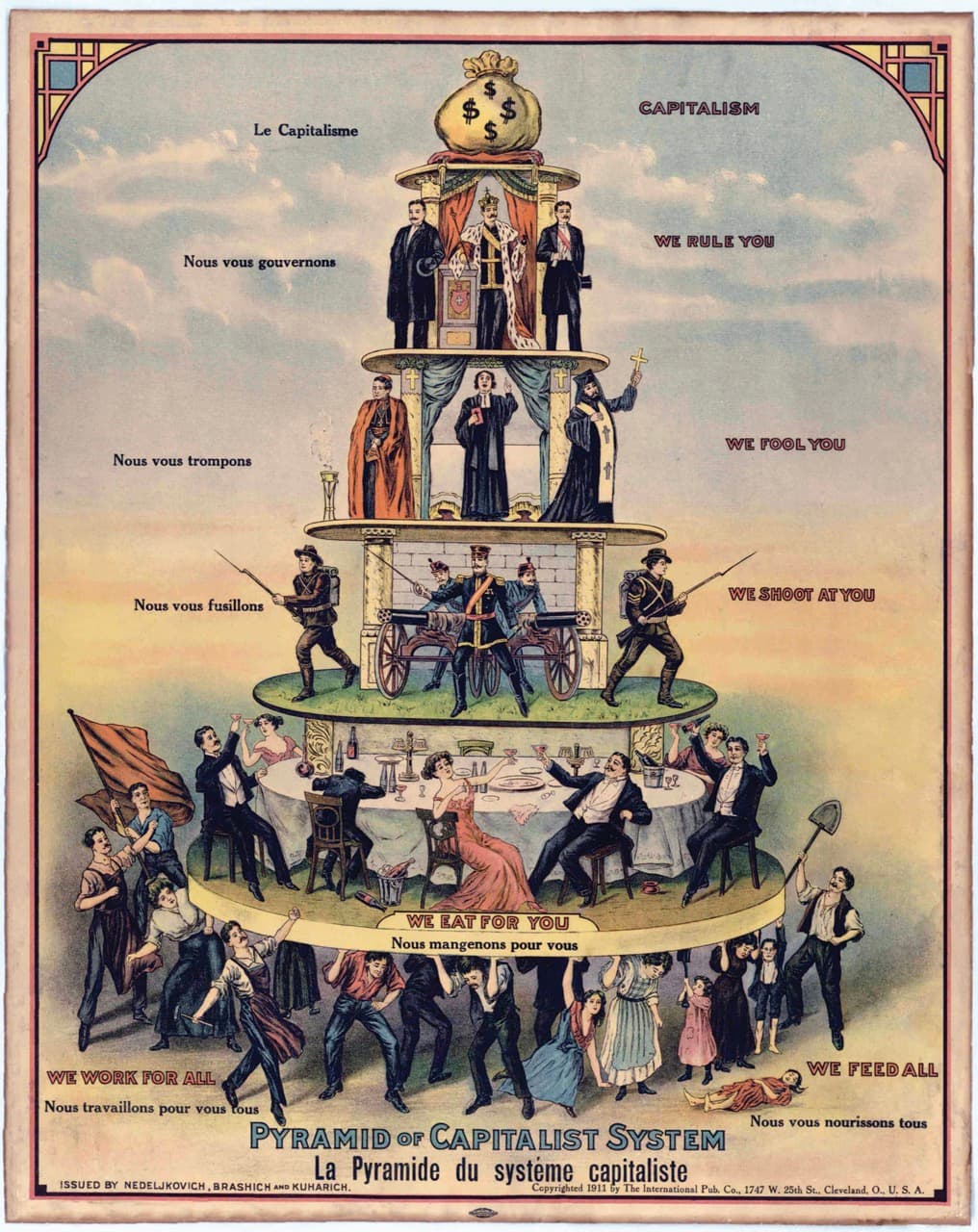
Pyramid of Capitalist System, issued by Nedeljkovich, Brashich, and Kuharich in 1911. Published by The International Pub. Co., Cleveland, OH.
Word count: 4739
Paragraphs: 28
Capitalism: A Global History
Penguin, 2025
When I was twenty, I was a Marxist in theory. I had a rough idea of socialism rather than a grasp on the theory of Marx. I had a general distaste for capitalism rooted in my working-class upbringing, and I had always had a love of history and an abiding curiosity about how the past developed into the present. When faced with the prospect of being drafted to fight in the war in Vietnam, I could not bring myself to participate in what I saw as an unjust and immoral war of American imperialism, and so I chose draft resistance. In the Anti-Vietnam War movement of the sixties and seventies, socialism in all its imagined forms was in the air, from back-to-the-earth communalism to anarchism to Stalinism—the full spectrum. It was in this milieu as a draft resistance activist that I became radicalized. I was at that time what I once heard my brother Paul refer to himself as: “a fuzzy one-worlder. “
After a few years, I decided to get serious and learn what I could about Marxism. While working as a day laborer in Boston in 1969, I joined a study group run by Students for a Democratic Society (SDS) at Northeastern University. There were a dozen in the class, mostly graduate students and members of SDS who met once a week and discussed books that were gaining widespread attention among the New Left: Paul Baran and Paul Sweezy’s Monopoly Capital, Herbert Marcuse’s One-Dimensional Man, Frantz Fanon’s The Wretched of the Earth, etc. The others in the group were far more knowledgeable than I was. I respected their understanding of capitalism, Marxism, and socialism, and looked to them for guidance in learning about these things. It turned out my respect was misplaced. In the middle of that summer, Eric Mann, a leader in SDS, arrived in Boston and spoke to SDS members about the recent split in the national leadership, with many, himself included, deciding to form the Weatherman faction. His advice was to leave school and start the revolution. When I arrived for the next scheduled class all but three had left to join the Weathermen, and the study group dissolved. I couldn’t fathom how these seemingly intelligent people had decided to do something so foolish and self-defeating as thinking that the time was right for starting a violent revolution. I became disillusioned with trusting leaders in the movement for insights into Marxism, but I continued with my reading of contemporary left-wing literature.
I eventually found what I was looking for when I joined a study group to read Marx’s Capital. I began to see that the world I was living in was embedded in a system that was unconsciously regulated by market forces, a system in which capitalism, a self-expanding process of value creation, had been spreading its logic and its power throughout the world for centuries. I saw that capitalism was not a natural outgrowth of technological development or a supposed tendency to truck and barter, but a human-created social force operating in the background of our society beyond conscious control. There was more to it than greedy capitalists using their wealth and power to exploit the working class and further enrich themselves. Capitalism had created something new in the world, and under its laws of motion, it was compelling economic and social development into channels, fostering its own reproduction on an expanded scale, and reaching out to affect more and more of the world’s people in more and more aspects of their lives. Improvements in living standards, life expectancy, health care, and cheaper commodities resulting from increased labor productivity have greatly improved the lives of many, but these benefits have been far from equally distributed. The disparity between the wealthy and the poor, and between the advanced capitalist countries and the less developed nations of the global South is immense. The actual quality of people’s lives, our health, happiness, and well-being does not factor into the self-expansion of capital. Improvement in these things only matters if it increases capital accumulation—if it’s profitable.
At the present moment many people are coming to the conclusion that capitalism is unsustainable. This is not surprising, as the looming ecological cataclysm shows no signs of slowing under the capitalist system that has now extended itself into every corner of the world. For more than twenty years, scholars and military security analysts have been predicting that the growing climate crisis is a “threat multiplier” that will likely entail social and political breakdown. We can see the beginnings being manifested today in the rebirth of fascist movements, Trumpism, genocidal wars, and a world economy on the brink, where a kink in the supply chain like a pandemic or closing the Strait of Hormuz can unleash an economic collapse.
Science, in spite of the dependence of much of its research on funding from nation states, wealthy individuals, and corporate capitalism, is still the best and only proven method for ascertaining true facts about the world. Climate science has been unequivocal in locating the cause of global warming in human-created greenhouse gas emissions, and on the absolute necessity of ending society’s dependence on fossil fuels, and yet the climate crisis is far from being adequately addressed. The models used to predict the detrimental effects of rising greenhouse gases in the atmosphere have been proven to be too conservative in their forecasts. Multiple tipping points and cascading feedback loops are now threatening to manifest themselves earlier than previously thought. Although hopes were raised for a green transition to renewable energy sources as the price of solar and wind fell below that of fossil fuels, it’s becoming clear that capital—which can rightly be called “fossil capital”—is exceedingly resistant to a transition away from fossil fuel.1 In spite of the growth of renewables as a proportion of total energy use, the use of oil, gas, and coal continues to rise every year, since the worldwide demand for energy is increasing even more rapidly.2
However, the dependency of the world economy on oil has skyrocketed not only as a result of increased energy demand. Over the last fifty years other uses were developed for petroleum and its byproducts that have become an essential part of modern life the world over. Plastics are now the feed stock for a vast amount of our commodity and machinery production, replacing much of the wood, rubber, leather, metal, and natural fibers of former times. This has not only greatly increased the demand for petroleum but created its own environmental catastrophe as plastic refuse entered the biosphere and, in the form of microplastics, into our bloodstreams. The chemical and drug industries, major components of the capitalist economy, are also dependent on petroleum for their products. Petroleum-derived asphalt for roads and roofs now covers hundreds of thousands of square miles of the planet’s land surface. Agriculture has been transformed with the use of chemical fertilizers, pesticides, and herbicides derived from oil.3 Meanwhile, not only has petroleum become essential in transportation, supply chains, and electricity generation, the extreme wealth of the petroleum industry finances so much of the world’s new investment that shutting it down would have a disastrous effect on the entire financial edifice, likely leading to a massive economic collapse. It can be seen that given the shrinking window for taking the necessary aggressive action to combat this cataclysm, our existing social, political, and economic institutions are woefully inadequate.
The result is that any viable future for humanity is now in doubt. The human economic and political entities responsible for the breakdown of the climate are not making the corrections needed to safeguard a habitable planet. The institutions that sustain the continued existence of the eight billion human inhabitants of Earth, the nation states, the industrial, scientific, academic, religious and commercial organizations that span the globe, have failed to correct the trajectory leading to catastrophic planetary heating and the associated breaching of other ecological boundaries. The role of capitalism in all this is obvious and it’s no surprise that it is generating increased scrutiny.
Onto this stage comes Sven Beckert’s Capitalism, a Global History. A professor of history at Harvard, Beckert has written an expansive history of commerce and capitalism beginning in the twelfth century. By starting at such an early date, he has set himself an ambitious task, resulting in a thousand-page book that spans over a millennium of human history and covers the whole world. It’s a work of prodigious research, full of stories of individual actors and accounts of little-known historical events that make for fascinating reading.
The first part of the book describes the growth of trade, presenting it as “islands” where capital existed. Beckert begins the global history of capitalism in the Middle Ages, at a time, he writes, when a “new kind of trader rose to prominence”—merchants who did not travel with their ships but stayed put. “These traders … became the world’s first capitalists.” Later we learn that these were capitalists without capitalism; since capitalism was not yet fully developed, this was only proto-capitalism. Throughout the book Beckert goes back and forth describing events as capitalism in one case, proto-capitalism in another, war capitalism in yet another. He often skips back and forth through the centuries in describing events in a particular place, from eras that were definitely not capitalist to the eighteenth and nineteenth centuries, when capitalism was becoming industrialized and spreading out from its point of origin. He often treats each case as if the social conditions, and especially the relations of production were the same at all times. This becomes a problem when trying to understand whether events he describes are a cause of capitalism or a result of already established capitalist relations of production.
Beckert recounts the dizzying expansion of trade in the late fifteenth and sixteenth centuries leading up to the birth of capitalism, describing it as “that cauldron [within which] capitalism emerged.”4 An important distinction for him is that capitalism existed in embryo stage for over half a millennium, waiting to break free of the fetters of feudalism. While capital as money certainly existed in the form of wealth acquired by merchants, capitalism—the self-expansion of capital—does not occur until the direct producers as well as the holders of capital are compelled to get their means of subsistence from the market. While trade was expanding and intensifying and enormous wealth was being appropriated by military means, the great masses of peasant producers were still independent of the market, which, while offering them some opportunities to trade, did not compel them to do so.
The book is a conscious refutation of Eurocentric history, which has dominated so much of Western historical writing until very recently. It tells of many places in the world where local merchants became exceedingly wealthy by focusing on long distance trade and finance: for example, Surat in western India, and Damascus and Aleppo in Syria. Beckert recounts how in 1574, twenty-five ships loaded with spices from the Indies came over the sea through the Strait of Hormuz to Basrah, where the goods were loaded onto smaller vessels and taken up the Tigris to Baghdad. Similar expansion of trade was occurring at the same time in China, Southeast Asia, Japan, Africa, and North and South America:
While the value of goods traded across long distances remained, in quantitative terms, much less than that of things produced and consumed locally, it allowed for flexibility and large, concentrated investments, and, as a result, unprecedented accumulation, none of which was yet possible in agriculture or industry.5
The story continues with the rapid expansion of trade in the West Indies, using the island of Barbados as an example. Here in the mid-seventeenth century, English merchants were buying up land and turning it into sugar plantations worked by convict labor at first, then by Irish and Scottish prisoners of war, and finally by African slaves, since many of the London investors were also shareholders in the slave-trading Royal African Company. By the 1650s “more capital was invested in Barbados and more trade conducted with the island than in ‘all the other English colonies put together,’ including New England, New York, and Pennsylvania.” The extraordinary profitability of this “plantation machine,” which has been called a “revolutionary form of social and economic organization,” was based on the super-exploitation of enslaved labor, “making Barbados one of the most unequal places ever in world history.” Beckert sees this new setting, where capital owners were free from feudal dependencies, state interference, and traditional customs that limited the use of land and labor, as the cutting edge of budding capitalism, as capitalists began to immerse themselves in production. He attributes this to the “planters’ determination to rethink agriculture, to create an industrialized form of cultivation, and—crucially—to commodify everything.”6
The time when this was taking place is important. If these changes were influenced by events in England that were altering the relations of agricultural production, then they were not merely an outgrowth of the planters’ desire to escape from state restrictions and traditional customs, but the adoption of a new mentality of “improvement” that was developing in the English countryside.7 New conceptions of landed property rights had been developing among English landowners and their tenant farmers for some time. The sixteenth century “marks the transition from the medieval conception of land as the basis of political functions and obligations to the modern view of it as an income-yielding investment.”8
In his effort to show that the history of capitalism is a world history and that it is not possible to confine its development to Europe, Beckert is compelled to reject the possibility that it had a beginning in a specific time and place in Europe. Historian Robert Brenner has made a strong case for locating the origin of capitalism in the English countryside in the sixteenth and seventeenth centuries. He stresses that as contradictions in the feudal system led to the collapse of serfdom, the unique historical circumstances in England involving the relationship of the landed aristocracy to the Tudor monarchy and the class struggle of their own peasants, producing a transition from labor service (corvée) to payment by rent, created what is known as the triad of landlords, capitalist farmers, and wage laborers. As the landlords became more dependent on the market for goods and services that had been provided by their peasants, the farmers now had to pay market-determined rents to survive. This led to landlords favoring tenants who were using new more productive techniques and thus able to pay higher rent. These more productive farmers were then able to buy up the land of the less productive, and hire them as wage workers. This created a market dependency that was unique at the time, in which the farmers were unable to survive outside the market, setting in train the accumulation of capital through competition in the market, leading to more innovation and increasing productivity.9
To show how the particular class relationships that developed in England with the dissolution of serfdom led to the establishment of a distinct and novel process in which the market took on a regulatory role, and former peasants became capitalist farmers, is not to claim that other parts of the world were at the time less developed or in any way inferior. Beckert shows that other societies beyond Europe were, if anything, superior in technological, scientific, and commercial achievements. That this did not lead to the development of the distinctive self-expansion of accumulation through the increase in the productivity of labor that is the defining feature of capitalism, is mere happenstance.
Beckert’s professed goal is to denaturalize capitalism and show how it was a fundamental break in human history that revolutionized how people live in profound ways—a transformation that can only be comparable in importance to the neolithic revolution that inaugurated sedentary agriculture eleven thousand years ago. He stresses capitalism’s revolutionary character, that produces continual upheavals in human society and makes “revolution a permanent feature of economic life.” He asks how the capitalist revolution began, how it changed society from one “in which markets were embedded in social relations to one in which social relations are embedded in markets,” and “by what mechanism has capitalism evolved and changed over time?”10 These are essential questions for determining just what capitalism is. What is it we are talking about when we use the term? It is difficult, however, to pin Beckert down to a clear definition of capitalism. By failing to adequately answer his questions, he undermines his own objectives.
Beckert feels strongly that capitalism must be perceived from a historical perspective. But he contrasts this with understanding capitalism on an abstract level. He sees the two as mutually exclusive and eschews theories about the mechanisms at play in the operation of capitalism, insisting that he is writing a history of really existing capitalism. In doing so, he misses an essential characteristic of capitalism: its self-expansion. Capitalism is a mode of production unlike any previous one, in which new class relationships have resulted in a continuing process of increasing labor productivity through the accumulation of surplus value and its reinvestment into innovation—a process in which both the capitalist class and the laboring class are compelled to participate in order to ensure their own survival and reproduction. Although Beckert maintains that capitalism is in no way a natural outcome of human nature or technological progress and that it is a new and unique form of human social organization, he insists that it does not have a beginning point at a particular time and place in history, but that it is a process that draws its energy from myriad sources. At the very beginning of his book he writes that “efforts to isolate one patch of soil as capitalism’s place of origin—Florence, Barbados, Amsterdam, Baghdad, the southern English countryside, or Manchester, for example—have all proved insufficient.”11 It is insufficient perhaps in explaining his view of capitalism as an outgrowth of trade and the expansion of trading networks, but if capitalism represents a fundamental break in human affairs, it is essential to establish just what that break entailed—what happened to cause a sudden increase in the productive capacity of labor (in an historical time frame) and where and when this first occurred. When he describes trading outposts in foreign lands that have existed since antiquity as “islands of capital,” and merchants’ desire to increase their profits as the logic of capitalism, he is following a long tradition in the investigation of capitalism, but one that does not rise to the explanatory challenge he has set.
Despite his denial of engaging in theory, Beckert is firmly wedded to the theory of the commercial origin of capitalism. The book is a long defense of the idea that capitalism grew out of the expansion of trade, an idea that has been long accepted in economic history across the ideological spectrum from Adam Smith to the early Karl Marx of the Communist Manifesto. Although in his later work Marx shifted his view away from the commercial origin theory, later Marxists tended to accept it, albeit with less focus on Europe alone and more emphasis on the worldwide expansion of trade. Henri Pirenne, an advocate of the commercialization theory whom I read avidly in the 1970s, was influential in its acceptance in the early twentieth century. Marxist economist Paul Sweezy adopted his approach, attributing the expansion of trade following the reopening of the Mediterranean to the origin of capitalism. Immanuel Wallerstein, in his three-volume work, The Modern World System, ascribes it to the formation of a European world economy that took off in the era of discovery and conquest. Brenner argued—successfully, in my opinion—against these positions. His criticism, which applies equally to Beckert, is that they cannot explain how a system such as capitalism arose that spontaneously and continually develops the productive capacity of labor. The expansion of trade that results in increased wealth and resources, the transfer of surplus from the periphery to the core, or the incorporation of more effective means of surplus labor extraction by the ruling class do not determine how a system comes into existence that continually revolutionizes the technical labor process and increases the productivity of labor—a system with a “built-in tendency to accumulate by means of innovation.” In other words, Beckert’s insistence that “[c]apitalism is a process, not a discrete historical event with a beginning and an end,” is insufficient for explaining what capitalism is. He assumes that profit maximization and market competition are enough to stimulate an increase in production and innovation leading to the increasing productivity of labor. However, it is only under capitalist class relations, where free wage labor exists and labor power is a commodity, that this tendency occurs. It is only when a class of people are divorced from any way of producing their own means of subsistence and are forced to get the money they need to live by selling the only commodity they own—their ability to work, their labor power—that the accumulation of capital on an extended scale takes place.
In Marx’s model of how capitalism works, only labor produces new value. In Capital, he distinguishes between the two ways this surplus value can be increased. One is what he calls “absolute surplus value,” in which the labor time of the worker is extended—longer working hours—or by labor intensification—working harder. There are, of course, physical limits to both of these. The other he calls “relative surplus value”: when the amount of commodity a worker can produce in a given time is increased through the use of innovative techniques, involving either more efficient use of their time or the use of more productive tools or machinery. By increasing the productivity of labor, the capitalist can lower the cost of production below the average cost, thus undercutting competitors who must then adapt the new techniques or go bankrupt. This cheapens the product, and eventually, as the process expands, cheapens the cost of commodities the workers need to live. This reduces the part of the workday required for the workers’ own subsistence—their wages—and increases the surplus value that goes to the capitalist in the form of profit, a portion of which can be reinvested in new, more productive innovation. As this process spreads through competition in the market, the new technology becomes the norm, and the socially necessary time needed to produce that commodity is lowered. Not only does this reduce the price of commodities, but it also forces the capitalist to spend more on the machinery needed for production and less on human labor. Since it is only labor that produces surplus value, this tends to reduce the amount of surplus value produced with a given capital investment, so the capitalist must now increase productivity even faster or risk being undersold by their competitors, resulting in a continuous cycle of increasing technological innovation and constant expansion of production, the growth which is the sine qua non of capitalism.
It was when this process first began that the self-expanding operation of the capitalist mode of production began. It did not happen automatically with increased trade and the accumulation of wealth, but in the context of particular class relations that emerged in the class struggles around the dissolution of serfdom in medieval Europe.
Why is this important today? Isn’t it enough for Beckert to recount the revolutionary character of capitalism, its history of extraordinary advances, worldwide connectivity, horrible exploitation, and the incredible flexibility that allows it to transform itself through the everchanging conditions of history? It is not. As I began to comprehend when I first attempted to understand how the system I opposed functioned, without a theoretical understanding of the mechanism that propels the ever-changing technical processes of production within capitalism—its unrelenting need to increase the productivity of labor and the exploitation of labor that underlies its self-expansion—there is no reason to think that it might, or even ever should be ended. Rather, as Beckert seems to think, it could continue to change and adapt to any crisis it faces and live on as a different form of capitalism. As he says in his concluding chapter: “We can expect capitalism’s enormous creativity to persist, along with its amazing adaptability—including its to-date undeniable record of generating technical, ecological, political, and social fixes for the multiple crises it has itself engendered.”12 Because he misunderstands what capitalism is, he can imagine it creating technological fixes for the ecological destruction it has caused. This aligns with the designs of some in the ruling capitalist class today who are grasping for wild, untested, and potentially disastrous geoengineering projects to stave off climate collapse without halting the use of fossil fuel, so they can continue to amass their wealth and power through the accumulation of capital and its ever-expanding production. The owners of capital embody the logic of capital, and in that sense, they are nothing more than the personification of its blind expansion—blind, that is, to the human and biological destruction that this logic entrains.
As the staggering inequality between the wealth of the super-rich and the poverty of the great mass of the world’s peasants and workers grows to enormous heights, and the sustainability of capitalism threatens the sustainability of a habitable planet, hope for the future lies in the development of an alternative to the capitalist system. This is the urgent and critical task of the present generation.
Of course, many past generations of revolutionary anti-capitalists have tried and failed, but their efforts and mistakes can help to guide us in the present. For this we need not only a history of capitalism, but a history of anti-capitalism as well. For a critical assessment of past communist and socialist movements, including those societies known as “actually existing socialism,” I recommend David Camfield’s Red Flags: A Reckoning With Communism for the Future of the Left.13 A historian and ecosocialist proponent of an emancipatory and democratic socialism, he is a critic of societies modeled on the Soviet Union. He bases this criticism on what actually happened in history that resulted in authoritarian and repressive regimes. He also is a critic of the anti-communism that, partly based on distortions and lies, was used to fuel right-wing movements in the twentieth century, as well as to justify the suppression of any popular movement that was seen as an obstacle to the spread and consolidation of capitalism and the imperialism of the dominant capitalist states.
If there is to be a movement to overthrow the capitalist order, a clear view of history is a necessity. No matter how improbable such a scenario may seem at the present, it should be remembered that while we can know a great deal about the past, the future is unknown. What we do know is that there has never before been a time like the present moment, when such a clear choice presents itself to a world that is united in one interconnected system of production, distribution, communication, and knowledge—where the future can be seen with mathematical certainty to lead to disaster unless a radical transformation of human society takes place. This alone makes the present situation totally unprecedented, and it means that the end of capitalism, with its blind control over people’s relationships to each other and to the natural world, is, however improbable, far from impossible.
My reading of Capital in that study group so many years ago, gave me a tool I have been able to use throughout my life: a theoretical framework with which I have been able to better understand the world I’ve lived in and the events that have swept us up in what otherwise would seem an incoherent and nonsensical salmagundi. By giving me an understanding of how capitalism directs so much of our world, I can envision a world without it: one in which people can take conscious control of their own destiny; in which democracy is extended to include the workplace; where human rights are respected; the environment and other species are protected; and all have an equal say in what is produced, how it is produced, and how much work should be extended. When the human race is free from the constraints that limit our creativity, our effort, and our power of collective activity to the pursuit of profit and the unending accumulation of capital, conscious human history can commence.
- As regards the difficulty in renewables replacing fossil fuel, see Brett Christophers, The Price is Wrong: Why Capitalism Won’t Save the Planet (London: Verso, 2024), p. 94
- UN Global Environmental Outlook 7. https://www.unep.org/resources/global-environment-outlook-7.
- See Adam Hanieh, Crude Capitalism: Oil, Corporate Power, and the Making of the World Market, (London: Verso, 2024).
- Sven Beckert, Capitalism, a Global History (New York: Penguin Press, 2025), p. 126.
- Ibid, p. 110
- Ibid, p. 180
- See Ellen Meiksins Wood, Empire of Capital (London: Verso, 2003), pp. 75–6.
- R. H. Tawney, The Agrarian Problem in the Sixteenth Century, (London: Longmans, Green & Co., 1912), p. 189. Cited in Wood, 2003
- Robert Brenner, “The Origins of Capitalist Development: a Critique of Neo-Smithian Marxism,” New Left Review, vol. 104 (July/August 1977), pp. 75–8.
- Ibid, pp. 3–5.
- Ibid p. 29.
- Ibid, p. 1083.
- David Camfield, Red Flags: A Reckoning with Communism for the Future of the Left (Winnipeg: Fernwood, 2025).