The Protestant War Ethic
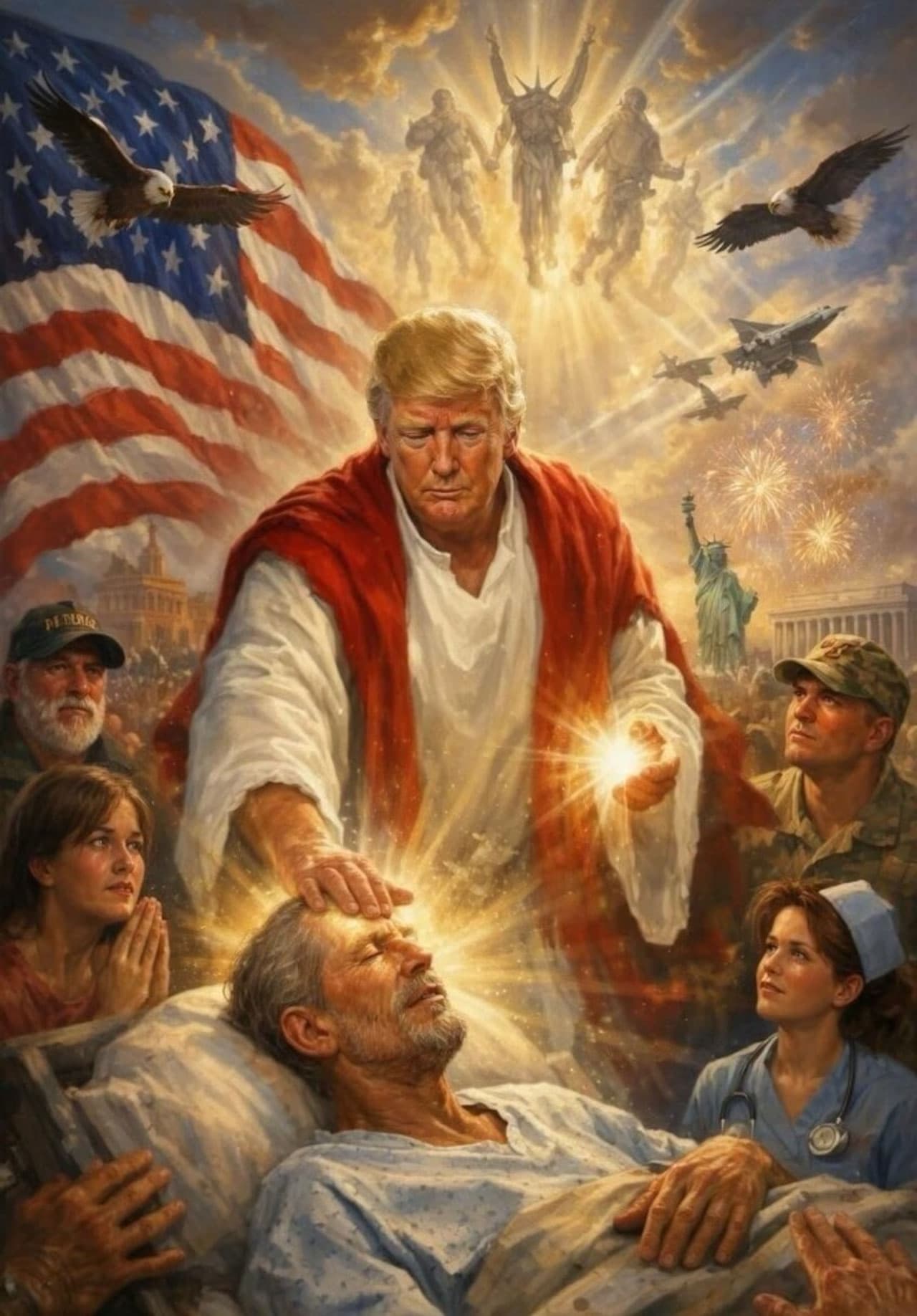
AI image of President Donald Trump as Jesus.
Word count: 2126
Paragraphs: 25
The White House turned Easter into a war liturgy. Donald Trump called the rescue of a downed American airman in Iran an “Easter miracle.” Pete Hegseth answered with scripture and triumph. Senior Advisor of the White House Faith Office Paula White-Cain compared Trump to Christ in the familiar key of persecution and vindication. Televangelist Robert Jeffress cast the conflict as a struggle between the kingdom of God and the kingdom of Satan. This unfolded as the war with Iran lurched into a fragile ceasefire, with Washington still insisting it was prepared to resume fighting if diplomacy failed. The scene was obscene, but not merely because it was gaudy. What was obscene was the intimacy between devotion and devastation, the way military force was made to shimmer as providence, the way war itself was offered up as a sign that history had not gone dark.
The easy explanation is hypocrisy. The Christian right, on this telling, wraps naked interest in holy language. Empire borrows the costume of faith. This is not false, exactly. But it is not enough. Hypocrisy assumes a stable secular reality beneath the performance, as if the pious rhetoric were only decoration, a layer of paint over policy. Yet the rhetoric here is not ornamental. It is functional. War is not simply being justified. It is being converted into evidence. Violence is asked to do more than secure strategic goals. It is asked to make belief feel real.
This is the possibility liberal commentary almost always misses. A certain strand of American Christianity does not merely interpret catastrophe through prophecy. It needs catastrophe to keep prophecy alive. War becomes more than foreign policy, more than spectacle, more even than ideology. It becomes a medium of conviction.
That is what I want to call the Protestant War Ethic.
The phrase deliberately echoes Max Weber, but it points to a mutation rather than a repetition. Weber’s great insight was never simply that Protestants worked hard and saved money. More profoundly, he described a structure of spiritual suspense in which invisible destiny had to be mediated through worldly conduct. Salvation could not be known directly. Election remained hidden. The believer therefore organized life so that discipline, sobriety, labor, and self-restraint might furnish indirect signs of an unseen fate. The point was not work for its own sake. The point was mediation. The unseen needed worldly traces. That structure has not vanished. It has migrated. The contemporary apocalyptic subject still confronts the same abyss. The kingdom is deferred. The promise remains just over the horizon. Christ does not return on schedule. Sacred history lingers in the tense of imminence. But the signs through which this delay is managed are no longer principally those of labor and discipline. They are increasingly those of shock, upheaval, military violence, and geopolitical crisis. What once attached itself to the calling now attaches itself to the breaking news alert. The scene of verification has shifted from the workshop to the war room.
Christian Zionism has long understood something that its secular critics often fail to grasp. A prophecy that never touches the world begins to thin out. It cannot remain pure expectation forever. It needs scenery. It needs institutions, maps, donor networks, tour buses, embassy ceremonies, prayer rallies, settlement rhetoric, and the ugly glamour of war. Israel, in this imagination, is not simply a state. It is a stage on which sacred time appears to brush against the ground. The miracle is not only that Israel exists. The miracle is that it can be watched, monitored, narrated, defended, and inserted again and again into a script of imminent fulfillment.
That is why Israel and the wider Middle East occupy such a singular place in the evangelical imagination. They are not merely policy concerns. They are sites of revelation. One does not simply observe events there. One scans them for prophetic density. A territorial shift, a missile exchange, a regional alliance, a war with Iran—each appears not as a discrete political fact but as a possible thickening of sacred chronology. The geography is already saturated before the first strike lands.
Iran enters this symbolic field preloaded with mythic voltage. It does not appear as a neutral modern state. It arrives clothed in typology, Persia, empire, civilizational enemy, scriptural weather, the old archive of menace, and the permanent possibility of apocalyptic escalation. So when Trump’s circle casts war in the language of miracle, providence, betrayal, evil, and deliverance, they are not improvising from nowhere. They are stepping into a sign-system already prepared to treat Middle Eastern violence as revelation. This religious framing is not incidental but central to how the Iran conflict is being sold to the evangelical base.
Still, theology alone does not explain the texture of the present. To understand why this form of belief has become so event-hungry, it is necessary to ask what kind of time we inhabit. Weber’s Protestants belonged to a world trained for delay. Their discipline was endurance. They knew how to bear the interval between promise and fulfillment through labor, restraint, and method. Ours is not such a civilization. Ours is trained for refresh.
Financialized capitalism does not simply teach people to postpone gratification. It teaches them to live by signals. Credit scores, market movements, dashboards, notifications, polling shifts, trending topics, threat levels, readiness postures, portfolio adjustments. All of it forms a sensorium in which certainty is never delivered once and for all but approached through constant interim valuation. The subject must monitor, update, recalibrate, hedge. The future remains uncertain, but uncertainty is no longer endured as silence. It is reformatted as information.
This is why the culture of prophecy feels so uncannily at home in the age of the feed. The prophecy believer scrolls like the trader. Not because they are identical figures, but because both inhabit a world in which terminal settlement is indefinitely deferred while intermediate signals become existentially decisive. The kingdom does not arrive. Christ does not return. But another war breaks out. Another embassy moves. Another settlement expands. Another pastor announces that scripture is unfolding before our eyes. The position is live again. The promise has not expired. History still flickers.
War, in this sense, is not the fulfillment of prophecy. It is the volatility that keeps prophecy tradable.
This is the heart of the Protestant War Ethic. It names a mode of religious-political life in which war and catastrophe become instruments for the maintenance of belief under conditions of delay. Not because war proves prophecy in any strict sense. It does something subtler and more practical than proof. It supplies updates. It keeps the promise from fading into abstraction. It reassures the believer that history has not gone cold.
The language of finance is useful here, provided it is used carefully. A hedge does not abolish uncertainty. It manages exposure to it. So too with war in the prophetic imagination. The end does not arrive. The promise remains open, strained, vulnerable to attrition. Every year of non-fulfillment threatens to erode belief. But each new crisis in the right geography, with the right symbolic density, temporarily covers the position. It does not settle the claim. It buys more time for it.
And this is why the appetite for catastrophe should not be mistaken for pure certainty. A familiar liberal reading treats the Christian right’s militancy as an expression of religious excess: too much certainty, too much zeal, too much conviction. But often the opposite is closer to the mark. What if the escalating need for signs indicates not the fullness of belief but its fragility? What if the reason war must be continually interpreted, amplified, and even welcomed is that prophecy, left alone with time, begins to lose force? What if the violence of the rhetoric comes not from serene assurance but from an inability to endure divine delay?
What presents itself as certainty is often doubt that has learned to speak in the language of destiny.
And doubt, once politically organized, seeks infrastructure. It seeks television, churches, donors, campaign rallies, influencer feeds, Pentagon podiums, White House ceremonies, policy shops, and state power. The danger of Christian Zionism is not merely that it dreams. Religions dream all the time. The danger is that it has built extraordinarily effective relays between dream and institution. It can move from sermon to lobbying, from prophecy conference to foreign policy, from pilgrimage to settlement boosterism, from biblical map to bomb map. It is a machine for translating sacred time into geopolitical appetite.
This is where Gaza and Iran begin to rhyme, even though they are not the same war and should not be collapsed into one another. In both cases, violence becomes scene. It becomes a stage on which sacred history can be consumed in the present tense. For Palestinians, that means living and dying inside the nightmare of another people’s prophecy. For Iranians, it means being cast into the old role of civilizational menace so that redemptive force can once again be staged as necessity. One population becomes obstacle, another threat, so that the machinery of sacred relevance can keep turning.
Alongside prophecy there runs a second idiom, one that belongs less to theology than to neoliberal admiration. Israel is praised not only as sacred state, but as resilient, innovative, entrepreneurial, militarily brilliant, permanently adaptive. The state appears as startup. The frontier appears as laboratory. Occupied land appears as development horizon. Theology and political economy do not collapse into one another, but they converge in admiration for the same formation. One venerates Israel as fulfillment of sacred time. The other celebrates it as model of security, technology, and competitive modernity. One sacralizes. The other rationalizes. Both help normalize a regime of permanent readiness and permanent Palestinian dispossession.
That is why the Protestant War Ethic belongs not only to theology but to the age of finance. Its distinctive feature is not merely that it wants the end. Millenarian movements have always wanted the end. Its distinctive feature is that it wants ongoing evidence of the end’s approach, and it wants it at the tempo of a civilization addicted to updates. The result is an eschatology with the nervous system of a market. The believer no longer simply waits for redemption. He monitors for movement. He wants the graph to twitch. He wants the siren, the screenshot, the satellite image, the official statement that things may escalate further, the charismatic pastor explaining that ancient scripture is suddenly breaking into the present.
This helps explain the grotesque usefulness of Trump himself. He is not merely defended as a politician. He is staged as vessel, instrument, persecuted redeemer, secular Cyrus, almost-messiah. Paula White-Caine’s comparison of Trump to Jesus is only the crudest expression of a wider liturgical instinct, the need to personify the fusion of providence, grievance, empire, and spectacle. In a world where the sign-system must constantly renew itself, the leader too must become sign. He is not revered because he is holy. He becomes holy because he can keep the machinery of eventfulness running.
Here the syntax of the present becomes unmistakable. Miracle, victory, pause, menace, reprieve, renewed threat. The oscillation itself matters. It is not a distraction from the theology. It is the theology’s emotional rhythm under contemporary conditions. Belief is not nourished by fulfillment. It is nourished by escalation, interruption, volatility, and the continuous sensation that history is tipping. No war can finally satisfy this structure, because war does not deliver the kingdom. It only refreshes the plausibility of the kingdom’s nearness. Each catastrophe buys more time for belief, but only by increasing dependence on the next catastrophe. The logic is inflationary. Yesterday’s sign loses force. A bigger one is needed. Then a bigger one still. The economy of reassurance begins to run on diminishing returns.
This is the bleakest point, and the one most worth insisting on. The Christian right’s relation to war is not accidental to its spirituality. War has become one of the forms through which that spirituality now reproduces itself. Not because all evangelicals desire bloodshed. Not because theology can be reduced to strategy. But because, under present conditions, catastrophe has become one of the few things powerful enough to keep certain promises from fading. What looks like steadfast faith is often a dependence on violent reminders. What looks like prophecy is often a regime of signal maintenance. What looks like moral clarity is often a terror of silence.
The Protestant ethic once tied invisible destiny to labor. The Protestant War Ethic ties invisible destiny to catastrophe. That is the mutation. And if we want to understand the current fusion of Trumpism, Christian Zionism, and imperial war, the issue is not only what these people believe. It is what kind of world they now need in order to keep believing it.
Austin Hayden Smidt is a social theorist and filmmaker currently based in Australia.