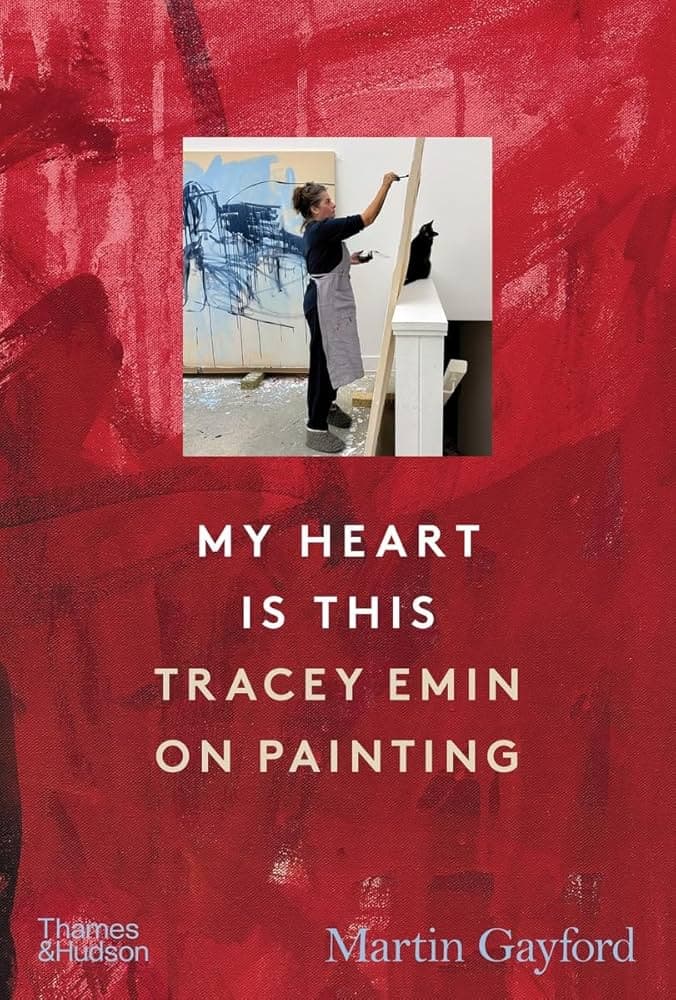
Martin Gayford’s My Heart is This: Tracey Emin on Painting
This is a unique blend of artist monograph, art-historical account, confessional biography, and casual conversation.
Word count: 792
Paragraphs: 9
Martin Gayford
Thames & Hudson, 2026
Former YBA-affiliate (Young British Artists) bad girl, now one of Britain’s best-known and most successful artists, Tracey Emin is also an accomplished author. She regularly contributed to The Independent for years, and her autobiography Strangeland caused a stir when it appeared in 2005. My Heart is This: Tracey Emin on Painting, by British author and art critic, connoisseur, and curator Martin Gayford, focuses on Emin’s two-dimensional work. The book encompasses selected passages from Emin’s writings as well as new material culled from Gayford’s extensive conversations with the artist, begun over twenty years ago. It is a unique blend of artist monograph, art-historical account, confessional biography, and casual conversation, which ultimately provides an emotionally wrought and intellectually engaging portrait of the artist.
Gayford has written books on David Hockney, Lucian Freud, and other School of London artists he has known personally. The latest book, however, follows on the heels of the author’s 2025 book, Venice: City of Pictures, which is a portrait of a venerable city told by means of a personal narrative of encounters with numerous extant artworks and architectural monuments, accompanied by many illustrations. It is a refreshing departure from standard art history books or academic treatises on the subject. Gayford adopts a similar approach for his living subject in My Heart is This: Tracey Emin on Painting, perhaps in the process developing a new genre for historical and recent art history studies that is highly visual and personal, without diminishing historical accuracy or intellectual rigor.
Early in the book, Emin relates to Gayford how she has emerged from a near-fatal battle with cancer and has become more energized and focused on her painting than ever before. Although she still must spend several days in bed each week to rest and recover, her other days are jam-packed with her own studio activities as well as engagements with the various art programs of the residency she has established in her beloved seaside hometown of Margate, as well as other community endeavors. “Cancer gives you lots of time,” she writes, “because every moment that you have is more special. That sounds so corny, but it’s true.… I thought, ‘I’ve got about six months; I’ve got to make the most of every day.’ I just got happier and happier, and four years later, I’m still here, getting better.”
Gayford provides an overview of Emin’s career and the vicissitudes of her reputation before embarking on a more chronologically based discourse with her about her art and life. “For many years, she was famous as one of the so-called ‘Young British Artists,’ a celebrity, an artist producing work in many media, but not especially as a painter.” Emin never considered herself a YBA. “Many of the core group—including Damien Hirst, Sarah Lucas, and Gary Hume—had gone to Goldsmith’s College,” Gayford explains. “Emin had been added to the category later on.”
The conversation and narrative trace Emin’s struggle to be accepted by any college or art institution, with tragicomic tales of a continuous succession of rejections. Since childhood, Emin had a passion for drawing and painting, and the book highlights her admiration for the work of Egon Schiele and especially Edvard Munch, whose idiosyncratic form of expressionism was something that the young artist tried to emulate. Although most academic administrators dismissed her work as sub-par and regarded the budding artist as virtually talentless, Gayford asserts that “Emin had little problem in blasting her way through the barriers presented by the educational system, powered as she was by talent, energy and effrontery.”
She landed at the Royal College of Art, where she studied with sympathetic mentors: professor Ken Kiff and Royal College affiliate Paula Rego. But that experience eventually proved to be a disappointment for her, and she eventually destroyed all the paintings from that period—eccentric figurative compositions, some of which were fortunately preserved in photographs and reproduced in the book. She entered a suicidal phase, saved from oblivion by serendipitous encounters with future art dealer and White Cube founder Jay Jopling and future YBA artist Sarah Lucas, who encouraged her toward more performance-oriented works that established Emin’s growing notoriety. She cannily used that notoriety to return to her lifelong, primary passion, which is painting and drawing highly gestural renderings of the human figure, often with herself as the principal model.
Throughout the book, Emin discusses in depth with Gayford the technical challenges of various media—painting, sculpture, and printmaking—that continue to motivate and inspire her. Ultimately, My Heart is This: Tracey Emin on Painting is a multifaceted book—an engaging artist biography and revealing confessional commentary combined, as well as a how-to, or how-not-to guide for all struggling artists to consider.
David Ebony is a contributing editor of Art in America. He is also the author of monthly columns for Yale University Press online, and Artnet News.