To What End Painting?
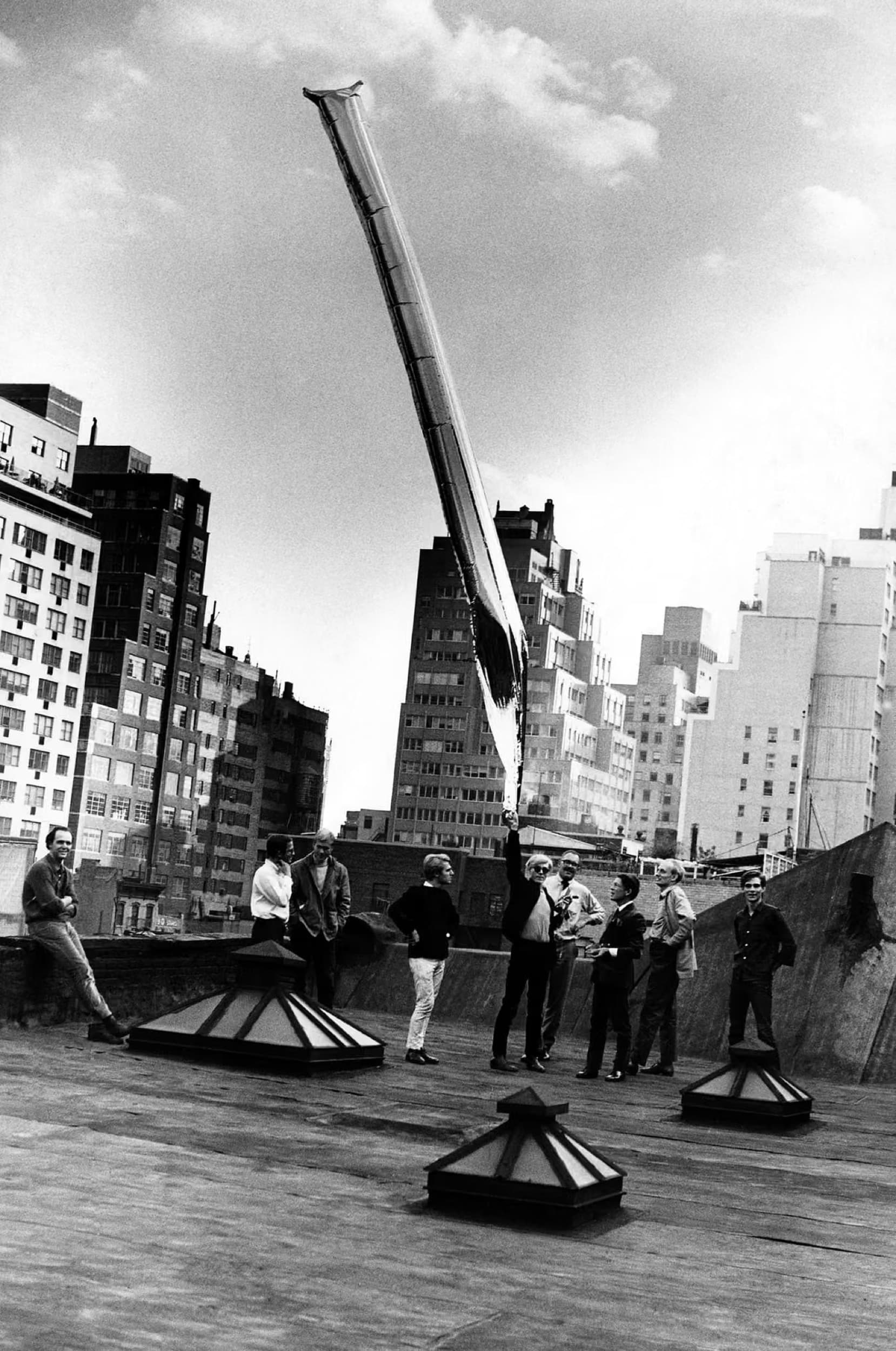
Billy Name, Andy Warhol with silver balloon sculpture, the Factory, 1964. © 2026 Billy Name Estate / Artists Rights Society (ARS), New York.
Word count: 796
Paragraphs: 6
In 1966, Andy Warhol debuted his Silver Clouds, a set of glittering rectangular flotations made from Scotchpak and developed in collaboration with engineer Billy Klüver. In interviews at the time, Warhol repeatedly described the works as a way of giving up painting (just a phase!) in favor of filmmaking. Sometimes he imagined himself blowing them up and letting them float out of a window; sometimes he delegated this melodramatic act of renunciation to an anonymous “you” who was invited to fill them up and let them go. His accounts slipped between the first and second person and between a singular gesture and its compulsive repetition. With his signature naïveté, Warhol ventriloquized the “death of painting” discourse in the air in a pointedly literal manner. And a poignant one: his friend Fred Herko—a dancer and habitué of the similarly glittering Silver Factory—had recently leapt out of a window to his death. Yet, despite his pronouncements, Warhol did not retire from painting to pursue film; he had already begun filmmaking and he continued to paint.
I first encountered Warhol’s lightly duplicitous words in 2010 in a graduate seminar on his films led by Douglas Crimp, whose book on the topic appeared soon after. We made our way through the literature on Warhol and watched his films, from Kiss (1963–64) to Eating Too Fast (1966), on the silver screen at the George Eastman Museum, the reels secured from MoMA’s collection. For Douglas, it was important that we saw the films on film and that we viewed them together. And it was from Douglas, and from his looking at, reading about, and writing on Warhol, that I began to learn, really learn, how to look at, how to read about, and how to write about art.
The strange temporality of the Silver Clouds is at odds with the story Warhol told about them. The period during which he developed them coincides exactly with the production of his “Screen Tests” (1964–66), and the clouds imperfectly echo the aspect ratio and, in their buoyancy, the slowed-down projection speed of his films. Synecdochic of both the Factory’s décor and the mirror-like affect of the artist himself, they recall the blank spaces and monochromatic doubles of Warhol’s silkscreens and the briefly notorious “silver blank,” as he dubbed it, of his censored mural, 13 Most Wanted Men (1964). They point at once forward, to the space-age futurism of sixties fashion, and backwards, campily, to classic Hollywood and the cruel, silvered glamour of Josef Von Sternberg’s cinematography.
Warhol’s burlesque of the end or death of painting ultimately stages not the medium’s obsolescence but the productive force of such narratives of closure and finality. While the imagined window scene tethers the clouds to the history of painting with a faint whiff of Leon Battista Alberti, Warhol’s most famous enactment of the scenario involved the release of an obscenely elongated “test balloon” from the roof of the Factory accompanied by an ebullient crowd. According to the catalogue raisonné, the Silver Clouds are an “indeterminate and expanding set” that have variously been discarded, reused, sold, or given away. They require repeated infusions to maintain their shape as well as elaborate contrivance to be made to hover evenly between floor and ceiling. And they have a knack for sticking around. The debut installation gained a second life as the film Andy Warhol’s Silver Flotations (1966) by Willard Maas (himself rumored to be the unseen star—or at least one of them—of Warhol’s 1964 film Blowjob). They feature in a Diana-Vreeland-era Vogue editorial, their pillow-like shapes recruited to advertise nightgowns. As the décor for Merce Cunningham’s RainForest (1968), they collide with the dancers and with each other, indexing the movement of the dance and interrupting it with their own woozy, glitzy pace. They have since returned in works and ephemera by Steven Parrino, Louise Lawler, and T.J. Wilcox.
Hardly enacting the disappearing act that Warhol promised, the Silver Clouds required constant maintenance; they were an occasion for profusion and were subject to promiscuous new liaisons; and they provided (still provide?) an alibi for continued work. In retrospect, they taught me something about the difference between words and deeds, and about the tension between the two, which has crystallized into a working method for my own articulation of other, less well-known histories of painting and its ongoing life in the world. While much ink has been spilled about the title of Douglas Crimp’s infamous 1981 essay “The End of Painting,” my pen remains guided by the often-forgotten question posed within: “To what end painting”? Going on in the interminably long wake of his death, I return to this question in the hope, to recall another of Douglas’s essays, of getting not only the Warhol but the art that we need and deserve.
Julian Nykolak is Associate Professor of Modern and Contemporary Art History at California State University, Los Angeles. His current book manuscript examines the politics of collectivity and painting in French art circa 1968, and his research has previously appeared in Art History, Art Journal, and Selva. He is an alumnus of the Graduate Program in Visual and Cultural Studies at the University of Rochester and the Whitney Independent Study Program.