Ad Reinhardt’s Posthistory
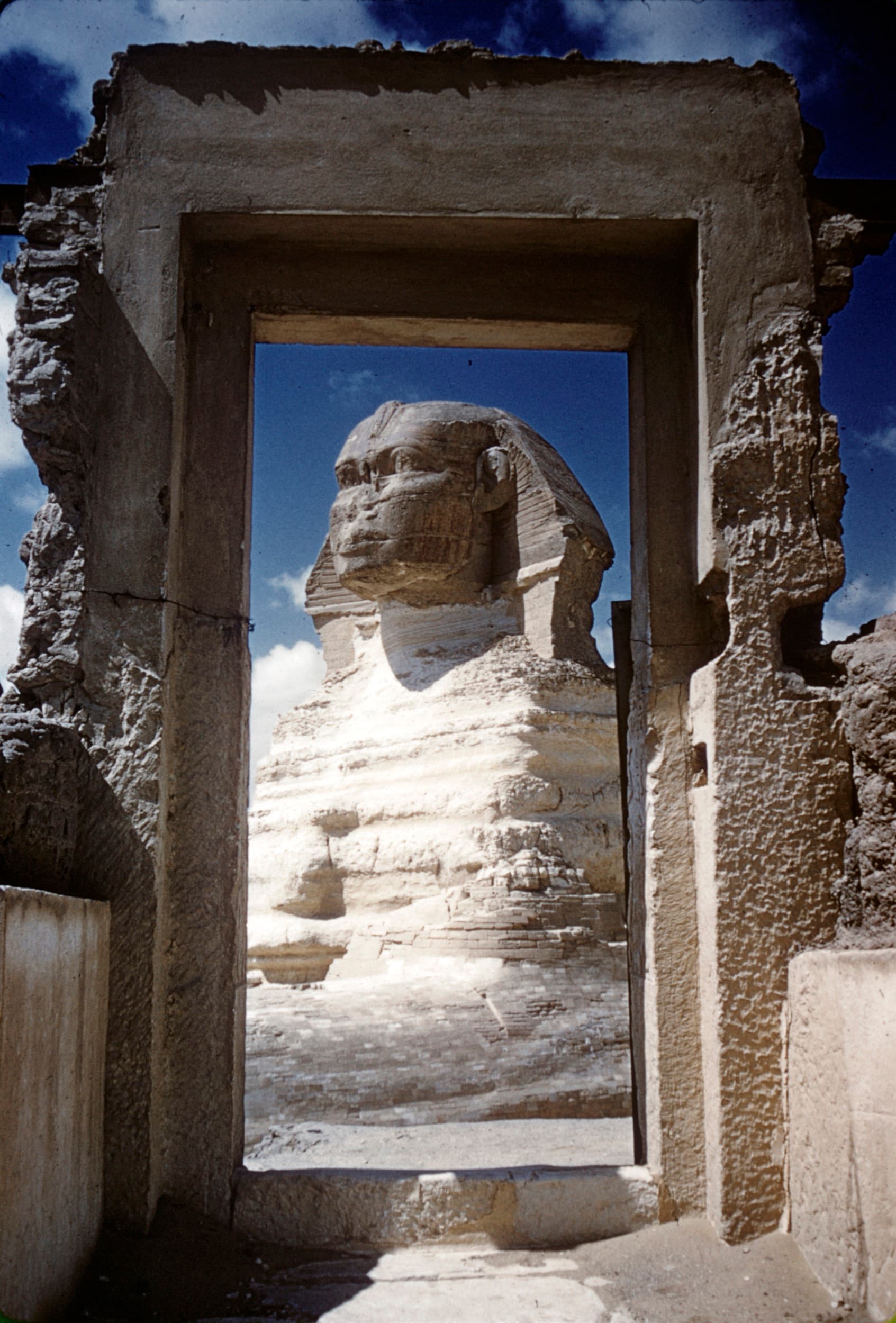
Ad Reinhardt, travel slides 1952–67. Courtesy the Ad Reinhardt Foundation. © Anna Reinhardt.
Word count: 790
Paragraphs: 6
What’s going on with Ad Reinhardt? According to him, nothing at all. This unstoppable polemicist, who makes a lasting impression with his mastery of language and his satirical drawings about art, constantly asserts that he is concerned neither with the passage of time nor with any place other than where he is: “There is no place to go.” He calls his slide projections “Anti-Happenings,” names his almost black paintings “ultimate,” and declares art history, on the verge of its global turning point and no longer providing any sense of wonder, to be over. Reinhardt undertakes a drastic reduction and compression of art and its history, but—and this is crucial—by devoting disproportionate resources to it, such as the thousands of kilometers he travels to prove that the history of art is finished. Reinhardt gathers, fixes, and spatializes time. And as long as he is alive, he is going on.

Ad Reinhardt, travel slides 1952–67. Courtesy the Ad Reinhardt Foundation. © Anna Reinhardt.
This begins in 1944 with his student notes at the Institute of Fine Arts, where Alfred Salmony’s lectures on Asian art require him to develop a system of notes capable of containing the vast amount of information imposed by this extensive spatiotemporal scale. His notes on art types, formal categories, periods, places, and materials lack verbs and gradually resemble lists. Composed of a plethora of common and proper nouns, these lists store data for memory, but also allow detachment and mobility. Reinhardt’s consistent and regular handwriting eases this equivalence of meaning. Freed from formal learning and practiced continuously until the very end, the list becomes the workshop of his language: both tool and matrix, it sections and assembles its modular units, exploring all possible combinations, with minimal syntactic structure and punctuation. This regular and often particularly demanding training allows Reinhardt to accumulate abstract concepts and evocative words, to form lexical fields, to generate or accelerate ideas, and to forge a formulaic style. Reinhardt moves from words without sentences to sentences without text. Sententious, the latter are quoted from the very first time they are written or uttered: they anticipate the memory of the future and rival the wisdom of the past.
This continues with his slides of archaeological sites in the Northern Hemisphere, as formulaic as his sentences. Each one is original, but taken together, they become monotonous due to their schematic and ostentatious resemblance, their sheer number, and the resulting length of the slide lectures. Purely paratactic, with no more syntactic cohesion than his lists, the sequences can last up to three or four hours yet disclose no development. Prioritizing detail over the whole, each unit sections, flattens, compresses. The sky and the motif, the empty and the full carry the same weight; everything is linear and blindingly clear, all meteorological irregularities are banished. In a globe becoming a vast interior, every fragment of a monument framed by Reinhardt is treated like a museum piece. By forcing astonishing diversity into a kind of resemblance, he reduces art history to a tautology: “Art is art” is a concept-anagram, a self-contained cycle, the most concise formula imaginable. Reinhardt’s universalism is blatant, shocking to some. But as a Western invention, art history concerns only the West. Other civilizations have had the wisdom not to invent history. As the projections progress, the past becomes simultaneous, a retinal lag of the entire history of world art.

Ad Reinhardt, travel slides 1952–67. Courtesy the Ad Reinhardt Foundation. © Anna Reinhardt.
Finally, Reinhardt makes and remakes his “ultimate” paintings. Created slowly, through a patient sedimentation of layers, these reduced abstractions possess an indivisible transformability that belongs solely to the subject who scrutinizes them. Their uniqueness is not the progressive product of mechanical division, but the subjective and circular fact of an encounter, cut off from the world and from time.
“Going on” proves to be an energetic problem for Reinhardt, who expends a tremendous amount of energy writing thousands of lists, traveling thousands of kilometers, and painting essentially the same picture. As if the goal were to convert this thermodynamic energy and the heat it produces into different states of slowness and coldness, to prevent action, events, and false novelty. The museum and academic destiny of art transforms it into forms to be exhibited, taught, photographed, and stored. The conditions of art production and circulation in the postwar global world are converted into lists, slides, diagrams, cartoons, and texts. Through heightened mimicry, Reinhardt appropriates the “graphic reason” of Western modernity and—as Theodor W. Adorno would have put it—its deceptively similar coercive techniques, to empty them. But in his painting, there is only difference, spatialized in unique works. As the litanies about the end of history begin to spread in the West, he takes care to delimit the advent of posthistory to art. For everything else, history will go on, with its good and bad.
Maria Stavrinaki is an art historian and professor at the University of Lausanne, Switzerland.