Critics PageJune 2026In Conversation
David Reed & Amy Sillman with Molly Warnock
‘To continue painting’: James Bishop and New York
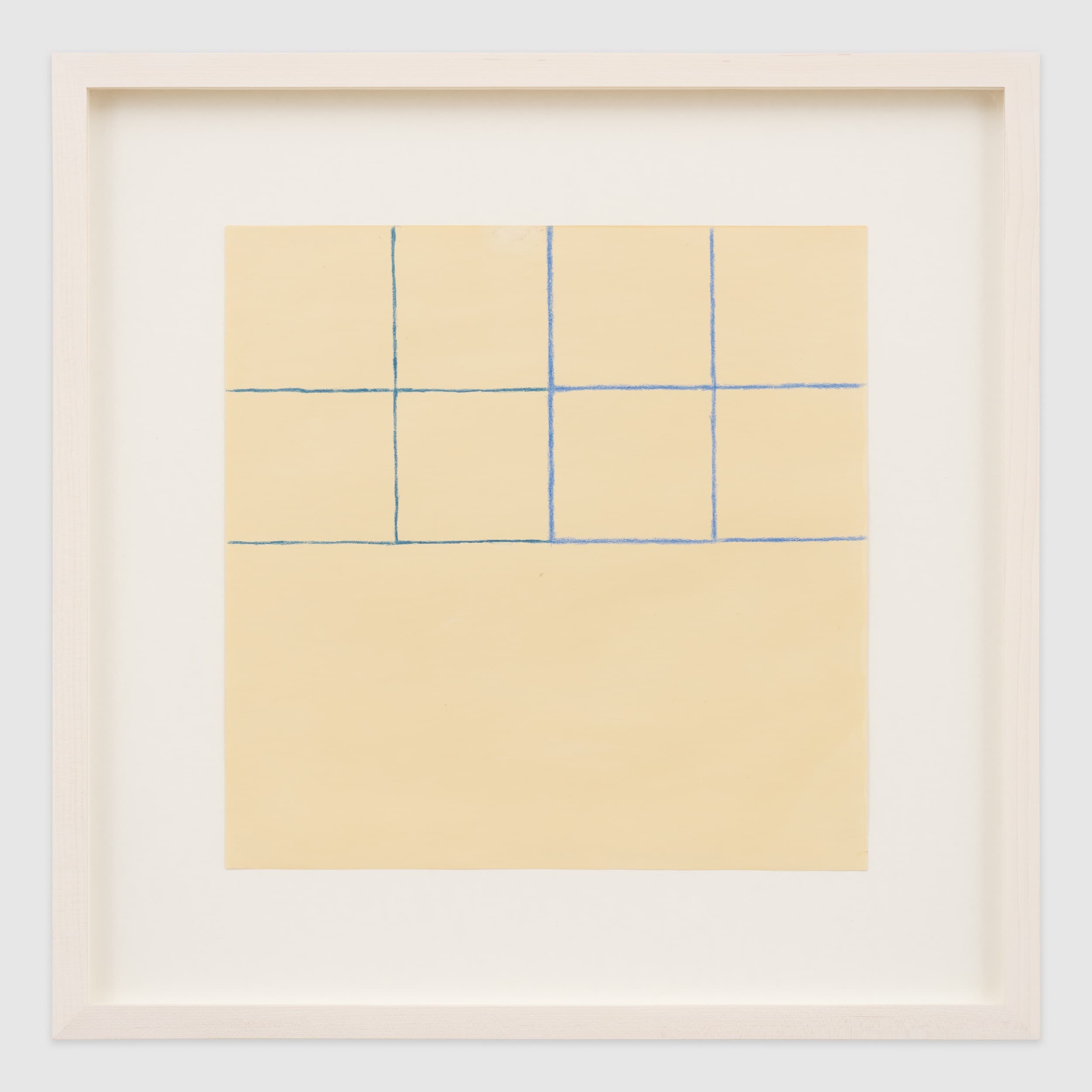
James Bishop, Untitled, 1969. Colored pencils on paper, 11 ⅛ × 11 ⅛ inches. Courtesy the estate and Timothy Taylor.
Word count: 2214
Paragraphs: 43
The following are excerpts from the transcript of a public conversation held at Timothy Taylor, New York, on January 28, 2026, during the exhibition, ‘To continue painting’: James Bishop and New York, curated by Molly Warnock. Excerpts have been edited for length and clarity.1
*
Molly Warnock: We are here tonight to think about James Bishop relative to developments in New York, and to consider his sustained commitment to the medium of painting during a period, the late sixties and seventies, of quite heteroclite artistic ferment. I would like to start by asking David and Amy to share their views of this period. David, you’re a student at the New York Studio School, and then you’re an emerging artist. Amy, you’re a student at the School of Visual Arts. How do you remember the perception of painting’s place, and what did it mean to you to continue painting in that context?
David Reed: When I first got to New York, I realized all the other art forms that I hadn’t been thinking enough about. I saw Merce Cunningham early on and decided that dance was the art form of the seventies. Going to see the performances was very important, and then from that, I started to see avant-garde theater. All of that influenced my painting. One of the things I love about Bishop’s work is that while he’s very much a painter’s painter, he’s interested in other art forms as well.
Warnock: I’ve heard you say that you feel that painting is a special medium in part because it can so readily absorb things from adjacent practices and disciplines. Was that your feeling already at this moment?
Reed: It’s always been my feeling that painting is very open to other mediums. Someone like Clement Greenberg thinks the opposite. Painting is a form that’s open to experimentation and can take in anything that comes near it and make it part of painting. I love that it’s open in that way.
Warnock: Amy, was this also your impression?
Amy Sillman: My impression was that painting was dead. I was told that repeatedly. David and I are slightly different ages and I think that decade accounts for a pretty profound swing. And David was important because people I know who went to school to study with David learned that painting wasn’t dead and was this porous receptacle. But I was told very specifically, you can’t paint, you shouldn’t paint, you won’t paint, and you’ll be a waitress if you try. But the funny thing was that all the kids in the rock and film and poetry worlds were doing this thing that seemed pretty Expressionist. You know, like, no painting, certainly no Expressionism, God forbid. But then, hey, we shoot from the hip. We make Dziga Vertov-inspired films. We play crazy music really loud. The language around painting was very prohibitive, but the language was very not prohibitive in fields like experimental film, video, music, sound, dance.
Warnock: This all helps to expand our sense of what was on offer to painters during the late sixties and seventies. When we talk about James Bishop, there’s a tendency, to which I have contributed, to zero in on his relationship to Minimalism, which is clearly important. But he’s also looking at a lot of other things with which we don’t typically associate him.
Let’s return to Merce Cunningham and the importance of dance, because I think Cunningham is a key figure for Jim as well. When Jim is at Black Mountain College in the summer of 1953, when he goes to study with Esteban Vicente, it’s the first summer that Cunningham has his company together. Jim told me that his favorite thing to do was to watch the rehearsals of Merce and his dancers.
I’ve always felt that Jim was very attentive to the idiosyncrasies of human embodiment that he saw in dance. In 1964, he titled a painting For Viola Farber. When I asked him about this, he said, well, you know, Carolyn Brown was always way up like this, and Viola Farber was always sort of hunkered down. And he mimed these differences physically.
We feel that sense of corporeality in his paintings, too. The form in the late painting in the back room (Untitled [1981]) is pulled by gravity; it’s centered within itself. The paintings are infused with a sense of the particularity of individual bodies and the forces that work upon bodies in the world.

James Bishop, Untitled, 1981. Oil on canvas, 76 × 76 inches. Courtesy the estate and Timothy Taylor.
Reed: You’ve reminded me that I saw Cunningham give some performances at Town Hall. He had a special program at five o’clock on a Friday, I think, for the workers in that area. He had his company come and do their rehearsal on the stage, so we got to see them do their exercises and see how each of them moved in a slightly different way. Then he taught them each a few steps for a dance, and we saw them each doing that, and then he put them together into groups. We saw him make a dance step by step. It was an amazing thing to experience, and I understood so much more about dance than I had before. It was a certain kind of process that I could see, and it had to do with normal kinds of movement.
Sillman: Like when Jim tilts and rocks the stretcher?
Warnock: That’s tricky because Jim never wanted us to fixate on the process, even though he does have a very distinctive painting technique.
As some may know, he’s working with extremely liquid oil paint that he’s thinned with turpentine. It’s in a receptacle, and he’s using a brush to transfer some of that medium onto the surface of a taut canvas that he’s placed horizontally on the floor, and then he’s lifting the stretcher bars to move the paint around the surface.
He made no secret of this process, which he was happy to describe in a straightforward way, but he always said it was the visual result that mattered. The method is just a means to an end. And he really wanted that formal, presentational quality of the painting that faces us and must be dealt with as a separate object.
Sillman: But maybe part of it is having to get away from Jackson Pollock and the mythic pouring. I mean, just this idea that it’s a kind of dance, tilting and picking it up from the floor. It’s off the wall, but it’s not Pollock, right?
Warnock: There I think we get into something important. When he talked about the method, he tended to say, “Well, I guess I was thinking about Helen Frankenthaler.” And we can feel the importance of Frankenthaler in Hours, from 1963, where he first uses this process in the central area. But what’s distinctive about his method is that it fully engages the resistance of that support in its physicality. When we think about pouring, it’s about gravity and the viscous material that is being guided and falls in a certain way. But the ground is down there—absorbing, being marked. Whereas with Jim’s process, he’s in constant contact with the support.
Sillman: Right. It’s a beautifully equilibrium-oriented kind of dance where you’re working with something, gently hoisting it. And at the same time, there’s a kind of seepage of the procedure into the painting.
I guess I was thinking about how that era of avant-garde dance embraced the everyday and a quality of facticity. You know, no princess and a prince, but the newspaper and some typewriters and ten movements that you make when you’re eating dinner.2
Installation view: ‘To continue painting’: James Bishop and New York, Timothy Taylor, New York, 2026. Courtesy the estate and Timothy Taylor. Photo: Erin Brady / Dan Bradica Studio.

*
Warnock: Let’s talk about painting and drawing in Jim’s practice. David, you said something that really surprised me the other day: that you much preferred painting, but Bishop was helping you to understand drawing in a different way. Could you say more about that?
Reed: I went to the New York Studio School, and we were taught a particular way of drawing. At the time, we didn’t realize how much it was based on Hans Hofmann and his style of Cubism. I was pretty good at it for a while, but it was of no use to me for my paintings, unfortunately, so I had to put it aside. It wasn’t until recently that I found ways of drawing within my painting that seemed to be mine, something I could use. By contrast, painting was freer for me. They could tell me how to make a drawing. They couldn’t tell me how to make a painting.
Sillman: Oh, that’s super interesting. I was exactly the opposite, because painting’s dead, but drawing’s not…. Nobody ever said drawing is dead. They also didn’t say that drawing is a bourgeois thing to do. All the critiques—the money, the power, the corporateness, the whole problem of painting—just weren’t located in drawing.
Drawings are small. They get stuck behind glass, but they’re not grand. Drawing is open for all. I don’t know how to think like a painter. I’ve said before that I think drawing is something you do with your paw and if your hand is this big, that’s about all you can hold. With painting, you have to have some kind of overview and think at least one step ahead, but in drawing, you can shoot from the hip.
Bishop is in the middle. He’s doing things that you can only do in drawing, where it’s totally tender, even diffident. There’s this sort of standing back that seems almost like a critique of painting. The paintings are also like drawings in that they’re made so personally. Tilting sheer layers on a surface you have to pick up isn’t something you can phone in. It’s almost drawing, and it’s so much about edges, even though there’s not a single line in sight except in the pieces of paper.
Warnock: Well, and these seams that he’s able to form with these mutual overlaps.
Sillman: But they’re not linear, they’re structural.
Warnock: Bishop always felt that drawing was the backbone of his entire practice, and his painting essentially reinvents drawing by creating new kinds of thresholds between forms. Drawing is no longer about cutting contours but dividing and inflecting extension.
And in many ways, especially after 1986, when he makes his last painting on canvas, the trajectory is back into work on paper. He always said that when he was working on canvas, he had to have a pretty good idea what he was trying to do—and then, having embarked on the painting, it had to be done in a day. Whereas with the drawings, he could surprise himself more. He didn’t have that projected concept that, of course, could change in the process of making, but had to be there to get the work going. He could also come back into the drawings in a way that he couldn’t come back into the paintings.
David, I know that you sometimes come back into paintings after long periods of not working on them.
Reed: Yes, I love that. Twenty years, thirty years on, I love to come back to a painting and work on it again.
Warnock: This is a medium difference for Bishop. It’s something that he can do in the work on paper, but not in the work on canvas.
*
Warnock: With Bishop, there’s always this sense of a statement that has restrained itself in a way. The paintings are saying and not saying in the same movement. But the feeling of a certain agitation under the surface, particularly in Limited, from 1971, is crucial to the work’s expressive effect.
Sillman: I think the thing about color with him is partly the intense suppression, the hint of presence and absence without withdrawing from color. Color is then even more important. And I think it’s not about almost anything except color at some points.
We were talking about it being partly about forgetting. It’s a weird mental state, like a slight oblivion. I feel like it’s partly about the time that it takes to make these paintings and the loneliness of the whole project and the mood of not quite giving. There’s only color or there’s only structure. That’s all that’s left.
Warnock: I think these are paintings that ask us to take the time it takes to get to know them. The scale is so much about our ability to share space and time with them. They don’t deliver themselves to us quickly. But I don’t think that they’re inherently withholding pictures.
Reed: No, I never feel that about them. They’re not withholding. They’re apparent if you spend enough time looking and noticing. A glance won’t give it to you, but if you spend time and figure it out, you do see something that surprises me always.
Bishop did some of his most refined and subtle paintings in 1969, the year that’s the most like the time we’re in now. And in a way, it fits for me that he did that. That by going in the other direction, it made the paintings more apparent, that they were about more than they appeared to be. And if you looked, you would find it.
- ‘To continue painting’: James Bishop and New York, curated by Molly Warnock at Timothy Taylor, New York, on January 28, 2026. https://www.timothytaylor.com/exhibitions/258-to-continue-painting-james-bishop-and-new-york/
- Cf. Bishop’s remarks in an essential interview of 1993. Asked by Dieter Schwarz whether he “accepted the use of chance strategies in Cage’s and Cunningham’s work,” Bishop responds: “I don’t know, I didn’t pay much attention to it … What interested me about Merce were the ‘natural’ as opposed to balletic movements. The chance procedures, I think that’s a little mechanical” (“Artists Should Never Be Seen nor Heard: James Bishop in Conversation with Dieter Schwarz,” in Schwarz and Alfred Pacquement, eds., James Bishop: Paintings and Works on Paper [Winterthur, Switzerland: Kunstmuseum Winterthur; 1993], 33).
David Reed is an artist. He studied at the New York Studio School in the sixties and has lived and painted in New York since the early seventies. He will have a one-person show at Rodder in New York in the fall of 2026.
Amy Sillman has lived and worked in NYC since the mid-1970s. She is best known for her rigorous formal engagement with painting and iterative drawings, and an excavation of form that lies between abstraction and figuration. She shows with David Zwirner.