Handoff
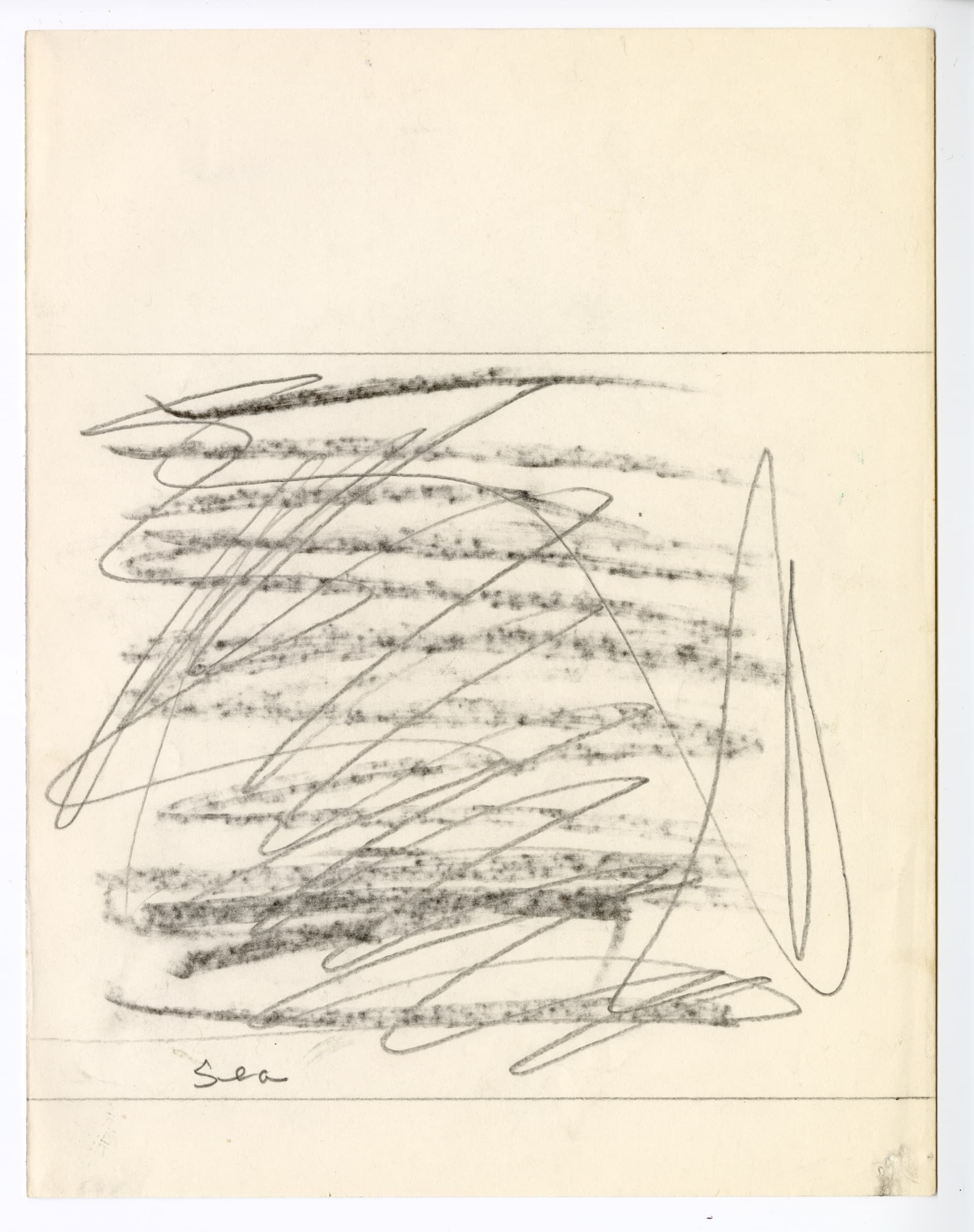
Sheet from Embers working portfolio, ca. 1980. Graphite and charcoal on paper, 10 ⅝ x 8 ¼ inches. Joan Mitchell Papers, Joan Mitchell Foundation Archives, New York. © Estate of Joan Mitchell.
Word count: 783
Paragraphs: 11
In the moment of handing off—work, a space, an idea, a baton—continuity and discontinuity must both be present. Alberto Giacometti often worked on one of his elongated, patched-together sculptures through the night. In the morning, if he thought it ready, he would hand it over to his brother Diego—whom he trusted as much as anyone on earth and who often did the work of creating the plaster mold from which the iron would then be cast—with the words, “Now it’s yours.”1
There were some nights in the late fifties and sixties when Alberto Giacometti, Samuel Beckett, and Joan Mitchell were all part of a group drinking and moving around Paris late at night. Although the youngest of the three, Mitchell was already an artist of significance, and the work of Beckett and Giacometti was helpful for her in thinking about abstraction, gesture, and condensed language.
Beckett and Giacometti likely met late in 1937. In the thirty years of their friendship, they had a shared routine. After working independently for much of the night, they met at a café to drink and walk the city. Apparently, they also often went to a brothel in the early hours, so that the work of sex workers was another aspect of their conception of nights and days. When Beckett asked Giacometti to do the set for the restaging of Waiting for Godot in 1961, the idea was a lone scraggle of a tree. Giacometti told the art critic Reinhold Hohl how he and Beckett had worked on it: “We experimented all night long with that plaster tree, making it bigger, making it smaller, making its branches finer. It never seemed right to us. And each of us said to the other, maybe.”2
We have hardly any correspondence between Mitchell and the two men, but we know she had an affair with Beckett and that Giacometti’s practices went on being part of her thinking after his death in 1966. In 1968, Mitchell established herself at her stone tower house in Vétheuil. There, through the nights, she mostly painted huge canvases with varying, improvisational strokes, often on several panels that required working across breaks. Time is different at night, the hours are less marked by changes in light and sound. At the end of her night’s work, Mitchell would write to the young artists she liked to have stay with her, giving directions about how they should walk the dogs or look out for glass she had broken. One autumn, she suggested the painter Bill Scott use her studio in the morning hours while she was sleeping; he would leave before she came back mid-afternoon to look at her own work in daylight. “Sometimes Joan would come into the studio a little early, while I was still there,” Scott told me. “We’d talk about my watercolors and her paintings.”
In a relay race, the handoff is crucial, a dropped baton is a lost race. The handoff must happen while both runners are running, ideally as fast as possible, and the challenge is synchronizing the speed and gait of the end of one runner’s race with that of she who begins the next. The baton is the concretization of action and momentum going across.
I think both Giacometti and Mitchell were unusually able to convey the at-workness of deciding and hesitating, going back, doing again. Studying Giacometti’s stringy, condensed bronzes, or his erased and redrawn works on paper and canvas, or going over a Mitchell painting and seeing the varying disposition of similar colors on neighboring panels, you can feel a rhythm of work. Were they unusually able to make this legible because they also practiced handing off at the end of their studio nights? Or is it clearer to think that it was natural to them to collaborate through and across spatial and temporal dimensions, and that this is manifest both in their studio practices and in the work itself? Handing off, sending activity to go on in another form, as in Beckett’s well-known lines: “I can’t go on. I’ll go on.”
Mitchell worked deeply with poetry, and one of her unfinished projects was around a copy of Beckett’s radio play Embers, first broadcast in 1959. In the Mitchell archive are pages where someone marked with pencil lines the typeset Beckett lines. Hearing and seeing, to see, the sea as sound, struggle across pauses and line breaks.
(Pause.) Nothing, all day nothing. (Pause.)
All day all night nothing. (Pause.) Not a sound.Sea.
In one place, Mitchell has rendered a rhythm in scribbled abstract lines, then a break, then a hand-written word that does not appear to be in her writing, so who else was there: Sea.
- “Diego et Alberto,” Fondation Marguerite et Aimé Maegt. https://www.fondation-maeght.com/diego-et-alberto/
-
“When Alberto Giacometti met Samuel Beckett,” Tate. https://www.tate.org.uk/art/artists/alberto-giacometti-1159/when-alberto-giacometti-met-samuel-beckett
Rachel Cohen, professor of practice at the University of Chicago, is the author of three books including A Chance Meeting: American Encounters, reissued by New York Review of Books Classics. She is currently a fellow at the American Academy in Berlin researching her next book, Time in Pieces: Artists at Work.