The Expressionist, As Practiced
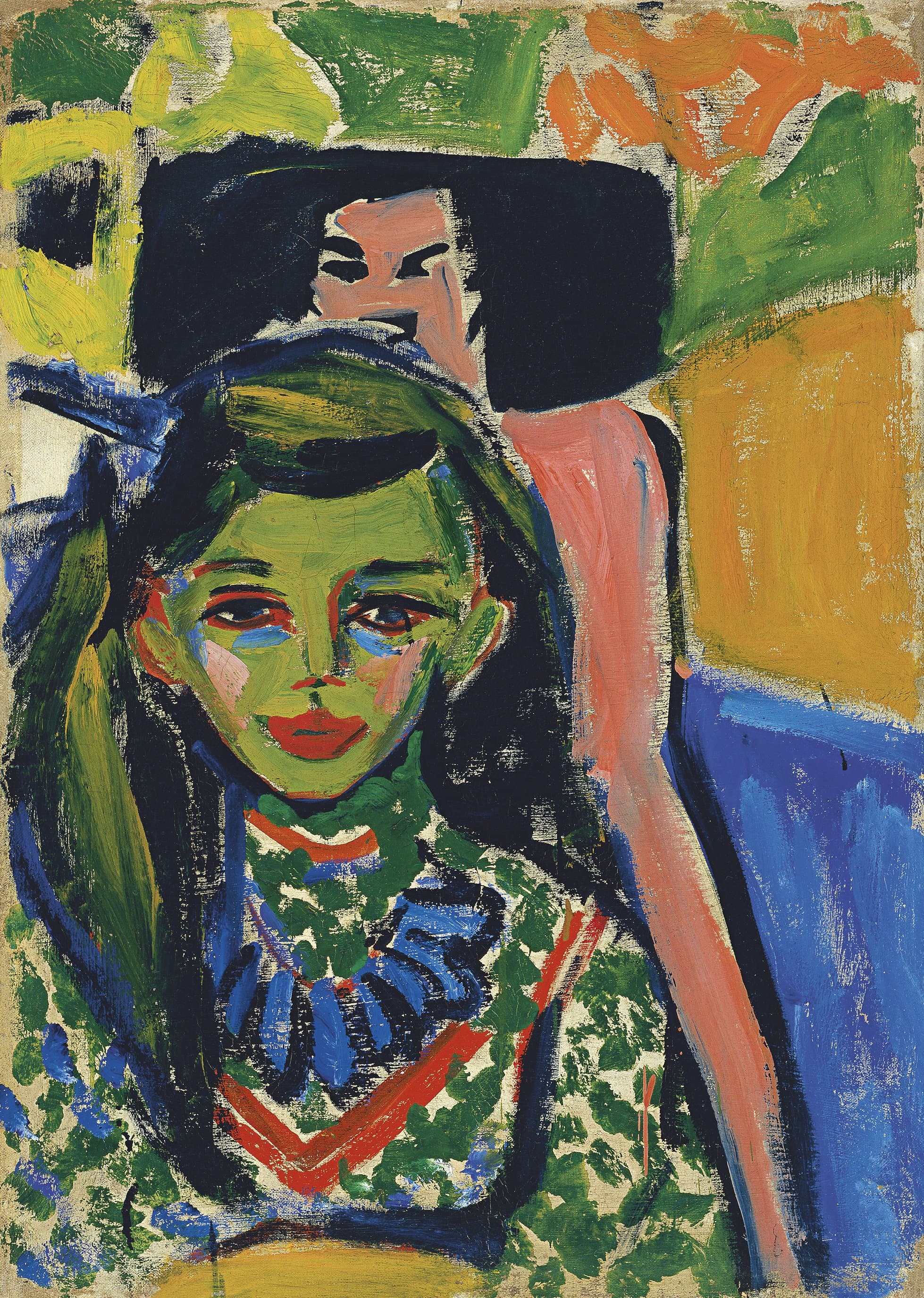
Ernst Ludwig Kirchner, Fränzi in front of Carved Chair, 1910. Oil on canvas, 28 x 19 ½ inches. Courtesy Museo Nacional Thyssen-Bornemisza, Madrid. © Museo Nacional Thyssen-Bornemisza, Madrid.
Word count: 797
Paragraphs: 8
Just what is individual about an artist’s practice? In art talk we are used to possessive locutions: your practice engages, my practice deals with. Yet so much of modern and contemporary art, at least, is predicated on other forces intervening in the creative act. The rules of a score, the shape of a canvas, the properties of a material—all such factors have historically assumed some responsibility when an artwork is made. And less tangible determinants can be in play: the weight of tradition, the impulses of the unconscious, the calculations of taste. Seen as a co-production with these outside elements, artistic practice approaches the broader sense of the word. You practice scales, drills, choreography, and vocabulary; you accommodate strictures, demands, and expectations beyond the singular self.
Art history, however, has typically reserved a space for a very personal sense of practice. It tasks the movement generally known as “Expressionism” with providing safe harbor for the true individual. In Expressionist practice, the cliche goes, the artist extrudes their ipseity through painterly gesture, impassioned action, and force of stylization. They convey their unique experience of the world; they express what they feel deep inside. So construed, the Expressionist has also become an art historical fall guy; he believes in the integrity and inviolability of the self, even as modernity proves all that impossible. The Expressionist’s art, typically painting, is a flat essence ripe for mediation by more advanced art via montage, the readymade, and photographic reproduction, among other strategies.
To be sure, this kind of periodized conflict belongs to an old historiography, one now challenged primarily by scholars of Fauvism and mid-century American painting. German Expressionism, however, if we stick with Euro-American art, remains recalcitrant to revisionism. Not quite critiqued and not quite deconstructed, it frequently becomes synonymous with a tonally overwhelming modernity tout court, with all the heightened affects of cities, sex, and industrialization. Yet returning to the premises of German Expressionism reveals something about the operative chiasm between personality and impersonality in ostensibly the most individualized of artistic practices.
Take, for example, the writing of the critic Max Raphael, recently available in English translations by Patrick Healy. Working in Berlin in 1911, Raphael had to make sense of new art by figures like Henri Matisse and Ernst Ludwig Kirchner appearing in the city’s galleries. He had been used to seeing paintings affiliated with Impressionismus, but something opposite was happening—what he could only call, likely borrowing from French, Expressionismus. As he writes in the essay “Expressionism,” Impressionism in painting had slackened into the ceaseless recording of optical phenomena. This leads to “subjective arbitrariness,” merely one person’s way of seeing things, when art in fact always needs a “regulative hindrance” and an “architectonic structure,” per some heady terms from fin-de-siècle German art theory. Enter the Expressionist, who must raise all formal variance into a “clear, simple and necessary concept.” This artist generalizes different visual perceptions into a coherent formal whole. Their capacity to affectively structure, not just emote, is what allows for an artistic experience.
Thus, at its very point of inception, Expressionism theorizes an artist not screaming into the void but adjudicating the flux of phenomena. Raphael stitched a thread that would run through much German criticism. For art historian Wilhelm Worringer, Expressionism followed a distinctly German “will to system.” The critic Rudolf Kurtz likened the work of such a “constructive spirit” to “great economic systems” merging into a “centralized structure.” Or look at the paintings themselves: in many of Kirchner’s emblematic works around 1910, for example, individualized, emphatic gestural marks funnel into coherent, bounded segments. His art more often organizes than unleashes forms.
Except, Raphael also theorized the exact opposite. In another essay from 1911, “Painting and Personality,” he insists that “one does not describe the birth of a new [work of art] with impersonal expressions; not ‘it’ and ‘one,’ but ‘he’: the artist.” So much for the dispersed drive of Expressionism: the individual is the absolute origin. But Raphael admits that when we actually look at a painting, we can’t distinguish between perceived “personality” and “desired painterly sensation.” Does personality generate forms? Or do forms create a personality? For Raphael, all art toggles between “individual particularity” and the (impersonal) generality of form; an aesthetic subject coheres only in the embrace of this generality. Art proffers the notion of a personality, one equally special and generic.
Herein lies a well-worn art historical maxim: selves are created in the moment of practice and in the perception of said practice, with all the externalities that practice inevitably entails. Expressionism suggests that this self is ultimately felt as distinct, even if it’s inextricable from the broader forces that shape it. For many, that’s an aporia one inhabits just to get out of bed, let alone walk into the studio.
Joseph Henry is a research associate in the Department of Modern and Contemporary Art at the Metropolitan Museum of Art.