Romantic Futures After the End of Art
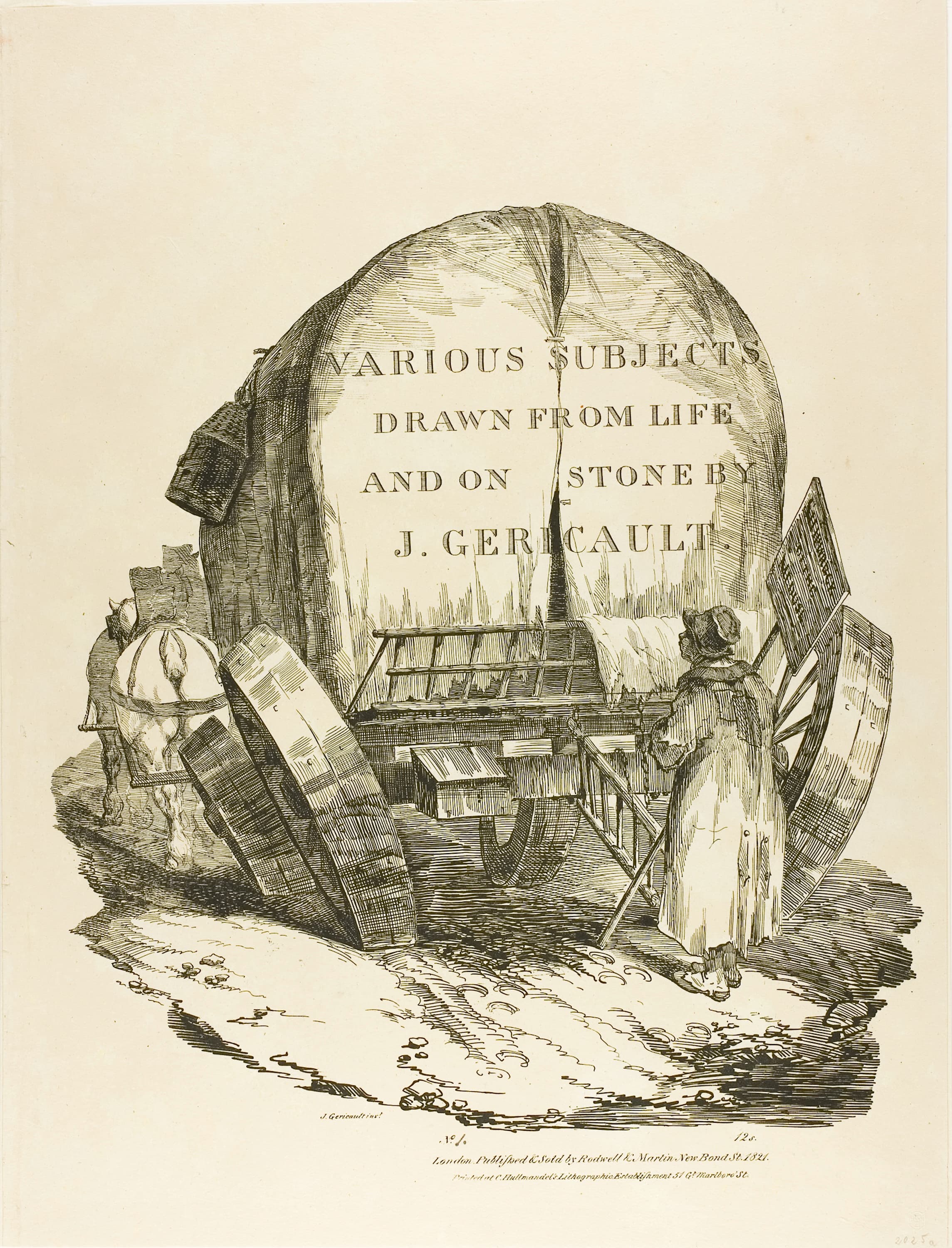
Jean Louis André Théodore Géricault, A Horse-Drawn Wagon, Title Page for Various Subjects Drawn from Life and on Stone (The English Suite), 1821. Bi-fold portfolio cover with pen-lithographed title page in black on buff wove paper, 14 ⅞ × 18 ¾ inches, printed by Charles Joseph Hullmandel, published by Rodwell and Martin, Art Institute of Chicago.
Word count: 786
Paragraphs: 8
“Modernist art continues the past without gap or break, and wherever it may end up it will never cease being intelligible in terms of the past.” According to Clement Greenberg, whether this going on succeeds is determined by art’s relation to the past. In contrast, Romanticism saw the work as a fragment that creates and even demands the possibility of its future completion. For the young Friedrich Schlegel, going on meant affirming a radical break to create an art that also renews life. But Romanticism also gave rise to the idea of an art that makes it possible to go on beyond the deep ruptures of modernity, one that lets painters experience their lives as possessing an inner coherence.
Inspired by Schlegel and early German Romanticism, Philipp Otto Runge saw the future of a “new art” in a “landscape painting” that would usher in a “beautiful era” in which we all would become children again. Though he believed that he would not live to experience this new beginning, he tried to prepare it in landscapes depicting his own life. By contrast, William Hazlitt understood painting as an activity that fills life with earthly happiness already in the here and now. Painters are happy because after every work—indeed, even during every work—they want to continue painting. As one can read in “On the Pleasure of Painting” (1821): “Who would wish ever to come to the close of such works,—not to dwell on them, to return to them, to be wedded to them to the last?” The artist’s desire never to come to an end does not entail despair and madness, as in Honoré de Balzac’s “The Unknown Masterpiece” (1831), but “delightful never-ending progress to perfection.”
Runge and Hazlitt also had different interpretations of the decisive historical upheaval of their time. Runge’s renewal of art was directed against the French Revolution and the ensuing wars; while for Hazlitt, the individual happiness to be found in painting kept the promise of the Revolution alive. But they agree on one point: the ultimate reasons for going on come from the future.
This orientation toward the future likely also stems from the fact that both write from the perspective of the painter, which was Runge’s actual vocation and Hazlitt’s first. While the public recognizes a new painting’s relation to the works of the past—which can be viewed as desired thanks to the establishment of museums—artists must above all be interested in whether their finished works open the possibility of future ones. This question becomes even more pressing when art seems to have come to an end.
Théodore Géricault had this feeling when he wrote from London in October 1821 to tell a friend in Paris that he was giving up history painting. He had just undergone a bitter experience: After the French state failed to purchase his The Raft of the Medusa (1818–19), he had been forced to ship it to London so he could exhibit it there for an admission fee. He saw his future in a new art: small-format lithographs. In 1821 he published Various Subjects Drawn from Life and on Stone, a portfolio of twelve prints depicting draft horses, blacksmiths, and the poor of London. The frontispiece presents a horse-drawn cart with the title of the series and the author’s name written on the tarpaulin. Accompanying the wagon is one of the poor vagabonds that appear in the lithographs. Gazing absently at the tarp, he carries a sign with an inscription: “The Shipwreck of the Medusa.” Apparently, the wagon moving away from us is loaded with Géricault’s monumental painting.
This can appear an ironic reference to the prosaic path Géricault intended to take after turning away from history painting. Yet, as has often been emphasized, Géricault imbued his lithographs with a certain monumentality. They depict the routine processes and chance events of the modern world as scenes in which people appear no less deeply moved, no less deeply immersed in their actions and suffering, than the figures in the exemplary events of history painting. Seen in this way, the frontispiece offers a clue as to how the artist was able to discover the art of the future in The Raft of the Medusa.
Even as that monumental work continues to guide his depictions of action and suffering in the modern metropolis, Géricault moves the human and animal labor required to transport and exhibit this heavy object to the center of his depiction. At what appears to be the end of history painting, he continues to pursue the genre’s great subjects—human action and suffering—in a new art. But he makes this ambition depend on bringing the material conditions of art into view. Going on becomes a critical practice.
Translated from the German by Anthony Mahler.
Ralph Ubl teaches art history in Basel. His recent publications include essays on Eugène Delacroix, Max Klinger, and Jeff Wall.