Going On
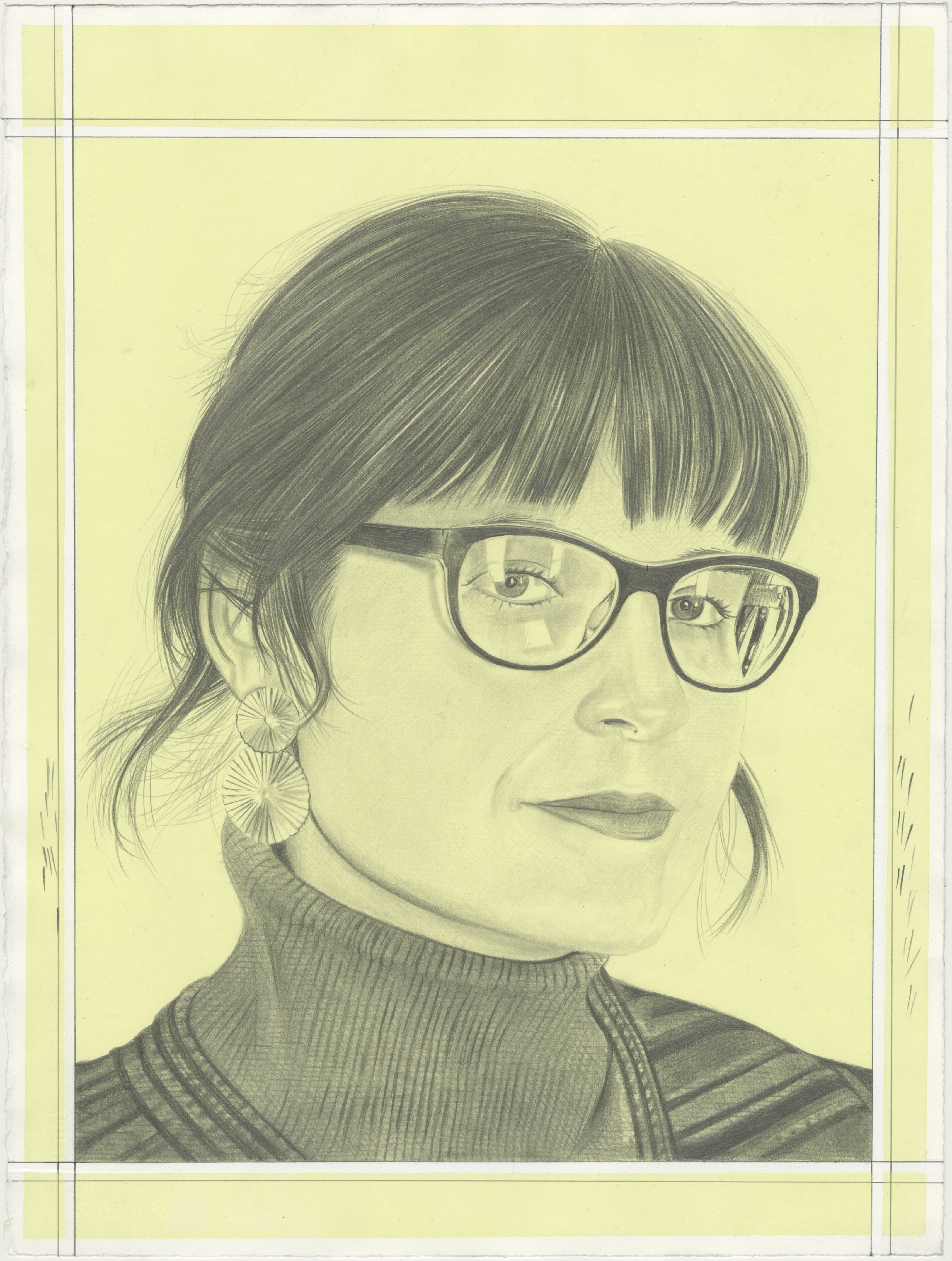
Portrait of Molly Warnock, pencil on paper by Phong H. Bui.
Word count: 523
Paragraphs: 7
“What makes a baker good at his job? He gets up, he gets to work—like everyone else.” It was April 25, 2006—a Tuesday, the day reserved for our weekly meetings in the Rue Georges Braque—and Simon Hantaï was telling me about Peinture (Écriture rose) (1958–59), the immense painting (now at the Centre Pompidou) that he created over the course of an entire year through daily acts of copying guided by the Catholic liturgy. The veritable linchpin of his oeuvre, the work differs decisively from his prior gestural abstractions. Previously, he had sought to “exit ordinary experience” by operating as rapidly as possible in a trance-like state; now, he labored steadily every morning, transcribing texts in minuscule script. Systematically liquidating an approach to painting he no longer trusted, the experience freed him to go on otherwise. Pliage, the new medium he developed in 1960 and continued to practice into the 1980s, was that going on.
I have written elsewhere, and at length, about that adventure. Suffice it to say here that Hantaï’s lifelong commitment to painting as a continually self-renewing enterprise remains an essential touchstone for my thinking, even as I’ve gone on myself to explore a broad array of very different bodies of work. His twisting, endlessly surprising itinerary serves to remind me that a given practice is always something more and other than its material bases and defining techniques; it is constituted at least equally by recognitions, acknowledgments, and convictions—as well as refusals, disavowals, and reconsiderations. Practices are riddled with—and often driven productively by—ambiguities, contradictions, and uncertainties. They are inevitably bound in real or imagined shapes of selfhood and community, enmeshed in the terms of our mutual facing and exposure.
For this Critics Page, I have invited contributors to reflect on practice beyond the horizon of the individual artwork, as a shifting composite of behaviors, procedures, and conventions that enables work to happen. Practice, for the purpose of this feature, is therefore envisioned in its temporal extension, indeed everyday-ness. A telegraphic overview of “topics of particular interest” shared with participants included the following:
Artistic practice as a paradigm of agency or comportment in a larger sense, a way of thinking and being in the world; moments of concerted regrouping (the deliberate alteration of existing procedures or the imposition of new ones); the philosophic implications of different models of continuity and discontinuity; and the interplay between the durational act of making, quotidian temporality, and broader histories.
Ranging from early-nineteenth-century Romanticism to the present day, the responses gathered here are remarkably diverse. Case studies by art historians, critics, and authors alternate with first-hand remarks and reflections by practicing artists. As with Hantaï’s account of the advent of pliage, one recurrent theme in the following contributions is the intimate relationship between going on and the sense of an ending: of history, of art, of painting, of the possibilities afforded by a specific way of working, or simply of a discrete session. Another theme, less immediately apparent but no less important, is the quiet hopefulness of practice, its essential openness to a future that remains unwritten.
All the participants have my deepest thanks.
Molly Warnock is an art historian and critic. The author of Simon Hantaï and the Reserves of Painting (Pennsylvania State University Press, 2020), she has written widely on modern and contemporary art. At present, she is the director of the Clyfford Still Catalogue Raisonné Project at the Clyfford Still Museum in Denver, Colorado, where she oversees the preparation of the painter's five-volume Complete Works and related research, curatorial, and publishing initiatives.