One Day After Another
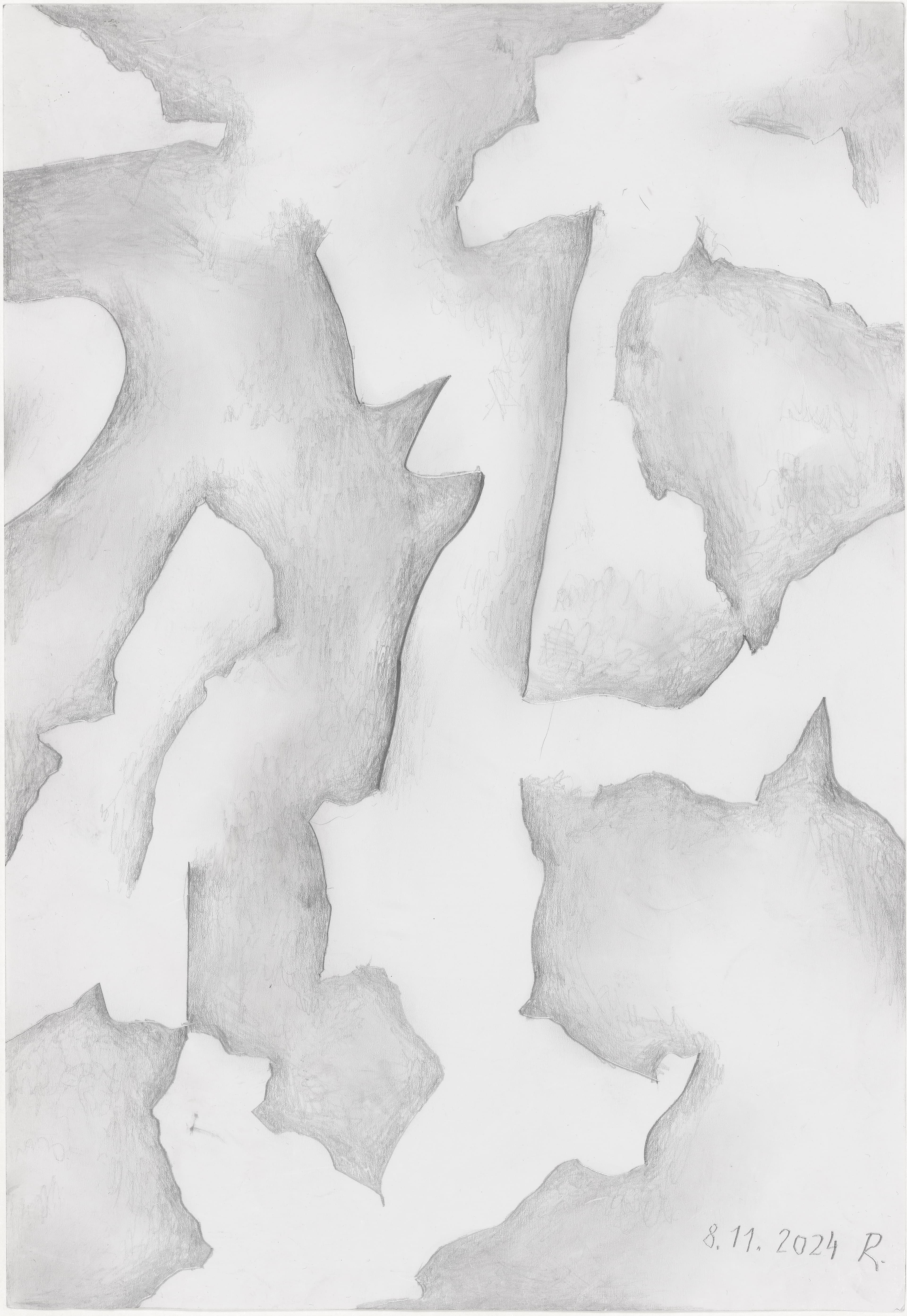
Gerhard Richter, 8.11.2024, 2024. Graphite on paper, 7 ⅖ x 5 inches. Private collection. © Gerhard Richter 2026 (05052026). Courtesy the artist.
Word count: 738
Paragraphs: 7
Whenever I visited Gerhard Richter in his studio in recent years, new drawings always hung on the walls, matted and framed (he had stopped painting in 2017). Before conversation even began, one would look over the new work, marveling at the variety of inventions and at how he managed to unfold them within the modest format of letter paper. “That’s it for drawing,” Richter would insist each time, and when one called to arrange the next visit, he would repeat that he had nothing new to show—and yet new sheets would be hanging there again. “That’s it”: a phrase that actually meant, “it goes on.”
Each drawing received a date alongside the signature, as had been the case in earlier years. In 1982, Richter had begun dating his drawings, since titles—as with the abstract paintings—were mostly a makeshift solution. The paintings he had numbered from 1962 onward, thereby starting an open-ended series of works in which the notion of a masterpiece had no place.
The dating was more than a means of distinguishing one drawing from another; it pointed to the moment of making and situated the drawing as a reference point in the continuum of lived and working time. In the exhibitions where Richter showed his new drawings in recent years, they were hung on the wall in sequences, strictly following the dates. As one looked at the sheets, one inevitably began to read the dates as well. When a sequence ended, one wondered what had happened afterward. Was there a day without a drawing? What did the gaps mean, before work resumed? Did they count only in relation to the drawing days that followed?
The date replaces inspiration; for the work, it means being present, still being present. The date is the arbitrary gesture par excellence, without content, prejudice, or form. It does not repeat itself and can be linked to events only in retrospect. The date neither conveys objective facts nor reveals anything personal. It goes hand in hand with the decisions that chance provokes in Richter’s drawing—in the scribbling of lines, in the pouring of inks—and it sets their limits.
For me, work on the Richter retrospective for the Fondation Louis Vuitton in Paris overlapped with preparations for a book on Sol LeWitt’s drawings. How does one do justice to this subject? First, by modestly attempting to gain an overview of a five-decade œuvre—that is, by understanding the sequence of the drawings. It soon became clear that LeWitt, during the years in which he invented and developed a new type of drawing, mainly from 1971 to ’76, inscribed each sheet with the date of its making. What was new about the drawing was that LeWitt understood it as the manifestation of an idea. Some ideas could be realized as drawings and as wall drawings, some in three dimensions as structures—in any case, the executions were equivalent, no hierarchy involved. Ideas were not abstract discourses; they encompassed a number of parameters from which actions could be derived—lines in particular directions, singly or layered, straight, non-straight, or broken; circles; arcs from sides and corners; then colors, singly, side by side, or one on top of another. On a given date, LeWitt decided on certain parameters and on the manner of their use; the next day he would vary them, and so on. The title simply described the parameters and thus produced a visual idea. In his journals, LeWitt noted his decisions in abbreviations and graphic marks. Viewed day by day, these entries read like a litany, a diary without any intimacy, yet persistent and insistent; without content or goal, yet steadily attentive to activity. What need is there for inspiration when there is an idea to hold on to? This idea does not restrict; rather, it opens an infinite field of thought and action. On May 1, 1973, LeWitt wrote a postcard from London to his mother: “Tomorrow I will do the wall-drawings. They are very simple—so they require much thought.”
To proceed day by day, holding to the dates and to nothing else, is reliable. As Richter said to me in 2017, in a conversation about the work of his colleagues Carl Andre, Sol LeWitt, and Robert Ryman: “It was so wonderfully unsentimental, far from any despair over the end of painting, far from any sensationalist self-importance, and instead these elementary forms, presented so radically, pointing to what truly matters. That is very hopeful.”
Dieter Schwarz, formerly director of Kunstmuseum Winterthur, Switzerland, is an independent author and curator, living in Zurich.