Word count: 1838
Paragraphs: 23
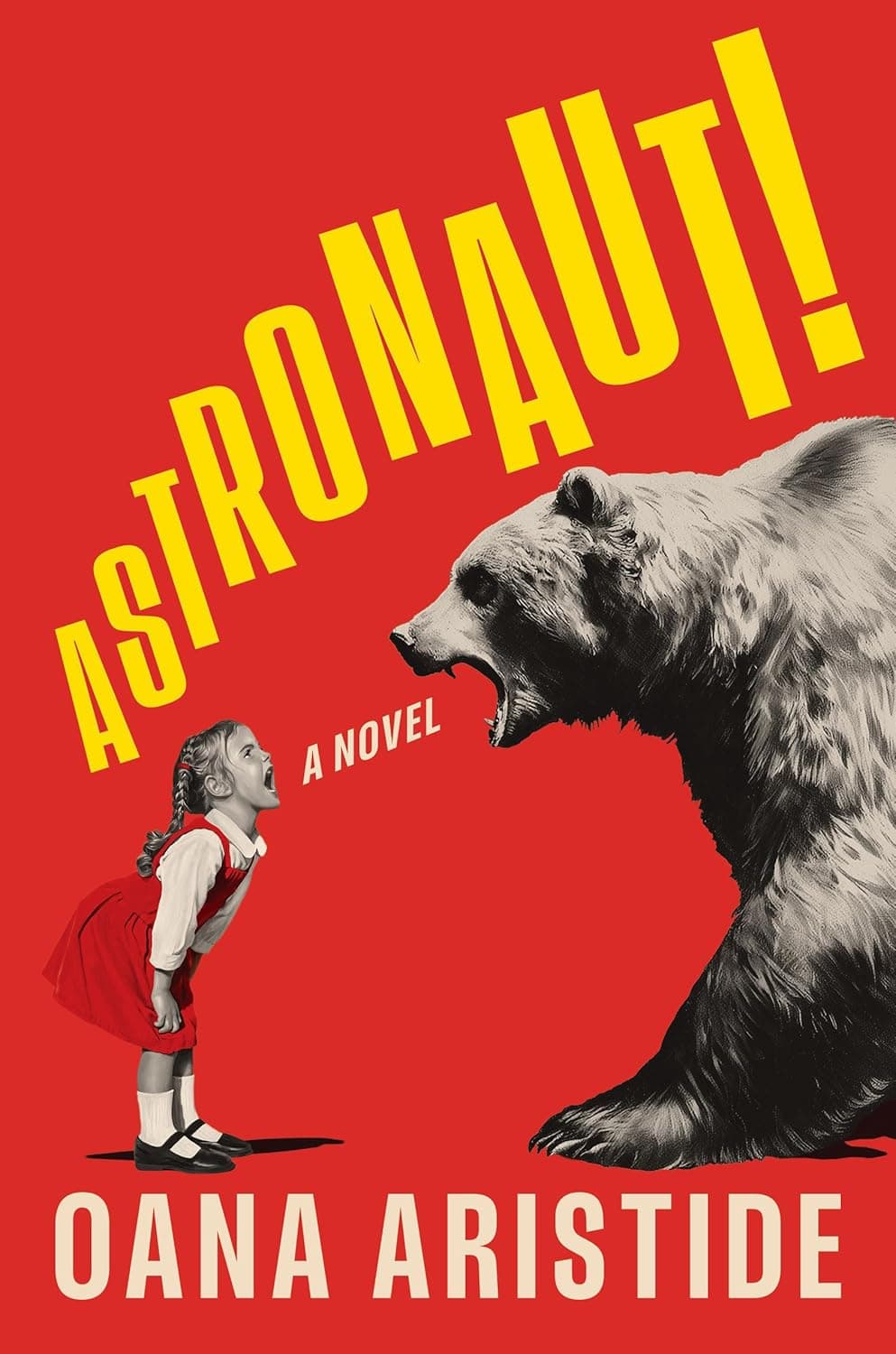
Astronaut!
W. W. Norton, 2026
Oana Aristide’s Astronaut! is the kind of novel that knows exactly what it’s doing without making a show of it. It moves in a calm, almost matter-of-fact way, while the world inside it keeps slipping sideways into something funnier, sadder, and more menacing than it first seemed. What stayed with me most was how easily absurdity and dread can live beside each other, and how a child’s point of view can make a damaged reality feel stranger, sharper, and less settled.
There is nothing dutiful about the novel’s relation to history. Aristide does not present the past as a sealed exhibit to be interpreted at a safe distance; she gives it back as atmosphere, rhythm, misapprehension, appetite, and fear. The result is a book that feels uncannily lived rather than arranged, alert to both the comedy and the humiliation of ordinary life under distortion. In the conversation that follows, Aristide speaks with remarkable precision about fiction, memory, and the problem of seeing clearly inside a world built to interfere with perception.
Jonathan Daniel Gardner (Rail): Because your relationship to this world is both personal and historical, I’m curious what fiction opened up for you that another form might not have. Did writing the book change the way you think about memory at all—whether that’s personal memory, family memory, inherited memory, or even the stories a country starts telling once a regime is over?
Oana Aristide: I’m always very careful to say that Astronaut! is a work of fiction. Autobiography feels a bit like sworn testimony by an inherently biased witness, and if you’re a novelist it’s worse—your job is to shape narratives and cherry-pick events and perspectives. I worry I’d be committing perjury in the first paragraph. But I also suspect that the novel is “more me” than a memoir could be, because it combines what happened with my experience of it. The events, the context, are the raw ingredients. In fiction, the world gets it back cooked.
Almost everything in the public space is at headline level, and personal experience is not that reductive. For instance, I profoundly hate totalitarianism, and yet I was a happy child under it. The headlines are right in general and wrong in particular, and fiction can gesture at that without inviting a verdict.
Rail: I was really struck by how the book carries so much historical pressure without ever starting to feel like it’s explaining itself to the reader. The setting stays lived-in and specific rather than turning into context or instruction. How did you maintain that balance on the page?
Aristide: Thank you, I’m glad to hear that. I think a writer needs to adopt a kind of benign arrogance, in the way reality is arrogant—it just shows up and fully expects us to buy what it’s selling. Self-doubting fiction pesters readers with explanations and facts when readers want nothing to do with facts that aren’t mediated by the characters. Their only factual requirement is that the context be understandable. One of my favorite historical novels is The Beginning of Spring by Penelope Fitzgerald. She’s not Russian and has never been to 1913, but the world she describes feels whole and real. There’s not even the whiff of a reference book in her characters’ lives.
Take the business of how badly we were underfed in Nicolae Ceaușescu’s Romania. I remember being served a whole chicken leg at some point shortly after 1989, the thigh and drumstick together, and refusing to touch the monstrosity. We rarely had meat, and then only in tiny portions, and so to me a chicken leg was a drumstick if the chicken was thin, and a thigh if it was fat; duh. There was no way anyone could convince me the thing on my plate in early 1990 wasn’t cat. But, for the purposes of the novel, the truth is I wasn’t aware of the food issue at the time. It only surfaced as a problem for me via queues and adults’ obsession with making me eat stuff I didn’t like, and so putting it in the novel directly as “we were underfed, we were allowed this much meat and this much oil” would have been beside the point.
Rail: I tend to think that a big story needs a smaller one inside it to keep the reader grounded and to carry the human thread. I really liked the way the novel moves on three tracks at once—the investigation, Lia’s story, and the much larger political story pressing on both. How did you think about those three narratives working on each other?
Aristide: I absolutely agree. With big stories, the risk is that the reader will feel they’re being told “this is important, pay attention,” whereas placing them alongside smaller stories achieves a more organic effect. The approach is old and rich with possibilities; the contrast between large and small can itself be the story. In my case, I realized partway through writing Astronaut! that Lia without Constantin results in an unbalanced book. Adults bore the full force of totalitarianism, and their experience of it is very different from a child’s. Showing only Lia’s perspective would have made it a much narrower story.
Rail: One thing I really responded to is Lia’s perspective, because a child’s misapprehension can be more illuminating than adult clarity. She doesn’t always understand the systems around her in the way an adult would, but that very incompleteness makes the world feel stranger, sharper, and more truthful. What did her vantage point let you do that a more adult, fully informed perspective wouldn’t have let you do?
Aristide: Humor, for one. Totalitarianism interferes with adults’ lives in a much less funny way. An adult reacting to every mad turn would be in prison, or literally mad. But a child can observe what’s happening from the outside, so to speak, and for them it’s a little like watching all these grown-ups doing a crazy dance and making fun of them. From the adults’ perspective, the crazy dance is just them trying to stay alive. Lia can roll her eyes at a pensioner who decides to queue blind, no idea what they’re selling, but that pensioner happens to be short of everything from butter to toilet paper.
Then there’s the inherent difference of focus, and how a child’s attention is a little skewed. Children are simply not looking at the same thing we’re looking at. If you try this with an adult point of view, the character may end up seeming slightly disturbed, too unlike recognizable adults, and then that needs explaining, additional context. Children are given more freedom in what they choose to notice and worry about. For instance, the image of the hammer and sickle was everywhere in Romania during communism, but only a child could spot the vast improvement potential in drawing it as a hammer and banana instead.
Rail: I was really interested in the book’s sense that not-knowing is not one thing. Sometimes it’s innocence, sometimes it’s survival, sometimes it’s a kind of willed unseeing. Was that spectrum something you were consciously building into the novel?
Aristide: Very good point. Forcing this not-knowing on people is the essence of totalitarianism. As you say, it’s a spectrum, but I find the whole range sinister, whether it’s denying people access to information, denying them the right to criticize those in power, or the perversion of forcing people to deny what they do know. This last one is the ultimate abuse of power—we haven’t just taken away your vote and your agency, we want you to betray your own senses. The parasitic system has lodged itself between your faculties and the self, effectively an erasure of the individual.
I remember the deep sense of humiliation I felt when my grandmother took me with her to vote. On the way there she explained the concept of elections, and I immediately thought “Yay, we’ll get rid of him!” (my political awakening consisted of: there were fewer cartoons on TV—whenever cartoons disappeared from the schedule they were replaced by Ceaușescu’s speeches—down with Ceaușescu). Then she explained that no, not really, because people can only vote for the Dear Leader. But why have the elections at all then, why put us through this circus? We were being made complicit in our own oppression in a way that was more insidious than brute force.
And yes, there’s also the willed unseeing in the sense that people who have to publicly pretend but could privately cling to their knowledge instead choose to adapt their inner life to the requirements of the dictatorship. I guess a totalitarian system forces a trade-off on its citizens: can I live with my intellect intact if my will is crushed, or is it easier then to just give up both?
Rail: What feels tricky in a novel like this is that fiction can make moral recognition seem more available than it is in life. Readers can stand outside the world and see patterns that people inside it might only feel dimly, or not at all. Did you think about how to make things legible without giving the reader too flattering a sense of their own perceptiveness?
Aristide: True, and I hope that Lia’s naturally limited perspective helps address that risk, since the reader can’t feel too smug about a child not fully understanding what’s happening. But your question also suggests the reverse, that we might ask if there are patterns we’ve missed in our world—a bit like a visit to the zoo invites unsettling lines of questioning. The idea that it’s far easier to tell right from wrong in dictatorships cuts both ways, and I suspect that all of us are very likely wrong about quite a few things, especially if we’re aligned with a political party or a religion. Anything, really, that claims to have definite answers to a wide range of issues will be wrong about some of these, perhaps many. All dictatorships lie downhill from a flattering sense of our own perceptiveness.
Rail: I liked that the book lets childhood still feel vivid and open in certain ways, while adulthood feels narrowed by compromise, concealment, and daily management. Did you think of that contrast as one of the novel’s central tensions?
Aristide: Absolutely, and this narrowing of the soul is what Constantin fears will happen to his son. But I wouldn’t want to romanticize children’s approach to serious problems. They genuinely have fewer constraints and responsibilities, it’s not a case of adults being easily led by the nose. I suppose the main difference between the two is the optimism. Kids do resist more, believing that resistance is worth it. We adults have learned to absorb fear, and are more aware of the costs of picking even a smallish fight. Politically, though, the rule tends to be that the higher the cost of a small act of resistance, the more you should probably do it. The kids have a point there.
Jonathan Daniel Gardner, originally from the American South, lives in Brooklyn, New York. His work has appeared in Change Seven Magazine, Maudlin House, and Avalon Literature & Arts Magazine, with pieces forthcoming in Blood+Honey and The Disappointed Housewife. He is currently completing his first novel, In Moon I Keep You.