Word count: 1165
Paragraphs: 21
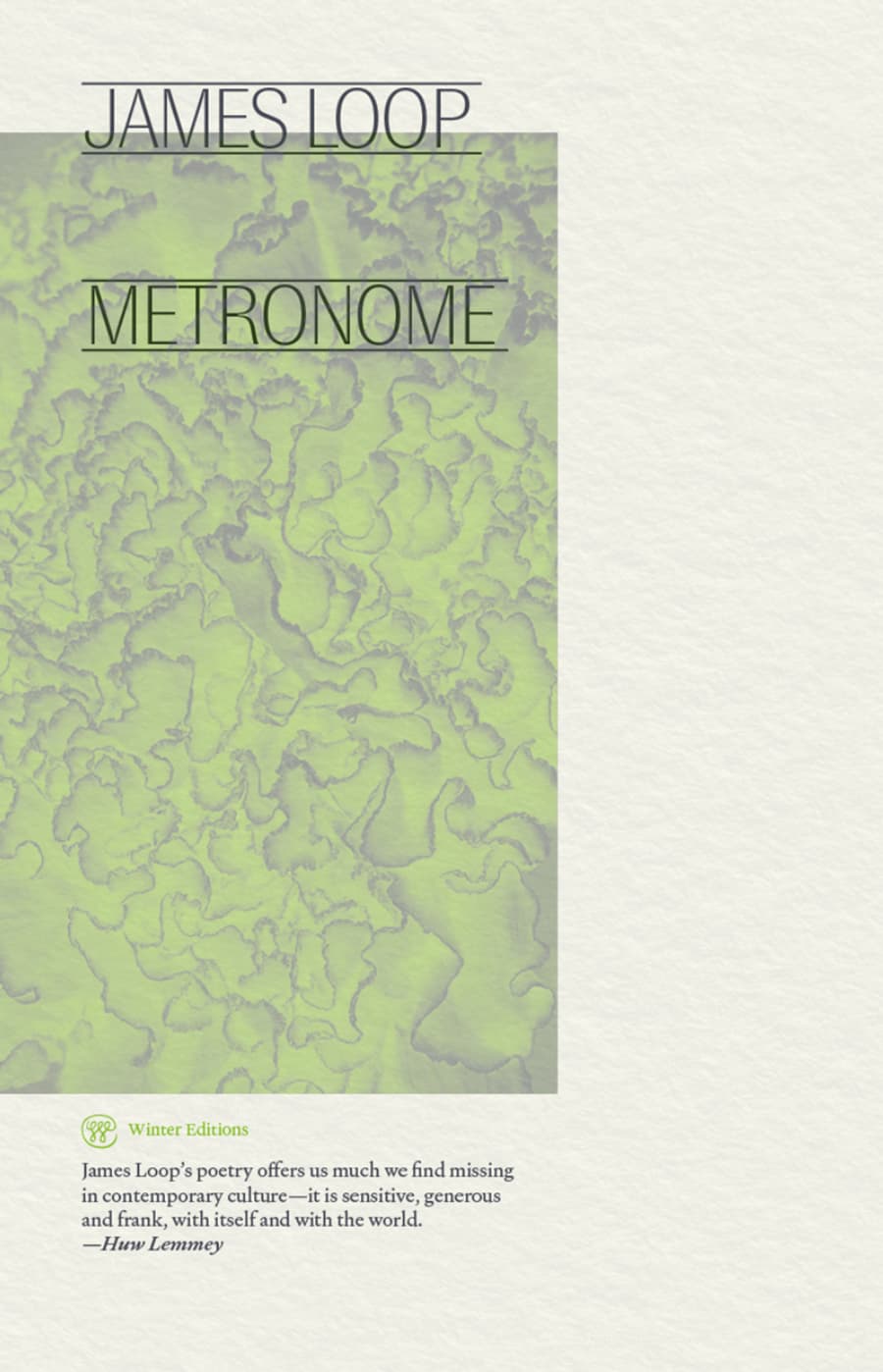
Metronome
Winter Editions, 2026
Many of the world’s best pieces of literature begin in the middle for the same reason that spoilers only ruin the most mediocre books or movies—plot is not the point. Or put in the wellness mumbo-jumbo of farcically empty sayings (which the subject of this review loves to parody, but more on that later!)—it’s about the journey not the destination. We might think of the Odyssey, the Iliad, or the Divine Comedy. Now add to this list James Loop’s debut poetry collection Metronome, out with Winter Editions this past spring. Don’t get your panties in a bunch, I’m not calling Loop the new Homer—his horizons are distinctly more everyday than epic, though his interest in entertainment is paramount and bard-like in its devotion to putting the time a reader affords him to good use, by which I mean this book is a good time.
In fact, Loop takes this idea of beginning in medias res a step further by beginning at the end with a poem fittingly titled “The End”:
remember me reader
age thirty-four and naked
in a small kitchen
straining spaghetti
while reading the aenied
to what perilous absurdities
of love and nutriment
would I not stoop
out of the hope of you
From the outset, this speaker is in our ear with his special mix of frank and unsentimental sincerity.
This tone shifts throughout the book which, in part because it was written and compiled over a decade, has a virtuosic array of modes—very rare for a debut collection. At times, the work is raucously entertaining in the tradition of light verse—think limericks and nonsense poems—that is almost more joke than traditional lyric. This is a collection to challenge assertions of poetry’s own self-seriousness as the second vignette in “Pastoral” does so well:
There once was a faggot named Rose
Who douched with a garden hose
His hole was as clean
As his suitors were mean
And his flowers were dead in their rows.
Could we analyze the inclusion of queer figures in this traditional form? Sure, we could! But I, for one, would rather laugh and move on.
Loop is certainly not all fluff—in “Dejection” he writes of poetry: “We do it to keep each other alive / I have always believed that”—so the stakes are as high as the continuation of living itself. He is also a poet with a particularly keen sense of the current moment. Sometimes it feels we have taken the important feminist dictum, the personal is political, too literally, by which I mean we have forgotten the political is also political. Much of today’s poetry evidences this fact, allowing its revolutionary thrust to exist at the level of common tropes like “the body” and “desire.” Of course, Loop is part of renewing and extending a long tradition of queer verse from Catullus to Walt Whitman to Frank O’Hara and thus both are recurring themes in his work. Still, this is too simple for him as he lays out in “Eating”:
It’s true it was mostly a vacation from my informational labor,
To a place called “My Body” – don’t you hate that?
When a poet says Body, Body. Is there anything less sexy, less embodied than that?
Instead, Loop is keenly aware of the dirty proper nouns poetry avoids for fear of being seen as more immanent than transcendent, more contingent than timeless. Rather than abstractions, this speaker muses on George H. Bush and calls helicopters Obamas. He notes the privileges afforded to those born in the United States while remaining clear-eyed about the evils of empire, acknowledging realities of class, work, and cold hard cash.
As soon as I try to write any statement about Loop’s writing, I realize one must also say the direct opposite. He is slippery like that, muscling against any singular school of thought or type of being like a fractal shining through a kaleidoscope onto a white wall, always shifting. And lucky are we that his work is also that beautiful. So, while he is attentive to the current crises and looks them directly in the eye through naming in poems like “Grand Army Plaza” or “Dejection,” he also has a more surreal streak evidenced in poems like “This is Serious, James” which rankles
the time to panic is now, James
so gather your stomachs into your throat
your human throat
gather them there gather
your he-stomachs and she-stomachs
and make it count
The familiar sense of dread common to our current epoch is loosed from its referent, left as an all-permeating feeling that, free from a particular cause, becomes absurd, almost hilarious.
At times, these poems also run on the engine of language itself—“We All Work in the Hotdog Factory Now” is one such piece. It begins,
We all work in the hot dog factory now
Kissing late on the cheek and late to
And already working at work at work
In the hot dog factory we all don’t
Eat time and messaging webs the dogs
And us who work at work and working
Worked in the hot dog factory we all
Live in the hot dog lotto hopscotch of
Essential surgeries
Here, Loop lays bare the meaninglessness that is the hamster wheel of late capitalism. Through rhythm and repetition, he creates the semblance of sense without actual meaning, like the word-salad of corporate speak and advertising we are all continually bathed in.
There is no final word to have on Metronome since it is so varied, but that is precisely its pleasure. If there is a cohesion to the collection, it is Loop’s voice—that ephemeral thing we could do better than try to define. In lieu of definition let me note that this voice resists the spareness of the contemporary lyric, preferring inventive and baroque verbosity. Of course, there is a tension in this—to sound both archaic, outworn, and completely singular and new. This achievement is hard won and involves clear accounting influences like those he gives in “Amatory Imitations.”
I likely don’t need to tell you that we are living in the age of large language models where programs like ChatGPT love to spew clear, intelligible, yet meaningless writing. Loop’s poetry is the sort of antidote more writers could try on–opaque yet not unfeeling, imbued with place and time rather than imagining some impossible transcendental vantage that sounds more and more like a loose approximation of human creativity, which is all artificial intelligence is or can be.
If there is a statement on voice in the book it is found in the final installment of “Mezzogiorno,” a series of poems written to a friend from Italy: “The scholars will say I am being grandiose / but if there’s another way of staying interested / I await it.” This is Loop’s invective: remain interested, precisely because it is what our world wants to rob us of, numb us towards. Metronome is the perfect place to become interested again.
C. Francis Fisher is a poet and translator. Her first book of translations, In the Glittering Maw: Selected Poems of Joyce Mansour, appeared with World Poetry Books in 2024. She has been supported by fellowships from Yaddo and the Bread Loaf Writers Conference. Her work has appeared in the Yale Review, the Adroit Journal, and the Los Angeles Review of Books among others.