Word count: 1082
Paragraphs: 17
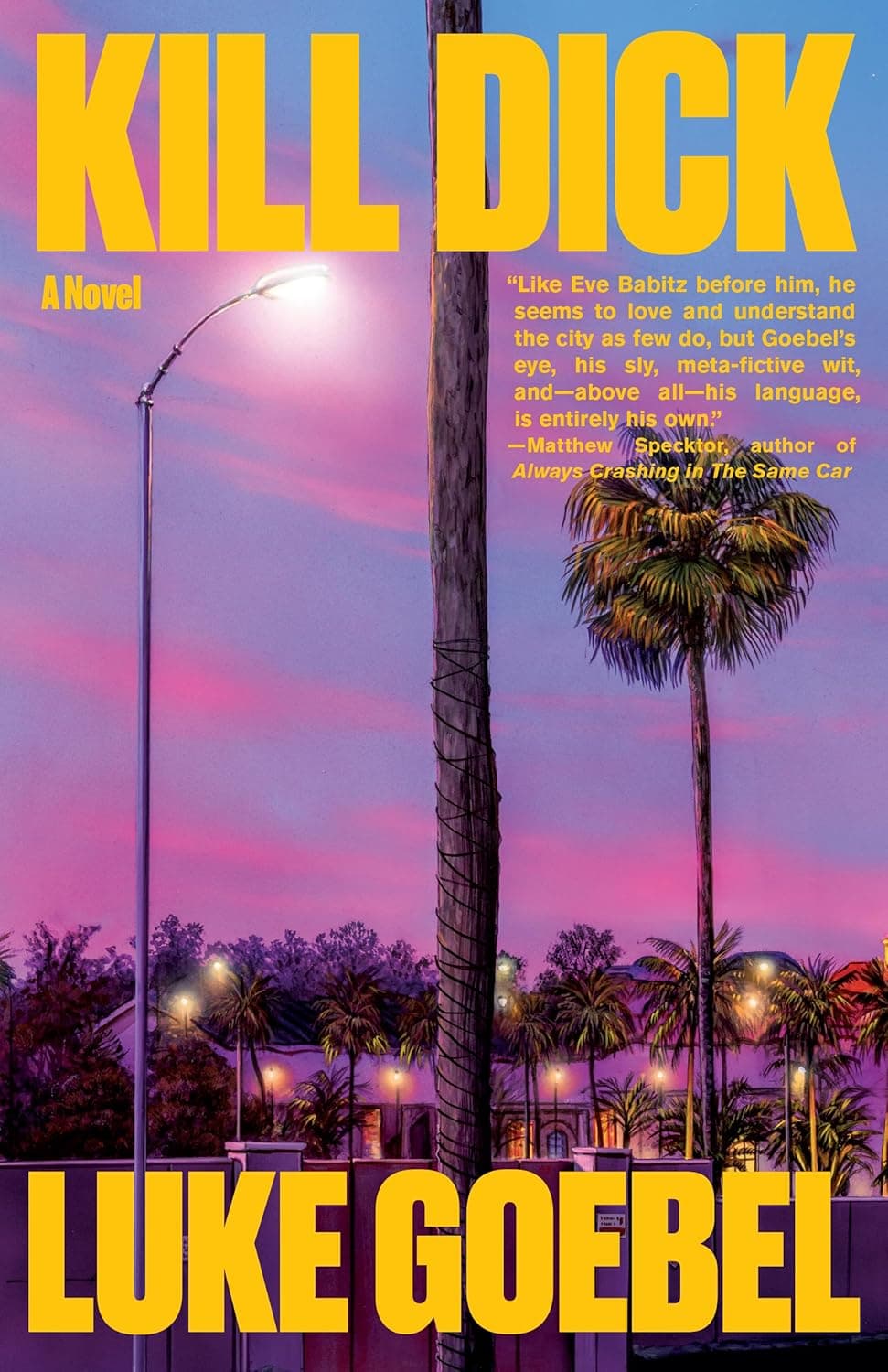
Kill Dick
Red Hen Press, 2026
The word-of-mouth and press campaign for Luke Goebel’s Kill Dick has been impossible to ignore. Flashy pink- and yellow-hued social videos. Stenciled sidewalk graffiti. Street teams. Goebel took a page from the promotional lessons he learned in his film career—he co-wrote and produced Eileen and Causeway—to ensure the news of his first novel in a decade reached potential readers. His swagger, passion, and relentless energy spill out onto the page, as well.
Kill Dick follows an NYU student from Brentwood as she returns home to city on fire and a serial killer targeting addicts. Kill Dick is an indictment of the systems and fraying social contract that created the opioid crisis and a feverish, vociferous addition to the vaulted canon of LA noir.
I met Goebel at his AWP off-site party for Kill Dick, shortly after he purchased a stake in iconic independent publisher New York Tyrant. This interview was conducted over email.
Jackie Corley (Rail): The protagonist in Kill Dick is Susie, a privileged nineteen-year-old who is addicted to opiates and returns to her parents’ Brentwood home after being kicked out of NYU. You’ve spoken about your addiction to opiates and losing your brother to the disease. Did seeing addiction through her eyes change your understanding of your own experience?
Luke Goebel: I’ve been a drug addict since before I hit puberty. I guess this is what Susie Vogelman taught me about my addiction and my brother’s addiction. Just how simple the need is for a little peace and quiet. She lies every moment on the knife’s edge and feels all this pressure to matter—and this is something the rich really do experience, the privileged, although I hate that term—who bestows the privileges? I really feel Susie exists and has a soul. Maybe it’s transmogrified from my soul and other addicts’ souls I’ve known and engaged with, but I feel she’s real, and she needs some comfort. The equation was laid bare by Susie Vogelman’s expository set up: you get abused, your father abuses you, society pressures you with this insanely painful negation of self unless you’re powerful and rich and talented and charming and good looking, and when you come from privilege, it’s amplified, and when you find the drugs your dad makes all his money serving as primary attorney for the manufacturer, an oligarch who owns the company and has pocketed billions, Dick Sickler, and you say, “Ahhhhhhhhhhhhhhh.” Then it tries to kill you! Unless you kill it first.
Rail: In her blurb, Harriet Armstrong called it a “fever dream,” which was how I experienced it as a reader. What were some of those scenes or visuals that arrived first and haunted you?
Goebel: The first scene is the hospital. The morphine. The bone. The moment everything changes. I became a vampire of the poppy when a male nanny snapped my femur in half when I was twelve. When the morphine hit me after an hour without medical attention and with my femur in half and my bone jangling near the femoral artery, which, if nicked, you’ll die in minutes, I just knew everything.
Another scene is Susie by the pool in Brentwood—stoned on a chaise longue, wiggling her toes in the hot wind, plastered to the chair in her mother’s bathrobe, feeling nothing, high, while the killings begin to circle her life. Another is New York. The dorm room. The body. The pills gone. The carpet. The questions. Finding her NYU roommate dead on their dorm room blue-gray carpet hadn’t helped her state of mind, with campus police swarming, a body bag, all the questions. Another is the hotel.
“She checked into The Carlyle Hotel, where she ordered whole lobsters and cheesecake and bottles of Veuve Clicquot, took the girl’s Oxy, kept the TV on mute, hung the ‘Do Not Disturb’ sign.” Another is the first killing. A body in a motel room. Hair cut off. Blood in the shower. The Cecil Hotel.
Rail: You're not originally from LA. How did you get to know the city well enough to write it—from Brentwood to Skid Row—with this kind of authority? Was there a particular moment for you when you knew you had it down?
Goebel: I wrote: “Los Angeles was out there, right here, surrounding her.” The winds. The pool. The gated houses. The bougainvillea. The guards. The illusion of safety. I had seen it. Lived in it. Moved through it. The visuals were the things you see when you drive in LA. It’s people in tents on the sidewalk, and filth, and the doped stupor, and the dead. And then the splendor. Brentwood. The pool. The pills. The silence.
The authority comes from being inside it and outside it at the same time. From the pool to the motel. From Brentwood to the dead in rooms. From NYU to Skid Row in the imagination of the same system. From being there. From knowing it’s all the same story. The short answer: I watched everything, looked everything up, cared enough for the first time in my life to learn about a place and its people, because I wanted something from it, and because it’s my job. The longer answer is about access, marriage, nights of questioning how dinner parties went, studying people who were smarter than me, and taking a lot of mental and physical notes. Ripley shit.
Rail: Earlier this year, you purchased a stake in the legendary independent press Tyrant Books. How will the Luke Goebel era of Tyrant continue former publisher Giancarlo DiTrapano’s legacy and diverge from it?
Goebel: I would have never done what I did to promote Kill Dick if I didn’t believe one million percent in it. I will publish books that I believe in at that level, and I will hold Gian in my mind while I do it. And once we take someone on as an author, we will fight for their visibility, for their privilege, for their right to be seen and read and exert their influence and beauty upon the world.
I will hopefully expand the catalogue with new voices that are inclusive, brilliant, powerful, earned, dangerous, experienced, and deadly. I am not fucking around on this planet. If I’m going to work this hard and sacrifice what could be the peace of calm living, by hustling and raging to make something radical and counter-culture, and needed, then I am not going to go easy on it.
Jackie Corley has been a reporter, a drone operator, and the publisher of Word Riot. In the current one, she's VP of Content for Townsquare Media. Corley received an MFA from the Bennington College. Her fiction has appeared in BULL, Vol 1 Brooklyn, Rediveder, and Fourteen Hills, among others. She lives in the Hudson valley, but will always be a Jersey girl at heart.