Word count: 1928
Paragraphs: 27
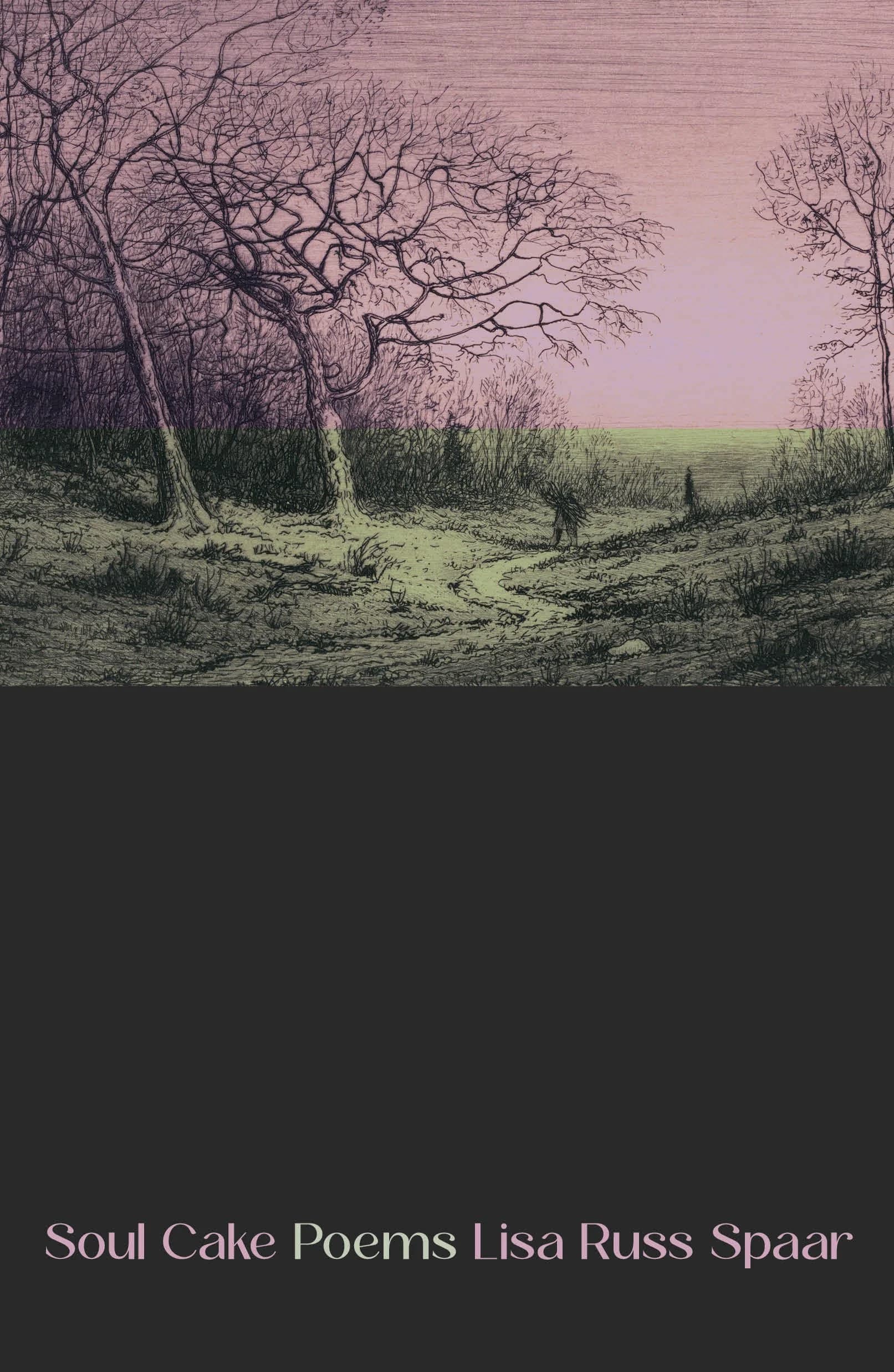
Soul Cake
Persea Books, 2026
Lisa Russ Spaar’s seventh full-length poetry collection Soul Cake, which takes its name from an ancient carol, is her latest effort to discover the ingredients that make up the soul. On the heels of her 2022 debut novel Paradise Close, Spaar is fully aware she’s in the autumn of her life. The final poem of the collection “December, Mon Amour,” captures a better-late-than-never consciousness with its verse: “since then, I will always arch / body at last opened, yours. Ajar—.”
Rather than a dark brood on mortality, Spaar’s collection opens readers to a meditation on the seasons of nature and life with sensual and evocative language. She combines her musical style with a keen eye for recognizing the spiritual in mundane objects and earthly chores.
In corresponding with Spaar for this interview, she shared insights about her lifetime passion for carols, her current dance between writing poems and novels, and what sparks questions about what lies beyond this mortal coil.
Geoff Graser (Rail): Soul Cake features the dedication “For my father, Warren,” and several poems in the collection include a father-daughter relationship. What led to dedicating this collection to him?
Lisa Russ Spaar: My now ninety-three year-old father, a retired research chemist, moved with my mother some decades ago from New Jersey to the same county in Virginia where I now live. My mother passed away in 2014, but Warren continues to be quite hale and hearty, changing the oil on his small tractor, tending a large garden on his seven acres, canning salsa and pickling okra, driving a big pickup truck. With my four grandchildren and their parents also living in this area, we are lucky often to have four generations at the dinner table. I see him at least once a week, either at his house or mine, and I am beyond grateful for the father/daughter bond we share. He’s not a big reader of poems, but he will, I think, crack the spine of Soul Cake enough to see the dedication, an expression of my gratitude for his steadfast presence in my life. Also, Soul Cake is a very hibernal book; its poems are written by someone in the late autumn, early winter of her life. Which makes me treasure all the more the time I’ve had to spend with my father, who is, as he likes to say, “now really old.”
Rail: The title of the collection comes from an ancient carol with the title “Soul Cake.” How did you discover the carol and what inspired you to call this collection Soul Cake?
Russ Spaar: I first heard Peter, Paul, and Mary sing a version of “A ’Soulin’” when I was seven years old and visiting a friend whose parents were listening to the group’s second studio album, Moving, on their living room stereo. Sting does a later version of the song. I was entranced by the music these voices were making, the haunting harmonies, the melancholic beauty. (My parents didn’t play a lot of recorded music during my childhood; my father’s tastes ran to the Russian piano composers—so lots of Pyotr Ilyich Tchaikovsky and Sergei Rachmaninoff when we heard anything).
My parents gave me a copy of Moving for my eighth birthday, and for a long time I listened to it at bedtime every night on a portable record player, absorbing the poetry and the contralto, autumnal melodies of old ballads and folk songs (“Old Coat,” “Tiny Sparrow,” “Morning Train”) mixed in among the songs for which P, P & M were better known (“Puff the Magic Dragon” and “This Land is Your Land”). My early attraction to the old carol “A’ Soalin’,” in particular, would presage a lifetime interest in carols and ballads, learned at church and through folk singers like Jean Ritchie and groups like Fairport Convention, and through the ancient solstice carols that have come to us since medieval times, often “translations” of melodies and texts that go back to pagan solstice and other seasonal “carols,” sung while dancing and as part of rituals. The word “carol” derives from the French carole, a kind of circular dance. Soul Cake contains a section of “carols” that owe to the spirit and cadence of that early music.
John Keats called poetry a “vale of Soul-making,” and for as long as I can remember I’ve wondered about what the “soul” might be and how poetry (reading and writing it), like some music, might help me to understand that.
Rail: How many of the poems in this collection did you finish after the publication of your debut novel Paradise Close in 2022? In what ways did working in fiction influence this collection or did you find it any different gearing your attention to a poetry collection again?
Russ Spaar: I worked on the novel for well over a decade and for a long time wasn’t even sure what it was I was writing, only that the kind of material with which I was working required more duration than I could find in the sort of poems—brief, dense, musical—that I tend to make. I never stopped writing poems when I was working on the novel. I’d say about over a half of the poems in Soul Cake were written while writing the novel, and the rest after its publication. I found (and find) it productive to work in both prose (articles, reviews, lyric essays, short fiction, a novel) and poetry at the same time; the rhythms of one informing the sonic intensity of the other, and vice versa.
Interestingly, the novel I’m working on now—which follows the denizens and outliers of an Emily Brontë cult and a group of squatters living on the grounds of an abandoned Renaissance fair—concerns itself quite a bit with the question of “what is a soul?” So I think my explorations of a topic or theme in one genre triggers or excites exploration in another.
Rail: I understand that both for yourself and in your teaching, you try to diversify the scope of your reading lists. In our previous interview, you’ve also shared that you consider books “our best teachers.” Is there a poet whose work you feel is different from yours who might have shined a light or opened a new door for you in regards to this collection?
Russ Spaar: Such a good question, Geoff. Something I really treasure in the MFA workshops here at University of Virginia is the aesthetic diversity of our MFA student writers. It is a challenge and privilege as an instructor to meet each writer where they are and to appreciate and explore the various formal and thematic directions from which their work is coming.
Obvious influences for Soul Cake, I think, are writers like Emily Dickinson, Gerard Manley Hopkins, Emily Brontë, Charles Dickens, Thomas Hardy, Lucie Brock-Broido, and musicians like Thomas Tallis and Joni Mitchell, among others.
Less obvious because their styles are less baroque than mine, I would say that Robert Frost, Gwendolyn Brooks, Arthur Sze, Lucille Clifton, and Charles Wright opened doors here. These poets show that the most complex and haunting perceptions can be spoken plainly. All offer much sustenance to those of us with soul-hunger.
Rail: This collection is divided into three sections: “God-Ache,” “Carols,” and “December, Mon Amour.” Could you let us in on how these sections and their titles came to be? Also, I’m curious about how you decided the order of the sections?
Russ Spaar: A triptych seemed right for this collection that explores the mysteries and secrets exchanged among body/spirit/soul. Poems in “God-Ache” work out of what Charles Wright calls a “belief in belief,” even when doubts trouble. The “Carols” section offers poems that draw on a literal, imagistic, and sonic “vocabulary” of traditional carols and attempt to address some of the questions I have about desire and meaning that are always dancing, coursing through my imagination. “December, Mon Amour” embraces the late-life fire I feel, my appreciation for the advent season of expectant darkness.
Rail: The poem “Field” is dedicated to the poet Courtney Kampa. Could you speak a little about writing that poem and why you felt it fit into this collection and the “God-Ache” section in particular?
Russ Spaar: The late, luminous poet Courtney Kampa was my undergraduate student here at the University of Virginia, where she was a member of the prestigious poetry concentration I founded and directed, then known as the Area Program in Poetry Writing. When she died, too young, in November 2022, I wrote “Field” for her. I think I placed it in the “God-Ache” section of Soul Cake because the loss of someone you truly love raises anew the big questions about what lies for us beyond the mortal coil.
Rail: Your poems often feature subject matter with a mundane grittiness and wildness—“Behind Discount City” is one that comes to mind. Yet sometimes you employ forms, such as the sonnet, to help give you a little structure and create that wildness. Could you articulate how or why forms allow you to play?
Russ Spaar: Ah, mundane grittiness and wildness! Can I blame growing up in my motherland, New Jersey? I once had a conversation with fellow Jersey poet Robert Pinsky about how and why poets like us find beautiful things like a cuss-word-scribbled bridge piling or a certain slant of toxic sunlight on an asbestos shingle. I recall reading an article in the New York Times, I think, many years ago, in which the author posited that one reason there were so many gifted and diverse musicians, artists, and writers from New Jersey is that it is divided up into so many townships (240!), boroughs, and municipalities. It is possible to travel from Piscataway to Dunellen to South Plainfield in just a few miles and encounter very different demographics, history, culture, food scene, music, and so on in each. So maybe my interest in working in maximalist ways in relatively short formal spaces, like the sonnet or in “tidy” couplets or tercets, owes in part to the powerful and wonderful punch a small “place” can have precisely because it’s contained. I certainly enjoy the puzzle and torque that working within stanzas and with rhyme and off-rhyme afford.
Rail: In a past interview with the poetry journal 32 Poems, you said, “I think it is the ineffability of our most urgent and even ecstatic experience that makes poetry essential.” How do you feel this collection reflects that statement?
Russ Spaar: Working with language in this way has certainly been a way for me to grapple with what we call my youngest toddler granddaughter’s “big feelings.” Terror, hunger, joy, anger, frustration—these experiences can feel beyond the reach of language. Recently, in the midst of an especially fierce temper tantrum, as I was trying to calm her by asking her to “use her words,” this spirited two-year-old managed to gasp forth “Nana! Don’t. you. . . . know. . . when someone . . . . is CRYING . . . they Don’t. Want. To. Talk. To. YOU.”
My “adult” emotions may have more to do with causes like ecological anxiety, global fear, political fury, and erotic and religious desire than they have to do with filling my own sippy cup or wanting rainbow goldfish crackers rather than the offered Veggie Straws. But the primal sources of our inchoate feelings are probably closer than they might seem. Poetry allows me, at this point in my life, to “talk to you” about things. To talk to myself as well.
Geoff Graser is a writer/editor from Western New York who currently resides in Brazil. You can find more of his work and author interviews at geoffgraser.com.