Word count: 917
Paragraphs: 14
Without Terminus: Untraining an Archive
Graywolf Press, 2026
In prize-winning poet chaun webster’s first work of nonfiction, you can almost hear the words stretching to their breaking point. They wail from the strain of pulling so much weight—what is unknowable about his family’s past, what can be extrapolated about their lives from the general history of racism in America, what an irreparable ache this engenders in the son who must attempt to reimagine people he never knew—yet the words hold. And the tension becomes a song as webster shores them up at every turn with the sheer muscle of his visionary imagination.
(Perhaps as a nod to bell hooks—whose influence is everywhere evident in Without Terminus, particularly her assertion that Black Americans “make English do what we want it to do. We take the oppressor’s language and turn it against itself”—webster also styles his name in lowercase. Indeed, the entirety of his book is without initial capital letters.)
Only one of the many things webster is doing here is attempting a family memoir, which for him will mean an account of lives shaped by the brutality of white supremacy as well as by the cultural institutions Black Americans created so they might withstand and transcend it, from the church (webster’s own tradition is Black Pentecostalism) to the work of writers and thinkers such as James Baldwin, Zora Neale Hurston, Henry Dumas, Saidiya Hartman, and Toni Morrison.
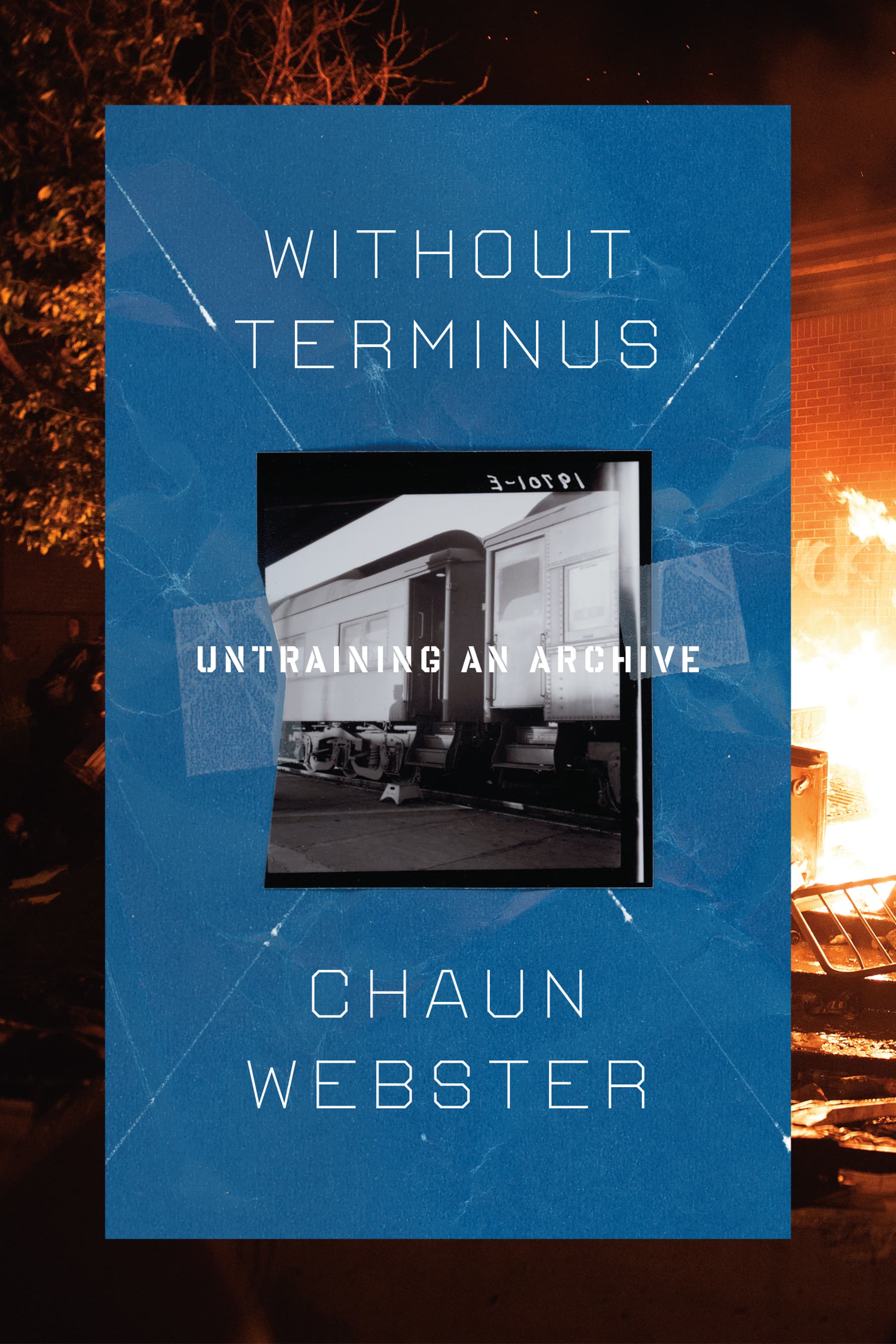
Webster’s grandfather, Reginald, was a Pullman porter on the Great Northern Railroad, as was Reginald’s father. These men worked in “the irony of the sleeping car, which stole their ability to sleep”; Reginald Jerry Clark died soon after retirement. The author re-pieces his grandfather back together with the help of his mother’s memories—“your mother is the inaugural archive,” webster notes, evoking the dual sense of being the primary repository of memories for the child and the origin of the archive we all become in time—and documentary evidence, what little of it remains from Reginald’s mysterious life. Punctuating Without Terminus is a four-part “Dream Sequence,” each riffing on a snapshot of Reginald as a child sleeping—that which he was denied soon enough.
Another of the book’s projects is to examine the way we experience time itself, and specifically the uncanniness of time’s passage in Black history, which webster maintains runs simultaneously forwards and back. The notion of “a train moving in two directions” repeats antiphonally, and he posits the idea that his life is a palindrome, constantly shifting between past and future from the still point of the I. (He even finds a literal palindrome among his forebears, a woman named Hannah six generations back.) Not for nothing is the book’s epigraph John Coltrane’s “I start in the middle of the sentence and move both directions at once.”
The effort to understand family history within the constructs of a racial history, expressed in language that also must be unpacked of its cultural freight, requires an “untraining” of the archive. That is, each part of the evidence must be broken down and reassembled by the mind that seeks to fully understand it. And in this case, it must also be “un-trained,” because, as webster points out, “if the train functioned as a fantasy of American progress, the porter functioned as a fantasy of inexhaustible black labor.”
Webster sees his literary task, then, as first to break traditional forms and next to remake them. Only wholly new typologies could begin to touch the depths of his sadness, loss, and anger. These range from the poetic—the power of “poetry’s tendency for refusal,” as webster put it in a University of Arizona Poetry Center blog—to investigations of grammar and syntax, the “remixing” of archival documents, and typographical interventions, including collage, blurring, strikeouts, fading. (Webster is also a graphic designer.) He examines individual words—“comportment,” “freight”—to trace in them the lineage of racial subjugation. He diagrams the headline from the shockingly brief death notice for his grandfather that appeared in the newspaper, “St. Paul Man Dies After Illness of Short Duration,” adding his own gloss and then spinning short poems out of the individual parts of speech. Under the word duration, for instance, he expands:
the time during which
the illness or the dying
or the after the time
during which the man;
the time of illness of
St., of the short after;
the time during which
man dies, where ill-
ness shorts man of an
after; the St. Paul man
dies not of illness, the
St. Paul man dies of
duration
Webster thus finds in language itself the roots of violence—as well as the roots of his resistance. In re-fashioning language to his own ends he enables a reclamation on his terms.
I struggled with finding an adequate way to describe all the elements of a dizzyingly complex project. It is so rich and multivalent, so much going on at the level of the broken-apart sentence—not to mention the restitched whole—that at first I despaired at what I believed was the necessity to diagram all of his diagramming. But that would take an ungodly number of words, far more than anyone would want to read from me.
Then it came to me. Read in wonder. That is all. Wonder that Without Terminus was written, and in exactly this wondrous way, by a writer who is endlessly inventive.
I am relieved of explanation, because the book is the only answer to its own questions. I don’t need to repeat them here; they sing loud, and soft, enough from the page all by themselves.