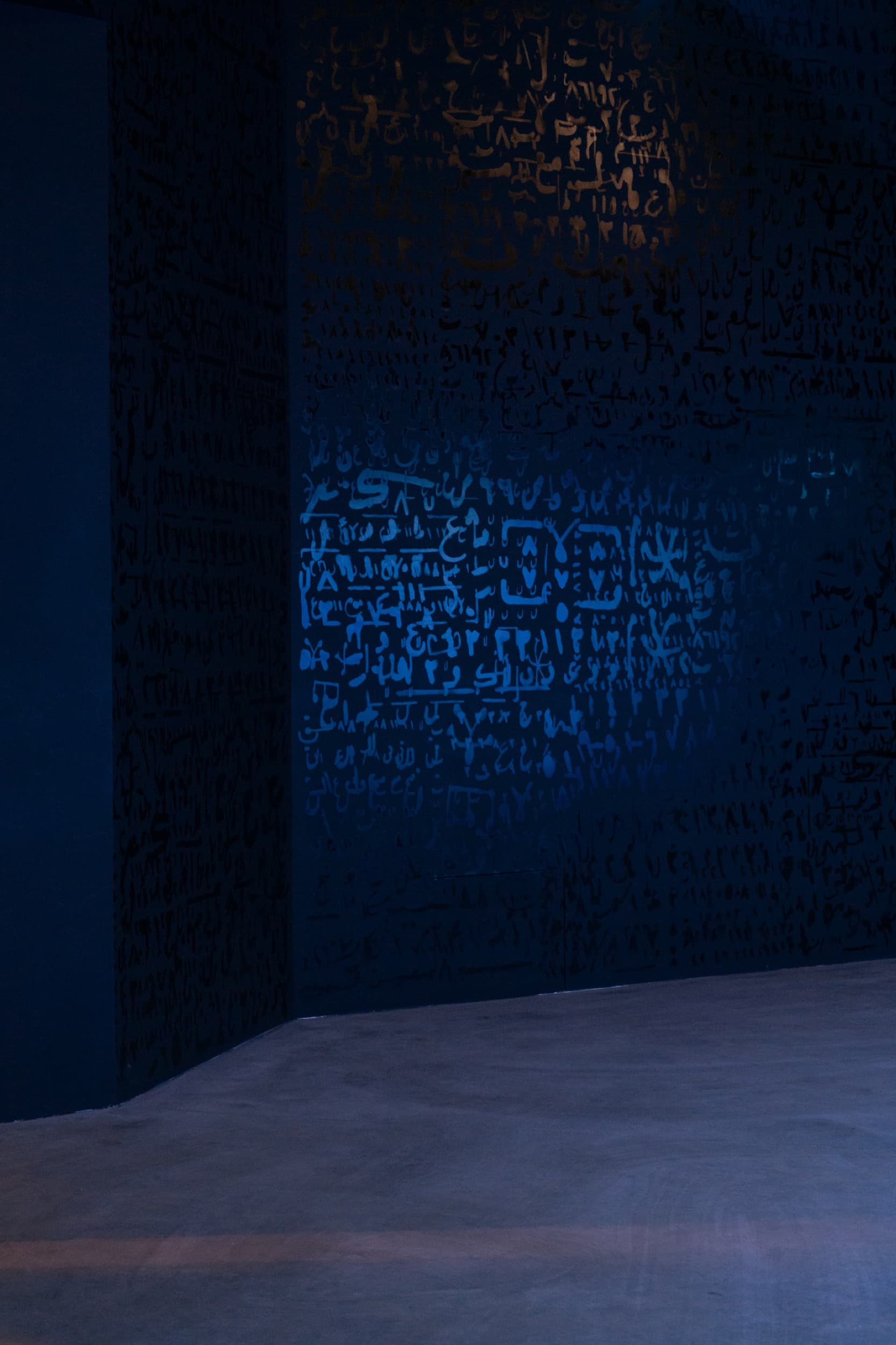
Installation view: Pavilion of Australia: conference of one’s self, La Biennale di Venezia: In Minor Keys, 2026. Courtesy La Biennale di Venezia. Photo: Luca Zambelli Bais.
Word count: 1516
Paragraphs: 20
May 9–November 11, 2026
Venice
In search of boundary-breaking art that happens also to be humanitarian, I landed in Venice for the Biennale preview week on May 5. That evening I attended the screening of Rafael Lozano-Hemmer’s Border Tuner/Sintonizador Fronterizo at the independent Cinema Giorgione. The recently completed film captured the earnest conversations activated by tens of thousands of people who gathered to honor the interdependence of life on both sides of the US-Mexico border, over the evenings of Lozano-Hemmer’s carefully planned event in 2019. The film captures the humble, even mournful exchanges that happened, a testament to the long-standing cooperation that is a part of daily life in the border cities. Lozano-Hemmer’s project and subsequent film broke through the complex and often heated rhetoric about borders in recent years, especially now that politics are more divisive than ever. During this moment of pervasive technological and societal change, Lozano-Hemmer’s film addressed the need for audiences to think seriously about geographies and the consequences of political grandstanding.
So far much has been written about the Biennale and the logic (or illogic) of artists representing nations through pavilions. The idea that an artist might serve as the standard-bearer of an entire country became increasingly untenable for many critics, given that today artists are not bounded by geography. I waded through the rhetoric, preferring not to read artists as proxies for nation-states that they may or may not inhabit.
Giardini
The morning of May 6, I went straight to the Australian pavilion in the Giardini and walked around Khaled Sabsabi’s contemplative installation, conference of one’s self. Placed at the center of the exhibition space stands a tall, unenterable eight-screen octagon with continuously morphing animated projections. The work is based on images the artist created by first making paintings that he filmed and then reworked in his computer. I deciphered enigmatic little faces emerging out of a dense and beautiful sea of dark blue, black and white, and listened to a gentle percussive soundtrack. The installation is a spiritual inquiry that explores migration and the vastness of shared humanity, and reflects the artist’s exploration of displacement and collective experience. On the adjacent black walls, Sabsabi wrote mysterious text in white that, even for readers of Arabic, was barely decipherable. Later I learned that this abstracted Arabic is based on meaningful Sufi texts. I navigated through the audiovisual sensation and felt a deep awareness of time.
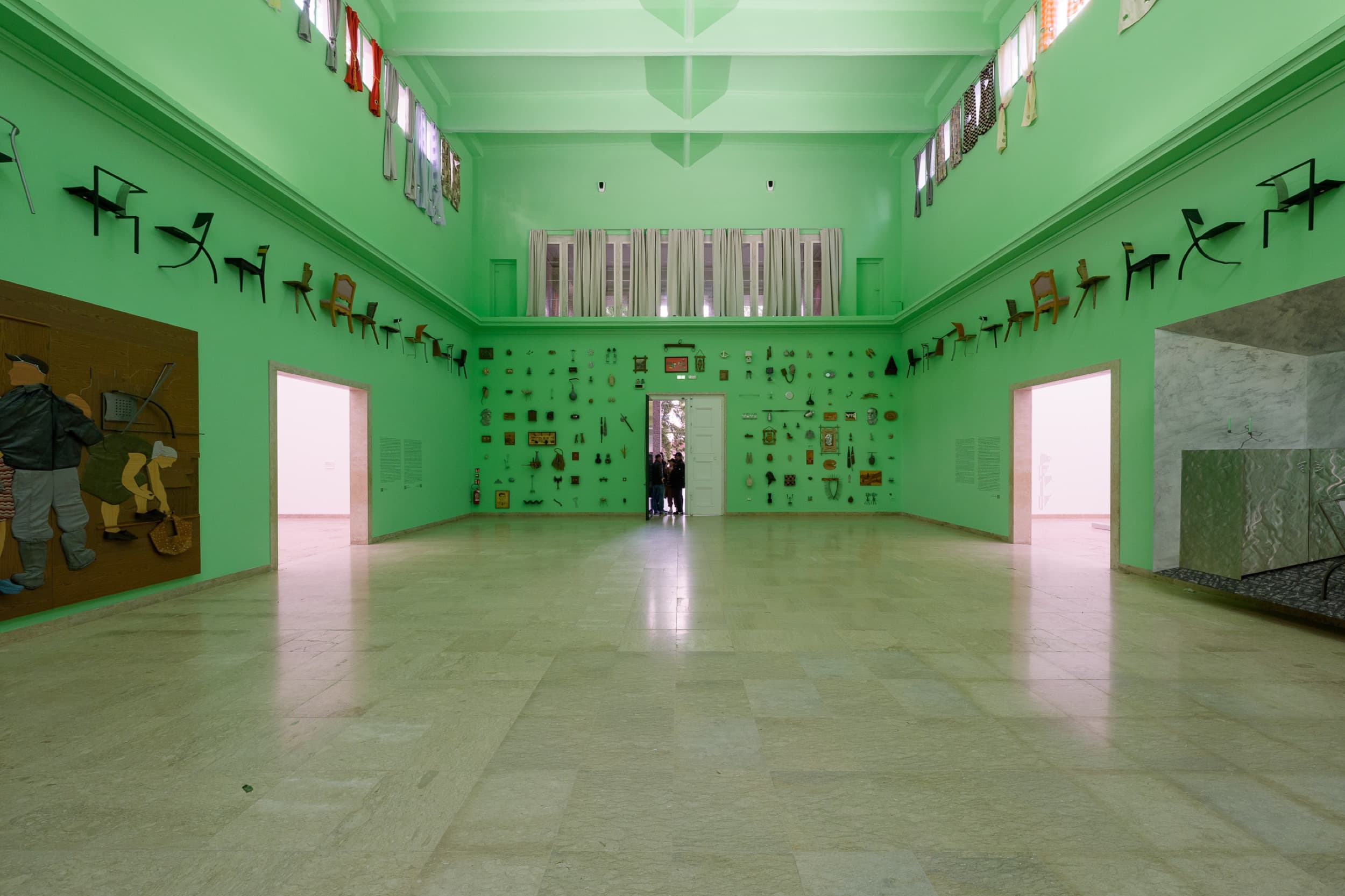
Installation view: Pavilion of Germany: Ruin, La Biennale di Venezia: In Minor Keys, 2026. Courtesy La Biennale di Venezia. Photo: Andrea Avezzù.
Next, I walked over to the German pavilion in order to experience Henrike Naumann’s installation, which quietly engages with post-war German histories. The artist is well known for her use of furniture and interior design to explore political upheaval and regime change. Entitled The Exhibition (Ruin), Nauman reframes the pavilion’s heavy 1938 fascist architecture as an ambivalent mirror of social dynamics. Various thrift store sourced chairs had been sliced in half and were installed like ghostly silhouettes high on the pavilion’s center walls. Naumann quietly but defiantly confronted the ideological and societal divisions between her native East and West Germany. Sadly, the artist passed away in February 2026, and her contemplative, carefully planned installation was realized by her studio team. Although I feel Nauman herself might have tightened and given more punch to the installation, it still reverberated with her powerful spirit and intellectual drive. I sorely miss this great friend.
I walked over to the Giardini’s main pavilion and visited Koyo Kouoh’s exhibition, which made strong connections between artists and contexts. The show is based more on register and mood—what Kouoh called “minor keys”—rather than on concepts or categories. Kouoh’s juxtapositions of the carefully placed work made a lot of sense. I appreciated the vistas, especially how I was able to look back and through work to make important connections between history and the present. I was taken with María Magdalena Campos-Pons beautifully arranged Anatomy of the Magnolia Tree for Koyo Kouoh and Toni Morrison (2026), which was accompanied by a beautiful sonic composition by Kamaal Malak. The oversized sculpture of colorful floral blossoms arranged on the floor was juxtaposed with Campos-Pons’s multi-part painting. The installation is a kind of memorial, a ritual space and affirmation of ancestral continuity and places. Kouoh’s curatorial vision in the heart of Venice extended Campos-Pons and Malaak’s long-standing exploration of memory, migration, Black diasporic identity, and spiritual resilience.

Installation view: Pavilion of the Democratic Republic of Timor-Leste: across words, La Biennale di Venezia: In Minor Keys, 2026. Courtesy La Biennale di Venezia. Photo: Luca Zambelli Bais.
Arsenale
I exited the Giardini and walked over to the Arsenale to see the second part of Kouoh’s exhibition. She had made an important choice in placing another new work of Khaled Sabsabi at the entrance to the show. This time viewers were invited to enter into the installation, as well as walk around the artist’s haunting multi-panel projection work. Sadly, the rest of Kouoh’s show didn’t live up to what her vision might have been had she lived. In the Arsenale, her associations felt a bit off, in some cases even crass, with work placed much too close together. Given her untimely death, I felt Kouoh didn’t have time to complete her project, which felt rushed and seems to have been completed by a team.
I moved further into the Arsenale and was struck by the Timor-Leste Pavilion, which featured the woven work of Veronica Pereira Maia, and the audiovisual works of Etson Caminha and Juventino Madeira. The project centers on language as a generative force within Timor-Leste’s layered systems of communication and on the artists’ ability to define the identity of this young nation with its tragic history. Timor-Leste is a Southeast Asian nation, located on the eastern half of the island of Timor. Timor-Leste is one of the world's youngest countries, having bloodily struggled against Portuguese and then Indonesian control, before finally gaining formal independence in 2002. In this pavilion of a nation with very limited resources, I found the artists’ work to be profound and powerfully produced. This important work stood out: great art matters more than geopolitics.
Nalini Malani, the Magazzini del Sale
I turned next to Nalini Malani’s Of Woman Born, a newly commissioned moving animation chamber that fills the Magazzini del Sale on the fondamenta delle Zattere. With an early background in experimental film and a lifelong career that revolves around drawing, the artist developed this very large, immersive video installation. The work is based on “sixty-seven of Malani’s animations derived from more than thirty thousand iPad drawings, organized across nine channels of larger-than-life projection, each lasting three to five minutes,” and run in a constantly changing order. The work takes viewers into a deep, dark cave-like chamber with moving images projected onto the heavily salt encrusted walls of the cavernous space. The work draws upon the ancient Greek myth of Orestes, who kills his mother to avenge his father and is absolved by Athena, a goddess not born of a woman. The viewer is invited into this unsettling space to live through the afterlives, unable to resolve the story of Orestes, and to listen to the dispossessed women whose muted histories return here with a demand to be heard. Malani’s powerful project was curated by Roobina Karode, the Artistic Director and Chief Curator of the Kiran Nadar Museum of Art (KNMA) in New Delhi, a leading art museum in India.

Installation view: Pavilion of Australia: conference of one’s self, La Biennale di Venezia: In Minor Keys, 2026. Courtesy La Biennale di Venezia. Photo: Luca Zambelli Bais.
Palazzo Grassi
One of my last stops in Venice was Pinault Collection’s Palazzo Grassi. I was eager again to see Amar Kanwar’s installation presented in an exquisite building, and with utmost attention to the installation’s detail. Kanwar’s The Torn First Pages (2004–08) documents the complexity of the struggle for democracy in Myanmar (former Burma). It is the result of Kanwar’s characteristic practice of collecting, synthesizing, and redeploying archival documents. As the literature explains,
The title of the installation is in honor of a gesture of protest by the bookseller Ko Than Htay, who tore the first page out of each book he sold—the page that, as mandated by law, contained declarations of the military dictatorship’s political objectives. Kanwar’s installation presents printed material and videos, drawing attention to the Burmese regime’s atrocities, and form an ode to the resilience of political protest in Myanmar and worldwide.
What struck me was the fastidious attention to presenting Kanwar’s installation perfectly. Every detail was carefully considered and carried out, adding to the installation’s brilliant lucidity.
For whom is history written?
After a week in Venice, I returned to Manhattan and mulled over what I had seen and experienced.
Venice still has its charm, and the Biennale always features strong work. But a lot has changed, especially given the surfeit of digital information readily at hand. What makes someone search for meaning and pause for a moment to ask, what is reliable knowledge and what is meaningful experience? These questions necessitate new forms of thinking in a communication society, where direct interaction is prized as a new form of narrative. And so, my visit forms a story drawn from my humanitarian interests that over the years more or less remain the same. I know that tastes will always change, and younger curators and critics will always see things differently. That’s simply how it is.
Barbara London is an internationally acclaimed curator, writer and consultant with a practice that revolves around media, installation, and sound art produced internationally. Founding MoMA curator of video and media art, London’s writings include Video Art/The First Fifty Years (Phaidon, 2021), and articles in the Brooklyn Rail, Artforum, Leonardo, Art Asia Pacific, and Art in America.